






Trump Trading Playbook: Now Entering Step Nine


- Core View: The US independent research firm The Kobeissi Letter points out that the two-week ceasefire agreement between the US and Iran marks the entry into the ninth step (agreement narrative construction) of its "conflict playbook," and warns that the tenth step (violent market repricing) is imminent. Historical patterns show that the dissipation of uncertainty triggers a sharp rally in stocks and a sharp drop in oil prices.
- Key Elements:
- The ninth step of the "conflict playbook" tracked by the institution (agreement reached and narrative construction) has been achieved, aligning with Trump's consistent negotiation logic of "maximum pressure in exchange for concessions."
- Warns that the tenth step, "violent market repricing," will occur in the coming weeks, forcing the unwinding of defensive positions (high energy exposure, low equity risk appetite).
- Historical analogy shows that this ceasefire is similar in nature to the "90-day tariff suspension" in April 2025, which was followed by the implementation of a trade agreement and the market not retesting previous lows.
- The expected market impact pattern is: a sudden drop in uncertainty triggers position adjustments, potentially causing a sharp rally in stocks, while oil prices may plummet rapidly due to expectations of reopened shipping lanes.
- The institution emphasizes that in this market environment, "pattern recognition" holds extremely high profit value, and the specific structure of the agreement is far less important than the timing of its announcement.
Original Author: Zhao Ying
Original Source: Wall Street News
The achievement of the US-Iran ceasefire agreement is unfolding precisely according to a repeatedly validated script.
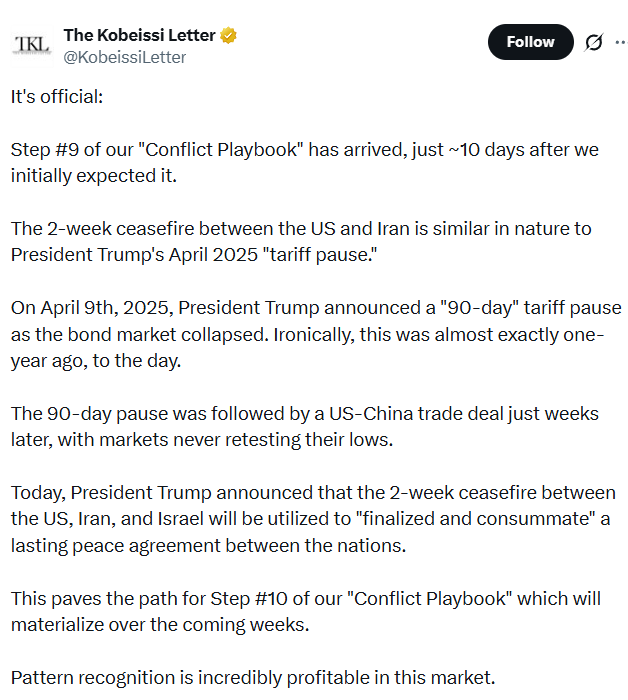
The independent US macroeconomic research firm The Kobeissi Letter recently stated that with Trump's announcement of a two-week ceasefire agreement between the US, Iran, and Israel, the ninth step of its tracked "conflict script" has officially arrived, namely the agreement's achievement and the construction of a narrative framework. This arrival is about 10 days later than the firm's previous expectation.
The Kobeissi Letter stated that, according to the Trump playbook, every major confrontation within Trump's framework ultimately concludes with the narrative of "maximum pressure in exchange for concessions."
The potential market impact of this development cannot be ignored. The Kobeissi Letter pointed out that the tenth step—the violent market repricing following the formal announcement of the agreement—will arrive in the coming weeks. At that time, investors who have long held defensive positions will face pressure to rapidly unwind their positions, potentially leading to a sharp rally in stocks, while oil prices may plummet rapidly as expectations for the reopening of shipping lanes solidify.
Ceasefire and Tariff Suspension: The Same Logic
According to CCTV News, based on information from the Iranian side in the early hours of the 8th local time, Pakistani Prime Minister Shehbaz Sharif has invited Iranian and US delegations to the capital Islamabad for negotiations. Shehbaz Sharif also stated that the US-Iran ceasefire will take effect at 3:30 AM Iran time (8:00 AM Beijing time) on the 8th. Trump indicated that this ceasefire window will be used to "finalize and facilitate" the signing of a lasting peace agreement among the parties.
The Kobeissi Letter compares this two-week US-Iran ceasefire to the "90-day tariff suspension" announced by Trump in April 2025, considering them highly similar in nature.
On April 9, 2025, against the backdrop of severe bond market turmoil, Trump announced a 90-day suspension of tariff increases on most trading partners. In the following weeks, the US-China trade agreement was subsequently implemented, and the market did not retest previous lows. The Kobeissi Letter points out that this ceasefire announcement comes almost exactly one year after the aforementioned tariff suspension.
The firm believes this pattern is not coincidental. Since taking office in January 2025, Trump has followed a highly consistent negotiation logic in tariff wars, Venezuela, Greenland negotiations, and the Iran issue: verbal pressure, maximum pressure to extract concessions, ultimately concluding with a "deal."
Step Nine: Constructing the Agreement Narrative
According to the 10-step "conflict script" outlined by The Kobeissi Letter, the core of the ninth step is the achievement of the agreement and the construction of the narrative framework.
The firm points out that every major confrontation within Trump's framework ultimately concludes with the narrative of "maximum pressure in exchange for concessions." This pattern has been confirmed in trade agreements with the EU and India, corporate negotiations in sectors like Intel and rare earths, and the multiple conflicts Trump helped end in 2025.
Regarding the Iran issue, The Kobeissi Letter believes that if the Iranian government does not collapse, the final agreement may involve a ceasefire arrangement linked to the nuclear issue, a regional security framework with enforcement mechanisms, or a sanctions adjustment plan conditional on compliance benchmarks. The firm emphasizes that "the specific architecture is far less important than the timing and the narrative framework."
Step Ten: Awaiting the Violent Repricing
The Kobeissi Letter warns investors that market repricing following an agreement announcement is often sudden rather than gradual.
The reason is that current market participants are generally in defensive positions—with high energy exposure, compressed equity risk, and volatility elevated due to latent uncertainty. Once uncertainty dissipates abruptly, these positions will be unwound rapidly, creating a concentrated market shock.
Citing historical cases from April, August, October 2025, and January 2026, the firm points out that following each tariff suspension or framework agreement announcement, the stock market experienced sharp rallies, while oil prices plummeted rapidly as expectations for the reopening of shipping lanes solidified. The Kobeissi Letter concludes: "Pattern recognition holds extremely high profit value in this market."


