






x402 Hailed by Giants, But Its Token Crashed 90%


- Core Viewpoint: The Linux Foundation spearheaded the establishment of the x402 Foundation, garnering support from numerous top-tier institutions. This marks the x402 protocol's potential to become the open standard for AI Agent autonomous payments. However, its ecosystem token has plummeted due to a disconnect between hype and real-world application, highlighting the disparity between technological promise and speculative bubbles.
- Key Elements:
- Protocol Essence & Opportunity: The x402 protocol revives HTTP's 402 status code, aiming to provide AI Agents with an on-chain micropayment solution (using USDC) that requires no pre-registration. Its urgency stems from the projected AI Agent economy handling trillions of dollars in value by 2030.
- Governance & Trust Upgrade: Transferring to the Linux Foundation means protocol control resides with the community, ensuring neutrality and transparent governance. This lowers the compliance barrier for major institutions like Visa and Mastercard and attracts industry-wide collaboration.
- Full Ecosystem Giant Backing: The 22 founding members span payment networks (Visa, Stripe), cloud infrastructure (AWS, Google), Web3 (Coinbase, Solana), and commercial applications (Shopify). This indicates industry consensus that AI autonomous payment is an inevitable trend requiring an open-source, neutral standard.
- Token Market Disconnect from Reality: The x402 protocol itself has no official token, but ecosystem tokens (e.g., PING) have crashed 80%-98% from their peaks. On-chain daily trading volume has plummeted from millions of dollars to just ten or twenty thousand, exposing the vast gap between narrative hype and genuine demand.
- Current Protocol Application Shortcomings: The x402 protocol lacks built-in fraud detection, tax calculation, and refund logic. These deficiencies limit its ability to support enterprise-level AI Agent applications at scale.
- Early Growth Data Questionable: Analysis indicates that approximately 48% of early transaction counts and 81% of transaction volume for the x402 protocol were flagged as non-organic activity, suggesting the initial "boom" was not entirely driven by real demand.
Original author: KarenZ, Foresight News
On April 2nd, the status code "402 Payment Required," which had been shelved for 30 years, officially got its own foundation.
The Linux Foundation, a benchmark institution in the open-source field, announced the launch of the x402 Foundation and accepted Coinbase's contribution transfer of the x402 protocol.
Choosing April 2nd for the announcement is itself a meme. What's more worth reading closely is the list of founding members released simultaneously. Coinbase, Cloudflare, and Stripe jointly issued a statement of support, with over twenty institutions including Amazon Web Services, American Express, Google, Mastercard, Visa, Circle, Shopify, Microsoft, the Solana Foundation, and Polygon Labs joining the initial member lineup.
This list can be described as "star-studded"; picking any few at random reveals top players in finance, technology, and Web3 infrastructure.
Yet, it is highly ironic that most x402 ecosystem-related tokens have plummeted 80%-98% from their highs. On one side is a technological concept collectively backed by industry giants, seemingly with limitless prospects; on the other side are token prices nearing collapse. This contradictory story is worth telling in detail.
The Internet Had a 30-Year-Old Hole
Let's clarify one thing first: 402 is not newly created; it revives an old rule shelved for nearly 30 years.
In the 1990s, Tim Berners-Lee and his team defined a status code while establishing the HTTP protocol: 402 Payment Required. The meaning is straightforward—a server can tell a client "pay first, then get the resource." But there was no suitable payment infrastructure in that era, so 402 became the most famous "placeholder" in internet history.
Until Coinbase decided to activate it. Coinbase officially launched the x402 protocol in May 2025. Its logic is extremely simple: when a client (which could be a person or an AI Agent) requests a resource, the server returns a 402 status code with payment specifications; the client evaluates the price, initiates an on-chain USDC micropayment, and then resubmits the request—the entire process completes within seconds.
The elegance of this design lies in: no need for account registration, no API Key, no need to establish a billing relationship in advance. An AI Agent reads the 402 response, pays, gets the resource, and continues working—completely without human intervention.
Why did this suddenly become urgent in 2025? Because the explosion of AI Agents has completely exposed the structural contradictions of payment systems. McKinsey predicted in October 2025 that by 2030, Agent Commerce, where AI Agents autonomously complete transactions on behalf of merchants and consumers, will coordinate and handle $3 trillion to $5 trillion in economic value.
The money is there, but there's no track. x402 is that track.
Why Is Joining the Linux Foundation Important?
The governance changed; this is the most important thing.
To push an open-source project to become an industry reference standard, you need to prove its governance does not depend on any single vendor. Take the container orchestration platform Kubernetes as an example. Initially developed by Google, its adoption soared after being donated to the CNCF (under the Linux Foundation), eventually becoming the industry standard for container orchestration. This path has been validated many times.
Specifically for x402, the transfer means three things. First, protocol control belongs to the community; Coinbase cannot unilaterally modify protocol rules or inject commercial interests into the standard. Linux Foundation CEO Jim Zemlin's exact words were: The x402 Foundation will become an open, community-governed home, ensuring the protocol evolves in a transparent, interoperable, and broadly participatory manner.
Second, it lowers the compliance threshold for large institutions. Companies like Mastercard and American Express have strict legal requirements; they are unlikely to approve infrastructure that "relies on a single commercial company's protocol." Once the protocol belongs to a neutral non-profit foundation, this barrier disappears.
Third, transferring the protocol to the Linux Foundation sends a signal: this is a technological direction the entire industry is collectively betting on. Coinbase proactively gave up ownership of the protocol in exchange for the entire industry's willingness to build it together.
The premise for this deal being worthwhile is Coinbase's belief that once x402 becomes a true internet standard, the dividends it gains as the largest ecosystem participant will far outweigh the cost of hoarding the protocol for itself.
What Does This List of Founding Members Indicate?
Looking back at the April 2nd announcement, the list of founding members is very worthy of close reading.
The 22 founding members span four dimensions, essentially listing the answer to the question "who is needed for AI Agent payments?"
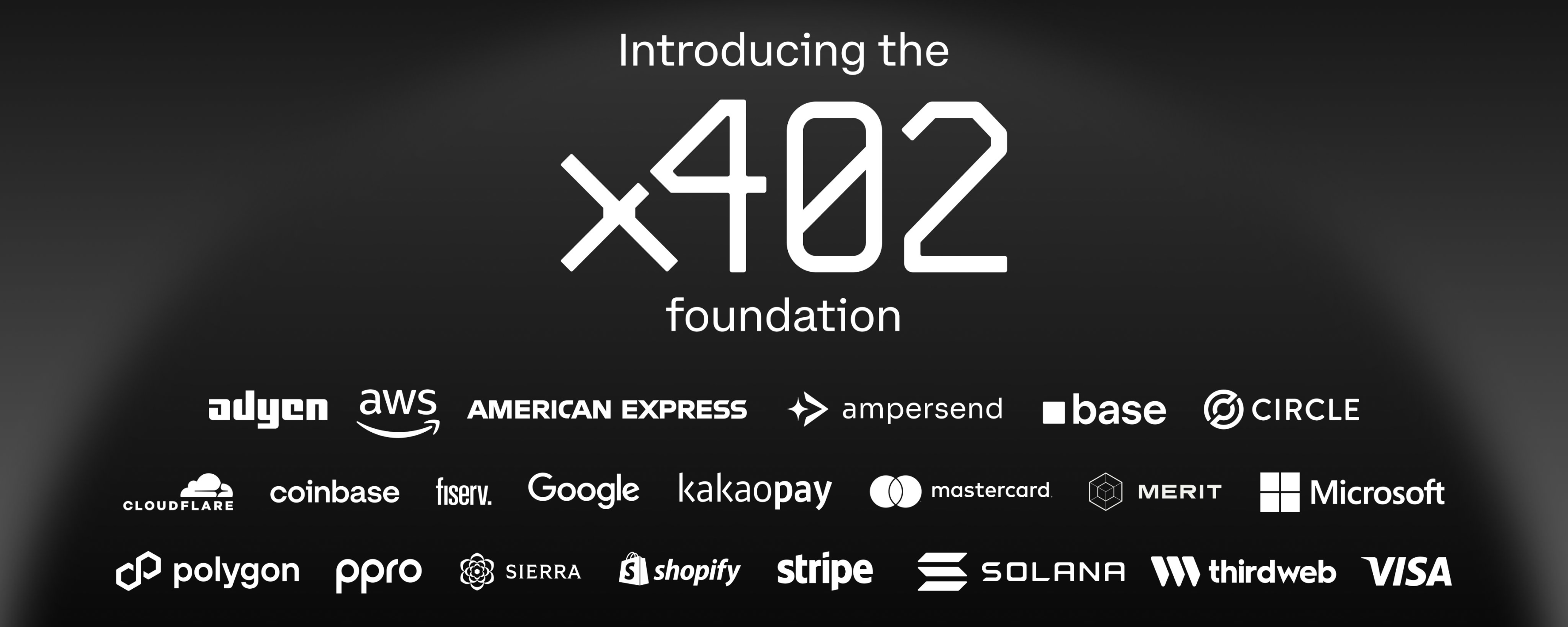
The payment and financial network layer carries the most weight: Visa, Stripe, Mastercard, American Express, Adyen, Fiserv, Circle, PPRO, KakaoPay, Ant International (Ant International appeared in Coinbase's announcement but was not mentioned in the official announcement graphic or Linux Foundation materials). These institutions together handle the vast majority of global consumer and merchant payment traffic.
Among them, Stripe is both a co-founder of the x402 Foundation and is pushing its own Machine Payments Protocol, placing bets on both sides. Visa's statement is meaningful; its Global Head of Growth Products and Strategic Partnerships, Rubail Birwadker, stated that Visa's goal is to ensure that payments happen securely and seamlessly wherever AI Agents transact, whether using credit cards or stablecoins.
The cloud & infrastructure side includes AWS, Google, Microsoft, and Cloudflare. AWS's managed infrastructure for building, deploying, and operating production-grade AI agents, AgentCore, already has an x402 reference implementation. Google Cloud's AP2 protocol incorporates x402 into its on-chain settlement layer. The head of AWS AgentCore stated that for AI Agents as autonomous participants in the digital economy, the ability to execute secure, frictionless payments is no longer optional but a fundamental capability.
The Web3 side includes Coinbase, Base, Solana Foundation, Polygon Labs, Circle, and thirdweb.
The business application layer includes Shopify, Sierra, Merit Systems (developer of x402scan, MPPscan, AgentCash), and Ampersend.ai, which can integrate x402 into e-commerce, content, and data monetization scenarios.
Let's highlight Merit Systems and Ampersend.ai here.
Merit Systems is a startup focused on Open Agentic Commerce, with products covering multiple layers of the agent commerce stack: Discovery, developer tools, and mass-market applications. For example, the x402 ecosystem browser x402scan, the MPP (Machine Payments Protocol) ecosystem browser MPPscan, the CLI and agent skill AgentCash that enables AI agents to instantly access premium paid data and services, and the AI-driven business automation tool Poncho.
Ampersend.ai is an agent economy control layer, officially launched on April 2nd, supporting each Agent in creating independent wallets and budgets for full control.
This diverse membership composition conveys several clear industry consensuses: First, AI autonomous payment is an irreversible technological trend, and no major player is willing to be absent from this future payment war. Second, open-source, neutral protocol standards are the foundation for cross-domain ecosystem collaboration; closed solutions dominated by a single enterprise are difficult to adapt to the needs of the entire industry. Third, the future payment system will inevitably be a fusion of traditional finance and blockchain technology; they are not opposites but complementary and symbiotic.
Such a Great Concept, Why Have Related Tokens Fallen Over 90%?
Now we come to the most subtle part.
Let's clarify one thing first: the x402 protocol has no official token. The protocol's settlement currency is USDC. AI Agents pay with USDC, and developers receive USDC. The entire protocol's design philosophy is to make payments as transparent as an HTTP request—it simply doesn't need an "x402 token" to capture value.
Well-known x402 ecosystem tokens include PING (the first token minted via the x402 protocol), Daydreams (focused on building autonomous agents and applications on the x402 payment rail), and PAYAI (a payment verification infrastructure project). Their token prices have fallen 80%-98% from their previous all-time highs.
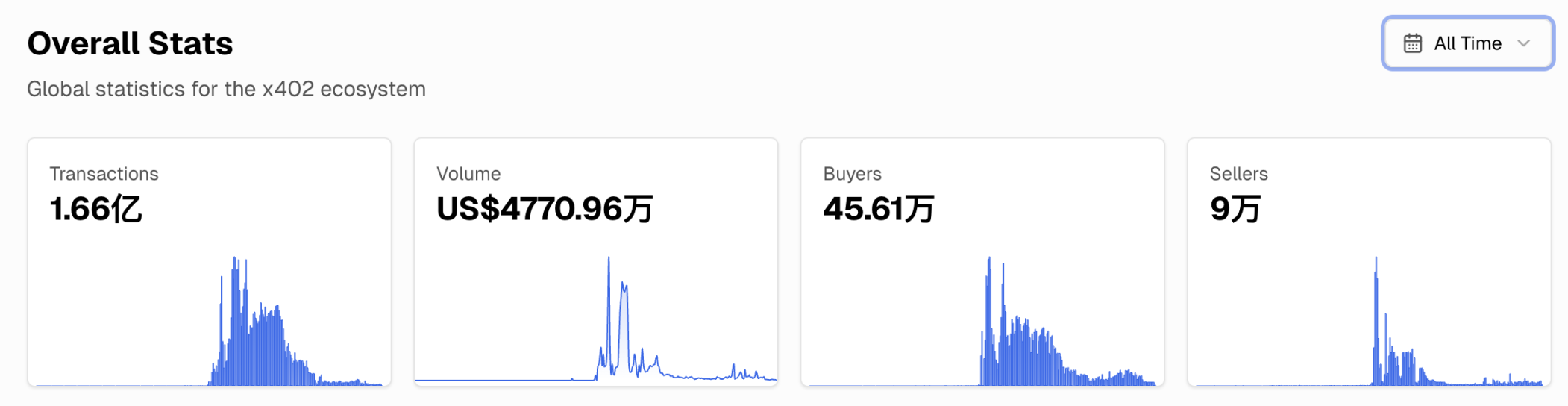
On-chain data more intuitively reflects the ecosystem's cooling. Daily transaction count on x402 has shrunk from a peak of about 3.8 million in November 2025 to tens of thousands today; daily transaction volume has retreated from over $2 million to recent levels of ten to twenty thousand dollars.
Source: x402scan
This contrast between "hot concept, cold adoption" stems from several core logic dislocations in the crypto market:
1. Decoupling of "Protocol Standard" and "Token Value Capture": The success of a protocol does not mean a specific ecosystem token can capture all its value. When on-chain data shows no substantial application growth, market capitalization propped up solely by narratives naturally collapses. More critically, the x402 protocol itself has obvious architectural limitations and application shortcomings, lacking built-in fraud detection, tax calculation, and refund logic. For the large-scale application of enterprise-grade AI Agents, these flaws are enough to be fatal shortcomings, making it difficult to support long-term value expectations for tokens.
2. Asymmetry Between Institutional Entry and Retail Expectations: When AWS and Coinbase announce their entry, formal protocol development and commercial implementation may take years. The crypto market is accustomed to discounting the "it will be huge in the future" narrative upfront. When real adoption speed cannot keep up with narrative expansion, a correction arrives.
3. Early Data Was Inflated: Although the x402 ecosystem once experienced explosive growth, an Artemis analysis at the end of 2025 indicated that approximately 48% of x402 protocol transaction count and 81% of transaction volume were flagged as non-organic. The data speaks clearly: the protocol's "prosperity" was not supported by real demand from the beginning. However, the situation is currently improving.
4. The plunge of x402 concept tokens has also been dragged down, to some extent, by the overall market environment.
But there is no doubt that real agent commerce activity is far from arriving.
An Honest Conclusion
The launch of the x402 Foundation is a key step for this protocol to become a truly open standard. The simultaneous appearance of Visa, Mastercard, and Google on the list of initiators is not just talk; it means the x402 proposal has been recognized by traditional financial infrastructure as a direction "worth participating in shaping."
The fate of the x402 protocol ultimately depends on one simple thing: whether there are enough AI Agents that truly need and can autonomously complete micropayments without human intervention.
The concept is real, and the future is real. But for investors, it's crucial to distinguish between "technological victory" and "token speculation." A 98% drop is the bursting of a bubble, but on top of the ruins, this foundational architecture for the AI economy is just beginning to break ground.





