DeFAI Tools Overview: How to Use AI Agents to Drive On-Chain Asset Management


- Core Viewpoint: The DeFAI (Decentralized Finance and Artificial Intelligence integration) sector is at a critical transition window moving from proof-of-concept to productization. Technical feasibility has been preliminarily validated, but it faces systemic challenges such as security, trust, and scalability, offering opportunities for teams with combined Web3 and AI capabilities to fill the gaps in infrastructure and execution layers.
- Key Elements:
- DeFAI aims to build an autonomous on-chain financial execution layer. Its evolution has gone through two stages: from information-interaction type to execution-closed-loop type, with the latter already capable of managing assets through off-chain computation and on-chain execution.
- Current practical applications focus on four major scenarios: cross-protocol automatic yield optimization, quantitative strategy automation, natural language command execution, and risk management & liquidation monitoring, aiming to improve efficiency, lower barriers to entry, and strengthen risk control.
- Security is a core challenge. The industry employs MPC (Multi-Party Computation) or TEE (Trusted Execution Environment) to manage private keys and overlays permission control mechanisms (such as Almanak's Zodiac Roles Modifier) to prevent Agents from performing unauthorized operations.
- A 2025 McKinsey report shows that large-scale deployment of AI Agents in general enterprise scenarios is less than 10%. The narrative hype in the DeFAI sector is ahead of its actual implementation progress, with most projects still being essentially automation tools rather than autonomous Agents.
- Future trends include: AI Agents are more likely to gain institutional trust in low-risk scenarios like monitoring and early warning, and integration with RWA (Real World Assets) to manage larger-scale on-chain and off-chain asset portfolios.
For teams capable of navigating both the Web3 and AI dimensions, the current moment presents a window of opportunity for entry—whether building more reliable on-chain Agent systems at the execution layer or bridging critical links in data, permissions, and trust at the infrastructure layer, there remain significant gaps to be filled.
Before delving into the analysis, it is necessary to clarify a core concept: DeFAI.
DeFAI is a portmanteau of DeFi (Decentralized Finance) and AI (Artificial Intelligence). It refers to the introduction of AI Agents into on-chain financial scenarios, endowing them with the ability to perceive market conditions, autonomously formulate strategies, and directly execute on-chain operations—thereby completing a series of financial activities traditionally requiring professional intervention, such as asset allocation, risk management, and protocol interaction, without relying on real-time human intervention.
In short, DeFAI is not merely an AI-powered upgrade of DeFi tools, but an attempt to build an autonomously operating financial execution layer on-chain.
This sector has rapidly gained traction since Q4 2024, driven by three landmark events worth noting, each corresponding to a different level of AI Agent integration into Web3: narrative breakout, assetization infrastructure development, and the real-world implementation of execution capabilities.
- The first event occurred in July 2024. The Twitter bot Truth Terminal, built by developer Andy Ayrey, quickly gained prominence after receiving a $50,000 BTC grant from a16z co-founder Marc Andreessen, triggering the viral spread of the GOAT token. This marked the first time an AI Agent, as an on-chain economic participant, truly entered the public consciousness.
- The second event occurred in October of the same year. The Virtuals Protocol exploded in popularity on the Base network, tokenizing AI Agents themselves. Its ecosystem market capitalization peaked at over $3.5 billion, becoming a typical representative of the assetization infrastructure phase in the DeFAI sector.
- The third event was the successive launch of projects like Giza, HeyAnon, and Almanak on the on-chain execution layer, driving the industry from narrative-driven hype to a productization phase—AI Agents began to truly "act" and execute on-chain operations, moving beyond mere information interaction.
Looking at the global market size, multiple research institutions share a highly consistent growth outlook for the AI Agent sector:
Chart 1: Comparison of Global AI Agent Market Size Forecasts
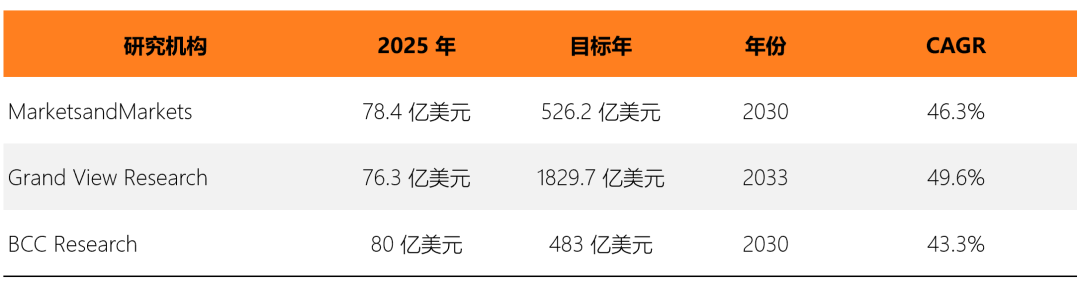
Data Source: MarketsandMarkets (2025), Grand View Research (2025), BCC Research (2026.01)
However, a significant gap remains between capital enthusiasm and industrial implementation. According to McKinsey's November 2025 report "The State of AI in 2025" (based on 1,993 respondents across 105 countries), while 88% of organizations are using AI in at least one business function, nearly two-thirds remain in the experimental or pilot stage. Specifically in the AI Agent domain: 62% of organizations have begun experimenting, 23% are scaling in at least one function, but the proportion achieving scaled deployment in any single function is less than 10%.
This data suggests that the narrative heat in the DeFAI sector currently outpaces its actual implementation progress. Understanding this gap is a prerequisite for objectively assessing the value of this sector.
The Technical Foundation of DeFAI: How AI Agents Interact with the On-Chain World
To understand how DeFAI operates, one must first answer a key question: Through what mechanism does AI intervene in on-chain financial operations?
The core execution unit of a DeFAI system is an AI Agent built on large language models (LLMs). According to the academic review by Wang et al. (2023), its core capabilities can be summarized into a three-layer architecture, with each layer corresponding to specific functions in on-chain scenarios:
- The Planning Layer is responsible for goal decomposition and path optimization, corresponding to strategy generation and risk assessment in on-chain scenarios.
- The Memory Layer achieves cross-cycle information accumulation through external storage like vector databases, carrying historical market data and protocol states.
- The Tools Layer extends the model's capabilities, enabling it to call external systems such as DeFi protocols, price oracles, and cross-chain bridges.
However, one point needs clarification: AI models themselves cannot directly interact with the blockchain. Almost all current DeFAI systems adopt an architecture that separates off-chain reasoning from on-chain execution—the AI Agent completes strategy computation off-chain, then converts the results into on-chain transaction signals submitted by an execution module. This architectural design is both a practical choice under current technological constraints and the source of a series of security issues, including private key authorization and permission management.
In essence, AI Agents are autonomous decision-making systems based on LLMs, achieving closed-loop execution through task decomposition, memory management, and tool invocation. Currently, the interaction between AI Agents and on-chain assets has already taken initial shape.
Chart 2: Three-Layer Architecture of AI Agents

The Evolution of DeFAI: From Information Interaction to Execution Loop
Having clarified the technical foundation of DeFAI, a natural question follows: How did this system evolve to its current state?
According to research by The Block, the evolution of DeFAI did not happen overnight but progressed through two distinct phases—from early interactive Agents focused on information processing to today's execution-oriented systems capable of truly intervening in on-chain operations.
The two differ fundamentally in their target positioning, technical means, and risk levels.
Chart 3: Comparison of the Two Waves of DeFAI Evolution
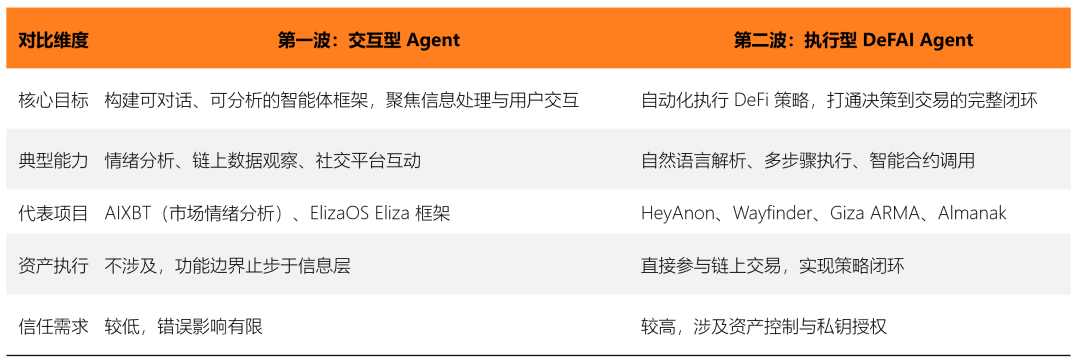
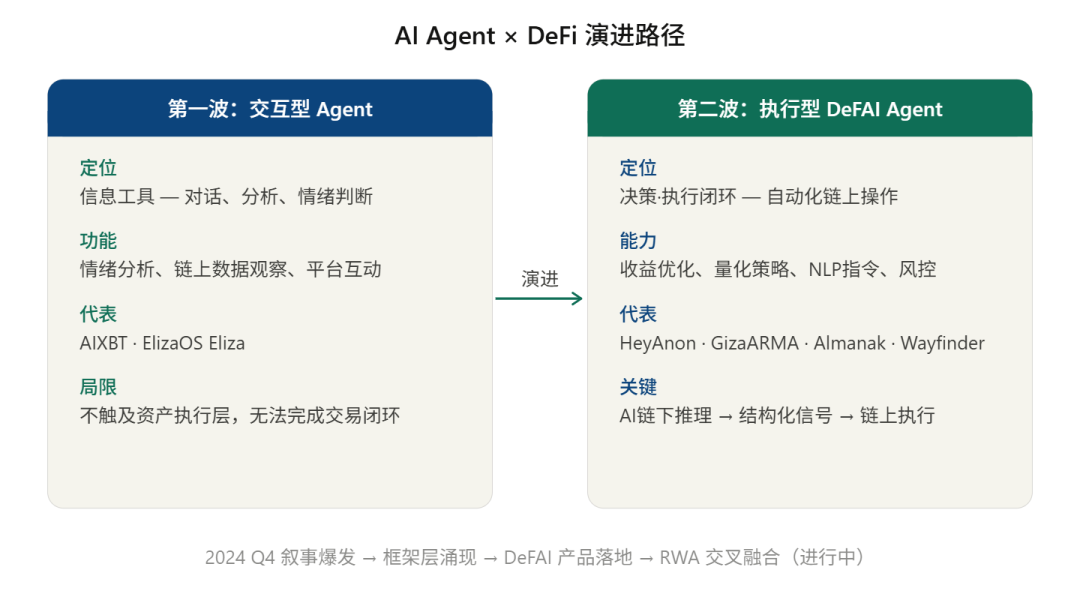
The evolutionary trajectory of these two phases can be understood as follows:
The first wave consisted of Interactive Agents, focusing on building conversational, analyzable intelligent agent frameworks. Representative projects include the Eliza framework by ElizaOS (formerly ai16z) and Virtuals' G.A.M.E. The essence of this phase remained informational tools—Agents could read, speak, and analyze, but their functional boundaries stopped at the information layer, not touching any asset execution operations.
The second wave, Execution-Oriented DeFAI Agents, truly entered the decision-making and execution loop. Representative projects include HeyAnon, Wayfinder, Giza (ARMA Agent), and Almanak. The common feature of these systems is: AI runs off-chain, outputs structured strategy signals, and completes transactions through an on-chain execution module—it does not replace existing DeFi protocols but introduces a layer of AI decision-making on top of them, transforming the entire operational chain from "human instruction" to "Agent autonomous execution."
The fundamental difference between the two waves lies not in technical complexity, but in whether they truly touch assets. This also determines that the challenges faced by second-wave systems in trust mechanisms, permission design, and security architecture are far more complex than those of the first wave—precisely the focus of the next chapter.
The Implementation Landscape of DeFAI: Four Mainstream Application Scenarios
From technical architecture to evolutionary path, the "capabilities" of DeFAI are becoming clearer. So, at the product level, what real-world problems is it solving?
Overall, current DeFAI application exploration has formed a relatively mature implementation pattern around four core directions, corresponding to four key pain points in on-chain operations: "yield efficiency, strategy execution, interaction barriers, and risk control."
Yield Optimization: Automated Portfolio Rebalancing Across Protocols
Yield optimization is currently the most mature DeFAI application scenario. Its core logic is: continuously scanning the deposit APYs of mainstream DeFi protocols like Aave, Compound, and Fluid, judging whether rebalancing is needed based on preset risk parameters, and performing transaction cost analysis before each operation—funds are only moved when the yield increase can cover all gas and transaction fees, thereby achieving automated optimal allocation across protocols.
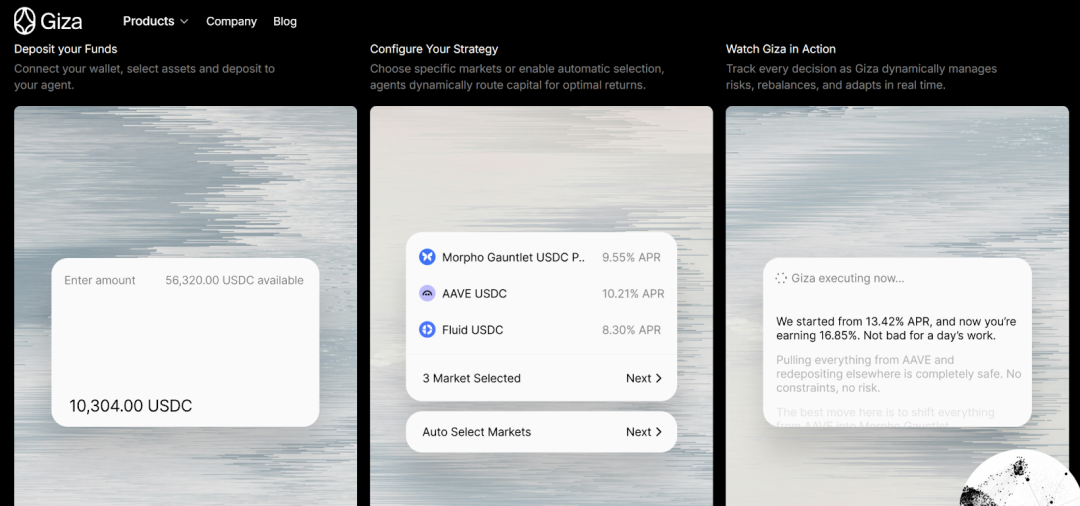
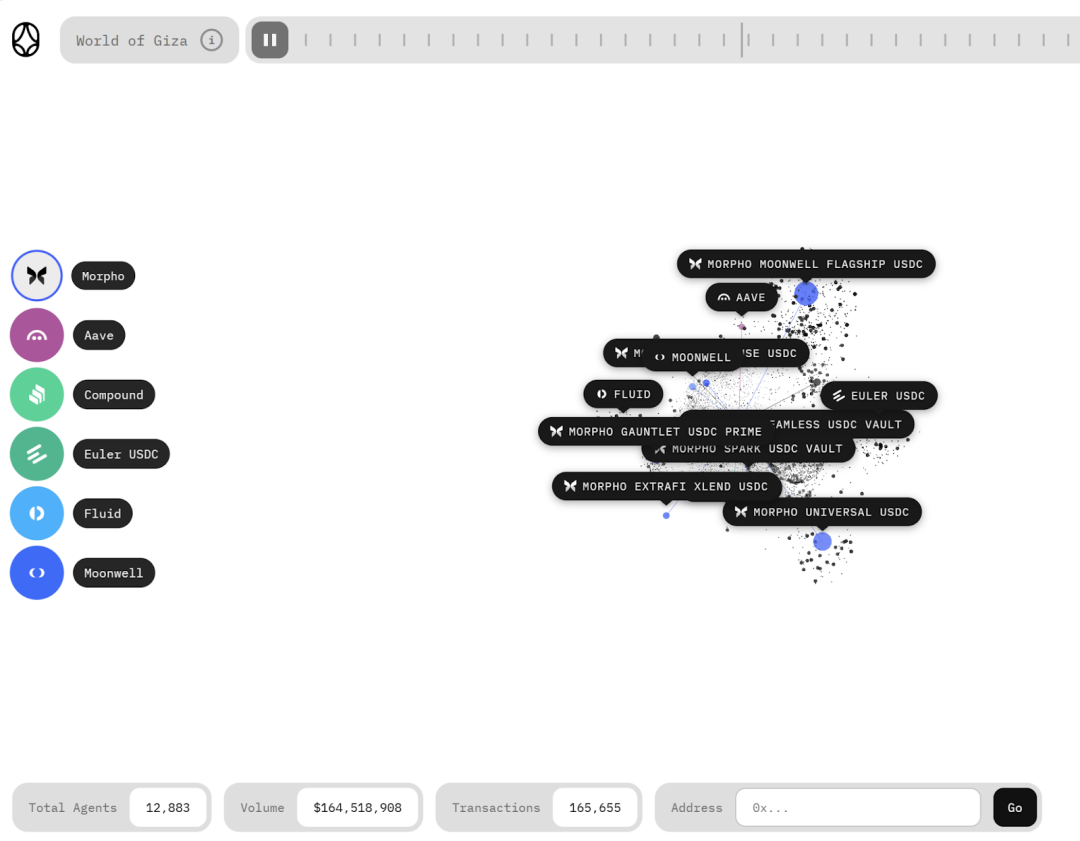
Taking Giza as an example, its ARMA Agent launched a stablecoin yield strategy on the Base network in February 2025. It continuously monitors interest rate changes in protocols like Aave, Morpho, Compound, and Moonwell, intelligently allocating user funds to maximize yield after comprehensively considering protocol APY, fee costs, and liquidity. According to public data, ARMA currently has approximately 60,000 unique holders, over 36,000 deployed Agents, and Assets Under Administration (AUA) exceeding $20 million.
In a market environment where DeFi protocol yields continuously fluctuate, the efficiency and timeliness of manual monitoring and manual rebalancing are far inferior to automated systems, which is the core value of this scenario.
Chart 4: Example Diagram of Giza Platform's ARMA Agent
Quantitative Strategy Automation: Democratizing Institutional-Grade Capabilities
In the quantitative strategy automation scenario, DeFAI platforms attempt to modularize and automate the entire workflow of traditional quantitative teams, enabling individual users to access institutional-grade strategy execution capabilities.
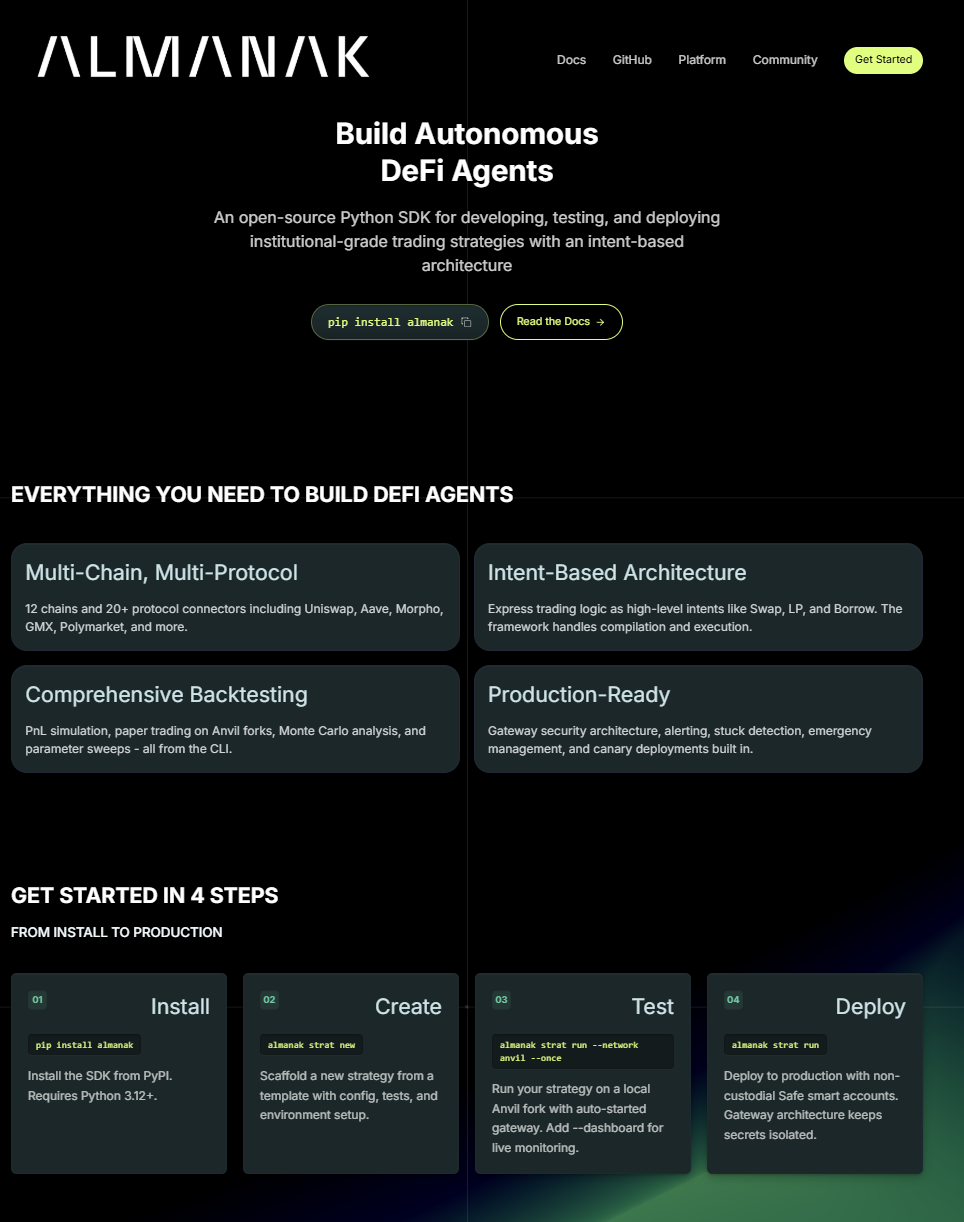
Taking Almanak, backed by Delphi Digital, as an example, its AI Swarm system decomposes the quantitative process into four components:
- The Strategy Module supports writing investment logic and conducting backtests via a Python SDK.
- The Execution Engine automatically runs audited strategy code and triggers DeFi calls after obtaining user authorization.
- The Security Wallet, built on Safe + Zodiac multi-signature architecture, grants strategy execution rights to the AI Agent through role-based permission control, ensuring funds remain within user control.
- The Strategy Vault packages strategies into tradable vaults compliant with the ERC-7540 standard, allowing investors to participate in strategy profit distribution similar to fund shares.
The significance of this architecture is that the AI agent handles data analysis, strategy iteration, and risk management functions, while users only need to perform final review of the system's output, eliminating the need to assemble a professional quantitative team—achieving what the project calls "democratization of institutional-grade strategies."
Chart 5: Homepage Display of the Almanak Platform
Natural Language Instruction Execution: Making DeFi Operations as Simple as Sending a Message
The core of this scenario is Intent-based DeFi: leveraging natural language processing technology, users issue transaction instructions in everyday language, and the AI parses and converts them into multi-step on-chain operations, significantly lowering the barrier to entry for ordinary users.
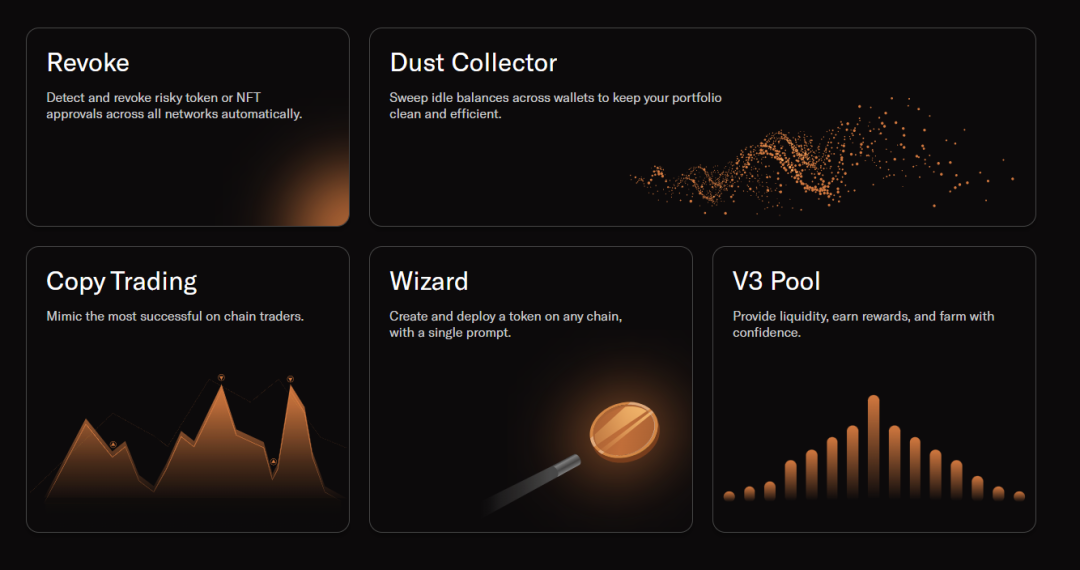
HeyAnon has created a DeFAI chat platform where users input instructions through a dialog box, and the AI can execute on-chain operations such as token swaps, cross-chain bridging, lending, and staking. It integrates LayerZero cross-chain bridges and protocols like Aave v3, supporting multi-chain deployment on Ethereum, Base, Solana, and others.
Chart 6: Homepage Display of the HeyAnon Platform
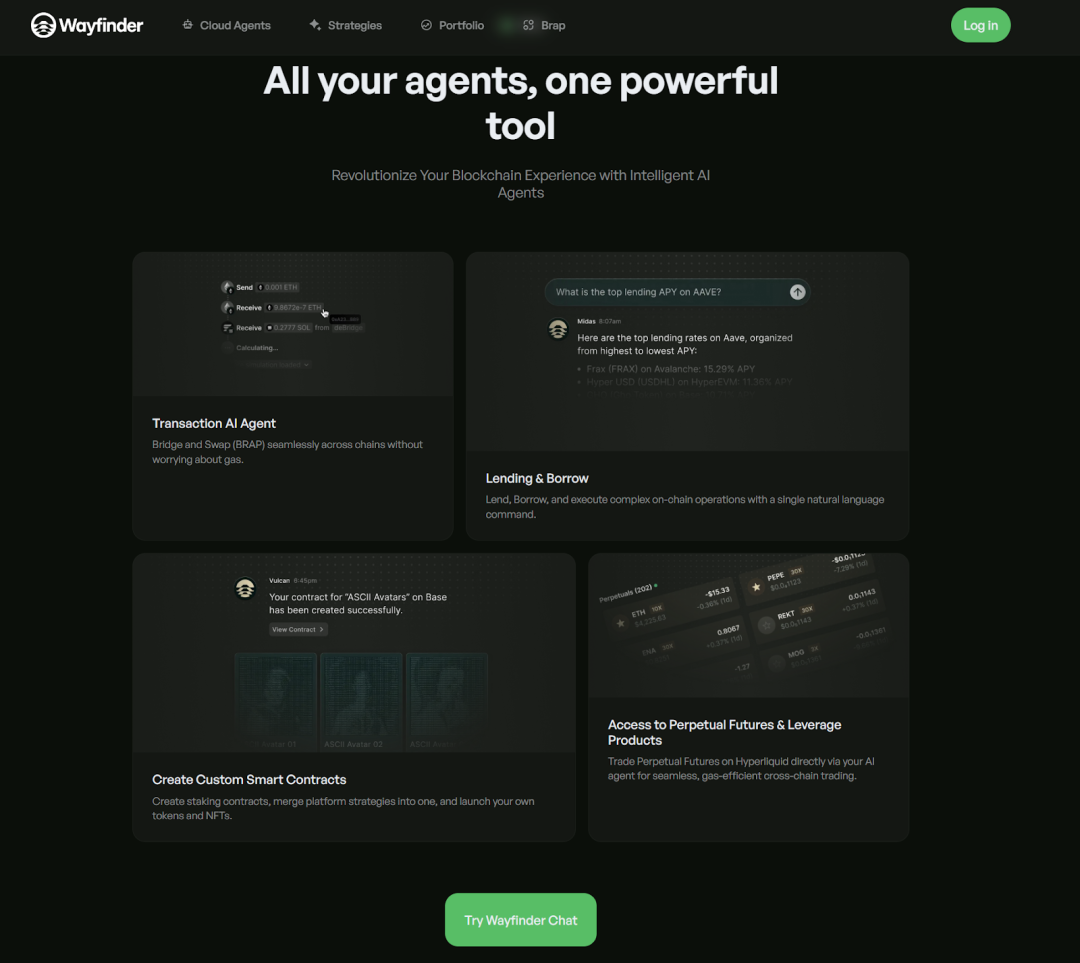
Wayfinder, backed by Paradigm, provides further omnichain transaction services. Its AI Agents (called Shells) automatically find optimal transaction paths across different chains, executing operations like cross-chain transfers, token swaps, or NFT interactions. Users do not need to concern themselves with underlying technical details like gas fees or cross-chain compatibility.
Chart 7: Homepage Display of the Wayfinder Platform
In summary, natural language interfaces significantly lower the barrier to DeFi interaction but also place higher demands on the accuracy of underlying intent parsing—if the AI's understanding of an instruction deviates, the operational result may differ significantly from user expectations.
Risk Management and Liquidation Monitoring: Mechanisms Embedded Within On-Chain Protocols
In DeFi lending and leverage scenarios, one of the most common applications for AI Agents is real-time monitoring of on-chain position health and automatically executing protective actions before approaching liquidation thresholds. This type of application is being gradually integrated into major mainstream DeFi protocols, becoming a native feature of DeFi platforms.
- Aave uses a "Health Factor" to measure position safety. When the Health Factor falls below 1.0, a borrower's position becomes eligible for liquidation.
- Compound employs a "Liquidation Collateral Factor" mechanism. Liquidation is triggered when an account's borrowing balance exceeds the upper limit set by this factor, with specific parameters for each collateral asset set by on-chain governance.
Manual monitoring struggles to maintain consistent response efficiency in the 24/7 high-volatility on-chain market. AI Agents in this scenario can achieve continuous tracking, intelligent assessment, and automatic intervention, elevating risk control efficiency to a level difficult for manual or rule-based automated systems to match.
Chart 8: Four Mainstream Application Scenarios of Agent×DeFi
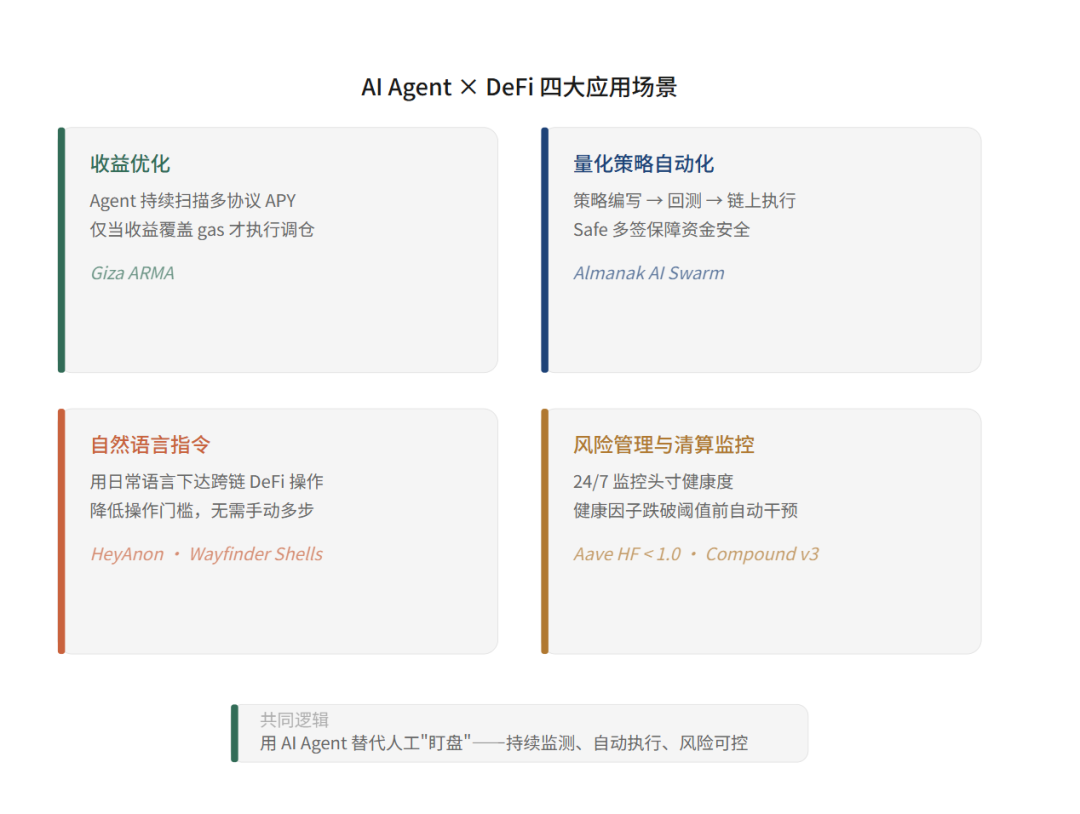
In summary, the aforementioned four scenarios are not independent but form complementary components around a common theme: Yield optimization and quantitative strategy automation target advanced users with a certain scale of assets, with core advantages in execution efficiency and strategy precision; natural language interaction aims to lower the operational barrier for ordinary users; risk management serves as the underlying security guarantee across all scenarios. Together, they constitute the basic implementation framework of the current DeFAI ecosystem and lay the groundwork for more complex on-chain Agent applications in the future.
The Security Bottom Line of DeFAI: Private Key Management and Permission Control
The premise for realizing the four application scenarios described above, whether yield optimization or quantitative strategy automation, is singular: The AI Agent must hold some form of signing authority, i.e., access to private keys. This is the most critical, yet most easily obscured by narrative hype, technical challenge in the entire DeFAI sector—once the signing mechanism is compromised, all upper-layer strategic capabilities become meaningless.
Currently, the industry's mainstream private key security management solutions fall