






MSX Q1 Review and Q2 Outlook: Grasping the Main Theme of U.S. Stocks, A Methodology for Precise Stock Selection


- Core View: Against the backdrop of an overall sluggish crypto market in Q1 2024, the decentralized RWA trading platform Maitong MSX achieved impressive stock-picking performance by focusing on small-to-mid-cap U.S. stock token targets with clear industry trends and promising earnings potential. The core of its success lies in tracking real capital flows and industry realization paths, rather than relying on macro narratives.
- Key Elements:
- MSX launched 39 U.S. stock token targets in Q1, with 38 achieving positive returns, an average gain of 37.6%, and 4 targets surging over 100%, primarily concentrated in the AI Hardware and Optical Communications themes.
- The core of the stock selection framework is to avoid grand narratives and focus on discovering small-to-mid-cap companies with clear industry trends, real order transmission, and earnings realization, rather than betting on a broad market reversal.
- AI Hardware and Optical Communications were identified as systemic opportunities based on tracking the surging capital expenditure guidance in major tech companies' financial reports, confirming real demand transmitted down the industry chain.
- The platform's portfolio strategy emphasizes structural integrity, incorporating defensive exposures like Aerospace & Defense, which have low correlation with the tech cycle, to balance the risks of high-volatility offensive targets.
- The pace of new listings is a result of dynamically following the landing of industry data and market capital preferences, not a mechanical plan, achieving high-frequency interaction with the market.
- It is believed that capital is currently flowing from the crypto market, which lacks narratives, to U.S. stocks with higher certainty, especially those in the AI industry realization cycle. A growing user demand for learning fundamental analysis of U.S. stocks has been observed.
- Looking ahead to Q2, AI Hardware and Optical Communications remain core directions, but stock selection will become more differentiated. Structural opportunities in the Aerospace sector and potentially oversold Software/SaaS segments are also being monitored.
Original | Odaily (@OdailyChina)
Author | Qin Xiaofeng (@QinXiaofeng 888 )

The crypto market performed poorly in the first quarter that just ended. Affected by geopolitical tensions (such as the Iran conflict), macroeconomic uncertainty, and declining risk appetite, Bitcoin fell from around $87,500 at the beginning of the year to about $66,700, a drop of approximately 23%, marking its worst quarterly start since 2018. Other altcoins fared even worse. Apart from traditional asset tokenization and the AI sector, which still maintained growth, the overall market narrative has fallen into a lull.
In contrast, the US stock market seems to be following a different script. Even though the "Magnificent Seven" all fell by double digits, with Microsoft plunging 23% for its worst quarterly performance since 2008, the profit-making effect hasn't disappeared. Some hot sectors have rotated quickly, achieving decent results. These quality assets were promptly listed on the decentralized RWA trading platform, Maitong MSX.
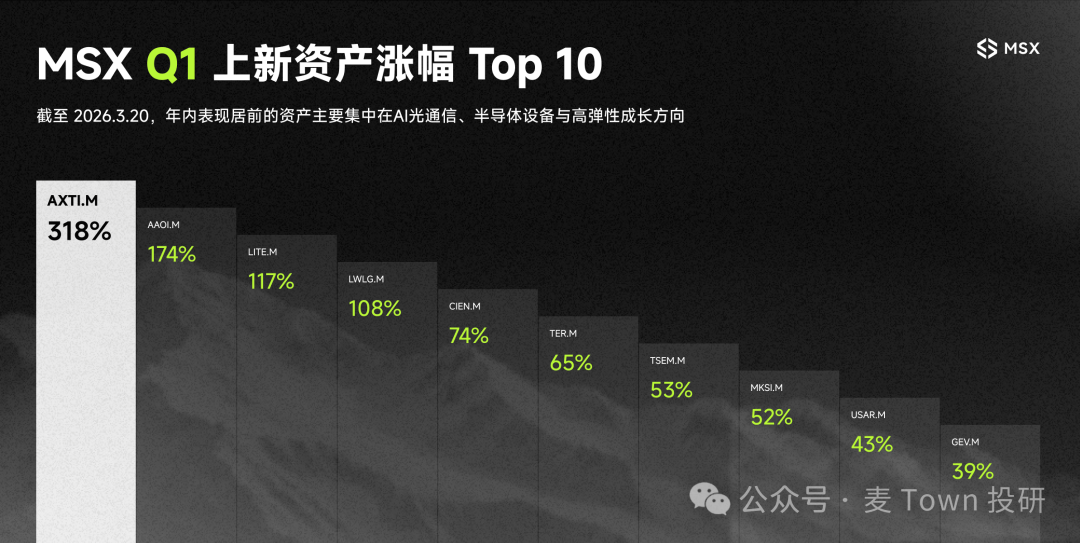
Data shows that in Q1 2026, the MSX platform listed a total of 39 new US stock token targets, spanning individual US stocks, sector ETFs, and macro tools, covering five main themes: defense & aerospace, energy & resources, AI hardware, optical communications, and regional allocation. The results show that this batch of targets performed remarkably well overall. As of the time of writing, only 1 out of the 39 targets recorded a negative return (CRDO.M, -7.81%), with all others being positive. Among them, four targets achieved gains exceeding 100% year-to-date: AXTI.M (+318.59%), AAOI.M (+174.70%), LITE.M (+117.58%), and LWLG.M (+108.95%), all concentrated in the AI hardware and optical communications themes. Additionally, seven other targets gained over 50%, accounting for nearly one-fifth of the total.
On the evening of April 2nd, Odaily invited Frank, a researcher from the MSX Maitong Research Institute, to review MSX's Q1 performance and provide a forward-looking perspective on Q2 new listings, helping listeners grasp the main themes of US stocks and select stocks precisely.
Odaily: MSX listed 39 new targets in Q1, with 38 achieving positive returns and an average gain of 37.6%. Such a win rate is quite rare in the current volatile market. What is the core stock selection framework behind this "top student" report card?
Frank: I'd like to first correct a statement: Q1 wasn't "volatile"; it was a genuine downturn.
Throughout the quarter, both the S&P 500 (-4%) and the Nasdaq (-7%) weren't moving sideways; they were actually declining. The pressure on heavyweight tech stocks was particularly evident. Core assets like Microsoft, Tesla, Meta, Google, Nvidia, Amazon, and Apple all experienced varying degrees of pullback, even falling below their 200-day moving averages.
In other words, Maitong MSX's report card of "39 new listings in Q1, 38 positive returns, 8 with gains over 50%" was achieved against a backdrop of a falling market and valuation compression in heavyweights.
If we break down the logic behind this result, frankly, timing played a part. The listing times for some targets indeed fell just before their rallies. But beyond luck, the more important factor is that Maitong MSX has always adhered to a relatively stable principle in stock selection:
We avoid stocks that seem to have great potential but lack clear industry direction, and we don't bet on when large-cap blue chips will bottom out. Instead, we prefer to find small-to-mid-cap stocks with clear industry trends, transparent capital flow chains, and the potential for gradual earnings realization.
Simply put, we're not betting on whether a major trend will suddenly reverse; we're digging down the most certain industry chains. We focus on who is securing orders, who is receiving capital expenditures, and who truly benefits from industry expansion.
To be more direct, we're not gambling on whether a grand narrative will suddenly reverse; we're following the most certain industry chain downwards. Those who are securing orders, receiving capital expenditures, and truly benefiting from industry expansion are more likely to enter Maitong MSX's observation and listing scope. This is precisely why, in an environment where indices and heavyweights were under pressure, we were still able to produce a relatively impressive "top student" report card for Q1.
Odaily: You categorized the Q1 new listings into five main themes: AI Hardware, Optical Communications, Energy & Resources, Defense & Aerospace, and Regional Allocation Tools. How were these five themes identified and established as "tradable directions" at the beginning of the quarter? Were there quantitative or macro indicators supporting this?
Frank: Actually, these five themes weren't "planned" at the start of the quarter. More accurately, they emerged gradually through continuous tracking of industry dynamics, earnings data, and market anomalies.
A core daily activity of the Maitong MSX MaiDian research team is to continuously monitor the earnings reports, Capex guidance, and industry chain data of major tech companies, as well as the latest hot narratives and sectors with unusual capital flows.
For example, when Meta, Microsoft, Google, and Amazon continuously raise their capital expenditures related to AI infrastructure, these numbers in earnings reports might seem like cold budgets, but essentially, they will inevitably flow down the supply chain—to chips, optical modules, power equipment, cooling, and testing segments.
So, rather than making macro judgments, we are more like tracking capital flows and industry realization paths. Because the real money spent by big tech often has more explanatory power than many abstract macro indicators—PMI, interest rate expectations, and macro narratives are important, but the real money from signed contracts, placed orders, and capacity expansion is the most solid signal.
Based on this, we further distinguish which companies in a sector have actually received orders and started to reflect it in revenue and profits, and which ones are just concept-driven or hype-driven.
As for directions like Energy & Resources and Defense & Aerospace, their drivers are not exactly the same as the AI industry chain, leaning more towards policy, geopolitics, and cyclical logic. But essentially, they still fit MSX's same screening criteria: first, check if the driver is real; second, see if the benefit is specific; finally, assess if the trade is viable.
Odaily: Among them, AI Hardware and Optical Communications became the strongest dual themes in Q1. At what point did you confirm that these two lines had "systematic opportunities" rather than being short-term trading themes?
Frank: For the AI Hardware theme, our research institute actually started paying attention from Q2/Q3 last year. At that stage, almost all market attention was focused on Nvidia. But Maitong MSX started looking upstream and downstream the supply chain earlier, searching for who was doing packaging, cooling, power management, and who was meeting more niche supporting demands.
The reasoning is simple: Nvidia's market cap is already in the trillions. While highly certain, its upside potential is limited. However, its Tier 2 and Tier 3 suppliers are still in the early stages of an earnings explosion. There are two transmissions here: one is the real transmission of orders, revenue, and profits along the industry chain; the other is the rotational transmission of market attention, capital preference, and narrative heat. The former determines fundamentals, the latter determines valuation re-rating, and both require time.
The confirmation for Optical Communications came later, roughly between Q4 last year and January this year. The key inflection point came after the Q3 and Q4 earnings reports of major tech companies landed, with capital expenditure guidance becoming increasingly aggressive. When you do the math, you realize that with data center expansion and increasing computing density, the demand for infrastructure connecting these compute nodes—including optical modules, fiber optics, switching, and interconnect—isn't just possible; it's real.
Therefore, MSX's core criterion for judging whether a theme has systematic opportunity is never how hot the concept is, but whether there are real orders flowing along that industry chain, whether real money is moving, and whether there are companies positioned at critical junctures that are already showing revenue growth.
Only when these conditions are met is it not a short-term trading theme, but a systematic opportunity worth continuous allocation and new listings. We generally avoid purely story-driven directions.
Odaily: In comparison, Defense & Aerospace and Regional Allocation Tools didn't show outstanding gains but were still included in the system. How do you evaluate their real value in the portfolio?
Frank: The lack of outstanding gains precisely indicates that their role was never meant to be the "spearhead of offense."
A mature platform product logic cannot allocate all exposure to high-volatility sectors. For analogy, if users held only AI Hardware and Optical Communications stocks, looking back at Q1, they would have done exceptionally well. But once the main theme corrects, they would be very vulnerable. Just like an article about Cathie Wood I read today—her investment style is very aggressive. Although operating in the secondary market, she invests with a VC-like, aggressive underlying logic.
This easily becomes a double-edged sword. When catching the left side, it surges dramatically, like the tech stock frenzy in 2020-2021 during the big rate cuts, which helped propel Cathie Wood to be hailed as the "female Warren Buffett," with assets under management once reaching $59 billion. But the declines are equally brutal; now, it's down about 70%, with tens of billions evaporated...
Ultimately, high volatility is an advantage, but without structural hedging and diversification, it can also become a double-edged sword.
Therefore, the value of Defense & Aerospace and Regional Allocation Tools lies in providing "exposure to different directions." After all, Defense & Aerospace has its own independent drivers, with low correlation to the AI cycle—escalating geopolitical games and increasing national defense budgets follow a logic completely out of sync with the tech cycle. Regional Allocation Tools are more instrumental, allowing users to conveniently gain exposure to non-US markets.
These types of targets may not aim to deliver the highest gains, but they enable users to build a more structurally complete and resilient portfolio on the MSX platform. We are not a platform that only offers the fastest-rising assets; we aim to provide sufficient, user-friendly configuration tools to help users navigate different market environments.
This is a point MSX has consistently adhered to in its listing system: having both offensive elasticity and structural integrity.
Odaily: The Q1 listing rhythm showed clear phased progression: January focused on macro foundational frameworks, February delved deep into AI infrastructure, and March supplemented with tools and materials. How should we understand this dynamic follow-up mechanism? Was this rhythm a result of active design or dynamic adjustment following market sentiment and capital flows?
Frank: Both, but if we must weigh them, dynamic adjustment carries greater importance.
January leaned towards macro frameworks because the themes that heated up first at the beginning of the year were energy, resources, and geopolitics; the market's initial feedback was also in these directions. By February, major tech earnings reports had landed, with Capex data consistently exceeding expectations. This allowed for more confident deep dives into specific segments of AI infrastructure—who makes optical modules, liquid cooling, power support, and who actually received orders from the capacity expansion logic.
By March, supplementing with tools and materials was more because the main theme stocks had already rallied, and capital naturally began seeking surrounding segments not yet fully priced, catch-up logic, and relatively low-priced beneficiary assets. Coupled with catalysts like GTC and major optical communications industry conferences, market focus further diffused from leaders to supporting and application layers.
So, you can understand MSX's listing rhythm as: having forward-looking judgment on the broad direction, but dynamically advancing what to list each month, how many, and which category first, based on the pace of industry data realization and market capital preferences.
It's not a monthly plan made arbitrarily, but more like a mechanism of "when the signal arrives, we advance." This is why MSX's listings don't seem mechanical but more like continuous high-frequency interaction with the market.
Odaily: In an environment of globally tight liquidity, the cost-effectiveness of US stocks versus Crypto is being re-evaluated. How do you view this trend of "capital choosing one over the other"? Will it continue into Q2?
Frank: Altcoins have indeed entered a "cooling-off period." In the US stock market over the past two years, there have been too many stocks that doubled or even increased tenfold within months. For example, LITE, listed in Q1, more than doubled in just one or two months.
So, I don't think this is purely a simple "either-or" choice. It's more about capital reallocating priorities. Over the past two years, Crypto users have shown a clear learning curve, gradually shifting from pure MEMEs and on-chain games to paying attention to macroeconomics, the Fed, and major tech earnings.
Once this cognitive upgrade occurs, it's irreversible. When they find opportunities in US stocks with higher certainty and relatively controllable volatility, a portion of their capital will naturally allocate there.
Will it continue into Q2? I think it's highly likely, possibly even accelerating. The reason is simple: the Crypto market currently lacks new major narratives, on-chain activity is declining, while the earnings realization cycle for the AI industry in US stocks has just begun. Smart money flows to places with higher certainty.
Based on this trend judgment, MSX recently launched a content campaign called "The Great US Stock Learning" (interested users can find the "Beginner & Education" entry in the MaiDian section on the official website). It aims to help users with a Crypto background understand the basic logic of US stocks—how to read earnings reports, understand valuations, and analyze industry chains—systematically building up the foundational ability to "read earnings, valuations, and industry chains."
This content isn't just for promotion; it's because we genuinely see changes in user demand. Users don't want to "abandon Crypto"; they just want to allocate capital to more efficient, more profitable directions in the current market environment. Therefore, they indeed need to learn about US stocks, actively adding a new arsenal for themselves.
This change is the trend more worthy of attention.
Odaily: After the implementation of securities tokenization, the "entry barrier" for US stocks is lowering. How do you think this will change the future retail investor structure of US stocks?
Frank: The most direct change is that with lower barriers, the people entering will naturally change.
In the past, an Asian retail investor wanting to participate in US stocks often had to go through a series of frictions: traditional brokerage account opening, fund transfers, account systems, minimum capital requirements, etc. With the gradual implementation of securities tokenization, users can participate in related targets through lighter, on-chain methods, with more flexible and fractionalized holdings.
Essentially, this isn't simply moving the trading interface on-chain; it's unlocking a new batch of users previously blocked by infrastructure barriers.
From a structural change perspective, our MSX Research Institute believes two trends will be relatively clear.
First, the proportion of retail investors from the Asia-Pacific region and emerging markets will increase. In the past, it wasn't that they lacked demand, but they were blocked by channels, costs, and processes. Once these constraints weaken, incremental users will naturally enter.
Second, the trading style of these new users in the future will likely lean more towards "industry theme-driven" rather than traditional passive index allocation. This is because these users are naturally accustomed to sector thinking, narrative thinking, and thematic investment thinking. In Crypto, they follow new narratives and chase new sectors. When they enter the tokenized securities market, they likely won't simply buy an index and hold long-term; they will actively seek more elastic niche opportunities within industry chains.
This point is highly aligned with MSX's target screening logic because we are not building a generalized portal offering only broad market tools. We are striving to build a thematic, structural trading platform more suitable for the new generation of on-chain users to understand and operate.
In other words, securities tokenization changes not just "how to buy," but also "who buys, what they buy, and why they buy."
Odaily: Standing at the start of Q2, how do you view the continuity and switching risks of the current main themes in US stocks? Are AI Hardware and Optical Communications still the core offensive plays? Are any new main themes entering MSX's listing horizon?
Frank: I believe the AI narrative will likely continue, but its form is already changing.
In Q1, the market actually began to move away from the singular thinking mode of "if Nvidia rises, it's an AI rally," shifting instead to see who truly benefited from the AI infrastructure expansion. This means AI Hardware and Optical Communications will still be the core offensive directions in Q2, but the rally will likely gradually shift from "broad-based gains" to "differentiated selection."


