






When DPoS Governance Becomes Unbalanced: How Vaulta Rebuilds On-Chain Democracy Through Triangular Checks and Balances


- Core Viewpoint: This article analyzes the structural dilemmas of the DPoS governance model in the Vaulta (formerly EOS) network, particularly the power concentration and governance failure caused by vote pools. It proposes a reconstruction plan centered on on-chain staking via Treasury and the introduction of a community governance organization, ECF, for supervision, aiming to re-decentralize power to the community.
- Key Elements:
- DPoS governance has structural dilemmas: It's difficult to balance efficiency, decentralization, and fair governance simultaneously. The proxy voting mechanism has fostered "vote pools" that are indifferent to the ecosystem and only seek profit-sharing, leading to the alienation of the service targets for block producers (BPs).
- A disconnect exists in governance: "On-chain voting, off-chain decision-making." The process for major decisions lacks transparency, making it difficult for ordinary token holders to participate and trace, rendering decentralized governance nominal.
- First step of the solution: The Treasury plan involves locking and depositing 220 million $A tokens into the on-chain staking system REX, providing development funds for the network and demonstrating confidence in the ecosystem.
- Second step of the solution: Introduce the independent community governance organization ECF. The Treasury will delegate the voting rights generated from staking to ECF, which will evaluate BPs and allocate voting power based on public standards to break the hold of vote pools.
- Third step of the solution: The annualized yield of approximately 20 million $A generated from Treasury staking will be used to incentivize BPs and ecosystem projects that actively participate in governance. ECF will have the authority to review and veto funding applications.
- The new mechanism aims to establish clear checks and balances: Treasury manages assets, ECF represents community supervision, and BPs are responsible for operations and maintenance. Any resolution requires the support of a 15/21 supermajority of BPs, preventing any single party from overriding power.
Preface: From Turmoil to Reconstruction
The Vaulta ecosystem has experienced a period of genuine turmoil over the past few months. Yves La Rose, founder of the Vaulta Foundation, announced his resignation and the dissolution of the foundation. During the prolonged transition, the price of the token $A continued to decline amidst uncertainty, leading to a series of escalating internal disputes. At the governance level, BPs (Block Producers), holding the highest governance authority, faced declining rewards—approaching the shutdown price, causing some BPs to abandon governance participation or show severely diminished enthusiasm. At the community level, token holders suffered from low information transparency; they were not only kept in the dark about the progress of the former foundation's handover but were also completely excluded from participating in the subsequent network development plans, forced to watch the token price fall helplessly. The changes in organizational structure also caused discussions surrounding the network's development to gradually deviate from narratives and technological progress, ultimately focusing on the use of funds from the Vaulta Treasury (hereinafter referred to as Treasury). Network development devolved into a battle over dividing the spoils! It can be said that the dissolution of the foundation precisely lifted the veil covering the failure of DPoS governance. When you see one cockroach, it means there are already hundreds nearby.
This article, from the perspective of Vaulta Labs and the Treasury, will delve into the experiences and reflections on Vaulta Network's adoption of the DPoS model and propose solutions. Furthermore, this article will sound the clarion call for DPoS mechanism reform, marking a commitment to the community and the starting point for Vaulta to rebuild its governance order.
The Promise of DPoS: An Experiment in Democracy and Efficiency
Imagine a world without banks, without governments, without any central authority—tens of millions of people collectively maintaining a ledger that no one can tamper with, where no single entity has the final say. This is not a utopia; it is the core proposition blockchain attempts to solve: how can a group of strangers reach consensus without trusted intermediaries?
Around this proposition, the blockchain world has offered several distinct answers within just a few years. Bitcoin first tackled it with Proof of Work (PoW)—letting computational power speak; whoever contributes the most computing resources has the right to record transactions. Secure, decentralized, but the costs are equally clear: slow, extremely high energy consumption, and nearly impossible for ordinary people to participate. Ethereum later introduced Proof of Stake (PoS), replacing computational competition with staking by token holders, improving efficiency, but ordinary token holders still lacked substantial influence over the network's direction.
In 2013, Dan Larimer first proposed the DPoS (Delegated Proof of Stake) mechanism, charting a third path. Its logic directly addresses the core issue: rather than having everyone compete with computational power or staked capital, let token holders vote directly to elect a group of representatives trusted by the community to maintain the network. Efficiency comes from a streamlined set of representatives; democracy comes from the votes of token holders. DPoS was first implemented on BitShares and subsequently adopted by several well-known projects like Steem, EOS (now Vaulta), and TRON, becoming a consensus mechanism tested in real-world competition among public chains.
In 2018, the EOS mainnet officially launched, becoming one of the most watched new public chains at the time. The election of 21 BPs (Block Producers) was hailed by many as "the first large-scale on-chain governance experiment in blockchain history"—node teams released whitepapers, promised ecosystem development, rallied community support, and token holders genuinely used their votes to decide the network's direction. At that moment, the promise of DPoS seemed achievable—democracy and efficiency could coexist.
However, a good mechanism requires good governance to function. DPoS provides us with a framework, but how it operates within that framework remains an incompletely answered question.
The Structural Dilemma of DPoS Governance
The Breakthrough of On-Chain Governance
The first two years after the EOS mainnet launch were the period when DPoS governance came closest to its ideal state. BP elections were in full swing, with node teams from around the globe, vibrant community discussions, and a dense emergence of ecosystem projects. On-chain transaction volume once ranked among the top global public chains, and token holders were full of anticipation for the network's future.
During this period, EOS's DPoS governance also demonstrated its truly groundbreaking value—on-chain governance gained real execution power for the first time.
Before this, governance in most blockchains remained at the level of off-chain discussions—communities could debate but could not directly execute. EOS changed this: token holders could vote to replace underperforming BPs at any time; BPs could freeze hacked accounts, execute arbitration rulings, and push protocol upgrades. In its early days, EOS successfully froze multiple hacked accounts through BP multi-signature actions, an operation nearly impossible on traditional public chains. For the first time, blockchain possessed a governance mechanism with government-like executive power—rules were not just written in whitepapers but could actually be enforced.
However, this high-efficiency execution did not last long. The flip side of voting development was the high concentration of power—the formation of vote pools.
The Trilemma and Vote Pools
Early EOS attempted to constrain power through the on-chain Constitution and the arbitration body ECAF, but both failed due to a lack of enforcement mechanisms. This is not merely a regret of institutional design; it exposed a deeper structural dilemma of DPoS—efficiency, decentralization, and fair governance are difficult to maximize simultaneously.
Among the current top 21 nodes in the Vaulta network, some nodes that gained early fame have gradually reduced their enthusiasm for participating in governance, yet they still hold decision-making power, which is inherently contradictory. To achieve high efficiency, the number of nodes must be small, but fewer nodes make power concentration easier. To achieve democracy, voting power is allocated based on token holdings, but larger holdings mean greater voting power, giving vote pools the loudest voice. Currently, nodes almost entirely rely on votes from vote pools, with little of their own holdings, causing nodes to essentially become spokespersons for vote pools rather than conduits for the opinions of ordinary token holders.
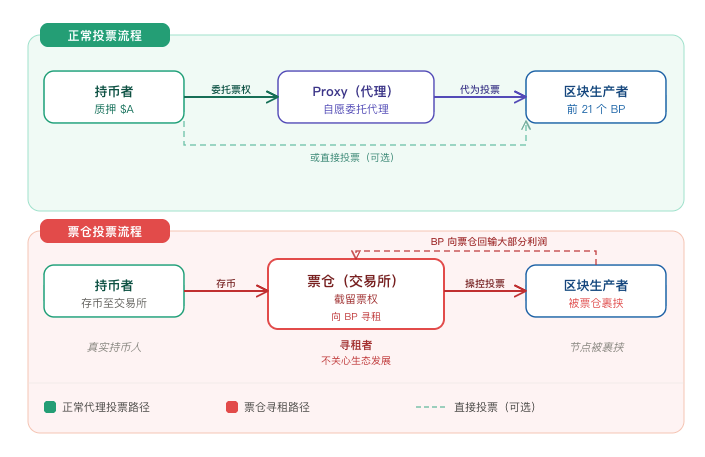
To understand this issue, one must first understand DPoS's proxy voting mechanism. Under Vaulta's DPoS system, token holders can participate in governance in two ways: first, by directly voting for BPs they endorse; second, through the Proxy mechanism, delegating their voting power to a third-party proxy, which exercises the votes collectively. The design intent of proxy voting was to lower the participation barrier for ordinary token holders—after all, not everyone has the time and energy to continuously track BP performance.
However, in practice, this mechanism gave rise to "vote pools"—third-party entities or individuals specializing in aggregating large amounts of proxy voting power to extract profit-sharing from BPs. Vote pools are not ordinary token holders but governance rent-seekers: they do not care about the chain's technological development or the ecosystem's long-term health, only about stable returns from their voting power. For BPs to retain a top-21 position, they must pay a portion of their block rewards to vote pools in return. Consequently, the primary service target of nodes shifted from the token-holding community to vote pools, leaving ordinary token holders completely voiceless in governance.
On-Chain Voting, Off-Chain Decision-Making
A deeper issue lies in a fundamental disconnect in EOS's governance from the very beginning—on-chain voting mechanisms exist, but real decision-making flows off-chain.
Major decisions are formed through consensus in Telegram groups, private meetings, and informal channels, then finalized procedurally through on-chain votes. Ordinary token holders only see the results, not the process—who exerted influence, how interests were exchanged, and the basis for decisions are difficult to trace. On-chain records show the votes; off-chain is where governance truly happens. The disconnect between the two creates an unignorable chasm between so-called "decentralized governance" and its true vision.
This chasm was filled during the boom period by soaring token prices and a bustling ecosystem. But it never truly disappeared. And when the prosperity receded, what was revealed was a complete mess.
The practice of DPoS on EOS shows that on-chain governance mechanisms can operate in reality, but under a voting system based on token weight, issues like power concentration and interest alliances easily arise. This experience, combined with other factors, influenced the design orientation of subsequent public chains, leading newer-generation projects like Solana, Aptos, and Sui to prefer consensus structures combining PoS with Byzantine Fault Tolerance, strengthening security and determinism at the consensus layer while correspondingly reducing reliance on on-chain voting governance mechanisms.
These reflections are valuable for the entire industry, but for EOS, the problem never remained theoretical—it walked step by step to today's crossroads on its own mainnet, with real communities, real assets, and real governance博弈.
After EOS was rebranded as Vaulta, the historical governance challenges did not automatically dissolve with a brand refresh. To understand why we propose this solution today, we must first confront Vaulta's current real situation.
Power imbalance is never a new problem. History has proven that the solution does not lie in overthrowing elite governance but in establishing truly effective checks and balances for it. This is the starting point for our proposed solution below.
Democracy First: Reshaping a New Governance Order for the Vaulta DPoS Network
We observed that during the turbulent period of the foundation transition*, a group of community members who genuinely still care about the Vaulta ecosystem's development spontaneously formed the community governance organization ECF (EOS Community Foundation). Most of its members have been with the network since the EOS era, representing the stance of token holders. Currently, they are attempting to consolidate the community's voice, seeking a path forward for the ecosystem's future during this vacuum period without a central coordinator. After careful consideration and thorough observation of the ECF organization, Vaulta Labs and the Treasury have decided to incorporate it into the network governance as part of optimizing DPoS governance—accepting supervision and returning power to the community.
About the Treasury
First, the positioning of the Treasury needs to be clarified. The Treasury is a public asset reserve independent of BPs, Vaulta Labs, and the former Vaulta Foundation. Its core responsibility is to continuously create long-term value for the ecosystem while ensuring asset security. During the foundation era, the Treasury's main role was to support strategic network development, ensure the network's normal operation even under adverse conditions, and generate returns through active investment operations, using profits for continuous $A buybacks.
Currently, the Treasury's stance is: while prudently managing assets, actively transforming them into practical driving forces for promoting ecosystem governance and sustainable development, rather than letting the money sit idle.
Step One: On-Chain Staking, Enabling Assets to Continuously Generate Value
The Treasury will first address the issue of network development funding, swiftly shifting focus away from the quagmire of the "dividing the spoils" battle. The assets currently held by the Treasury mainly originate from the RAM Ecosystem Fund specifically established in the 2024 EOS new tokenomics plan and additional tokens acquired through market-making buybacks. The total scale currently exceeds 350 million $A. A portion is allocated to the $V (RAM) market as planned in the whitepaper, another portion serves as funds for market-making, custody, marketing, and exchange listings, with the remainder held and managed by the Treasury.
Currently, the Treasury plans to lock and deploy 220 million $A of this into REX. Locking means selling tokens becomes an open move; therefore, this lock-up can also be seen as the entire ecosystem's confidence in $A.
REX (Resource Exchange) is the on-chain staking system on the Vaulta mainnet—token holders deposit $A into REX to receive continuous on-chain staking rewards, with a minimum lock-up period of 21 days. Rewards come from the network's pre-allocated staking reward pool.
Depositing 220 million $A into REX is the first step in securing development funds for the network without touching existing cash flow reserves.
Step Two: Introducing Democratic Oversight Mechanisms, Returning Power to the Community
The Treasury does not participate in network governance. We aim to rebuild the effectiveness of the DPoS governance mechanism by introducing the community governance organization ECF to oversee existing BPs.
The initial 7-member interim committee of ECF comes from Chinese, English, and Korean communities, completely independent of other network management organizations, solely representing the community's voice. Members rotate every 6 months, with a maximum consecutive term of 12 months, to prevent power consolidation. Formal committee elections will commence six months after the Treasury's vote pool is activated. Community members holding at least 10,000 $A can participate. Leaders of interested organizations cannot participate in ECF committee elections. Specific details will be gradually disclosed by ECF over the next two weeks.
ECF, representing the broad base of token users, will evaluate BPs and allocate voting power through the Proxy mechanism—the on-chain voting power generated after the Treasury deposits into REX will be delegated to ECF, making it one of the largest single voting proxies in the Vaulta network by voting power. ECF will, through its independent communication channels, publish transparent BP scoring criteria, allocating votes with different weights based on node rankings. Higher scores result in more votes, directly linking voting power to real contributions. This move will fundamentally solve the dilemma of nodes being held hostage by vote pools: on one hand, nodes are relieved from the cost pressure of sharing profits with vote pools, increasing their收益; on the other hand, nodes also need to actively participate in network governance to obtain higher votes. Simultaneously, the community gains more say in network development through BP evaluation. Incorporating centralized power into decentralized management while simultaneously decentralizing power is a more reality-based exploration of the DPoS governance mechanism.
Step Three: Network Incentives, Returns Flowing Back to the Ecosystem
Based on current yield estimates, the funds deposited by the Treasury into REX are expected to generate approximately 20 million $A in annual on-chain收益. These收益 will be entirely used to incentivize BPs actively participating in governance and other ecosystem projects contributing to the network, aiming to become a positive incentive driving the ecosystem's sustainable development.
In the allocation of these funds, an oversight mechanism is also introduced: ECF has the right to review every on-chain funding application within the network and holds veto power over the Treasury's expenditure resolutions.
A clear boundary of power is formed among the three: the Treasury manages assets without participating in governance; ECF represents the community in exercising oversight and veto power; BPs are responsible for network maintenance and governance, with any resolution requiring 15/21 majority support—no single party can unilaterally override the others.
Of course, whether this mechanism can truly be effective ultimately depends on the community's sustained participation and the support of the BPs. In this regard, the community has already proposed a clear three-phase roadmap for governance reconstruction: Phase One: Break the利益 chain of BPs buying and exchanging votes, purify the governance environment while alleviating BP收益困境. Phase Two: Activate BP contribution incentive mechanisms, allowing real contributions to receive corresponding回报. Phase Three: Gradually reduce nodes' dependence on the ECF vote pool, promoting the return of voting power to decentralization. We encourage BPs to gradually establish close communication with ECF to restore the network to a healthy state as soon as possible.
Conclusion: Mechanism is Trust
To trust a person requires judging their character. To trust a mechanism only requires verifying its rules.
Every link of this solution—the Treasury's on-chain staking, ECF's voting power delegation, BP scoring criteria, incentive distribution rules, veto power触发 conditions—can be verified on-chain, supervised by the community, and held publicly accountable. It does not rely on anyone's moral consciousness or any organization's unilateral承诺.
This is Vaulta's historic, earth-shattering endeavor, the foundation for rebuilding market trust, and our responsibility to everyone who remains here.


