






Those Unable to Buy Anthropic Have Driven Its Shadow Stock to a 16x Premium


- Core View: The VCX fund, listed on the NYSE, has achieved a super-high premium due to its holdings in unlisted star AI companies like Anthropic. This reflects the investment anxiety and FOMO sentiment among ordinary investors towards scarce AI assets. However, this premium is built on short-term scarcity caused by share lock-ups and faces significant risks from the end of the lock-up period and the potential future IPOs of the underlying companies.
- Key Elements:
- The core assets of the VCX fund are unlisted Anthropic (21%) and OpenAI (10%). After listing, its share price soared from $19 to $315 within four days, representing a premium of up to 16 times.
- The primary reason for the high premium is the fund's closed-end structure, with the majority of shares held by over 100,000 investors locked until September. This results in an extremely small float and a severe supply-demand imbalance.
- Current tech giants (e.g., Anthropic, OpenAI, SpaceX) are generally delaying or even avoiding IPOs, making it difficult for ordinary investors to directly participate in their growth. This has fueled demand for such "shadow stocks."
- The market is not chasing all private companies. VCX's frenzied performance highlights that capital is highly concentrated on top-tier AI targets like Anthropic, while other funds with different holdings have shown lackluster performance.
- VCX's high premium has an "expiration date," facing supply shocks from the September lock-up expiration and the ultimate risk of companies like Anthropic potentially going public in 2026-2027.
Original Author: David, TechFlow
Last Thursday, a new stock with the ticker VCX began trading on the NYSE.
It is actually a fund. The fund holds shares in companies like Anthropic, OpenAI, and SpaceX. Anthropic accounts for 21% of the holdings, while OpenAI makes up 10%.
These companies share a common trait: they are all private, and ordinary people cannot buy their stock.
VCX is currently one of the very few vehicles available that allows ordinary investors to indirectly hold shares in Anthropic.
Its net asset value (NAV) is $19 per share. On its first trading day, it opened at $42, surged to $125 intraday, and closed at $76. By the fourth trading day, it hit an intraday high of $315, triggering volatility halts twice.
Four days, from $19 to $315.
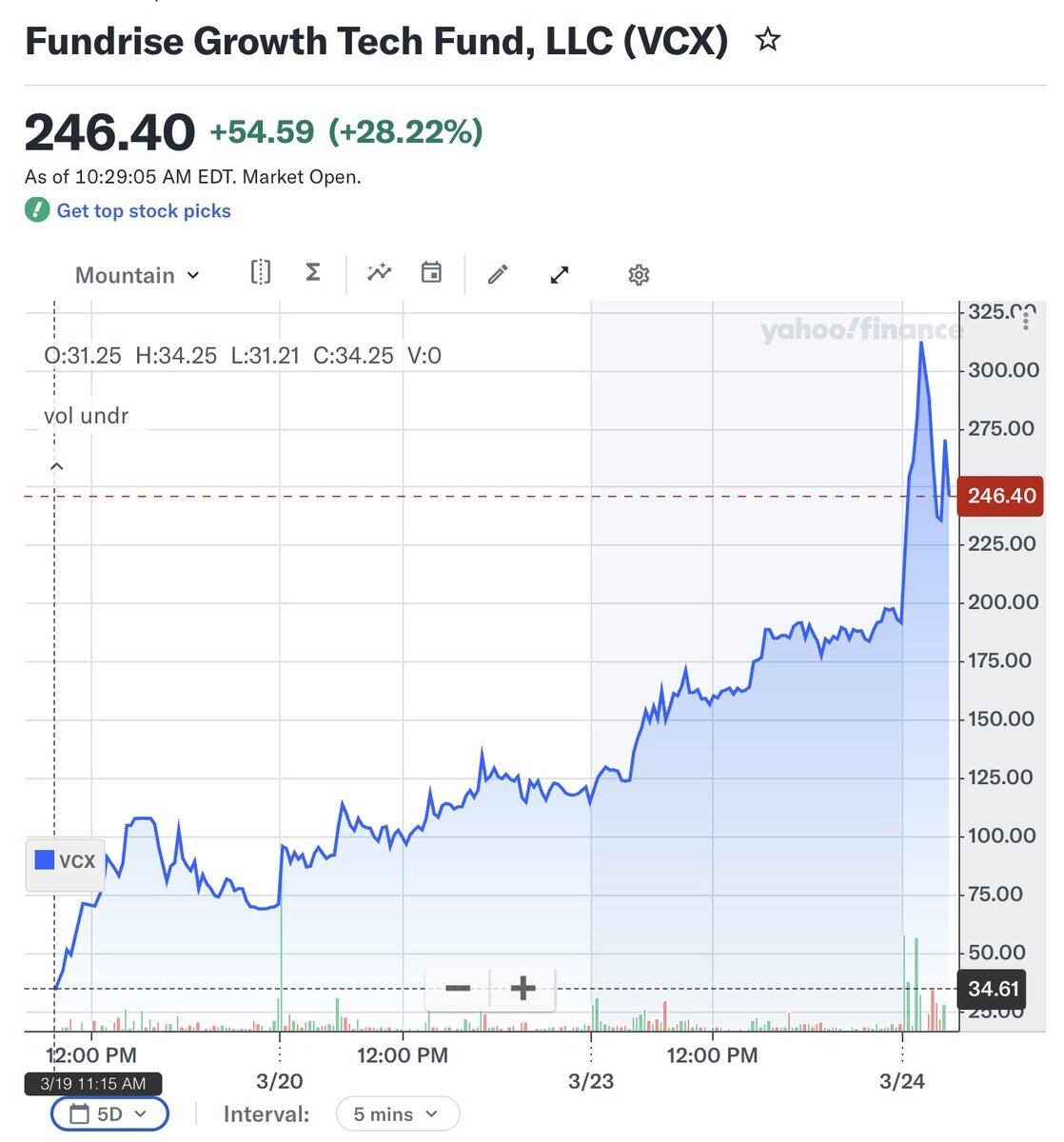
Investors are essentially scrambling to buy this fund at 16 times the value of its underlying assets. This isn't because the fund manager is exceptionally skilled; it's because it contains Anthropic.
Just a month ago, Anthropic raised $30 billion at a valuation of $380 billion, marking the world's second-largest financing round this year. Its annualized revenue is $14 billion. Yet, it remains private, has no stock ticker, and you won't find it in any brokerage's search bar.
If you can't buy the real thing, you chase its shadow. Currently, VCX is the shadow of Anthropic, or rather, the shadow of AI FOMO.
Why Is It So Expensive?
VCX is not a traditional fund.
With a regular fund, if you think it's expensive, you can wait for it to drop because the fund manager can issue more shares; the supply is elastic. VCX is a closed-end fund. The number of shares was fixed at its listing and will not increase.
More critically, the vast majority of shares cannot be sold at all. Investors who bought before February 20th have their shares locked up for six months and cannot trade until September. VCX has over 100,000 investors, but only a tiny fraction of shares are currently available for trading in the market.
What does this mean? Many people want to buy, but very few shares are available to buy. A small amount of buying pressure can twist the price out of shape.
So, that 16x premium is essentially pricing in "how many people want a piece of Anthropic and how narrow the door is." However, this frenzy wasn't created by VCX itself.
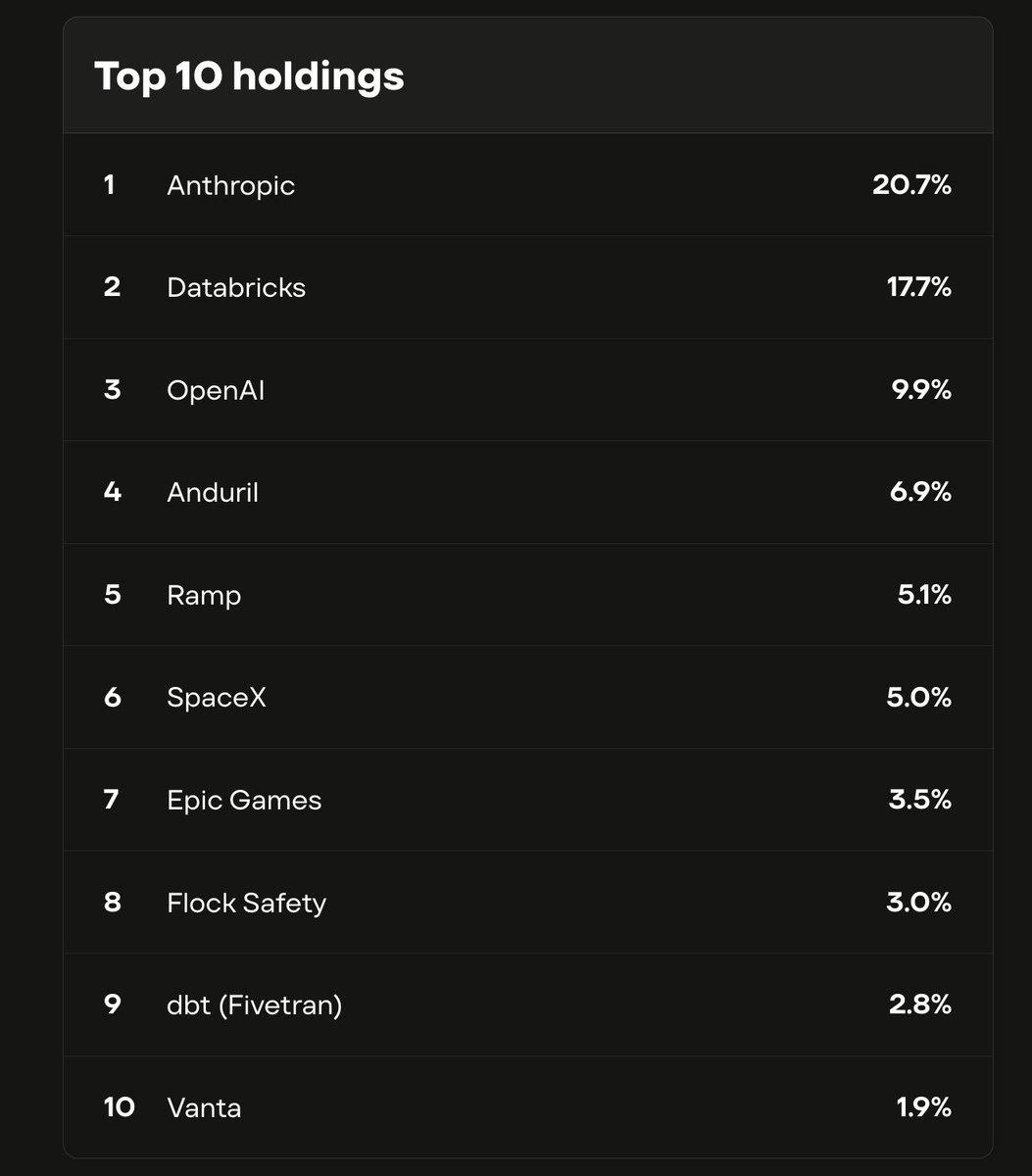
Chart: Top 10 Holdings of Fundrise's VCX Fund
Over the past decade, a structural shift has occurred in the tech industry: the best companies are going public later and later, or not at all.
When Facebook went public in 2012, its valuation was $104 billion, which was astronomical at the time. Today, Anthropic's private valuation is over three times that of Facebook's IPO, yet it previously had no clear plans to go public.
OpenAI is valued at $500 billion and is also not public. Rumors about SpaceX preparing for an IPO have circulated for over a year, with no confirmed date yet.
A decade ago, a company of this scale would have long since rung the bell on the NYSE. Now, they don't need to. The private market can provide almost unlimited capital without the pressure of quarterly reports or dealing with retail investors and short-sellers.
For founders, this is a rational choice. For ordinary investors, it means you can only watch from behind glass as some of the fastest-growing companies in history operate.
VCX was originally scheduled to list on March 9th but was delayed by ten days due to the war in Iran. In those ten days, nothing changed—Anthropic's valuation didn't rise or fall, and the fund's holdings remained exactly the same. But the delay itself brewed an extra ten days of anticipation.
When it finally listed, all the pent-up demand from those ten days squeezed through an extremely narrow channel.
Not All Shadows Are Valuable
There are more ways than just the VCX fund to gain exposure to shares of private companies.
But before discussing those avenues, there's a more fundamental question: Since Anthropic is private, how did a publicly traded fund acquire its shares?
The answer is through the back door.
Large private companies conduct funding rounds every few months, from Series A to Series G, each allowing new investors in. Anthropic just closed a $30 billion Series G last month, with a long list of participating institutions from GIC to Sequoia to Goldman Sachs. These rounds are typically only open to institutional investors, with minimum investment thresholds often starting in the tens of millions of dollars.
But there's a second path.
A company being private doesn't mean its shares can't be traded privately. Early employees and angel investors hold shares, and some want to cash out early. This creates a secondary market for private companies—not public, not transparent, but where real trades happen.
Fundrise started buying through these two channels back in 2022, when valuations of private tech companies had just experienced a significant drop, making prices cheap. Over four years, they accumulated a portfolio including Anthropic, OpenAI, and SpaceX. Then they packaged it into VCX, listed it on the NYSE, and now ordinary people can buy it like a stock.
In the same month, at least three other similar funds were trading on the NYSE, all selling the same concept:
Selling you, through the front door, what was bought through the back door.
Robinhood created a fund called RVI, which listed on March 6th with an offering price of $25. Its holdings include Databricks, Revolut, and Ramp—all solid private companies. It fell 11% on its first day, closing at $21.
Destiny Tech100, ticker DXYZ, listed back in 2024, a pioneer in this space. It is heavily weighted towards SpaceX, which makes up about 16% of its holdings. It only added a small indirect exposure to Anthropic in February of this year. Its stock price is currently hovering around $24.
Then there's XOVR, the first ETF approved to directly hold shares of private companies, with SpaceX comprising about 21%.
Four funds, similar structures, similar concepts, all trading on the same exchange. Yet their fates are completely different.
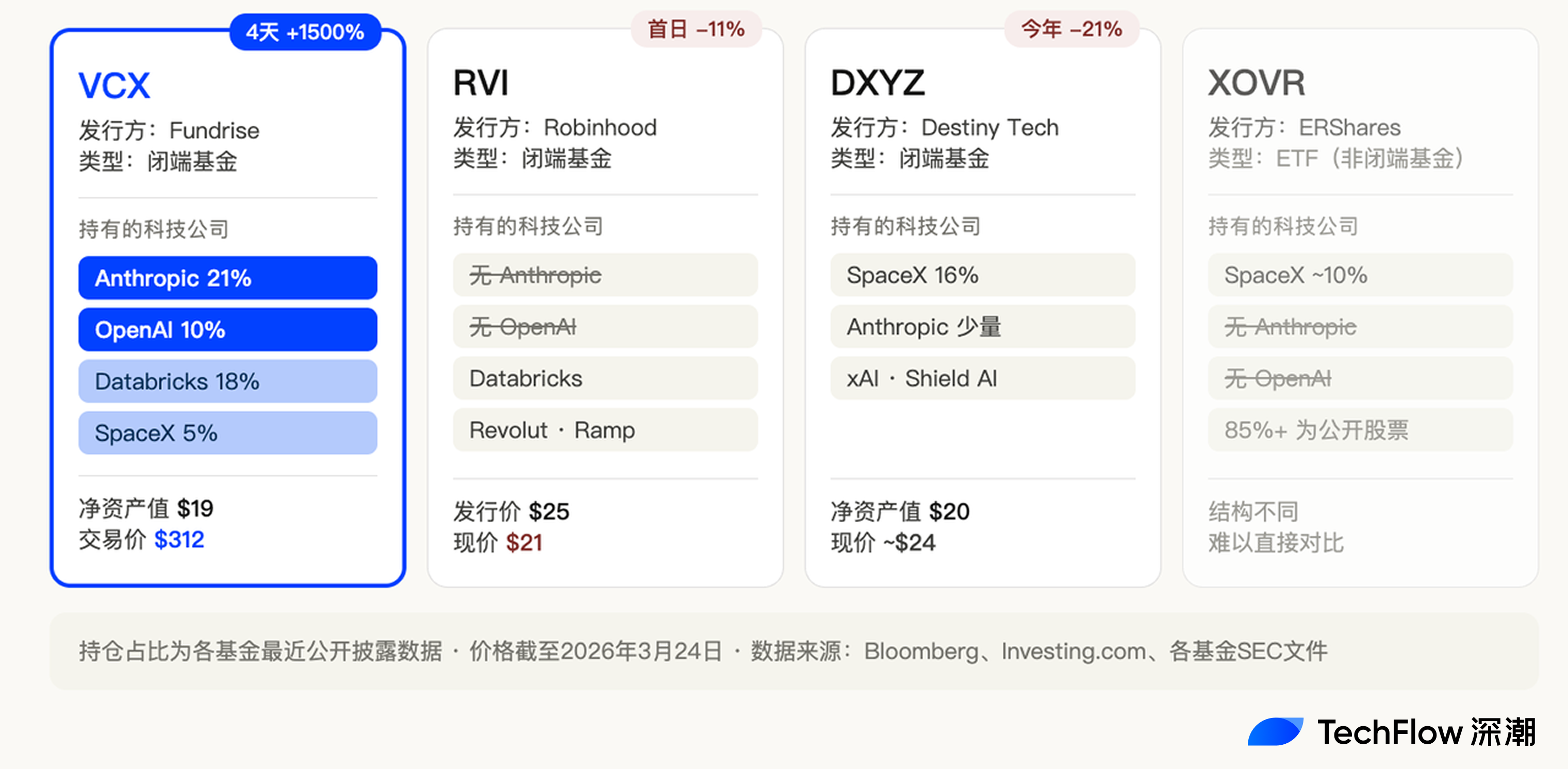
VCX surged 1500% in four days. RVI broke its IPO price on the first day. DXYZ is lukewarm.
VCX holds 21% Anthropic and 10% OpenAI. RVI's holdings include neither Anthropic nor OpenAI. DXYZ's exposure to Anthropic was added recently and is very small.
This indicates that, at least for now, the market isn't chasing "shares of private companies." The market is chasing Anthropic.
Whoever is closest to them is valuable.
This is where Robinhood's RVI lost out. Databricks and Revolut are certainly good companies, but right now, they are not the names people are willing to pay a 16x premium for.
Shadows Also Have an Expiration Date
What are those who bought VCX at $312 betting on?
They are betting that before the door opens, someone else will be willing to pay an even higher price for the inability to get direct Anthropic exposure.
However, this door won't stay closed forever.
VCX has over 100,000 investors, and the vast majority of their shares are locked up for six months. The lock-up period ends on September 19th. At that time, a large number of shares will flood the market, and supply will shift overnight from extreme scarcity to abundance.
The reason VCX can sell at a 16x premium is partly because it contains Anthropic, and partly perhaps because the number of shares available to sell is so small. Once the lock-up period ends, the second condition disappears.
There's an even bigger variable.
Anthropic, OpenAI, and SpaceX are all rumored to be targeting IPOs in the second half of 2026 to 2027. Anthropic just raised $30 billion last month at a $380 billion valuation and has already hired Silicon Valley law firm Wilson Sonsini to prepare for its public listing. SpaceX's CFO has been communicating with investors about IPO plans since late last year, targeting mid-year.
Once the real thing goes public, the shadow becomes worthless.
If you can directly type Anthropic's stock ticker into your brokerage search bar, why would you pay a 16x premium for a fund that indirectly holds it?
For example, when DXYZ first listed in 2024, it also experienced a frenzy, but as SpaceX's IPO kept getting delayed, the hype faded, and its stock price fell by more than half from its highs.
Therefore, VCX investors are experiencing a classic countdown.
What they bought for 16 times the price is not shares in Anthropic, but a ticket with an expiration date. When the door opens depends on when Anthropic decides to go public.
Before that, the premium is sustained by scarcity; after that, the premium goes to zero.
But the phenomenon of shadow stocks itself is not accidental.
Every wave of technological innovation creates the same anxiety: you can't buy the most important companies. In the 2000s, it was before Google's IPO, with Goldman Sachs employees fiercely competing for internal allocations. In 2020, it was SpaceX, where secondary market intermediaries in Silicon Valley suddenly became the most sought-after connections.
Now it's AI's turn.
And this time, the anxiety runs deeper. Anthropic and OpenAI may not be profitable now, but they are rewriting the rules. Because of AI's impact, SaaS stocks have crashed, cybersecurity stocks have crashed, and IBM lost $31 billion in a single day.
Investors aren't just seeing "this company is very profitable," but rather, "if I'm not on its side, I might be on the side it runs over."
The 16x premium on VCX isn't just pricing a fund; it's pricing this anxiety itself.
Tickets will expire, premiums will fade. But as long as AI keeps accelerating, as long as the most valuable companies keep their doors closed, there will be people willing to pay irrational prices for the shadow.
Not because the shadow is worth that much, but because the feeling of being locked out is too expensive.


