Won or Lost the War? Trump: Made Money


- Core Viewpoint: The article analyzes that former U.S. President Donald Trump has deliberately and repeatedly manipulated financial markets by making statements affecting geopolitical situations. His aim is not only potential economic gain but also leveraging the political dividends from market rallies to consolidate his political capital and evade legal risks.
- Key Elements:
- On March 23, Trump posted on Truth Social claiming progress in U.S.-Iran dialogue and a delay in military action, causing sharp volatility in gold, U.S. stock futures, and a plunge of over 14% in Brent crude oil prices.
- Market monitoring showed that around the time of his post, a large buy order of $1.5 billion in S&P 500 futures and a sell-off of $580 million in crude oil futures appeared, suspected of insider trading, though it's difficult to directly trace it back to Trump himself.
- The article cites last year's tariff disputes, where Trump successfully created two rounds of market volatility by first releasing "false information" and then officially announcing policies, employing a similar tactic.
- Trump uses stock market performance as his personal report card on governance. Market prosperity pleases voters and wins political support from backers, capitalists, and business owners. The crypto industry was once a successful case for him.
- His market manipulation actions are difficult to hold legally accountable, partly because he may not directly obtain economic benefits but pursues political power, thus exploiting legal loopholes.
Original | Odaily (@OdailyChina)
Author|Golem (@web3_golem)
Whether Trump is a competent president is debatable, but he is undoubtedly an excellent financial market manipulator.
On March 23, Trump once again began his antics regarding the US-Iran conflict. At 19:05 Beijing time, he posted on Truth Social, stating that the US and Iran had held productive talks over the past two days and that all military strikes targeting Iranian power plants and energy infrastructure had been postponed for five days.
As soon as these words were uttered, gold, which had fallen sharply in recent days due to inflation concerns and rising global interest rate hike expectations, rebounded instantly. According to Gate data, after Trump's post, gold, which had been falling all day, rebounded by over $200. S&P 500 index futures also rose nearly 4% in response. Meanwhile, Brent crude oil fell from a high of $113 per barrel to a low of $97, a drop exceeding 14%.
However, within an hour, Iranian media jumped out to "debunk" the claim, stating that there had been no direct or indirect contact between the US and Iran. Iran's Tasnim News Agency even quoted a senior Iranian security official saying Trump's related remarks were "psychological warfare."
Faced with this rebuttal, Trump tried to brush it off with a simple "I don't know what the Iranian media is talking about." To onlookers, this was just another instance of T.A.C.O. (Trump Always Chickens Out). But for traders, it was a mixed bag. Because this series of events caused market fluctuations exceeding a trillion dollars within hours.
According to The Kobeissi Letter, 15 minutes before Trump's post, a mysterious large buy order for S&P 500 futures with a notional value of $1.5 billion appeared in the market. The order was so large that it directly lifted the S&P index by about 0.3% in one minute. Fifteen minutes later, the trader/institution that opened this $1.5 billion position pocketed $60 million.
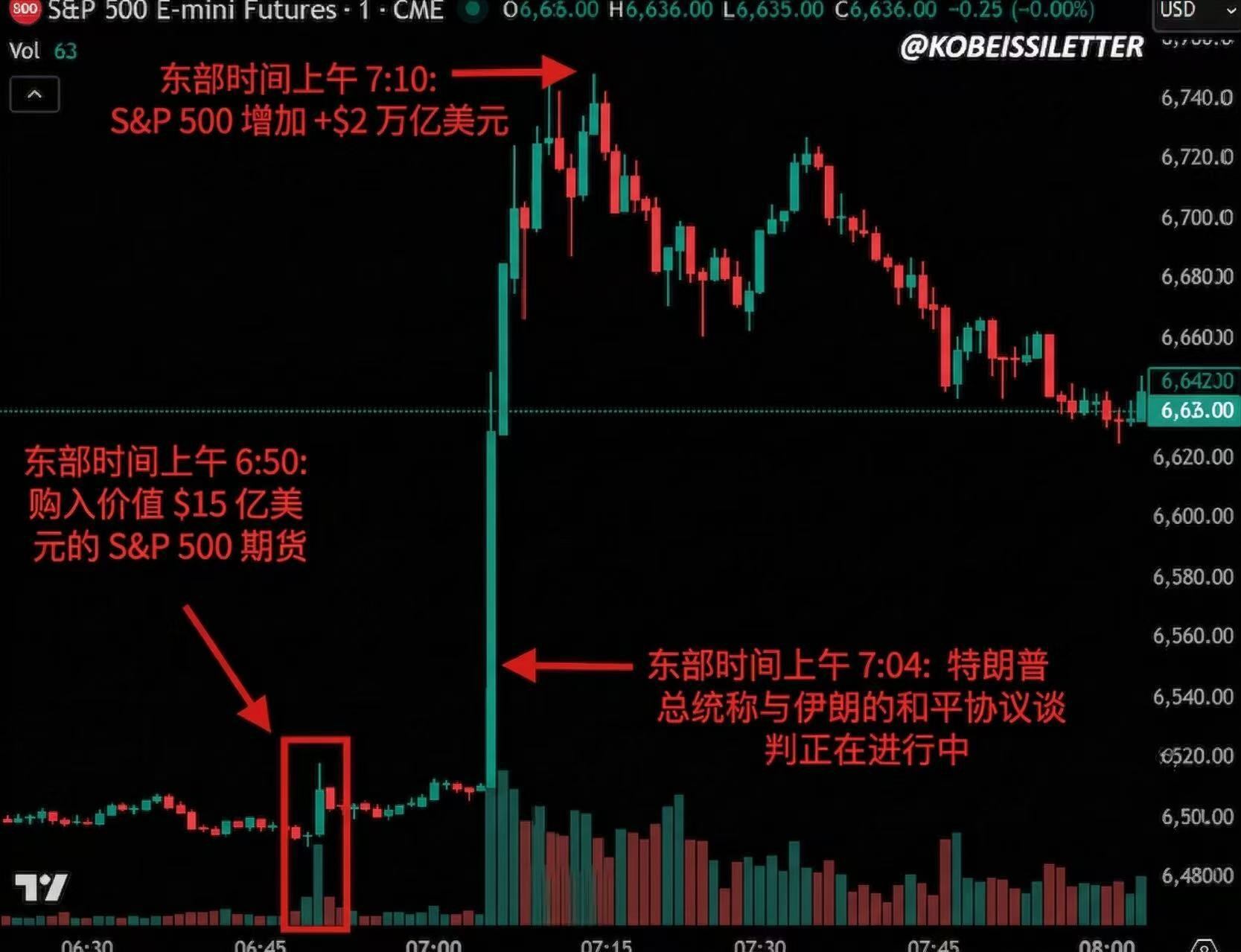
Besides the one who reaped full profits, there were also traders who perfectly timed the market top. According to the Financial Times, also 15 minutes before Trump's post, approximately 6,200 Brent crude and West Texas Intermediate crude oil futures contracts were sold, with a notional value of $580 million.
Placing large buy or sell orders just before major market news is announced—this looks less like news trading and more like classic insider trading. But whether the source can be traced to Trump is hard to say. After all, it's not the first time Trump has done something like this. Iranian scholar Seyed Mohammad Marandi posted on X, "Every week when the market opens, Trump makes such statements to suppress oil prices. Even the five-day deadline he set coincides precisely with the energy market's closure."
This means those seemingly insider trades could also be top-tier traders who have figured out Trump's playbook. It wouldn't be surprising if Wall Street truly studied Trump himself as a standalone market trading indicator, because his method of influencing markets isn't new, and it's remarkably effective every time.
The tariff turmoil last year was the most classic example. On April 7, 2025, US stocks were reeling from Trump's reciprocal tariff policies when news suddenly emerged that the White House was preparing to suspend tariffs for 90 days for most countries except China. Upon the news, the Dow Jones surged by about 800 points. But soon after, the White House出面辟谣, calling it "fake news," and the Dow ultimately closed down 629 points that day.
Few suspected at the time whether this rumor was spread by Trump-related interests, but the answer soon appeared.
On April 9, Trump first promoted his own stock on Truth Social, stating verbatim, "THIS IS A GREAT TIME TO BUY!!! DJT." A few hours later, he announced a new tariff policy, essentially identical to the "fake news" from two days prior: suspending the 90-day "reciprocal tariffs" for countries not taking retaliatory measures, but raising tariffs on China to 125%. The market took off again, with all three major US stock indices rising, marking a significant single-day rebound not seen in days.
A mediocre manipulator can only use one piece of good news to create one wave of gains. Trump can use one piece of good news to create two.
Now, amplified by the war environment, every statement from leaders and official media of the conflicting parties inherently carries a price lever. A强硬表态 can send gold soaring on the spot; a缓和表态 can trigger an immediate rebound in risk assets,上演“言出法随” in financial markets.
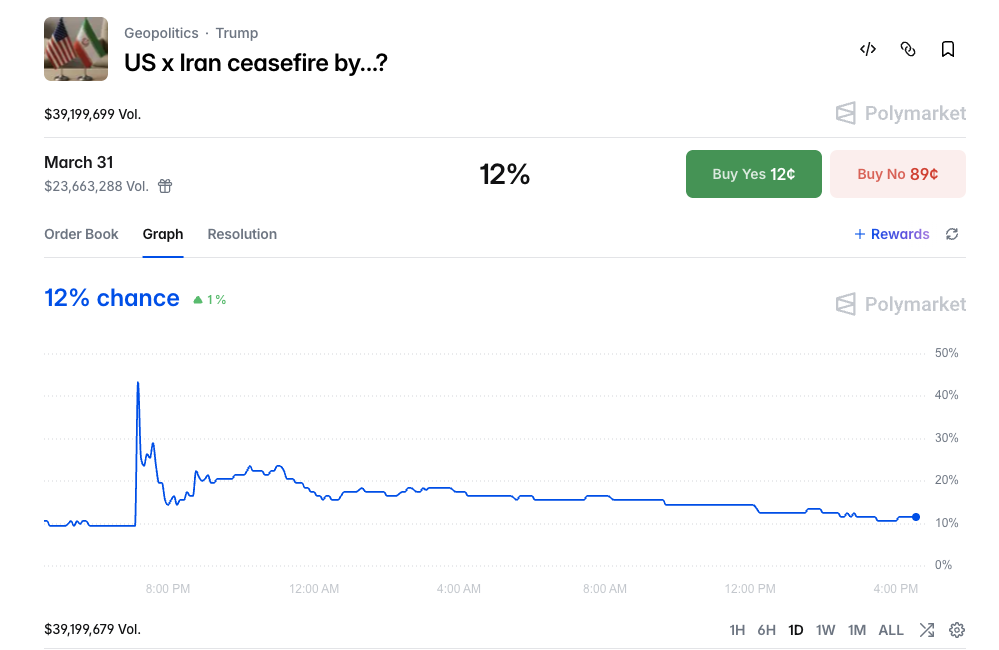
Faced with a master like Trump, even prediction markets, which claim to be ahead of the truth, can be spun in circles. According to monitoring by the Odaily Seer Channel, after Trump posted about the good progress in US-Iran talks, the probability of the "US and Iran will cease fire before March 31" event on Polymarket quickly rose to 54%. After it was revealed as a farce, the probability rapidly dropped back to 16% and has now fallen to 12%.
Does Trump intentionally manipulate markets? The answer is certainly yes. But is it just for money? If you think so, you're overlooking another, more cost-effective business—the political红利 behind rising stock markets. As a businessman by origin, Trump understands this economic calculus better than anyone.
During the 2024 presidential campaign, Trump promised that if he won the election, he would usher in a new era of Trump economic prosperity. But economic construction takes time, and economic prosperity is itself a subjective concept for ordinary people—having money to spend is prosperity, not having money is not. Therefore, Trump urgently needed an immediate indicator to prove to voters that he was delivering results. Thus, stock market prosperity became the best "substitute" for economic prosperity.
During his first term, Trump repeatedly touted new highs in the Dow and S&P, almost treating the stock market as his personal governance scorecard. But every time Trump influences the market with his rhetoric, he aims to please not just retail investors but also the capital and business owners behind them, as they are often either already or will eventually become Trump's political donors.
This script has already played out in the crypto领域. Trump was previously called America's first "Crypto President" because during the 2024 US election year and early in his 2025 presidency, he frequently extended olive branches to the crypto industry—participating in crypto conferences, making various crypto promises, enacting crypto-friendly regulations, etc.—each time bringing upward momentum to the crypto market. In return, the crypto industry gave Trump support from tens of millions of American voters and hundreds of millions of dollars in political donations from crypto firms.
Manipulating markets without the primary goal of making money also allows Trump to exploit legal loopholes. Countless US lawmakers and regulators have previously accused Trump of profiting by manipulating crypto markets, but these accusations ultimately went nowhere because there is no direct evidence showing Trump derived economic benefit from the markets.
After the March 23 farce, some also accused Trump of涉嫌内幕交易. White House spokesperson Kush Desai stated that the White House does not tolerate any officials using insider information for illegal profit—provided there is evidence. But the "profit" referred to here mostly means economic gain. Trump? He has long extracted himself from the family business, retreated behind the scenes, and operates within the gaps of the law,施展错综复杂的政治和商业手段.
This is Trump's true "brilliance." He knows that in this world, power trumps money; but he also understands exactly how money, in turn, influences the power structure.