






Free Mirroring or Land Grabbing? OpenClaw Founder Slams Tencent for Copying


- Core Argument: Domestic tech giants like Tencent launching OpenClaw "one-click installation" and localization platforms (e.g., SkillHub) ostensibly address access and user experience issues. In essence, however, they are competing for the gateway, traffic, and platform control of the next-generation AI Agent ecosystem. This risks gradually pulling the originally open, individually-controlled OpenClaw ecosystem into the closed commercial systems of these major corporations.
- Key Elements:
- OpenClaw's founder publicly questioned Tencent's SkillHub for copying without prior communication. The core dispute is not about technical mirroring, but about how the actions of large companies affect official statistics and touch upon the issue of ecosystem dominance.
- Tencent responded that SkillHub is a localization platform, has credited the source, and handles significant traffic to alleviate pressure on the origin server. However, this has not quelled concerns about "unilateral action" and "ecosystem control."
- Domestic tech giants (led by Tencent) are collectively deploying OpenClaw-related products. The underlying commercial logic is to capture AI Agent as a potential new traffic gateway and operating system-level platform.
- The typical path for these giants is: first attract users and developers with free, convenient services to build platform scale; then gradually gain control over distribution, review, and commercialization to construct ecosystem walls.
- This controversy reveals that the open, personalized AI future represented by OpenClaw may face the risk of being repackaged under the guise of "localization adaptation" and integrated into the commercial closed loops of these major corporations.
Original | Odaily (@OdailyChina)
Author|Golem (@web 3_golem)
As major domestic tech giants rush to launch "one-click install OpenClaw" features, controversy has followed.
On March 12, OpenClaw founder Peter Steinberger publicly questioned on X the SkillHub created by Tencent, alleging it caused a slowdown in official rates preventing rapid data scraping, and stated, "They copied it but don't support the project in any way."
Facing the controversy, Tencent quickly responded, expressing understanding of Peter Steinberger's concerns. They stated that SkillHub is a localized Skills platform built by Tencent based on the OpenClaw ecosystem. As a local mirror site, it not only consistently credits ClawHub as the data source but also handled 180GB of traffic (870,000 downloads) for users in its first week of launch, pulling only 1GB of non-concurrent requests from the official source. Tencent also expressed willingness to become a sponsor.
Logically, Tencent's response in this round clarified the issue most likely to trigger public backlash—"whether it was excessively consuming the source site's resources." However, Peter was not convinced after reading it. He indicated that this wasn't the main point; he could make SkillHub the official fifth mirror and synchronize download statistics, but Tencent should have proactively communicated with him beforehand.
While the matter ends here, if we only interpret this as "the OpenClaw founder emotionally lashed out" or "a major company was misunderstood while legitimately localizing," we would be oversimplifying the issue.
The Problem Isn't the Mirror, It's the "High-Handedness" of Big Tech
If we look only at the technical actions, this is actually not uncommon.
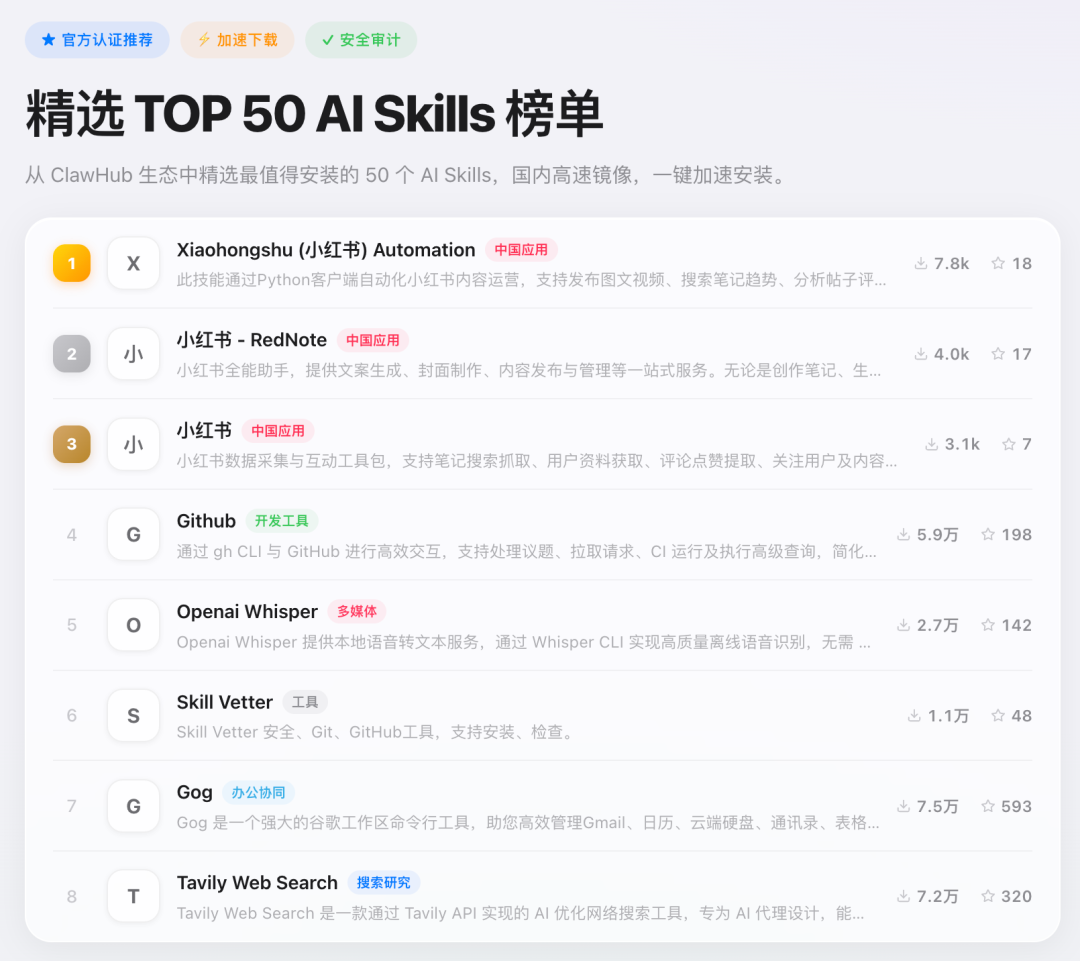
In China's developer ecosystem, mirroring open-source projects is a standard practice. International open-source infrastructures like npm, PyPI, and Docker Hub all have numerous Chinese local mirrors. Precisely because of this, Tencent denied that its created Skillhub was copying, calling it a localized Skills platform. It explained that it wasn't free-riding or draining the official site but was distributing, accelerating, and adapting to help OpenClaw land in China.
In a sense, Tencent's approach indeed addresses the most practical needs of Chinese "Lobster Farmers." OpenClaw's popularity in China is unreal, but not everyone is willing or able to stably access the original community, let alone the fact that the installation, discovery, and search experience for many Skills themselves is still quite primitive.
Skillhub
But the question is, are mirror sites inherently blameless? The answer is not necessarily.
Because what open-source licenses permit, what community ethics accept, and what commercial reality ultimately brings are often three different sets of accounts.
At the license level, as long as the terms are followed and the source is credited, many mirroring and redistribution actions are valid. At the community ethics level, Tencent's SkillHub credits OpenClaw's official source status and has proactively reduced bandwidth costs for the source site, seemingly taking responsibility.
But Tencent forgot that OpenClaw is not a small, resource-starved open-source project needing deliberate injection from big tech. It is the #1 hottest and most-starred project on GitHub. At this point, Tencent's action without prior communication becomes "high-handed." It's no longer just a simple mirroring issue; it quickly touches on three more sensitive questions: Who represents the official ecosystem? Who is taking the user entry point? And who is defining the download, distribution, and statistical metrics?
This is what truly made Peter uncomfortable. He stated that Tencent's actions would directly affect download statistics. Peter isn't against Tencent localizing OpenClaw for China; he believes it would have been best to communicate beforehand, rather than Tencent first building the platform, onboarding users, and then explaining under public pressure that it was actually there to help.
Furthermore, from a commercial reality perspective, once a platform shell like SkillHub gains scale, the official status and statistical authority originally held by the OpenClaw community can easily be marginalized. Today it's a localized Skills platform; tomorrow it could be the "default Skills distribution marketplace." Later, it could become "who decides which Skills are seen, installed, and commercialized."
This is the real danger signal behind this controversy and the most familiar scene in Chinese internet over the past decade: land grabs.
Big Tech Isn't "Raising Lobsters"; They're Using Lobsters to Stake Claims in AI
Over the past period, "raising lobsters" has become the hottest meme in China's AI circle, and OpenClaw has been rapidly pushed into an almost emotional industry symbol. Everyone says lobsters represent the new imagination of the Agent era, the future of personal AI assistants—it sounds very passionate.
But when big tech looks at lobsters, they never see idealism; they see entry points, traffic, distribution rights, and the shell of the next-generation operating system.
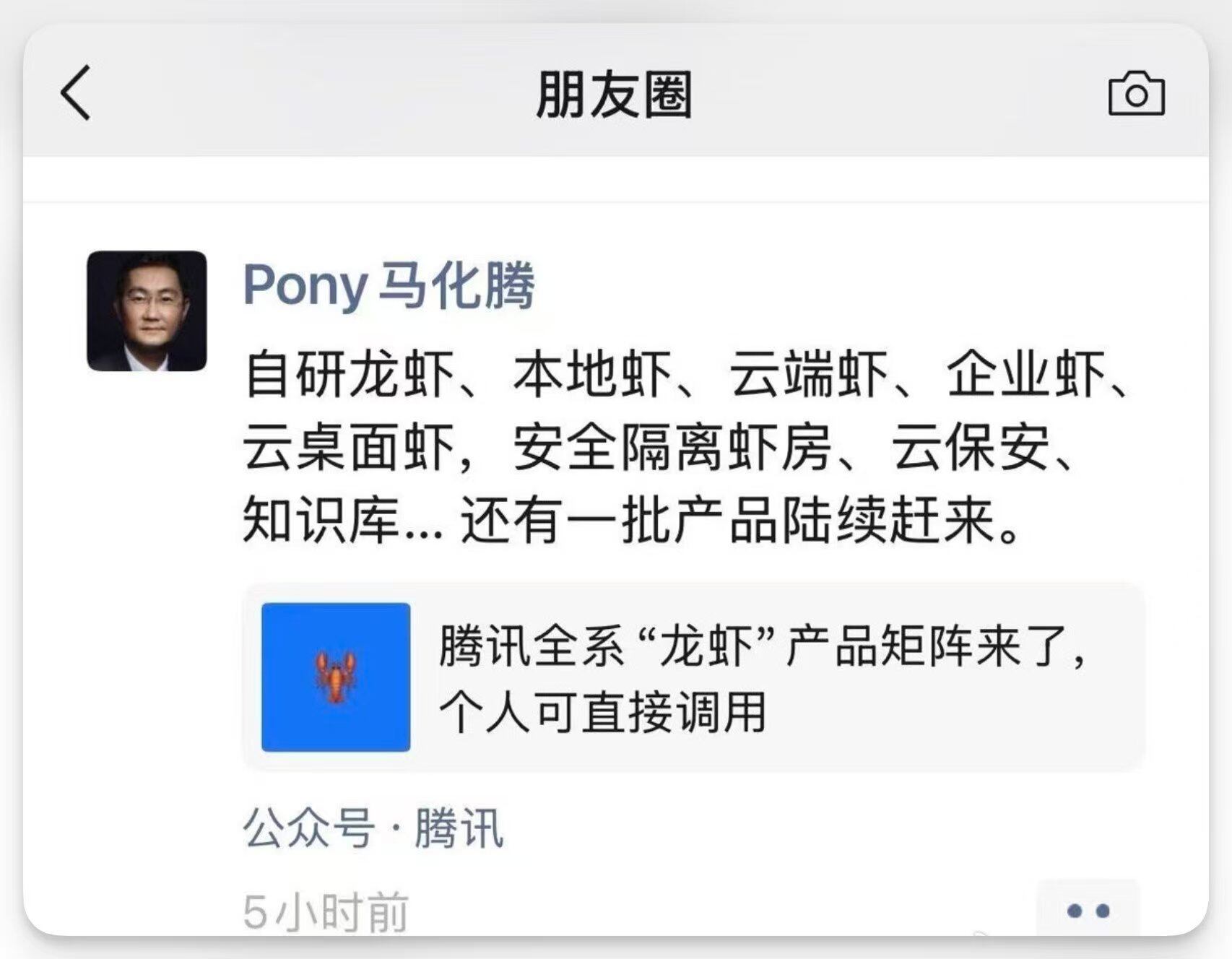
In the early hours of March 11, Pony Ma promoted Tencent's full suite of "Lobster" products on his WeChat Moments. Tencent's "Lobster Family Bucket" tailored a "little lobster" for ordinary users, developers, and enterprise users, supporting one-click installation with no barriers. SkillHub was launched simultaneously at this time, built-in with 13,000 localized Skills for one-click invocation, usable directly in scenarios like Xiaohongshu operations and Baidu searches.
Of course, Tencent isn't the only one "catching the wind." If we extend the timeline, we find that domestic tech giants have almost collectively stepped in to help users solve the "lobster-raising" difficulty, their movements so uniform it's like they pressed the same switch, though Tencent's approach is currently the most comprehensive.
On the surface, everyone has good intentions, but in reality, this hides the most familiar set of commercial path dependencies for Chinese internet companies. Faced with a new ecosystem already validated by the market and hyped by public opinion, the first move isn't profit or business models, but grabbing the entry point first, building the platform first, onboarding users first.
What Tencent wants isn't just to make it easier for Chinese users to "raise lobsters," but to ensure that when Chinese users truly start "using Agents to get things done," their first instinct is to do it within Tencent's product shell.
This is the most intriguing aspect of actions like SkillHub. On the surface, it's a mirror site; in essence, it could be the starting point of a larger closed loop. Today, users see local Skill search and download; tomorrow, it could be default access to a certain cloud, a certain account system, or a certain enterprise workbench. Later, developers will slowly realize that although they are still developing within the OpenClaw ecosystem, what truly decides exposure, recommendations, review, and commercialization paths has become the platform.
This script has been played out too many times in the Chinese internet. From ride-hailing to food delivery, from short-video platforms to cloud markets, almost every "ecosystem boom" has been accompanied by the same structural ending—platforms first attract users with free, open offers, then build walls, using traffic, advertising, and other means to turn the ecosystem back into their own subsidiary layer.
Big tech companies know that old entry points like search, social, content, and e-commerce are now fiercely competitive to the limit, while Agents might be the most promising new entry point for the next round. In that case, rather than waiting for OpenClaw to grow wildly on its own, it's better to take it over, package it, and get users accustomed to "commanding lobsters" within their own systems while it's still in its explosive early stage.
Therefore, everyone is all too familiar with what happens next after big tech companies compete to help users solve OpenClaw installation problems. And Peter, unfamiliar with the Chinese internet, naturally can't understand why Tencent didn't communicate with him beforehand or synchronize data with him.
OpenClaw originally represented another AI future: local operation, personal control, community extension, open connection. Its most imaginative aspect is making Agents truly the user's own execution layer. But once this ecosystem gets repackaged by big tech with "localized mirroring," "domestic adaptation," "unified distribution," and "security review," the flavor changes. In the product logic of big tech, the entry point belongs to me, distribution belongs to me, so ultimately payments and commercialization should also belong to me.
To put it more bluntly, big tech companies aren't "embracing lobsters"; they are "using lobsters to stake claims in the AI era's territory."
And this is the most unsettling aspect behind this small controversy. Walls are never erected all at once; they always grow slowly in the name of "more convenient" and "more stable." By the time developers, users, and traffic are all packed into the same shell, so-called openness and autonomy may ultimately just become a component within the big tech ecosystem.
OpenClaw currently faces the most paradoxical fate in China: The lobster hasn't even grown up yet, but big tech has already started setting up the nets.


