OpenClaw Gold Rush: The Shovel Sellers Never Worry


- Core Viewpoint: The explosive popularity of OpenClaw has spawned a complete industry chain. Its core is not the technology itself, but profiting by monetizing users' "collective anxiety" about the technology. From hardware and APIs to deployment services and skill packages, "shovel sellers" at every link are capitalizing on the information gap window to cash in.
- Key Elements:
- Hardware Industry Chain Responds Rapidly: Original crypto mining machine manufacturers (e.g., iPollo) and white-label factories quickly launched rebranded OpenClaw hardware, monetizing the complex barrier of local deployment, with prices reaching hundreds of dollars.
- API Relay Market is Highly Profitable and Chaotic: There exists a large number of gray-market services offering discounted APIs through credential theft, reverse engineering, or "bait-and-switch" tactics (using cheap models to impersonate GPT/Claude). Top relay stations can generate monthly profits exceeding one million dollars. Their deeper value lies in collecting high-quality user data for model training.
- Deployment & Customization Services Leverage Information Gaps: Service providers without technical backgrounds profit by offering out-of-the-box deployment, workflow customization, and exclusive Skills packages for SMEs. A single service fee in China can reach tens of thousands of RMB, while the US-based RoofClaw project has already generated over $1.8 million in total revenue.
- Profit Models Focus on Lowering Barriers: The most profitable OpenClaw-related projects are mostly "shovel-selling" services like one-click cloud hosting and pre-installed hardware, rather than directly developing AI applications. This validates the rule: "The higher the technical barrier, the greater the demand to pay for lowering it."
- Short Industry Cycle with Rapidly Dissipating Dividends: The information gap window is measured in "weeks." Early entrants (e.g., QuickClaw) quickly considered selling their projects and exiting after the traffic surge, reflecting the speculative and fast-iterating nature of this wave.
Original Author: 黑色小虾笼, Deep Tide TechFlow
OpenClaw has exploded in popularity across China. How many people around you are anxious, and how many are counting their money?
Some travel nationwide, flying to Shenzhen, Chengdu, and Hangzhou, specifically to configure this "lobster" for small business owners, charging tens of thousands per order.
Others directly install OpenClaw into Apple devices and ship them to clients, ready to use out of the box, accumulating $1.8 million in earnings.
Crypto mining machine manufacturers, once struggling, have now transformed, selling OpenClaw hardware.
Middlemen reselling Token APIs are quietly making fortunes, with monthly profits reaching millions.
This is the real cross-section of the OpenClaw wave: on the surface, millions are tinkering with deployment, buying hardware, and purchasing courses; behind the scenes, a complete industrial chain is monetizing this collective anxiety, layer by layer.
From selling hardware to cloud servers, from selling Tokens to Skills, the open-source code is free, but the anxiety is the real commodity.
Turning OpenClaw into Hardware
A photo circulating online has left many people amused and exasperated.

In the 1990s, qigong masters drew circles on people's aluminum pots, claiming to connect to cosmic energy; in 2026, people wear lobster hats in conference rooms receiving ideological baptism, as if not raising a "lobster" means falling behind the times.
After the laughter, it's worth focusing on the person speaking on stage. His name is Kong Jianping, a crypto OG and founder of iPollo.
The well-known KOL "Crypto Fearless" commented on social media: "In the crypto world, the one always standing at the hottest trend is definitely Boss Kong Jianping... never missing the big money, and meticulous with the small."
When Bitcoin mining was hot, he launched the mining machine company Nano Labs. When the metaverse was hot, he announced a gradual shift from mining to metaverse business, stating the metaverse would usher in a new era for humanity; when Hong Kong's policies became prominent, he expanded there, becoming a director at Hong Kong's Cyberport; when the DAT concept was hot, he started a DAT company...
This time, with OpenClaw's popularity, Kong Jianping is hosting offline events across various cities in China, declaring that humanity has entered the "Web 4.0" era led by AI Agents, while simultaneously launching the hardware iPollo Claw PC. The official description is "born for Open Claw applications," featuring an AMD 5600H processor, up to 64GB RAM, pre-installed with the native ClawOS system, priced at $439 on the official website.

Kong Jianping is not an isolated case; he is just the most visible name on this hardware industrial chain.
In Dongguan, a hardware manufacturer's salesperson's social media feed is filled with the lobster logo: OpenClaw Lobster Hardware Solution, supports OEM ODM, B2B and large commercial clients welcome to call.

A standard white-label factory. Anyone wanting to enter the market can make a call and get a rebranded "AI host optimized for OpenClaw."
Like this Dongguan company, many upstream players in this hardware chain are former factories that made crypto mining machines for Filecoin, etc. They are all too familiar with this script: concept explodes, hardware demand emerges, rebranding for premium, harvesting the window period.
The supply chain responsiveness honed during the mining machine era works just as well in a different field.
The core logic of this business is not mysterious at all: The Mac Mini is the most widely recommended local hardware for running OpenClaw, but for most ordinary users, a 3,000+ RMB Mac Mini plus a command-line configuration without a graphical interface is too high a barrier. Thus, demand arises. Someone comes to sell a "lowering the barrier" service, or simply sells a "ready-to-use" machine, monetizing this barrier.
The deeper the anxiety, the higher the premium.
Token Relay is a Big Business
OpenClaw itself is free, but running it requires continuously feeding it model Tokens.
Domestic large model companies like MINIMAX and KIMI have become some of the biggest beneficiaries, but there are still those who want to use overseas large models like Claude and ChatGPT to complete complex tasks.
The trouble is: registering accounts and making payments is difficult, and Claude frequently bans Chinese-speaking users. Official API prices are steep; a high-intensity OpenClaw user fully running Claude can easily exceed $800 per month.
This has spawned a massive Token relay market.
On the market, you can buy many "50% off or even 70% off Claude APIs," but their origin has always been a mystery.
On the surface, this industry is about making a price difference—acquiring low-cost APIs, reselling at a markup, and pocketing the middle profit—but the waters run much deeper.
At the bottom, some rely on stolen credit cards to batch-register OpenAI and Anthropic accounts. After obtaining accounts, the most common tactic is to reverse-engineer the web interfaces of ChatGPT and Claude, package them into standard APIs, and resell them.
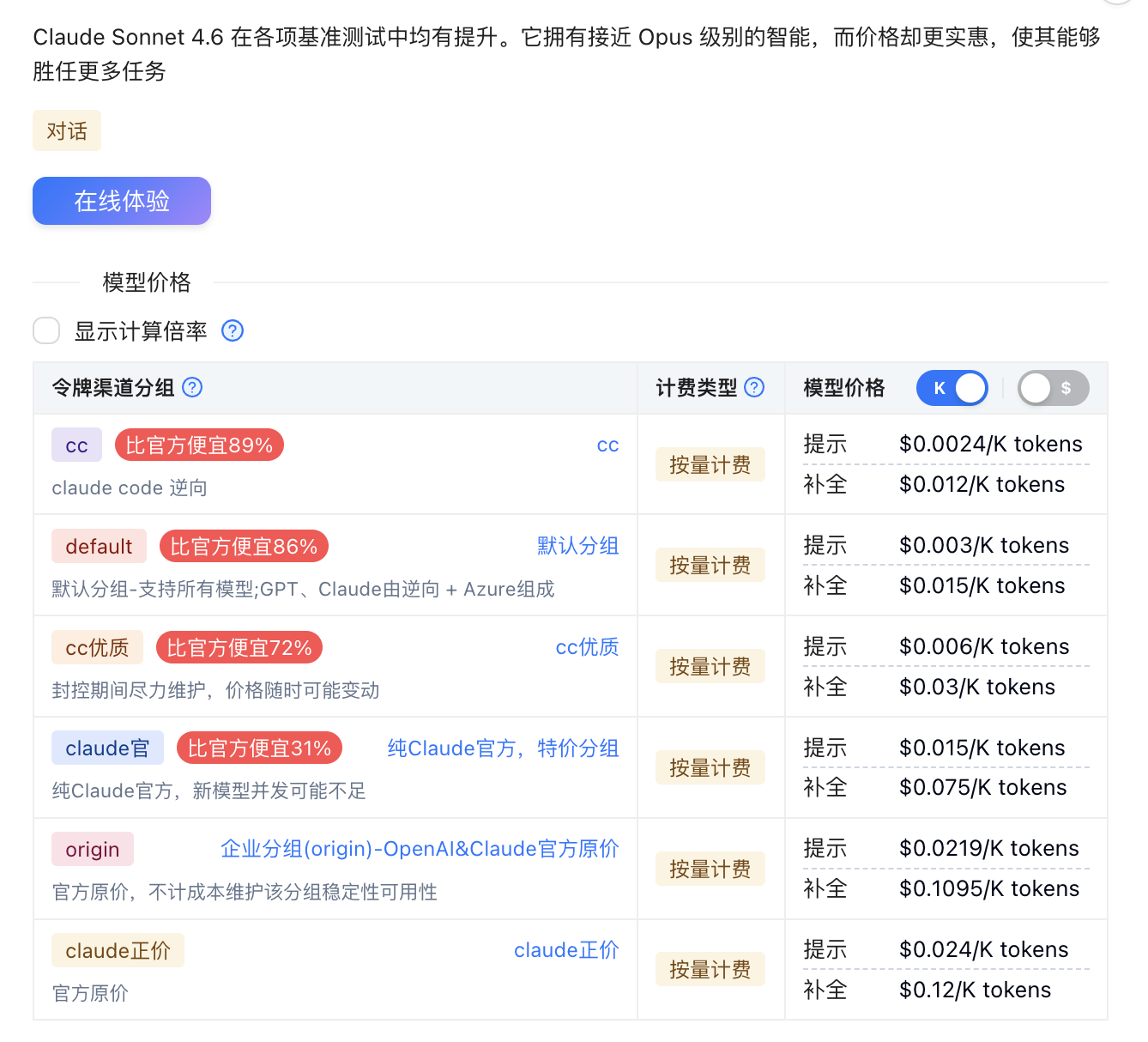
The price list of one API relay station shows its reverse-engineered Claude Code API is 89% cheaper than the official price. The official price is $0.024/K Token, while it charges only $0.0024/T Token.
Even more lucrative is selling outright fakes.
In early March, CISPA (Helmholtz Center for Information Security) published a research report titled "Real Money, Fake Models: Deceptive Model Claims in Shadow APIs."

They found that nearly half of third-party API endpoints are engaged in bait-and-switch schemes.
You pay the API fee, happily thinking you're calling GPT-5, but the merchant is likely quietly running a low-cost domestic model in the background, or even a free, locally-run open-source model (like GLM-4-9B).
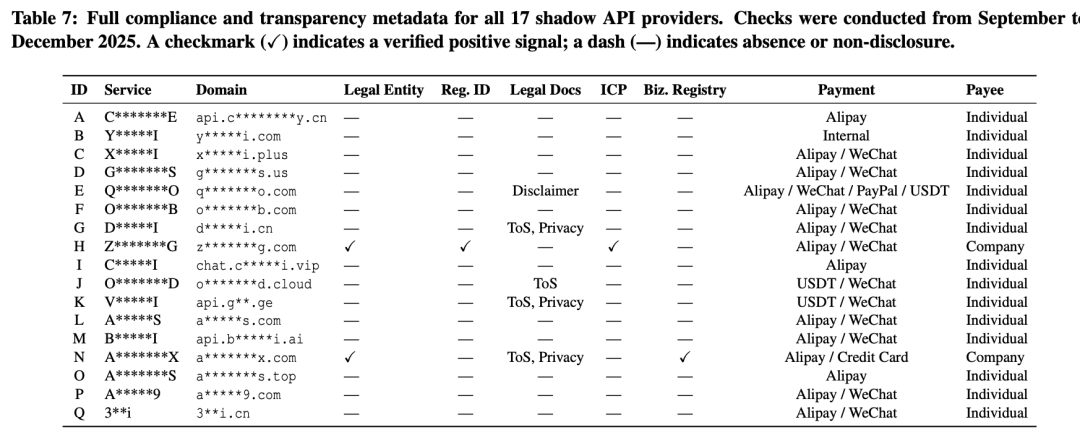
Among the 17 top independent shadow API service providers identified by CISPA's audit, 15 were operated purely by individuals, and over 88.2% of providers didn't even have the most basic Internet Content Provider (ICP) filing.
An industry insider engaged in API relay agency told Deep Tide TechFlow that top relay APIs can now achieve monthly profits in the millions, with demand extremely strong.
These are just stories from the cost side. Former Manus staff member Yan publicly disclosed a deeper logic behind this business: The core purpose of many Token relay stations is not to sell APIs at all, but to collect high-quality distillation corpora for specific scenarios.
"All requests passing through the relay, the complete prompt plus response, constitute ready-made distillation data. Especially in OpenClaw's programming scenarios, users produce complex reasoning chains and real engineering decisions, which are dream training materials for model companies. So, the real business model for certain relay stations is likely this: collecting your relay fee is the surface business; packaging your request data and selling it to large companies for model distillation is the core profit. You are a paying customer and simultaneously a free training data producer—killing two birds with one stone."
Above this entire chain, there's another layer of business that appears cleaner: Token aggregation routing service providers. They connect you to APIs from over a dozen models, automatically routing based on task complexity—simple tasks go to cheaper domestic models, complex tasks use Claude or GPT—claiming to save users 65% to 80% on API costs. The service itself has value. Those who control this traffic entry point accumulate real user usage patterns earlier than any single model company.
Data is always the true asset.
Information Asymmetry is the Oldest Business
If the first two lobster gold mines rely on hardware and data, the third relies on something more fundamental: You know, and others don't.
Li Huan's recent business involves nationwide travel. He carries a laptop, flying to Shenzhen, Chengdu, and Hangzhou, installing OpenClaw for local small business owners, connecting it to Feishu and DingTalk, and debugging automated workflows and exclusive Skills. Each order costs several thousand or even over ten thousand RMB. In a month, he earns significantly more than many programmers' monthly salaries.
A counterintuitive fact is that Li Huan is not a programmer but has a liberal arts background. He candidly states that he's not selling technology but information asymmetry—directly converting a hot concept into a product bosses can use immediately, while providing emotional value to soothe anxiety.
Taking this logic to the extreme is an American named Adam Sand.
Adam is also not an engineer. He and his wife Allison run a roofing industry consulting business. After OpenClaw became popular, he did something the tech circle sees as having no barrier: installing a pre-configured OpenClaw into a MacBook, connecting it to a roofing industry-specific Skills package, HubSpot CRM, and ticketing system, configuring data security, and directly mailing it to clients. Plug it in, and the AI employee starts work. One-on-one training, weekly ongoing support, priced at $5,000 per unit.
This project is called RoofClaw, with total historical revenue exceeding $1.8 million and over 360 roofing contractors served cumulatively.
Many people's first reaction is: Isn't this just putting a free open-source project into hardware and charging $5,000 for it?
Yes. But Adam isn't selling software or hardware. He's selling the certainty that a roofing contractor, without needing to understand any technology, can have an AI employee start work tomorrow. Most people spend that $5,000 without hesitation, because Adam understands their pain points better than anyone, having dealt with this industry for over a decade.
This is the essence of the information asymmetry business: truly understanding your client's needs.
Back in China, this business has already evolved into another style.
On Taobao, there are multiple installation service shops with cumulative orders exceeding 1,000, with engineering teams of dozens, earning 300,000 to 450,000 RMB in the past month just from installing OpenClaw. Some installers even promise in their product descriptions "on-site deployment, plus one free cooking service, can cook home-style dishes."
This track is so hot that even Meituan and JD.com have entered the fray, partnering with Lenovo IT services to offer remote deployment services. From individual operators all the way up to internet giants, people at every level are making money, indicating this demand is real and substantial enough.

Selling Skills is another facet of this logic.
On OpenClaw's plugin ecosystem ClawHub, community-contributed Skills plugins exceed 5,700. Some sell ready-made Skills packages, some sell SOUL.md character configuration templates—AI CEO, Marketing Director, Legal Reviewer—priced from $19 to $99 each. Some sell custom development services, others sell "Complete OpenClaw Practical Tutorials."
The higher the technical barrier, the more people willing to pay to lower it. This rule has never failed in any technology cycle.
The Shovel Sellers Are Never Anxious
On a startup project aggregation platform with Stripe-verified revenue, there are already 126 startup projects centered around OpenClaw, ranked in real-time by verifiable revenue over the past 30 days.
The data is stark: among the top 30 highest-earning projects, over 17 are doing the same thing—one-click cloud hosting.
Claw Mart's revenue in the last 30 days is $54,000, Donely's total historical revenue is $747,000, RoofClaw's total historical revenue is $1.8 million.
But the other side of the story is: The half-life of information asymmetry is measured in "weeks," not "months."
The first wave of shovel sellers has already begun to retreat. A project called QuickClaw, promoting "deploy OpenClaw on your phone in 30 seconds," rapidly gained traction during a weekly traffic surge, then offered to sell the entire package for $300,000.
This is the most realistic rhythm of this wave: a technology concept explodes, the information asymmetry window opens, the first wave of people swarms in, the红利 quickly dissipates, the shovel sellers sell their shovels and turn to leave.
Kong Jianping has long ingrained this rhythm into muscle memory. He has moved from Bitcoin mining machines to OpenClaw hosts, spanning an entire crypto era. Each time, he accurately rides the crest of the wave, not because he understood the technology earlier than others, but because he understands human nature better—he sees the fear of "I can't fall behind" and how much people are willing to pay to dispel that fear.
That comparison image of the qigong craze makes people laugh. The scenes from the two eras are structurally identical: aluminum pots and lobster hats are both rituals, visualizations of anxiety, symbols of "I'm already on the right side."
The only difference is that the lobster hat in 2026 is connected to a real industrial chain behind it—more sophisticated, more adept at monetizing human nature.
During the 1849 California Gold Rush, the ones who made money weren't the miners, but Levi Strauss, who sold jeans.
This story has been told for 175 years and gets retold with every technological wave.
Because every time, it's right.
The shovel sellers don't bet on the outcome of the technology; they bet on the stability of human nature.
So they are never anxious.