






DeFi Protocol Shutdown Wave: They All Had Perfect Technology, Then Died Gracefully


- Core Viewpoint: Recently, multiple crypto protocols have chosen to "gracefully shut down" due to their failure to adapt to market changes, lack of a sustainable business model (particularly insufficient liquidity), and depletion of funds. This reveals that the industry is transitioning from a phase of wild growth to a brutal stage of survival of the fittest.
- Key Elements:
- The decentralized stablecoin protocol Angle, citing severe homogenization in its sector, deemed its independent infrastructure no longer necessary and announced the shutdown of its business, which once had a TVL of $250 million.
- Protocols like the derivatives protocol Polynomial and the restaking protocol MilkyWay, despite having technical products, ultimately failed due to their inability to acquire or maintain sufficient liquidity, which is the core barrier in the derivatives field.
- The risks of multi-chain deployment strategies have become prominent. For example, ZeroLend was unable to sustain operations because the niche chains it bet on experienced liquidity drying up and service disruptions during the bear market.
- Market shifts have led to changes in user behavior. For instance, the data analysis tool Parsec lost its foundation for existence by failing to keep up with structural changes in the DeFi market.
- Projects are generally facing funding difficulties, unable to support their continuous transformation or survive long enough to find product-market fit. Even mainstream protocols like Aave are scaling back business lines due to losses.
- Unlike the "rug pulls" of the past, recent shutdown projects have generally allowed users to withdraw funds, with teams not engaging in malicious harvesting, reflecting a more responsible way of concluding projects.
Original Author: Ignas
Original Compilation: Chopper, Foresight News
Over the past two months, at least 10 crypto protocols have announced their shutdown. Not due to rug pulls, but because they had no users, no money, or both.
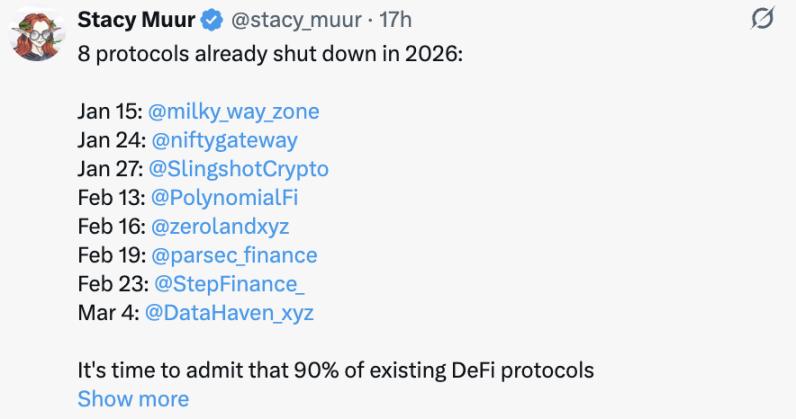
Not to mention mining companies like BlockFills and lending platforms freezing withdrawals. Just yesterday, Angle also announced (https://x.com/AngleProtocol/status/2029161525580112263) the gradual shutdown of its EURA and USDA stablecoins, despite once having a Total Value Locked (TVL) of $250 million and doing well in business partnerships.
Angle stated bluntly in its announcement, "The decentralized stablecoin landscape has fundamentally changed. Yield-bearing stablecoins today are essentially just branded wrappers over existing vaults and lending protocols. There's no longer a need to maintain a separate, independent infrastructure."
Almost all of these shuttered projects had products that functioned properly:
- Polynomial had a cumulative trading volume of $4 billion across 70+ markets.
- MilkyWay once had a TVL of $250 million.
- Step Finance's monthly active users peaked at 300,000.
I've used, or at least tried, these products. The technology wasn't the issue, but no one was willing to pay the fees necessary for the projects to survive.
MilkyWay is a classic example: four pivots in less than two years. It started with Celestia liquid staking, then shifted to restaking, RWA tokenization, and even a crypto debit card for paying rent... each pivot chasing the trend of the moment.
Their description of the restaking pivot is poignant: "We saw the restaking opportunity early, designed the system, TVL surged to $250 million, security audits were completed, and we were ready to launch. But the market moved away from restaking faster than anyone anticipated."
In the end, they had to admit their funds wouldn't last until they found product-market fit.
The Polynomial team was brutally honest about the reason for failure, offering a lesson for all perpetual swap projects: "In derivatives, great tech is useless. We improved execution speed, optimized UX, built innovative infrastructure, but none of it mattered. Traders go where the liquidity is, and we didn't have it. Everything else is just bells and whistles."
The conclusion is even harsher: "Liquidity is the only moat in derivatives. You can't beat liquidity with innovation, you can't beat it with marketing, you can't beat it with development."
ZeroLend's shutdown serves as a warning for decentralized applications trying to launch on multiple blockchains. They bet on supporting projects on niche chains like Manta, Zircuit, and Xlayer, but when the market turned bearish, liquidity on these chains dried up, and oracle providers stopped their services.
Ultimately, operating at a long-term loss was unsustainable.
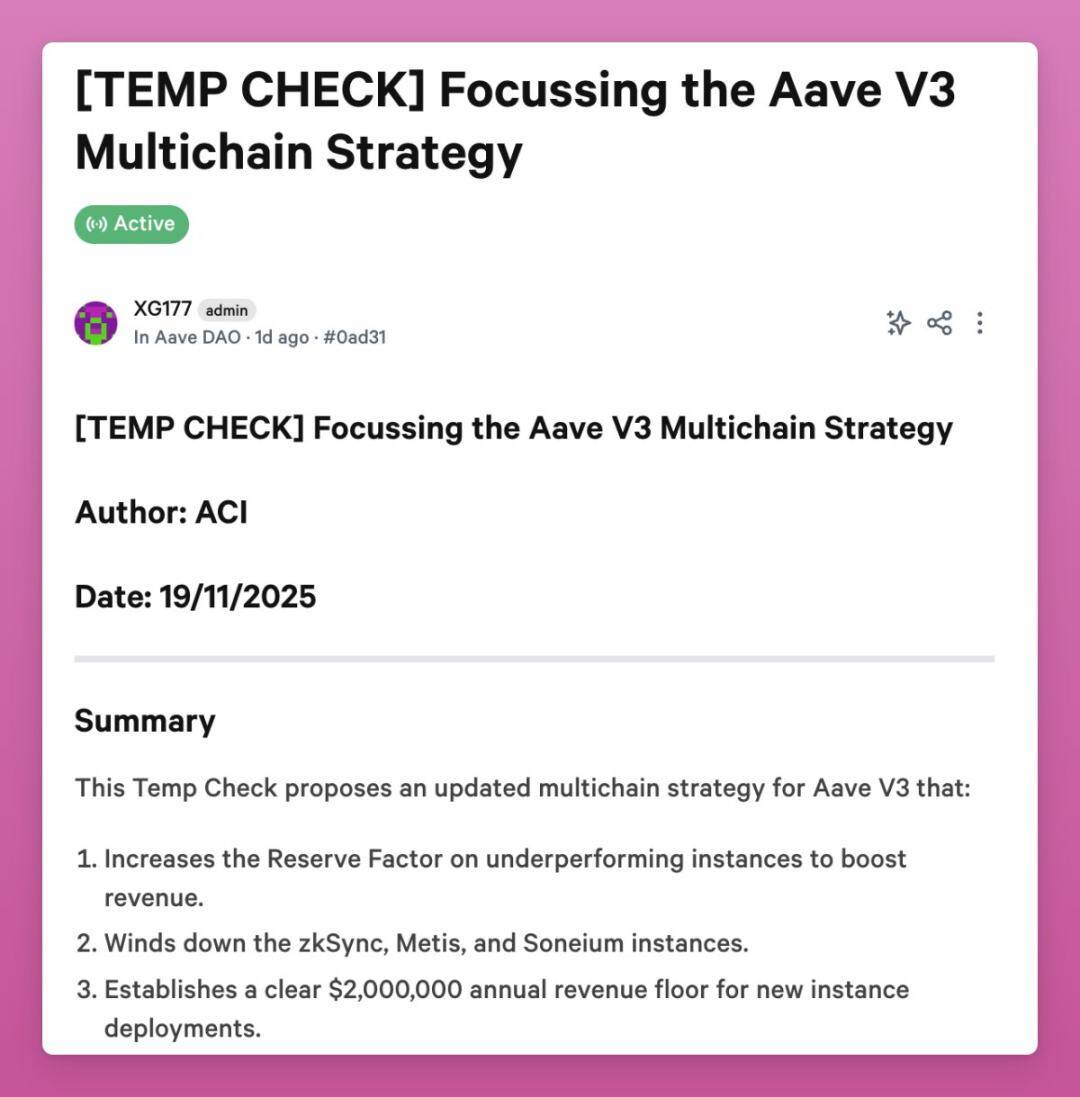
Aave recently also voted to shut down services on several chains, citing the same reason of operating at a loss.
Then there's Parsec, once a legendary tool in the crypto circle used to track Terra, 3AC, and the stETH depeg. But the team admitted, "After the FTX collapse, DeFi spot trading, lending, and leverage never returned to their former state. The market changed, on-chain behavior changed, and we didn't truly understand it."
Simply put, the market moved on, and we stayed behind. The market is brutal.
Slingshot was completely shut down after being acquired. Eden cut 80% of its unprofitable products, keeping only the core business.
As they said, "The 80/20 rule became reality; the products that cost us 80% brought in only 20% of the revenue."
Finally, Step Finance is a special case: it was hacked for $26 million on January 31st, which was a death sentence. "We tried fundraising, being acquired, nothing worked."
What do these dead projects have in common? They failed to adapt to the ever-changing market and lacked sufficient funds to pivot again.
Each team bet on a particular ecosystem experiencing explosive growth, but the growth either wasn't fast enough or never materialized. Celestia DeFi never truly took off, on-chain derivatives struggled to compete with Hyperliquid, and even established platforms like dYdX and GMX are having a tough time.
Expanding into new chains and narrative spaces is expensive.
For players like me, moving money from one platform to another is easy and cheap. But applications need to invest significant time and financial resources to prepare for potential new user bases.
The good news is, these were all "dignified deaths." All projects gave users time to withdraw funds, teams didn't run away or issue tokens to cash out. Compared to the direct rug pulls of 2022, the industry has indeed learned to die responsibly.


