






Those Who Hate Bitcoin Are Using Private Credit to "Plunder" the World


- Core Viewpoint: The article argues that the current massive private credit market is the newest and most concealed risk vector within the financial system. Through opaque valuations, long lock-up periods, and misaligned incentives, it systematically transfers and hides risk. Ultimately, the losses may be borne by the general public (e.g., pension beneficiaries), while the gains are captured by a small number of fund managers.
- Key Elements:
- BlackRock recently wrote down the face value of two private credit loans to zero in one go, exposing the market's fundamental flaws in opaque valuations and incentive structures.
- The private credit market has ballooned from $46 billion in 2000 to approximately $2 trillion. Its structure resembles that of the 2008 subprime mortgage crisis, but the losses will be socialized more broadly.
- The industry is spreading risk to retail investors through private credit ETFs, transferring the liquidity crisis of illiquid assets to ordinary investors.
- Vast amounts of private credit (estimated at nearly $500 billion annually) are flooding into infrastructure like AI data centers, distorting capital costs and potentially accelerating labor displacement.
- The core of its business model is "liquidity transformation": fund managers reap high performance fees, while the risk of loss is borne by long-term capital like locked-up pension and insurance funds.
Original Author: Jeff Park
Original Compilation: Chopper, Foresight News
In the world of finance, every generation invents a new tool to package its worst instincts into something that looks like a prudent product.
The 1980s had junk bonds, cloaked in the guise of "democratizing capital"; the 1990s had emerging market debt, packaged as a noble cause to help developing nations integrate into the global economy; the 2000s had structured credit, layered with such complexity that even its designers couldn't understand it before it collapsed.
These "innovations" share a common thread: they create artificial solutions (like liquidity transformation) to real problems (like insufficient growth), ultimately leading to disaster through overabundance.
Private credit is the latest chapter in this story, and perhaps the most insidious one yet. Unlike its predecessors, it was designed from the outset to make the reckoning before a crisis completely invisible, only to be discovered when the consequences are irreversible.
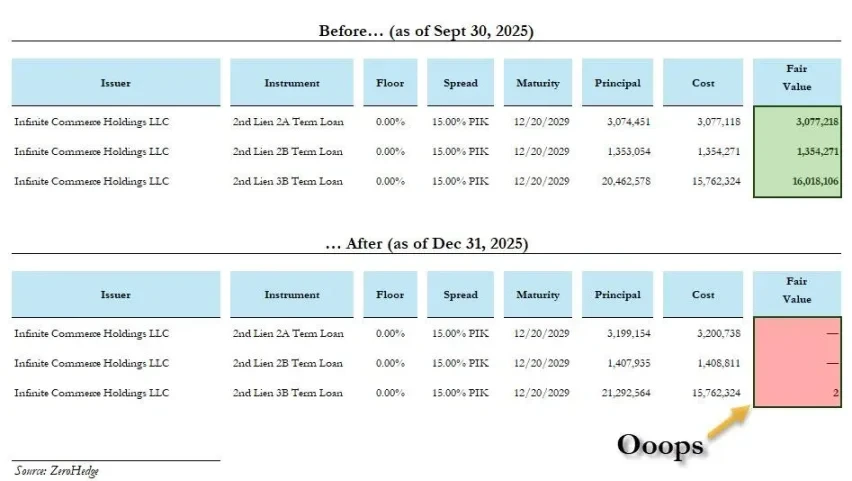
Recently, BlackRock directly wrote down the face value of two private credit loans from 100% to 0 in one go, with one of them taking less than a month. This looks less like a technical error in valuation methodology and more like a confession of flawed incentives.
How did we get here?
The Crisis Isn't the Root Cause; Concealing the Truth Created It
The mainstream industry narrative goes like this: after the 2008 financial crisis, banks, constrained by Basel III, became reluctant to lend. Non-bank institutions stepped in to fill the gap, serving small and medium-sized enterprises. This was the inevitable choice of the market.
The more accurate reality is that the post-2008 regulatory framework didn't truly eliminate risk; instead, it actively fostered a shadow system that takes on the same underlying risks while evading the regulations designed to constrain them.
The private credit market has ballooned from $46 billion in 2000 to about $2 trillion today. This money didn't appear out of thin air, nor did it accidentally flow into pension funds and insurance companies. It was precisely channeled to institutions with large capital pools, long lock-up periods, and a willingness to accept opaque valuations.
Its structure is identical to that which existed when the 2008 crisis erupted, with one significant difference. When the subprime mortgage market collapsed in 2008, losses were concentrated among reckless borrowing households and the banks that lent to them. If private credit collapses, the losses have no boundaries; the money comes from life insurance policyholders and pension beneficiaries—ordinary people.
The socialization of losses that outraged the public in 2008 at least had a preceding period of private gain. With private credit: profits go into fund managers' pockets, while losses are socialized, flowing into the retirement accounts of teachers, nurses, and civil servants—people who never agreed to bear this burden.
Worse, the industry isn't satisfied with harvesting only institutions; it's now targeting retail investors. Since 2025, private credit ETFs have become hugely popular, but the problem is even more severe: illiquid assets don't become liquid just by being packaged into an ETF. It simply transfers the bomb of "assets that can't be sold when redemption waves hit" from professional institutions to ordinary investors' brokerage accounts.
This is the reality unfolding.
Asset Allocators Who Hate Bitcoin Expose Everything
Over the past few years, as I've pitched Bitcoin to institutions everywhere, I've discovered a startling pattern: those who reject Bitcoin are often fervent proponents of private credit. This isn't two different perspectives on a problem; it's the same mindset.
Their objections to Bitcoin sound "prudent": too volatile, drawdowns are inexplicable, can't be valued due to lack of cash flow.
But the subtext is: Bitcoin's price is too honest. Real-time, public, visible to all. If it's wrong, it's wrong; there's no hiding it.
Private credit is the exact opposite:
- Valuation changes are extremely slow, "smoothed" quarterly by fund managers.
- There's no liquid market to puncture the lies.
- Lock-up periods are long enough for the decision-makers to get promoted, change jobs, or retire.
The so-called "exclusive deal flow" is merely an excuse for the lack of effective price competition.
A true fiduciary seeks the truth. These allocators seek to avoid facing the truth. This isn't risk management; it's the opposite of risk management, yet cloaked in professionalism, completely disregarding beneficiary interests.
The AI Boom Turns It Into Systemic Risk
Morgan Stanley estimates that from 2025 to 2028, global data centers will require $2.9 trillion in capital expenditure, with about $800 billion to be solved by private credit. This has transformed private credit from a lending market into the critical infrastructure for the most important technological transformation of the coming decades.
A typical case: In October 2025, Meta and Blue Owl completed a $27 billion data center financing deal, the largest private credit transaction in history. The money came from PIMCO, BlackRock, and ultimately from pension funds and insurance companies.
The cruelty of this cycle: the retirement savings of ordinary workers are used to fund the automation and AI that, in turn, replace those very workers' jobs. Private credit distorts the cost of capital and suppresses the value of labor. Now, nearly $50 billion in private credit flows into the AI sector every quarter.
The financialization of AI infrastructure and the displacement of the workers funding it form a closed loop: the left hand cutting off the right.
Liquidity Transformation Is Theft of Time
I'm not saying credit itself is sinful, nor that all private credit firms are terrible. Credit has always been a game of probabilities; bad debts and mismatches exist in every era.
The crucial difference lies in: who truly bears the loss?
- If a bank makes a bad loan, it's on its own balance sheet, regulated, facing bank runs and equity wipeouts—there's real, tangible risk.
- Private credit managers earn performance fees—incentives that "encourage you to place bets," not "encourage you to win responsibly."
By the time the loan goes to zero, the manager has already made enough money.
Every piece of financial engineering ultimately points to one question: who bears the cost that nobody wants?
The "brilliance" of private credit lies in answering this question with unparalleled "elegance":
Profits flow upward and backward: to the older, already retired, beneficiaries of long-term capital.
Costs flow downward and forward: suppressing wages, freezing hiring, delaying investment, distorting the entire economy's cost of capital.
Private credit is the theft of time.
This is the age-old liquidity transformation in finance, stripped of its disguise.
They bear risks they don't need to bear, through instruments they cannot choose, at prices they cannot foresee.
Lock-up periods ensure they cannot exit. The lack of public valuation ensures they cannot protest. And the quarterly valuation smoothing mechanism ensures that when the final bill comes due, there is no one left to hold accountable.
It doesn't look like plunder; it looks like "steady returns." The two are almost indistinguishable until the moment of collapse. While this story is an old one, the novelty lies in its sheer scale, its profound lack of transparency, and the astonishing success of an asset class built on an illusion of safety that has convinced even the world's most cautious capital managers.
There is no asset class in the world that can be valued at 100% for three consecutive months and then go to zero overnight.
If that's not theft, then I don't know what is.


