Same Case, Different Verdict: Why Was Uniswap Acquitted While Tornado Cash Was Not?


- Core Viewpoint: A U.S. court dismissed a class-action lawsuit against Uniswap and its founders, ruling that developers of open-source protocols are not liable for fraudulent activities conducted by third parties using their protocol. This ruling is seen as a significant positive development for the DeFi space, but it also highlights regulatory preference for "auditable decentralization."
- Key Elements:
- Judge Katherine Polk Failla argued that Uniswap's decentralized nature prevents it from controlling listed tokens or user behavior, drawing an analogy that developers of autonomous vehicles should not be held liable for users' illegal actions.
- The court dismissed the plaintiffs' allegations regarding securities violations, aiding and abetting fraud, and unjust enrichment, stating that Uniswap did not substantially assist in the fraud nor directly profit from it, and speculative indirect benefits do not constitute liability.
- In contrast, in the Tornado Cash developer case presided over by the same judge, the jury found the developers guilty. The core difference lies in the privacy protocol being deemed inherently used for money laundering with the developers' knowledge.
- This verdict sets an important precedent regarding the liability of open-source smart contract developers, emphasizing that under existing law, permissionless and auditable decentralized protocols may be more aligned with regulatory survival.
- The article points out that, while legally not liable, from a business ethics perspective, leading projects like Uniswap have the capability and are expected to use existing tools to screen for potential scam projects to protect investors.
Original author: Eric, Foresight News
In the early hours of March 3, Beijing time, a class-action lawsuit demanding that Uniswap and its founder Hayden Adams be held responsible for scam tokens on Uniswap was dismissed by the United States District Court for the Southern District of New York. Brian Nistler, General Counsel of the Uniswap Foundation, hailed it as a "landmark ruling for DeFi."
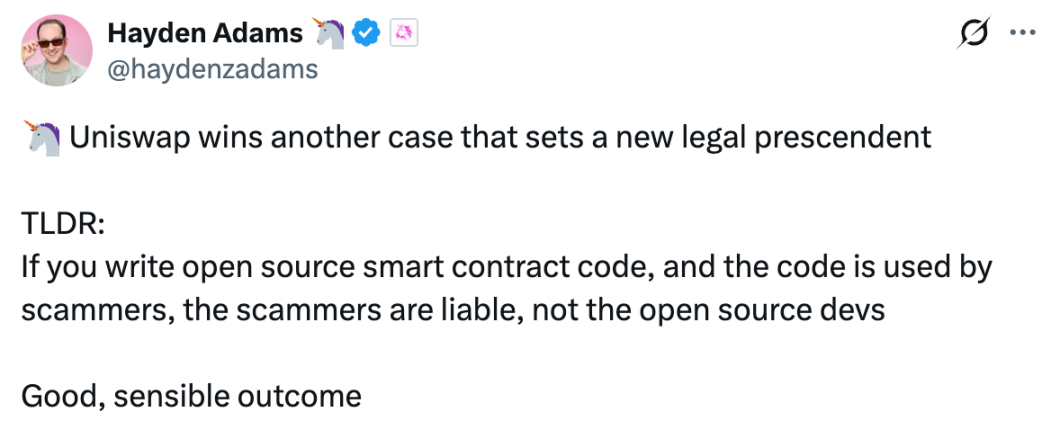
Hayden Adams also tweeted, "If you write open-source smart contract code, and that code is used by scammers, the scammers are responsible, not the open-source developer. This is a reasonable and fair outcome."
For Web3 developers, this is undoubtedly good news. However, what is less known is that the judge who made this "just ruling" is the same person who, during the tenure of the former SEC Chairman, found the developers of the mixer Tornado Cash guilty.
A Settled Judgment
Nearly four years have passed from the filing of the class-action lawsuit against Uniswap to its final resolution today.
In April 2022, Uniswap users, represented by Nessa Risley, filed a class-action lawsuit in court, accusing defendants including Paradigm, a16z, Uniswap, and its founder Hayden Adams of violating federal securities laws by issuing and selling unregistered securities, including UNI, in the form of tokens on Uniswap. The lawsuit also alleged that the defendants failed to register Uniswap as an exchange or broker-dealer under applicable securities laws and failed to provide investors with registration statements for the securities they issued and sold.
This lawsuit was initiated by the law firms Kim & Serritella and Barton, representing users who traded EtherumMax, Bezoge, MatrixSamurai, Alphawolf Finance, RocketBunny, and BoomBaby.io tokens on Uniswap between April 5, 2021, and April 4, 2022.
The phrase "unregistered securities" carried extraordinary weight against the crypto industry at the time, but this lawsuit surprisingly tilted heavily in Uniswap's favor very quickly.
Presiding Judge Katherine Polk Failla, while acknowledging that the "scam tokens" in question were indeed securities, ruled that Uniswap was not responsible for them. Failla argued that Uniswap's decentralized nature meant the protocol had no control over which tokens were listed on the platform or who could interact with it, stating, "The case is more akin to holding the developer of a self-driving car liable for traffic violations or bank robberies committed by third parties using that car."
Based on this, Failla dismissed the federal securities law claims in August 2023. The plaintiffs subsequently appealed. In 2025, the Second Circuit Court of Appeals affirmed the partial dismissal of the federal claims but remanded the state law claims for further proceedings.
Later, the plaintiffs amended their complaint and filed suit again. This time, the aggrieved investors accused Uniswap and other defendants of aiding and abetting fraud and misrepresentation, profiting from scam token transactions, and violating various state fraud statutes.
After another review by the same judge, Failla, the amended claims were dismissed again, with prejudice, meaning they cannot be amended and refiled, bringing the case to a definitive end.
The judge's reasoning this time was largely the same as before: Uniswap was not aware of the scam tokens, and even if it were, it did not provide substantial assistance. Furthermore, its actions did not meet the definition of fraudulent conduct under any state law. Regarding unjust enrichment, Uniswap did not receive direct benefits; any indirect benefit from an expanded user base due to such scam projects was deemed too speculative.

In a tweet, Brian Nistler stated that, to quote a line from the previous ruling, the idea that the drafter of a smart contract should be held liable for third-party misuse of the platform is simply "illogical."
A Different Outcome for Tornado Cash
Facing the same judge, Roman Storm of Tornado Cash met a different fate.
Tornado Cash was first added to the sanctions list by the U.S. Department of the Treasury's Office of Foreign Assets Control (OFAC) on August 8, 2022, accused of helping criminals, including North Korean hackers, launder over $7 billion. Two days after being sanctioned, Dutch police arrested Alexey Pertsev, one of Tornado Cash's core developers.
On May 14, 2024, a Dutch court found Alexey Pertsev guilty of money laundering and sentenced him to 64 months in prison. The court ruled that Pertsev was aware his developed and operated platform was used for crime but did nothing to stop it, subjectively acquiescing to Tornado Cash being used as a money laundering tool. Alexey Pertsev is currently appealing, with no recent updates.
Seven months before Alexey Pertsev's conviction, the U.S. Department of Justice indicted two other developers, Roman Storm and Roman Semenov, in the Southern District of New York. Roman Storm was previously arrested in Washington state, while Roman Semenov remains at large.

Roman Storm in court
Subsequently, although an appeal led a court to rule that OFAC's sanctioning of Tornado Cash was an overreach and invalid, Roman Storm still found himself in the defendant's seat last July. After proceedings presided over by Judge Katherine Polk Failla, a jury found Roman Storm guilty of "conspiracy to operate an unlicensed money transmitting business." Sentencing has not yet been formally announced.

Under Brian Nistler's celebratory tweet about Uniswap's victory, a comment by Sigil developer tim-clancy.eth criticizing the perceived inconsistency in Failla's rulings (noting that the Roman Storm verdict was actually delivered by a jury) received the most likes among all replies.
Decentralization is Fine, But Privacy is Not
I am not a professional lawyer, but setting aside political factors and speaking from a basic sense of fairness, one can roughly understand why Uniswap and Tornado Cash had different outcomes.
The core reason is that Tornado Cash's developers should have been fully aware that a mixer would inevitably be used for money laundering. This clearly reveals the regulatory stance: decentralization is permissible, but traceability is a must. Tether once faced similar dilemmas, which is why it later began cooperating with money laundering investigations and added freezing capabilities.
Perhaps Roman Storm, behind bars, would feel the injustice of today's ruling upon hearing it. But he should understand that even in a crypto-friendly United States under Trump, a platform aiding North Korean state-level hackers in money laundering cannot be tolerated. The power of crypto today is still insufficient to challenge state power.
Web3 practitioners lament the unfair treatment of Tornado Cash's developers while cheering Uniswap's victory. In our eyes, the two protocols are not fundamentally different; in fact, Tornado Cash even excels in privacy protection. Uniswap's addition of front-end blocking for sanctioned addresses in 2022 sparked some debate. Now, it seems that permissionlessness within the existing legal framework might be the only viable path for decentralized protocols.
But to be fair, does Uniswap truly bear no responsibility whatsoever in these scam incidents?
Strictly logically, as per the judge's analogy, you cannot hold Mercedes-Benz liable for a bank's losses just because a robber used their car. However, from a commercial perspective, there is a stronger expectation that industry giants should provide protection within their capabilities. Current security tools can already identify a large number of potential scam projects beforehand. For established projects that have reaped the benefits of Web3's growth, implementing simple screening measures is not overly burdensome.
Contributing to investor protection is not a mandatory obligation, but it is a responsibility that ordinary investors hope projects like Uniswap will proactively shoulder.