2026 Death List: Games Are Dead, DeFi Is Dead, Tools Are Dead, Who's Next?


- Core View: A wave of "quiet" collective shutdowns among Web3 projects in early 2026 fundamentally stems from a widespread lack of sustainable business models and self-sustaining capabilities. This reveals the industry is transitioning from a phase of extensive growth reliant on funding and token incentives to a stage of deep adjustment focused on product-market fit and financial health.
- Key Factors:
- Financial Imbalance is the Primary Cause: Multiple projects halted operations because their revenue couldn't cover high operational costs (e.g., GENSO Online's monthly expenses were 5 times its revenue), exposing the fatal flaw of lacking independent self-sustaining ability.
- Multi-Chain Expansion Became a Trap: Taking ZeroLend as an example, blind multi-chain deployment led to fragmented liquidity, failing to achieve economies of scale while instead increasing operational risks and maintenance costs.
- Security Threats Come from "People": Step Finance's $40 million loss due to a hack of an executive's personal device highlights that operational security (OpSec) and internal management are far more critical than code security.
- Execution and Timing Are Crucial: MilkyWay Protocol missed out on ecosystem benefits due to severely delayed product launches, while Parsec failed to build a moat in the fiercely competitive market for existing users.
- The Market is Accelerating Consolidation and Concentration: Stricter regulations and capital flowing towards top assets (like BTC/ETH ETFs) and sectors with genuine demand have drastically compressed the liquidity space for long-tail projects.
- Emergence of "Graceful Exit" Cases: Some projects (e.g., Polynomial, ZeroLend) chose to proactively cease operations, not liquidate user assets, and even offer compensation, demonstrating an improvement in industry accountability.
Original | Odaily (@OdailyChina)
Author | Ethan (@ethanzhang_web3)
The crypto market is no stranger to death, but the way projects die in 2026 is different.
In the past, projects died with a bang: implosions, rug pulls, founders going missing—there was always someone venting on social media, always a spectacle worth watching. But less than 90 days into 2026, Odaily has noted that over 10 Web3 projects have publicly announced they are ceasing operations—their disappearances have been eerily quiet: an announcement, servers shut down, funds depleted, and then nothing.
Gaming, lending protocols, on-chain tools, infrastructure—almost every major sector has seen projects halt during this period, with an average of one shutdown notice appearing on the timeline every 9 days. This density feels more like a long-overdue collective reckoning than a routine market clearing. Below are some cases compiled by Odaily.
Shutdown Project Review
Gaming & Metaverse: The Collective Collapse of Play-to-Earn
On February 26, 2026, the once highly-anticipated fantasy RPG GENSO Online regretfully announced it would shut down all core services on April 30, 2026, including game servers, the GENSO marketplace, LAND Viewer, and the dedicated MV wallet.
The team disclosed in an AMA that even after a series of downsizing self-rescue efforts, the project's monthly fixed expenses still amounted to a staggering 10 million JPY. Cloud infrastructure (3.4 million JPY) and personnel costs (3 million JPY) were the largest items, while maintaining secondary market liquidity through exchange listings and ROND token buybacks consumed another 1.3 million JPY.
In contrast, monthly total revenue—including marketplace fees, in-app purchases, and advertising—was only about 2 million JPY. Expenses were a full five times revenue, with no signs of narrowing. Under this severely imbalanced cash flow, although players' NFTs and tokens (like MV and ROND) will remain on-chain, their value is on the brink of zero as the game's utility vanishes. The official team also clearly stated that no refunds would be provided per the terms of service. This experiment to empower traditional gaming with Web3 was ultimately crushed by server bills.
On January 15, 2026, after struggling for two years on the Ronin ecosystem, the pixel strategy game Pixiland made a difficult and painful decision: indefinitely suspend all Web3 plans and pivot to a purely Web2 offline model. This means its Token Generation Event (TGE) has been completely canceled. What's even more heartbreaking for the community is that the wPixi points players accumulated day and night by "farming" for airdrops will never be converted into real crypto assets.
The team admitted that as a small, independent, and self-funded team, the cost of maintaining on-chain infrastructure and interactions had far exceeded their limits under the dual pressures of extreme market volatility and regulatory uncertainty. "Retreating to Web2" has become a desperate, survival-driven move for current Web3 games facing prohibitively high trial-and-error costs.
Similarly leveraging the Ronin network's traffic红利, the fantasy MMORPG Forgotten Runiverse announced it would go offline indefinitely on January 27, 2026.
The official announcement euphemistically attributed the shutdown to "compounding financial challenges"—plainly speaking, a complete break in the funding chain. Lacking sustainable revenue-generating capabilities, the team could no longer afford the most basic operational costs to keep the game running. Although the official wording preserved the polite notion that "the project may be revived in the future if resources become available," industry observers see this "indefinite offline" status as the standard exit strategy for mid-sized gaming projects when funds run dry.
DeFi Lending & Derivatives: Receding Liquidity Reveals Who's Swimming Naked
On February 17, 2026, ZeroLend, once seen as a leading Layer 2 lending protocol, announced it was entering an "honorable shutdown" phase, gradually winding down operations. At its peak, ZeroLend was immensely successful, with its Total Value Locked (TVL) surpassing $250 million, over 100,000 daily active users, and a dominant position in ecosystems like zkSync and Linea.
However, reckless multi-chain expansion ultimately backfired. As early-supported chains like Manta, Zircuit, and XLayer fell into ecosystem decline, the multi-chain strategy didn't bring scale effects but rather severe fragmentation of liquidity. Large amounts of assets were trapped in low-liquidity environments, becoming difficult-to-maintain "zombie assets." More fatally, oracle service providers discontinued their support, directly draining the pricing and liquidation foundation of the lending protocol. Coupled with the razor-thin profit margins in the lending market and persistent threats from hackers and fraud, the protocol fell into irreversible long-term losses.
Faced with an unsolvable predicament, ZeroLend chose a rare, dignified exit in the industry: directly lowering the Loan-to-Value (LTV) ratio for most markets to 0%, forcibly disabling borrowing functions, and only retaining withdrawals to guide users to safety. For liquidity-dry chains, the team redistributed assets via smart contract upgrades; they even used the team's own allocated LINEA airdrop份额 to provide partial refunds to LBTC suppliers on Base chain. A three-year operational journey concluded with a textbook "dignified shutdown."
On February 14, 2026, the DeFi derivatives protocol Polynomial, which had secured a $1.1 million seed round from notable institutions like Archetype and Synthetix's founder, announced an orderly shutdown of its business.
The team stated that while the on-chain derivatives market had grown 100x in recent years, validating the sector's direction, their execution had fallen severely short of expectations. After assessing the harsh reality that their product had entered a state of "irreversible decline," the team decided to actively cancel the TGE originally planned for Q1 2026.
The team believed that forcing a token launch with an uncompetitive product was a worthless gamble and merely transferring risk to the community. Instead, they chose to properly return funds and systematically analyze the 27 million accumulated past transactions to find a true product moat. They promised that the original team would restart the project when conditions were ripe, prioritizing participation from old users. This "no rug, no give-up" attitude preserved a rare bottom line for Web3 entrepreneurs.
On February 24, 2026, Step Finance, a veteran Solana DeFi platform that had received a $2 million investment from institutions including Alameda Research, along with its subsidiaries SolanaFloor and Remora Markets, announced an immediate and complete cessation of operations.
What crushed this ecosystem veteran wasn't competition but an extremely basic yet fatal operational security (OpSec) failure. In late January 2026, a Step Finance executive's personal device was hacked, directly leading to the theft of approximately $40 million in assets from the treasury. In the following weeks, the team exhausted all self-rescue efforts, seeking financing and acquisitions everywhere. However, in an already liquidity-tight market, no one was willing to take on a project with such a massive security breach; all attempts failed.
Although the team eventually recovered about $4.7 million in related assets and promised partial buybacks for STEP holders based on a pre-incident snapshot, as well as initiating redemption processes for Remora rTokens (still backed 1:1 by assets), it couldn't salvage the situation. One compromised personal computer instantly destroyed a project built over years, becoming the most tragic footnote for a Web3 project death due to internal mismanagement in 2025-2026.
On January 15, 2026, MilkyWay, a liquid staking protocol in the Celestia ecosystem, announced a permanent shutdown and began winding down operations.
MilkyWay's failure is a classic tale of "poor execution" and "dragging oneself to death." The project initially positioned itself in Celestia's modular ecosystem within the liquid staking赛道 and successfully secured a $5 million funding round led by Binance Labs and Polychain in April 2024. However, the team's execution severely lagged: the V1 launch and MILK token, originally slated for Q4 2023, were severely delayed until the second half of 2024 and even early 2025.
In the fast-paced Web3 market, being late is almost equivalent to being out. By the time its flagship product, WayCard, slowly launched, it had already missed Celestia's early ecosystem traffic红利. Facing underwhelming actual demand and adoption, the protocol, relying solely on capturing 10% of liquid staking fees, simply couldn't generate enough cash flow to support high daily operational costs. Ultimately, $5 million couldn't save it from running out of funds. As a final farewell, the team proportionally returned the fees (in USDC) the protocol had accumulated to eligible MILK token holders before quietly exiting.
Infrastructure & Tools: Some Lost to Competition, Some to "No Longer Needed"
On February 20, 2026, the on-chain analytics tool Parsec regretfully drew the curtain on its five-year entrepreneurial journey. The team announced the cessation of all services and began processing user refunds and subscription cancellations.
This was once a star project born with a "golden spoon." Parsec launched in early 2021, just before the peak of DeFi and NFT mania, aiming to provide users with highly customizable on-chain data visualization dashboards. With a product concept that hit the mark, it successfully raised a total of $5.25 million in seed and extension funding from top-tier institutions including Galaxy Digital, Polychain Capital, Robot Ventures, and Uniswap Ventures.
However, Parsec's lifecycle spanned a complete cycle from extreme狂热 to a prolonged bear market. When the tide receded and on-chain speculative activity plummeted, ordinary users' demand for complex on-chain data analysis tools also saw a cliff-like decline. More致命ly, it operated in an intensely competitive red ocean赛道. Facing Dune's community ecosystem, Nansen's smart money labels, Arkham's intelligence bounties, and DeFiLlama's free comprehensiveness, Parsec never managed to build an irreplaceable moat.
In 2026, with venture capital tightening across the board, infrastructure projects lacking sustainable cash flow generation were doomed. Parsec's dignified refund-and-shutdown reveals a harsh industry truth: top-tier capital can catalyze a good product, but it cannot buy a permanent survival slot in a winner-takes-all存量 market.
If Parsec died from fierce商业 competition, then the proprietary Layer 2 network Namechain, whose development ENS announced it was stopping on February 7, 2026, died entirely because it "died from底层 evolution."
Over the past few years, to escape Ethereum mainnet's often $10+ high Gas fees, the ENS team had grandly planned the proprietary L2 network Namechain, attempting to lower user registration barriers. However, with the successful implementation of Ethereum's Fusaka upgrade in 2025, the mainnet's Gas limit was historically increased to 60 million. This底层 breakthrough significantly enhanced Ethereum's transaction processing capacity, causing ENS's mainnet registration Gas costs to plummet by 99% over the past year, with average registration fees falling below $0.05.
Faced with this happy dilemma, ENS core developer nick.eth decisively axed Namechain, announcing that ENSv2 would be deployed directly back to the Ethereum mainnet. This not only saved the enormous cost of developing and maintaining an L2 but, more importantly, staying on L1 completely eliminated the additional trust assumptions brought by L2 cross-chain bridging, allowing identity域名—this most core digital infrastructure—to continue enjoying Ethereum's highest level of security保障.
Even Vitalik Buterin personally commented: "This is a wise decision." Although abandoning the L2, ENSv2's roadmap for experience optimizations like one-step registration and cross-chain stablecoin payments remains. Namechain didn't die from a code漏洞, nor from funding断裂, but from being "no longer necessary." Perhaps in the history of Web3, filled with烂尾 and跑路, this counts as an extremely rare, even standing-ovation-worthy dignified ending.
Reflection: What This Wave of Shutdowns Is Saying
Putting these cases together, a few things become clear.
First, the lack of revenue-generating capability is the underlying cause of all failures. GENSO Online's expenses were five times its revenue; MilkyWay couldn't cover operational costs by capturing 10% of staking fees; Parsec couldn't find a sustainable cash flow source after on-chain activity declined. These projects share a common underlying logic: using funding to buy time, using token incentives to drive growth, but never establishing an independent revenue-generating mechanism free from external输血.
Second, multi-chain expansion is a repeatedly proven trap. ZeroLend deployed simultaneously across multiple chains like zkSync, Manta, Linea, Zircuit, and XLayer, with TVL once exceeding $250 million, seemingly a success. But multi-chain didn't bring scale effects; it brought comprehensive fragmentation of liquidity—spread too thin on each chain, with any single chain's ecosystem decline directly impacting the entire protocol. With limited resources, breadth is inferior to depth—a simple道理, but during the peak of the "multi-chain narrative" a few years back, almost no one was willing to take it seriously.
Third, security is a human problem, not just a code problem. The $40 million lost by Step Finance didn't vanish in a sophisticated smart contract漏洞 but on a poorly managed personal computer. In 2025, the entire Web3 industry lost nearly $4 billion to hacker attacks, a significant portion of which came from social engineering attacks and supply chain vulnerabilities—that is, from "human error," not "code error."
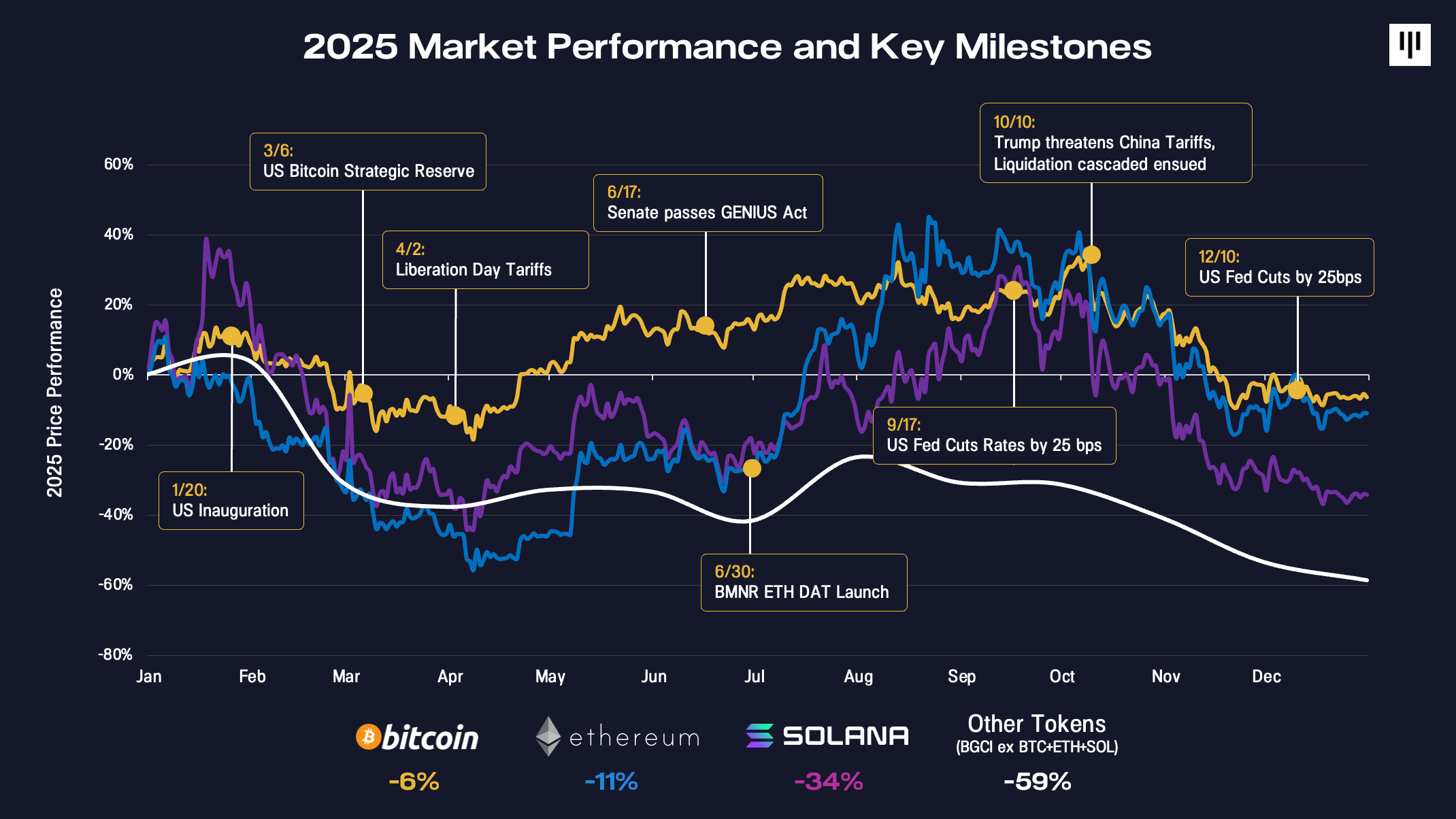
Fourth, capital is accelerating its concentration towards头部 with real demand. Stablecoins, RWA, and prediction markets showed clear product-market fit in 2026; BTC, ETH, and SOL-related assets continued to吸納 traditional增量资金 via ETF channels. Meanwhile, with regulatory frameworks like the 2025 GENIUS Act落地, non-compliant边缘 projects were further清退出市场. According to reliable research data, the liquidity space left for long-tail tokens and projects without real application scenarios is narrowing, with the median altcoin decline over the past year as high as 79%.
Of course, there's another noteworthy side to this batch of announcements. Polynomial not forcing a token launch, ZeroLend using its own airdrop份额 to compensate affected users, ENS果断砍掉 Namechain the moment it became unnecessary—these choices are actually not common in this industry. Clearing is painful, but it also筛选s: leaving behind teams truly willing to take responsibility for their users.
There are still over nine months left in 2026. This shutdown list will most likely continue to grow.
What exactly are those that survive凭的? That remains to be seen...