






The More Powerful AI Becomes, the More Valuable McDonald's Is


- Core Viewpoint: In early 2026, the rapid and successful application of AI technology triggered "AI anxiety" in the US capital market. Capital flowed out of potentially disrupted, asset-light tech stocks and poured into heavy-asset, low-obsolescence-risk (HALO) companies deemed "AI-proof." In contrast, the Chinese market exhibited the opposite logic, focusing more on the potential of AI to empower and enable applications.
- Key Elements:
- AI Triggers Industry Panic: AI product updates from companies like Anthropic directly led to significant stock declines in related sectors such as SaaS, cybersecurity, and banking IT, as the market grew fearful of AI's disruptive capabilities.
- The Rise of the HALO Concept: The investment community proposed a "Heavy Asset, Low Obsolescence-risk" (HALO) strategy, arguing that companies with physical assets—such as airlines (Delta), energy (ExxonMobil), and consumer staples (McDonald's)—are difficult for AI to replace.
- Divergent Market Performance: In early 2026, US stock sectors like energy and materials (heavy-asset) rose over 13%, while the information technology sector fell. During the same period, the Chinese capital market focused more on AI application stocks and their enabling potential.
- Historical Comparison and Differences: This panic differs from the 2000 dot-com bubble burst; it was triggered by "technology being too successful," and the AI giants themselves are also transforming into massive capital spenders.
- Markedly Different Sentiment in US vs. China Markets: The US market fears AI's "destructive power," with capital fleeing potential disruptees. The Chinese market focuses on AI's "helping power," chasing companies that can leverage AI to improve efficiency.
- Potential Overpricing: The author believes the market may have overpriced AI's destructive power. The capital flowing into HALO stocks includes a "fear premium," and this consensus may be an overcorrection.
Original Author: David, TechFlow
At the beginning of 2026, AI has scared the capital markets.
It's not that AI is ineffective; it's that AI is too effective. So effective that with every new product launch, a sector's stocks crash.
For example, throughout February, Anthropic, the parent company of Claude, intensively updated its AI products four times. AI can now automate enterprise workflows, SaaS software stocks crashed; AI can automatically scan code for vulnerabilities, cybersecurity stocks crashed; AI can help banks rewrite legacy code from last century, IBM plummeted 13% in a single day, wiping out $31 billion in market value, setting a record since the 2000 dot-com bubble.
One month, several industries, called out one by one.
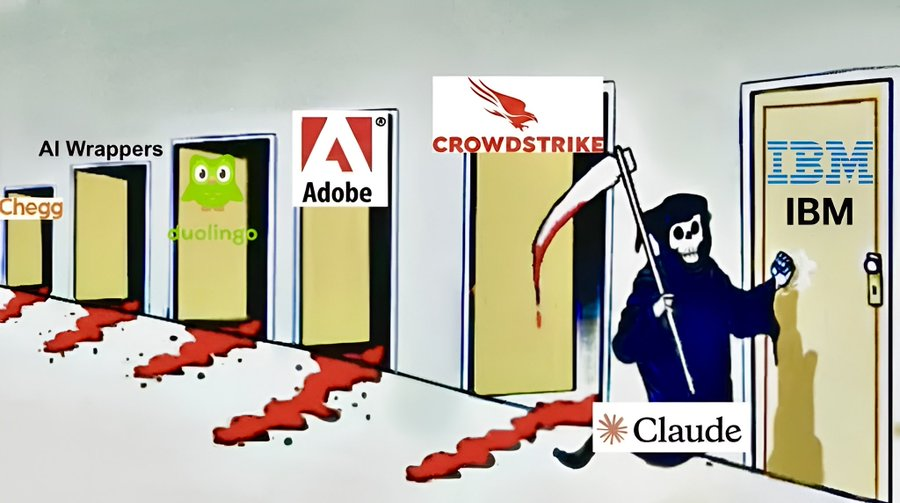
Panic is contagious.
The online education platform Duolingo, whose stock price was at an all-time high of $544 in May last year, fell below $85 by the end of February this year, evaporating over 80%. The iShares software ETF is down 22% year-to-date, 30% off its highs...
A trader told Bloomberg that software stocks have been continuously sold off, and a media headline like "AI will disrupt XX" can trigger a mini flash crash.
Money is fleeing these companies, but it has to go somewhere.
Following the AI investment trend is one path, like buying Nvidia, buying computing power, buying infrastructure... But this path is already crowded and getting more expensive.
Some are starting to ask another question: Is there a type of company that AI, no matter how it evolves, cannot kill?
HALO, Firing the First Shot Against AI Anxiety
In early February, a person named Josh Brown wrote an article on his blog.
This person is the CEO of a US asset management company and a regular guest on CNBC, essentially a financial influencer. In his article, he coined a term:
HALO.
Heavy Assets, Low Obsolescence.
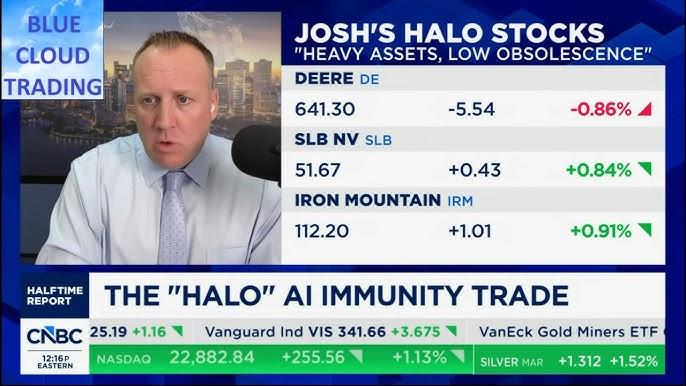
The meaning is simple: buy companies that AI, no matter how it evolves, cannot eliminate.
He also gave a simple identification method. The test for a HALO stock is just one: "Can you produce this company's product by typing a few words into a prompt box? If not, it's a HALO stock."
He gave an example.
Delta Air Lines and Expedia are both in the travel industry. This year, Delta is up 8.3%, Expedia is down 6%. What's the difference?
AI can help you find the cheapest flight, but you still have to board the plane. Delta has airplanes, Expedia only has a search box.
He also stated that this is the simplest investment logic he has ever seen.
For the past 15 years, Wall Street loved light assets. Software companies have no factories, no inventory, the cost to copy code is zero, profit margins are terrifyingly high. But now AI is here, and what AI is best at replacing is precisely these companies that make money from code and information asymmetry.
The tables have turned; now "heavy" is valuable.
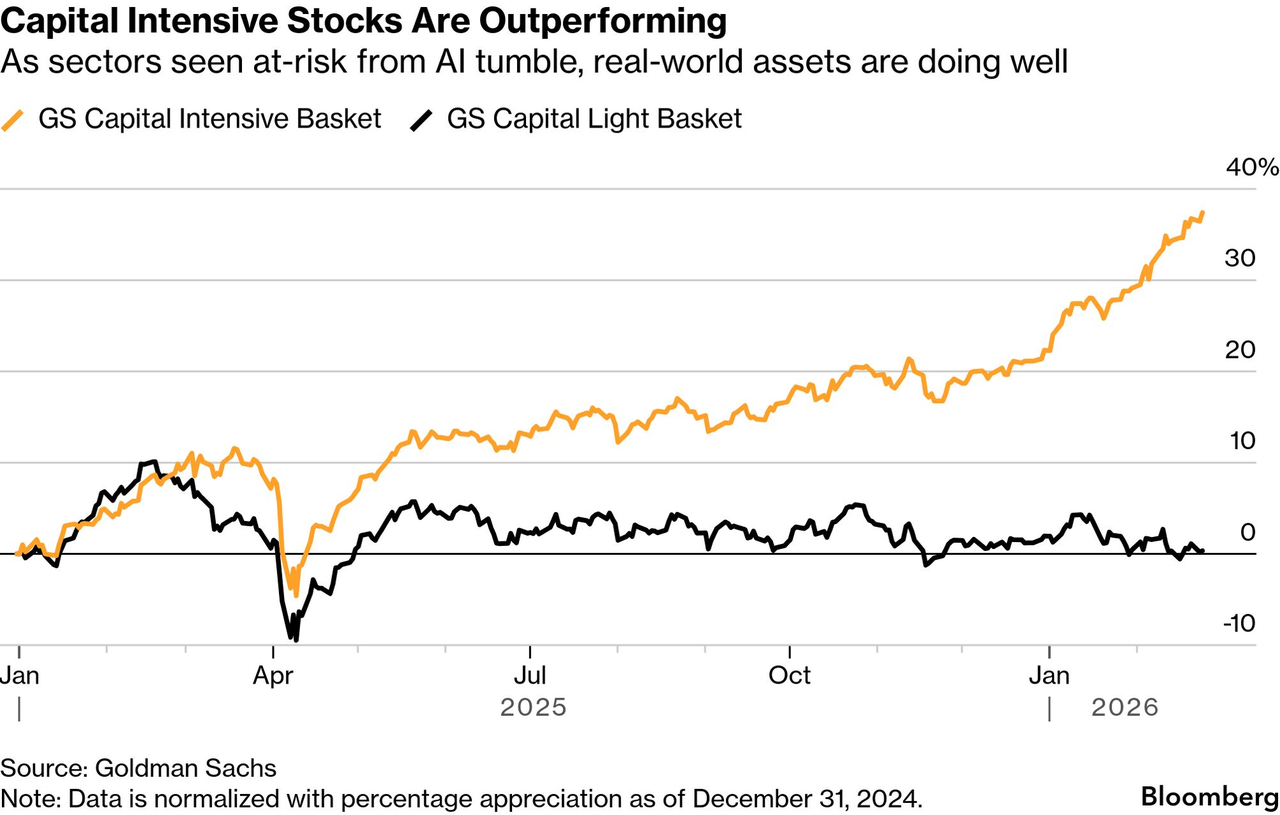
Within weeks of HALO's emergence, Goldman Sachs issued a formal research report titled "The HALO Effect"; data inside showed that from early 2025 to now, Goldman's portfolio of "heavy asset" stocks has outperformed its "light asset" portfolio by 35%.
Immediately after, Morgan Stanley's trading desk began using HALO to recommend targets to clients; Barclays and Bank of America also mentioned the term in their research notes. Axios, The Wall Street Journal, CNBC covered it intensively...
A term casually coined by a blogger became the biggest trading theme on Wall Street in 2026.
What does this mean? It's not that Brown is so brilliant; it's that people are genuinely panicked. So panicked that they need a term to tell themselves:
Don't be afraid, AI has disrupted many things, but there is a type of company that is safe.
The World is One Giant Heavy Asset
Do you think HALO is just a narrative? The capital market has already started voting.
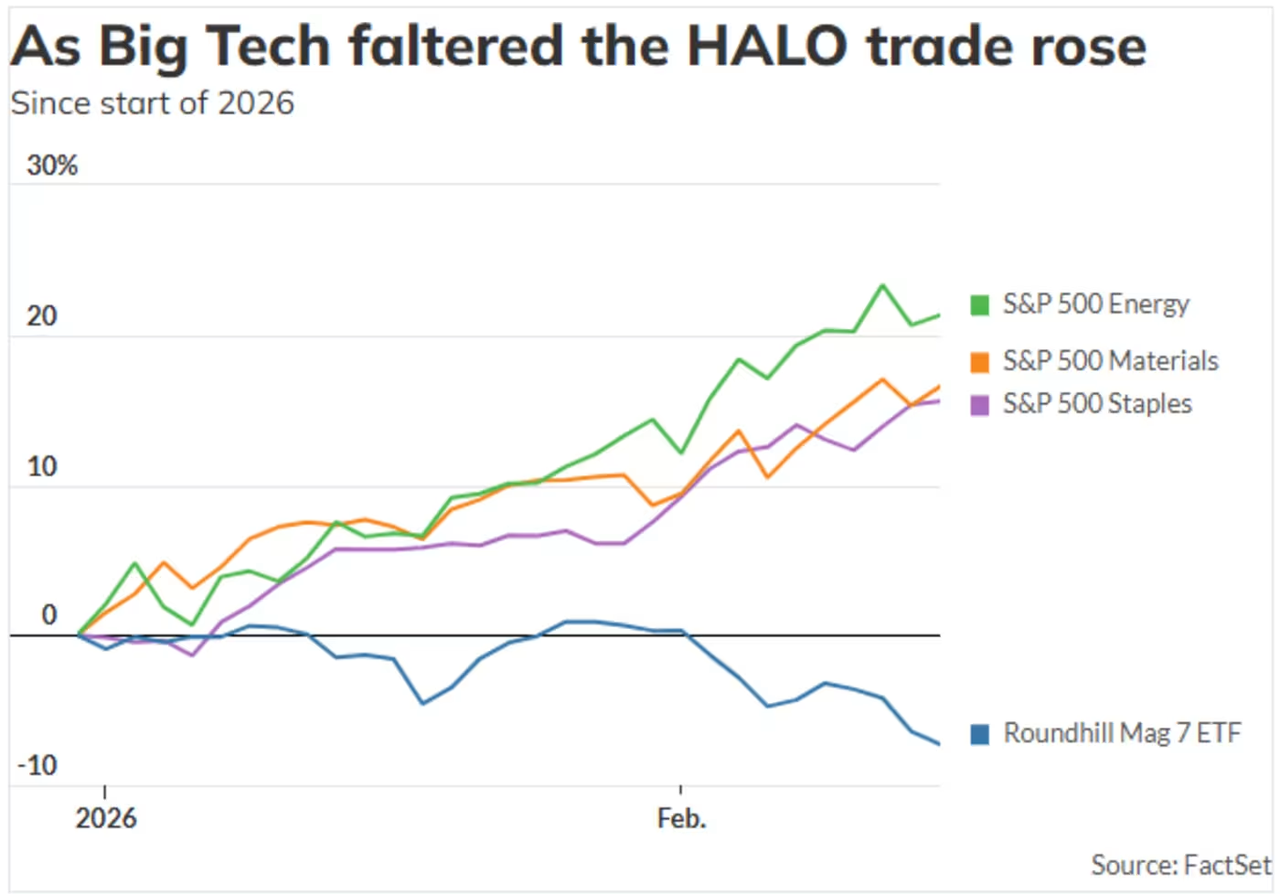
From the start of 2026 to the end of February, the S&P 500 Energy sector rose over 23%, Materials rose 16%, Consumer Staples rose 15%, Industrials rose 13%.
During the same period, the Information Technology sector fell nearly 4%, Financials fell nearly 5%.
Meanwhile, the "Magnificent Seven" US tech stocks collectively stalled. Alphabet, Amazon, Apple, Meta, Microsoft, Nvidia, Tesla—only two are up year-to-date.
Investors are worried whether these companies, burning hundreds of billions of dollars annually on computing infrastructure, can ever recoup their investments.
Specifically, what kind of companies are rising?
McDonald's, Walmart, ExxonMobil... selling burgers, running supermarkets, refining oil. AI can write poetry, code, and litigate, but it can't fry fries or drill for oil.
Budweiser has also risen 48% from last year to now, after all, you can't drink AI.
Therefore, HALO represents a flip in the capital market's valuation logic under AI anxiety. The last time such a flip happened was in 2000.
Back then, it was the same: investors fled tech stocks frantically, rushing into "boring" sectors like energy, industrials, and consumer staples. The Nasdaq fell from 2000 to 2002, evaporating nearly 80%, while the S&P Energy sector rose nearly 30% during the same period.
But there's a key difference. The dot-com bubble burst because the internet wasn't profitable, the story couldn't be sustained. This time it's a bit different:
AI is too capable, capable enough to be frightening.
Panic is not triggered by AI technology being too much of a failure; it's now panic triggered by technological success. This has almost no precedent in capital market history.
More ironically, AI companies themselves are also becoming heavy.
Goldman Sachs specifically mentioned in its report that the companies that most believed in the light-asset model in recent years are becoming the largest capital spenders in history.
The five tech giants' capital expenditures from 2023 to 2026 are projected to reach $1.5 trillion, with over $450 billion in 2026 alone, more than their total historical investment before the AI era combined.
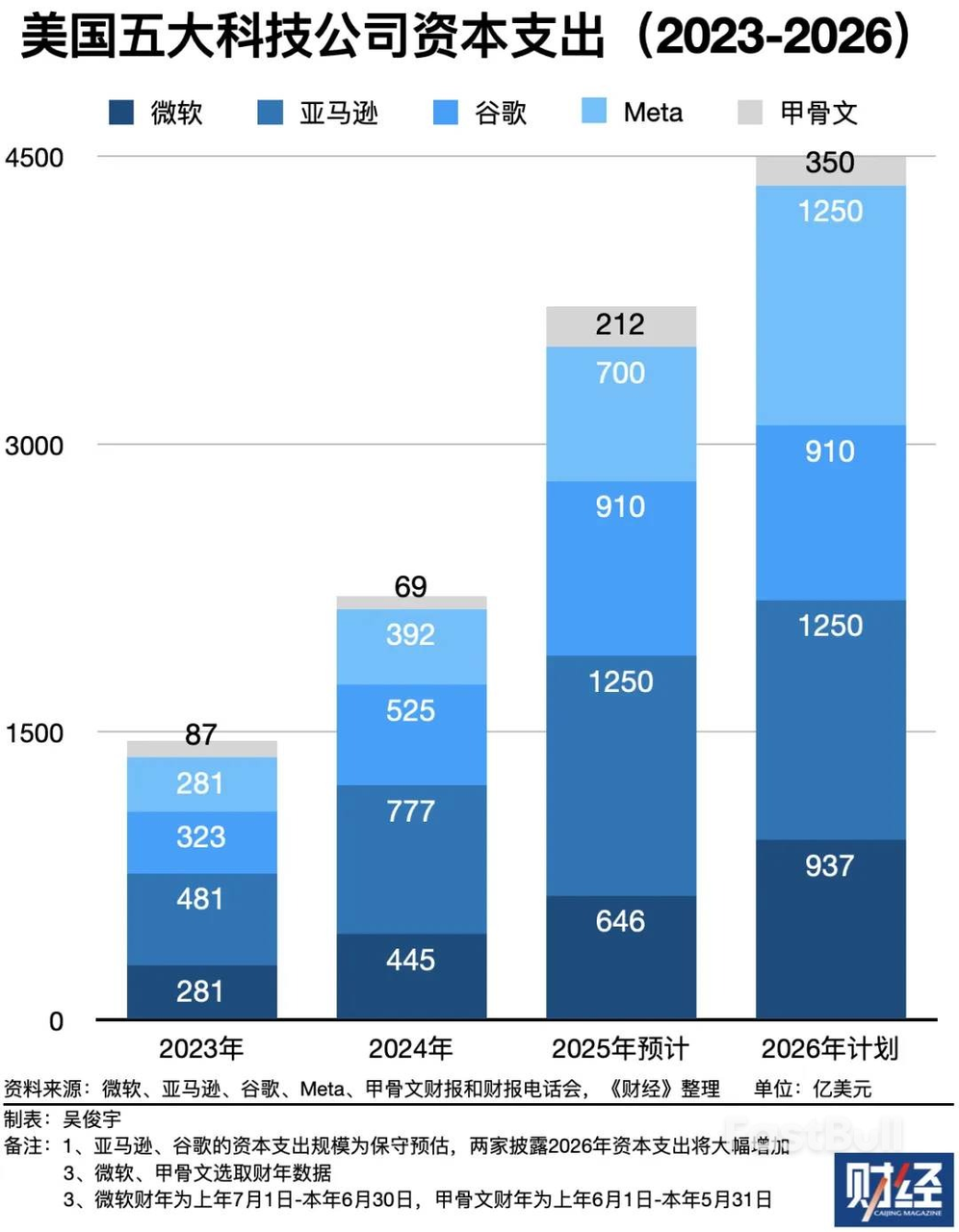
Source: Finance
Where is this money being spent? Data centers, chips, cables, cooling systems, power generation facilities. All heavy, expensive things in the physical world.
So you see an absurd picture:
AI shattered others' light-asset models, then itself became a heavy asset.
Companies claiming to disrupt the old world ultimately find they need the same things as the old world: factories, electricity, pipelines...
Wall Street chased "light" for 15 years, only to find that even AI itself cannot escape "heavy."
The US Hides in McDonald's, China Orders with Qianwen
At the same time, on the other side of the ocean, we provided a completely opposite answer.
Bloomberg published a report in late February, with a title roughly meaning: The Chinese market is resisting the global AI panic trade. There's a summary in the article I find very incisive:
The US market is focused on what AI can take away, the Chinese market is focused on what AI can help with.
The same technology, two completely opposite sentiments.
While US investors were inventing the term HALO and hiding in McDonald's and Walmart, Chinese investors were chasing AI application stocks.
JPMorgan gave "Buy" ratings to MiniMax and Zhipu in February this year; Goldman Sachs initiated new "Buy" recommendations for Biren Technology and Moore Threads around the same time; Bank of America analysts stated that AI Agents and their commercialization could be the biggest investment theme in the Chinese market for 2026.
For companies like Tencent and Alibaba, no one is worried they will be killed by AI; everyone is concerned about whether they can use AI to make more money.
Goldman Sachs said in a January report that Tencent is the biggest beneficiary of AI applications in China's internet sector, with every business line—gaming, advertising, fintech, cloud—being accelerated by AI.
Why are the reactions on the two sides completely opposite to the same wave?
US tech stocks have become too expensive over the past decade, so expensive that even a slight impact on their profit margins by AI makes their valuations unsustainable. Chinese tech stocks have just climbed out of a two-to-three-year trough, are cheap to begin with, and AI represents an incremental opportunity, not a threat.
But stock prices alone don't explain everything; the bigger difference lies in the soil.
Just as the HALO narrative was flourishing in US stocks, China had just experienced its most AI-infused Spring Festival in history:
Volcano Engine secured the exclusive AI cloud partnership for the CCTV Spring Festival Gala, Doubao became the exclusive AI partner for the CCTV Gala; Qianwen sponsored the Spring Festival galas of four major provincial TV stations (Oriental, Zhejiang, Jiangsu, Henan), Tencent's Yuanbao gave away 1 billion RMB in red packets, Baidu's Wenxin gave away 500 million. Alibaba was even more aggressive, with a 3 billion RMB "Spring Festival Treat Plan," using Qianwen to help order milk tea, delivering 1 million orders in 3 hours...
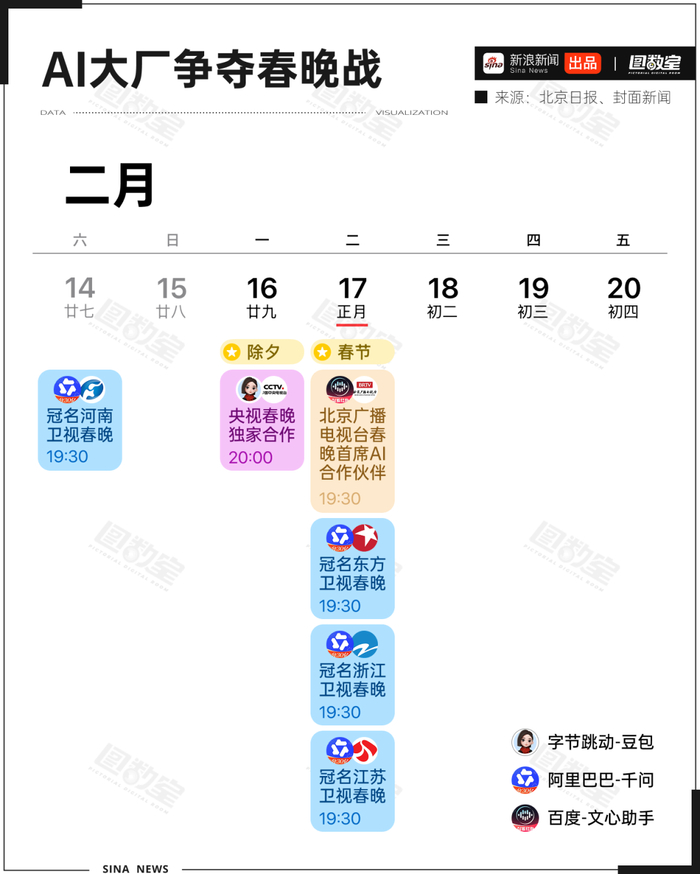
Source: Sina News | Data Visualization Lab
Four major tech giants spent over 4.5 billion RMB combined on AI marketing during the Spring Festival.
Ten years ago, it was WeChat and Alipay grabbing red packets during the Spring Festival Gala. Now it's Doubao and Qianwen. AI companies aren't treating the Spring Festival Gala as an advertising slot; they're treating it as a stage to popularize AI for the mass market.
The same fire is a disaster on dry wood, but provides warmth on damp wood.
The same AI wave: US capital is fleeing companies disrupted by AI, rushing into "AI-proof" companies; Chinese capital is chasing companies that can leverage AI well.
One side is chasing, the other is fleeing. The author feels the fleeing side is a bit overpriced.
The current situation is that AI's capabilities are being reasonably priced, but AI's destructive power is being overpriced. Funds rushing into HALO stocks are imagining who AI will kill, and running away in advance.
They've run to McDonald's, Budweiser, Walmart, etc. These are certainly good companies, but how much of their gains this year is due to performance, and how much is a premium paid for fear?
Wall Street's pendulum always overcorrects. In 2000, it thought all .coms were valuable; in 2002, it thought all .coms were scams. Now it thinks beer and tractors can also resist AI.
When this consensus becomes crowded enough, the next overcorrection isn't far away.
As for myself, here's how I see it:
AI is indeed getting stronger, there's no arguing that. But the distance between "getting stronger" and "killing an industry" is much farther than most people think.
Every technological revolution has the same script: first panic, then excessive flight, and finally discovering that the things fled from didn't die, but instead became cheaper because of the panic.
The internet didn't kill Walmart; Walmart learned e-commerce. Mobile payments didn't kill banks; banks learned to make apps.
What will truly be killed by AI are companies that shouldn't have existed in the first place—products with no moat, growth relying solely on financing, survival relying on information asymmetry.
These companies don't need AI to kill them; the economic cycle will.
So, the question perhaps was never "Will AI disrupt the world?" Each of us must ask ourselves: Does the company you invest in have the ability to turn AI into its weapon, rather than its obituary?
Those who can answer this question don't need HALO.


