Paradigm's New Arithmetic: When Crypto Can't Hold $12.7 Billion, AI Becomes the Answer


- Core Viewpoint: Top-tier global crypto venture capital firm Paradigm is planning to raise a new fund of up to $1.5 billion. Its investment focus will expand beyond solely cryptocurrency to include frontier technology areas such as artificial intelligence (AI) and robotics. The core strategy is to bet on the intersection of AI and Crypto, aiming to address the declining efficiency of deploying its massive capital within the crypto space and to seek a new growth narrative.
- Key Elements:
- Paradigm's assets under management (AUM) stand at $12.7 billion. However, its fund size has shrunk from $2.5 billion in 2021 to $850 million in 2024, reflecting the structural challenge of finding enough sufficiently large early-stage projects within the crypto space to effectively deploy its massive capital.
- The FTX implosion in 2022 resulted in a $278 million loss for Paradigm. This event prompted serious internal reflection and exploration of investment directions beyond crypto, such as AI.
- Paradigm co-founder Matt Huang has already taken concrete steps to position the firm at the intersection of AI and Crypto. These include investing $50 million in AI infrastructure company Nous Research, co-launching the AI security evaluation tool EVMbench, and founding stablecoin payments company Tempo.
- Its core logic is not a simple pivot to becoming a general AI investor. Instead, it is betting on the convergence of AI agents and programmable money (such as stablecoins, smart contracts), believing this to be a crucial future growth intersection.
- In 2025, 61% of global VC funding (approximately $258.7 billion) flowed into the AI sector. This provides Paradigm with a larger "capital pool" and growth story than the current crypto space, which is better suited to support its $1.5 billion fundraising target and persuade its limited partners (LPs).
Let's start with a math problem.
A VC firm manages $12.7 billion in assets. Its previous fund raised $850 million. The one before that raised $2.5 billion.
The trend is going the wrong way.
The scale is shrinking, not because it can't raise money, but because there aren't enough worthwhile bets to place. Now, this firm wants to reverse this curve. Where does it need to go to find the next big enough pool?
On February 28, 2026, *The Wall Street Journal* provided the answer: Cryptocurrency investment firm Paradigm is raising a new fund of up to $1.5 billion, expanding its investment focus to include artificial intelligence, robotics, and other frontier technologies.
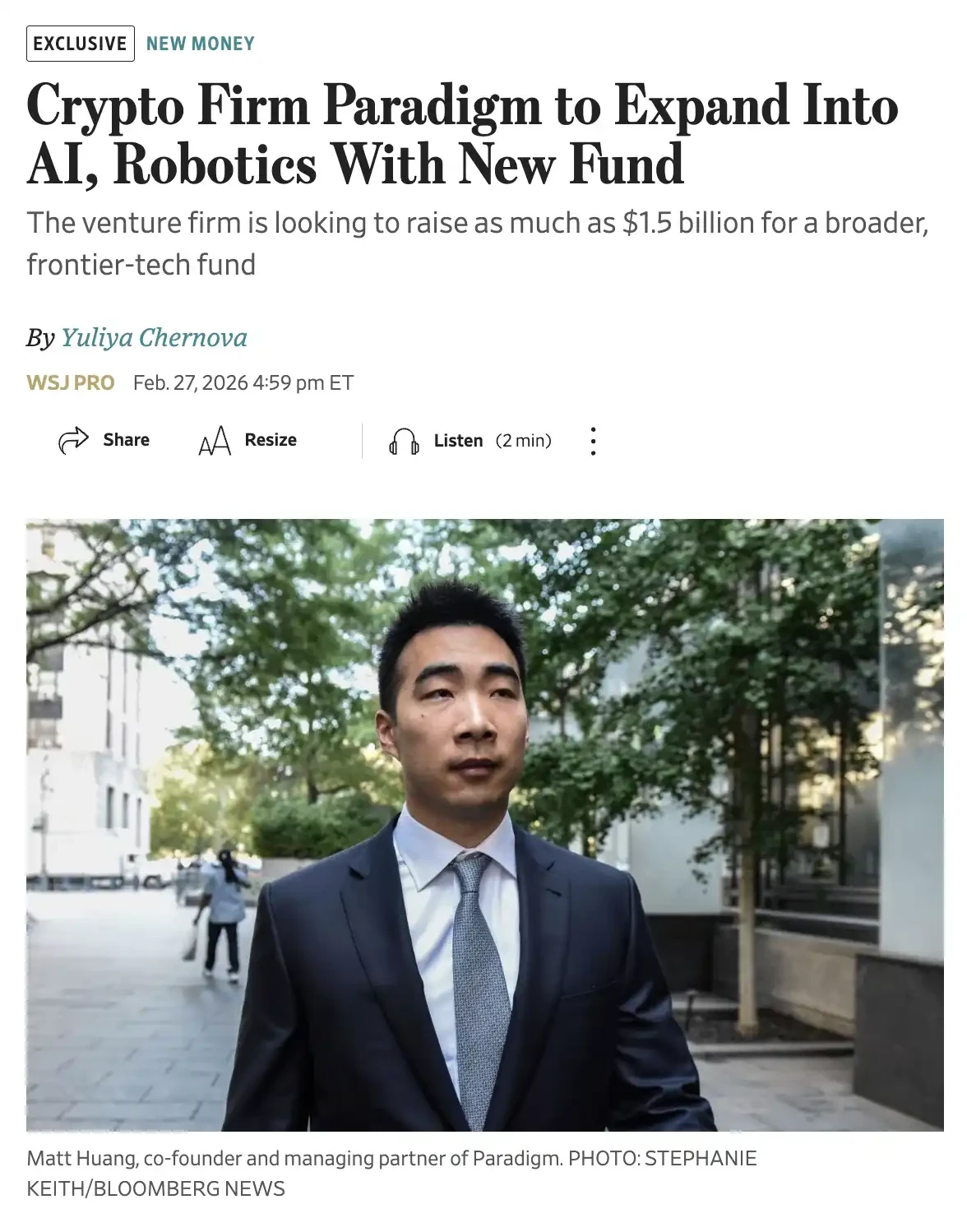
This is not a sudden decision. It's a math problem that has been calculated for a long time, with the answer only being announced today.
First, Let's Look at the Numbers
In 2025, the total global VC investment in cryptocurrency reached $49.8 billion. That sounds like good news. But looking at just this one number would lead to a misjudgment.
In the same year, the number of crypto VC deals plummeted by approximately 60% year-over-year, from about 2,900 deals to 1,200 deals. Money is increasing, but projects are decreasing. The funds flowing into the crypto space are increasingly concentrated in a few large deals rather than being dispersed across hundreds of early-stage projects.
For the vast majority of small and medium-sized funds, this might not be a problem. But for Paradigm, this is a structural issue. Paradigm manages $12.7 billion in assets, making it one of the largest crypto-dedicated VCs globally. Its problem isn't finding projects; it's finding enough large, early-stage projects to deploy capital at its scale while maintaining its accustomed return expectations.
In 2021, Paradigm raised the largest cryptocurrency fund in history at $2.5 billion. In 2024, it announced its third fund at $850 million, only one-third the size of the previous one.
This contraction is not a sign of weakness; it's an active adaptation to a narrower market. But it also indicates one thing: relying solely on crypto, Paradigm was already struggling to find a path forward for its scale.
After FTX, Paradigm Started Asking a Question
To understand today's $1.5 billion, we must go back to November 2022.
That month, FTX collapsed. Sam Bankman-Fried's empire turned to ashes in days, taking the money of countless institutions with it. Paradigm's book investment in FTX was $278 million. It all eventually went to zero.
For a top-tier firm known for being "research-driven" and priding itself on its technical vision, this wasn't just a bad debt. It was a public misjudgment that needed explanation to its LPs, to the market, and to itself.
What happened next seemed quite strange at the time. In 2023, people noticed subtle changes on Paradigm's official website: all mentions of "crypto" and "Web3" were removed, replaced by the more neutral term "technology investing."
This change had no official announcement but was quickly discovered by the community, sparking intense discussion. The biggest doubt was: Is Paradigm running away?
Co-founder Matt Huang had to step in to douse the flames. He tweeted that Paradigm had "never been more excited about crypto," while adding: "The developments in AI are too compelling to ignore. Framing AI and crypto as a zero-sum competition is a popular but false narrative. We don't buy it. Both are interesting and will have massive overlap."
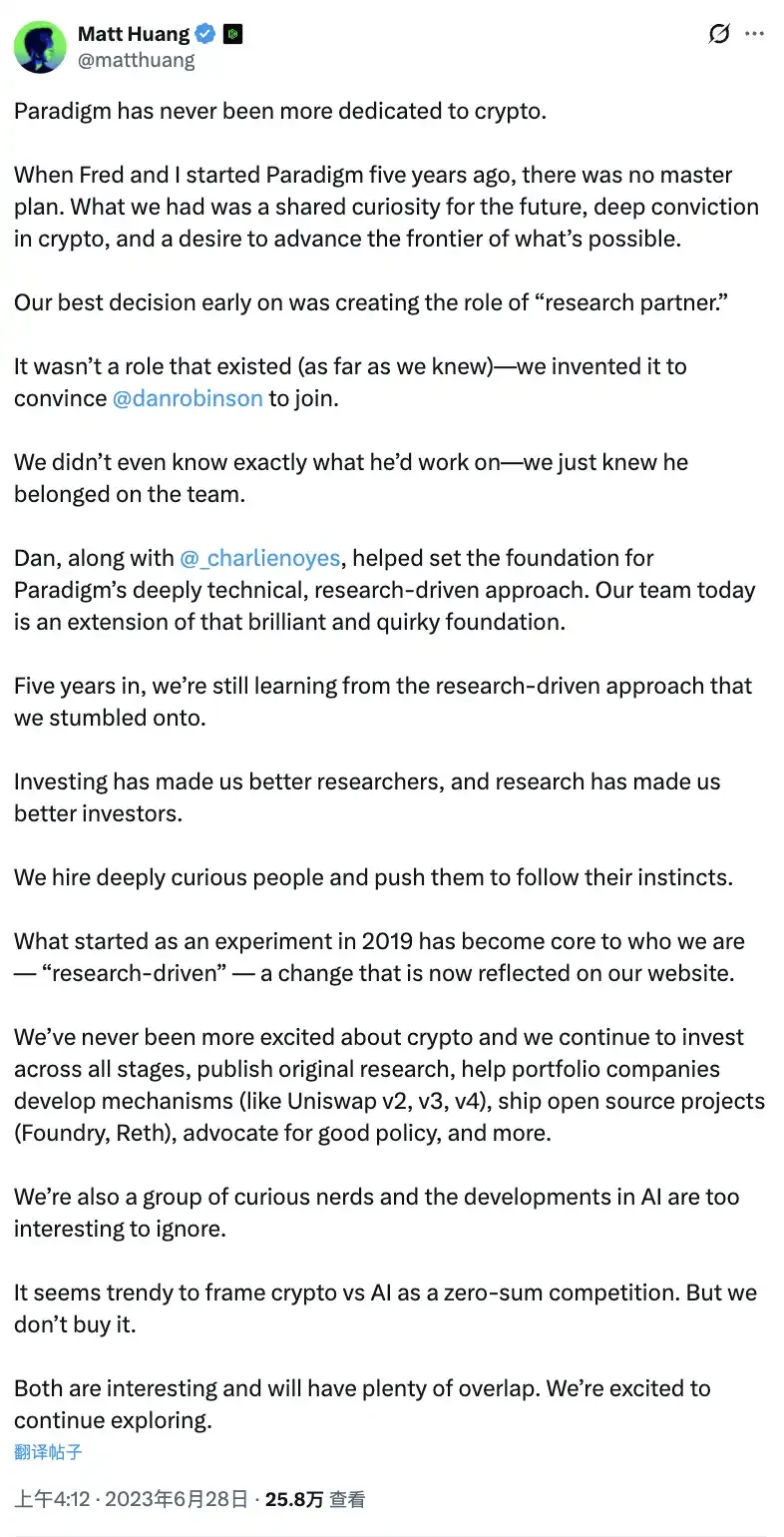
This was a PR-driven clarification, but it also stated a real fact: internally, Paradigm was already seriously considering AI.
After FTX, the question it was forced to answer was: What to bet on for the next decade?
Matt Huang Has Already Been Working on the Answer
If you only look at Paradigm's official announcements, the firm's pivot seems to have started today. But if you look at Matt Huang's actual moves over the past two years, you'll find he has long ceased to be just a crypto investor.
In 2024, Paradigm invested $50 million in Nous Research, an AI infrastructure company focused on open-source large language model research and development. This wasn't a small "exploratory" test; $50 million is a serious bet at Paradigm's scale.
In February of this year, Paradigm also co-released EVMbench with OpenAI, a benchmarking tool to evaluate different AI models' ability to detect and patch smart contract security vulnerabilities. Crypto's core infrastructure met AI capability assessment; the two things were placed on the same table.
Simultaneously, Matt Huang was building another company: Tempo. This is a stablecoin payments infrastructure company. Matt Huang is a co-founder, and his board membership at Stripe aligns perfectly with this direction. Stripe established a strategic partnership with Paradigm in 2025, and Stripe also launched its stablecoin payments product that year.
Looking at these together, Matt Huang isn't "planning to invest in AI"; he has been living at the intersection of AI and crypto for at least two years.
He's not betting on AI, nor is he betting on crypto. He's betting that these two things will collide at some point. And when AI agents need to execute transactions on-chain, when robots need a programmable monetary system, that collision point will be Paradigm's next main battlefield.
Why AI×Crypto, Not a Pivot to AI
Paradigm's move into AI doesn't mean it's competing with a16z or Sequoia for the same batch of projects.
There's a narrative mistake easily made here: interpreting Paradigm's new fund as "another VC pivoting to AI." But if that were the case, it would have no advantage; the general AI track is already crowded with traditional VC giants with deeper backgrounds and stronger resources.
Paradigm's real logic is: it doesn't intend to fight for the general AI pie; it wants to bet on the intersection that others haven't yet clearly seen.
AI agents are one of the hottest concepts today. These intelligent agents capable of autonomously executing tasks have already started replacing humans in various scenarios: searching, coding, analyzing data, managing workflows. But there's one thing they haven't solved: money.
When an AI agent needs to pay, receive payments, or transfer funds between different services, what does it use? PayPal? Bank accounts? These systems are designed for humans, requiring identity verification, manual authorization, and are incompatible with the logic of autonomous machine execution.
But stablecoins can. Smart contracts can. Programmable money can.
This is why Matt Huang is simultaneously working on Tempo (stablecoin payments) and investing in Nous Research (AI infrastructure): he believes these two lines will eventually merge, and Paradigm has the ability to place bets on both sides and capture the maximum return at the moment of convergence.
This isn't a pivot; it's an expansion. An expansion into a place he believes others haven't fully understood yet.
LPs Need a New Story
There's also a practical level that must be clarified.
Paradigm's LPs, the institutions and individuals who entrusted their money to it, saw the ambition of a $2.5 billion fundraise in 2021 and the restraint of a contraction to $850 million in 2024.
Such a vast difference between two fund sizes requires an explanation. Even more, it requires a compelling narrative for the next fund.
"Continue investing in early-stage crypto projects" – this story was already difficult to support a $1.5 billion fundraising target in 2024. But "leveraging crypto's technical advantages to enter frontier technology during the hottest era for AI and robotics" – that can.
In 2025, 61% of global VC funding flowed into the AI sector, totaling approximately $258.7 billion. This is the largest pool in venture capital today. The $1.5 billion Paradigm is raising this time is meant to draw water from this pool, not continue guarding a shrinking lake. For LPs, this is a bigger story and a more credible growth logic.
Now we can return to 2023. That year, when Matt Huang was forced to clarify the website rebranding incident, he said this: "AI and crypto are not a zero-sum competition."
At the time, this statement felt more like a defense. Reassuring the community, preventing LP panic, while leaving room for AI exploration. But if you read it again in today's context, it sounds more like a preview.
Paradigm took three years to emerge from the ruins of FTX. It didn't choose the easiest path of shrinking scale, focusing solely on crypto, waiting for the next bull market. It chose a harder but more imaginative path: betting on the convergence of AI and crypto, establishing positions in both tracks simultaneously, and waiting for the moment they meet.
Today's $1.5 billion fund is a milestone on this path at its current stage.
Matt Huang hasn't publicly responded to today's *Wall Street Journal* report yet. But his Tempo is still being built, Nous Research is still running, and EVMbench has been released.
He doesn't need to explain anymore. Those actions have already spoken more clearly than any statement.