BMX Year in Review: Value Unlocked Through Growth, Mechanisms, and Ecosystem Synergy



- Core Viewpoint: The significant value growth of BitMart's platform token BMX in 2025 was not solely driven by market sentiment. Instead, it stemmed from a value revaluation propelled by multiple structural factors, including deeper integration with platform business, a sustained deflationary mechanism, and expansion into real-world payment scenarios.
- Key Factors:
- Deep Integration with Platform Business: BMX is embedded into core functional benefits such as Slippage Protection and Staking for Loans, granting holders priority access. This creates a direct link where demand for BMX is driven by platform business growth.
- Sustained Deflationary Mechanism: The platform allocates 20% of its quarterly fee revenue to repurchase and burn BMX. With 4 buybacks completed in 2025, the cumulative historical burn has reached 36% of the initial total supply, continuously contracting the supply long-term.
- Breakthrough in Payment Scenarios: BMX has been officially integrated into the BitMart Card payment system, beginning its circulation in real-world consumption. This shifts part of its value anchor from investment expectations towards immediate utility.
- Formation of an Ecosystem Loop: Within the platform, BMX has established a multi-scenario application path encompassing "trading — wealth management — lending — consumption," increasing its usage frequency and creating genuine demand.
- Independent Market Performance: During certain periods, BMX's price increase outperformed mainstream assets, indicating that the market has begun to view it as an asset with independent fundamentals, leading to a value revaluation.
As 2025 draws to a close, various exchanges have begun releasing their annual operational data. For a year marked by market volatility and structural divergence, these reports are more than just simple scorecards; they serve as crucial windows into the shifting industry landscape—who is expanding, who is contracting; which business lines are growing rapidly, which models are being marginalized; and what role platform tokens play within this dynamic.
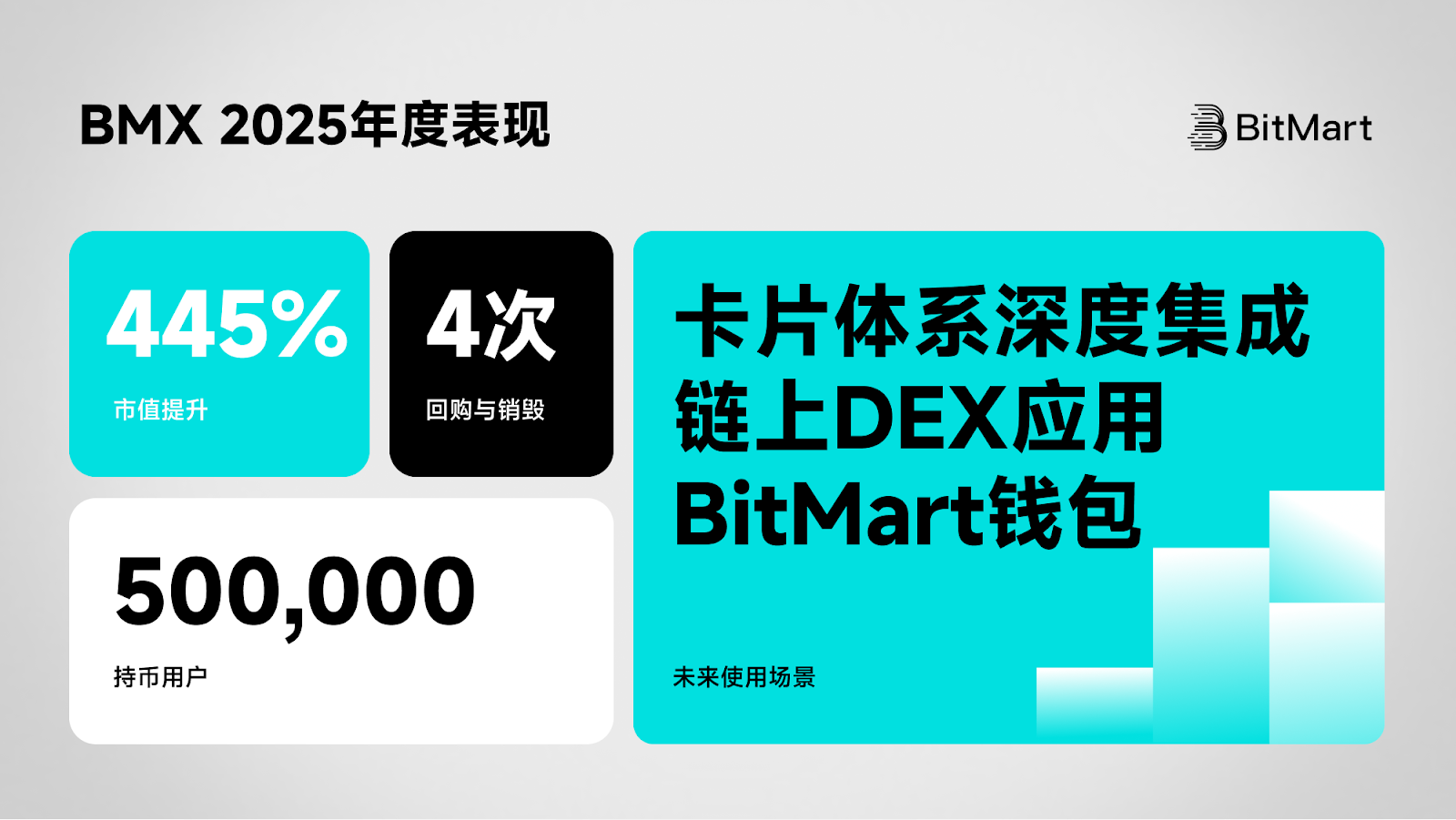
Among these, a set of figures in BitMart's 2025 Annual Summary Report stands out: BMX's market cap grew from approximately $35 million at the beginning of the year to $156 million, representing an annual increase of about 4.45x; a total of over 7.44 million tokens were repurchased and burned across four rounds throughout the year; the number of token holders surpassed 500,000; and BMX was officially integrated into the BitMart Card payment scenario.
If viewed solely through the lens of price appreciation, this might seem like just another platform token riding the bull market wave. However, when these figures are broken down into aspects of supply structure, utility scenarios, and user behavior, it becomes apparent that this resembles more of an adjustment in "value logic"—BMX's rise may not be solely driven by market sentiment but is closer to a structural revaluation.
This article attempts to analyze BMX's advancement path from three perspectives: platform fundamentals, token mechanisms, and the industry environment.
Platform Dimension: The Evolving Role of Exchanges
The ceiling of a platform token has always been determined by the platform itself.
Over the past few years, the positioning of centralized exchanges has gradually shifted. They are transitioning from mere trading venues to comprehensive financial service platforms—with features like wealth management, lending, card payments, on-chain products, and wallet tools becoming standard. In this evolution, platform tokens are no longer just "fee discount coupons" but are taking on the role of ecosystem connectors.
In 2025, BitMart advanced several upgrades at the product and activity level. Whether it was the Slippage Protection Plan, the Loss Compensation Mechanism, or the Staking & Borrowing feature, BMX began to be tied to core user benefits. For example, in the second phase of the Slippage Protection Plan, BMX holders enjoy higher compensation limits and priority review channels; in the "Staking & Borrowing" product, users staking BMX can not only borrow liquid assets but also earn interest. This design essentially reinforces a signal—holding BMX equates to holding priority access to certain platform functionalities.
From a third-party perspective, this deep integration means that the demand for BMX is not entirely dependent on market sentiment but forms a transmission relationship with the platform's business growth. When platform activity and product penetration increase, token demand naturally finds support.
Mechanism Dimension: The Long-Term Impact of the Deflationary Model
If platform business determines the demand side, then the buyback and burn mechanism acts on the supply side.
Public information shows that BitMart allocates 20% of its quarterly fee revenue to repurchase and burn BMX, with a target of burning 500 million tokens. The cumulative historical burn amount currently accounts for 36% of the initial total supply. The four repurchase rounds in 2025 continued this rhythm, steadily reducing the circulating supply.
Within the platform token sector, deflation is not a new concept, but the key lies in whether it is institutionalized and sustained. A one-time burn is more akin to marketing, whereas a stable repurchase program aligns more closely with the logic of financial dividends. The gradual contraction on the supply side creates a long-term anchor for BMX's price and improves market expectations regarding its scarcity.
From an industry observation standpoint, platform tokens of small to medium-sized exchanges often lack sustained burning capabilities, while top-tier platform tokens rely on scaled revenue to support repurchases. BMX currently sits between these two stages: its market cap remains relatively low, but its mechanism is relatively clear. Its value appreciation does not rely on a single event but on the gradual optimization of its supply-demand structure.
Of course, any deflationary model must be built upon genuine revenue. If the platform's business growth slows, the intensity of repurchases will naturally be affected. Therefore, the deflationary mechanism acts more as an "amplifier" rather than the sole source of value.
Utility Dimension: From Trading Benefits to Real-World Consumption
More important than price is usage frequency.
In 2025, the integration of BMX into the BitMart Card payment scenario was seen by many users as a critical milestone. A platform token entering a payment system signifies its participation in real-world consumption flows, moving beyond the internal circulation within the exchange.
When a token can be used directly on the consumption end, its value anchor shifts from being confined to "future price appreciation expectations" towards "present usable value." This is also a significant step in the transformation of a platform token from a financial instrument to an ecosystem asset.
Simultaneously, various types of activities allow BMX holders to participate in purchasing popular assets at discounted prices, further strengthening its liquidity attributes within the platform. Combined with the overlay of staking & borrowing and user protection mechanisms, BMX is gradually forming a closed-loop path of "trading – wealth management – lending – consumption" within the platform ecosystem.
From a third-party evaluation perspective, this multi-scenario penetration is a necessary stage in the evolution of platform tokens. Early-stage BNB also underwent a similar path—first tied to fee discounts, then expanding to Launchpad, payments, and on-chain ecosystems. The current position of BMX resembles the mid-stage of this process.
Industry Background: Intensifying Structural Competition
Competition within the platform token sector is entering a "structural phase."
Top assets like BNB and OKB have established stable ecosystems with relatively mature valuations; other platform tokens seeking capital attention must differentiate themselves through mechanisms or utility scenarios. The staged rise of BMX in 2025 was partly due to the market's repricing of its improved fundamentals.
It is worth noting that BMX's recent performance has not entirely mirrored broader market fluctuations. In certain months, its gains significantly outperformed mainstream assets, exhibiting a degree of Alpha characteristics. Such price action typically indicates that market capital is beginning to view it as an independent asset rather than a simple Beta follower.
However, industry cycles remain a variable that cannot be ignored. Platform token prices are highly correlated with exchange business, which in turn is linked to overall market activity. During phases of macro liquidity contraction, platform tokens also find it difficult to remain immune.
According to public plans, BMX will further extend into wallet systems, on-chain DEXs, and card ecosystems in the future. This suggests its role may transition from a single platform token to a cross-product utility tool.
If trading, payments, wallets, and on-chain products form a unified account system, the circulation frequency of BMX within it will significantly increase. For a token, frequency is often more important than total volume—frequent circulation implies genuine demand, and genuine demand is the source of long-term value.
Returning to BMX itself, the 2025 data appears more like a staged signal rather than an endpoint. The expansion of platform business, the rhythm of repurchases, and the increase in utility scenarios are gradually pushing this platform token from a single trading tool towards a more complex position within the ecosystem. For users, the significance of this change lies not in short-term price volatility but in the token beginning to participate in real business cycles—it is no longer just held, but used.
Of course, the growth of platform tokens is never linear. The business pace of the exchange, shifts in market cycles, and the competitive industry landscape can all impact token performance. The path currently demonstrated by BMX shares many similarities with the early stages of mature platform tokens, but whether it can translate its mechanistic advantages into long-term ecosystem value depends on the subsequent implementation of products and the sustainability of user engagement.
The changes in BMX over this past year indicate at least one thing: the market is becoming more willing to price in clear mechanisms and genuine utility scenarios. Whether this pricing will persist is itself a part worth observing in the coming period.