






We all worry about being replaced by AI, but what did Citrini's doomsday scenario overlook?


- Core Viewpoint: A fictional scenario report about AI triggering a future economic crisis caused short-term market panic and widespread discussion. Its core logic chain relies on aggressive assumptions regarding the speed of technological replacement, the transmission mechanism of demand, and the likelihood of a financial crisis. Counterarguments emphasize the buffering effects of institutional inertia, historical patterns, and policy intervention.
- Key Elements:
- The report fictionalized a 2028 scenario where large-scale AI replacement of white-collar workers leads to consumption contraction, SaaS asset defaults, and triggers a financial crisis. Its release caused significant stock price drops for related companies on the same day.
- Empirical research supporting its view shows that companies highly exposed to AI have indeed reduced online labor expenditures by approximately 15%, with AI replacement costs being far lower than human labor.
- Critics argue the report underestimates the resistance of "institutional momentum." The history of technology diffusion shows that moving from maturity to widespread penetration takes time, and technological shocks can create new output and demand in the long run.
- The report conflates demand-side deflation with supply-side deflation (where technological progress lowers costs). The latter may unleash new demand through the "Jevons paradox," while the "Moravec's paradox" suggests some physical labor jobs are more resilient.
- The transmission from an employment shock to a financial crisis is questioned. Current resilience indicators of the US financial system (e.g., bank capital adequacy ratios) are far superior to 2008 levels, and the government has both the capability and precedent (e.g., pandemic stimulus) for large-scale fiscal intervention.
- The fundamental disagreement lies in the judgment of the speed of technological impact versus the adaptive capacity of institutions, and whether micro-level industry shocks can be linearly extrapolated into macro-level systemic risk.
- The article's fundamental issue may be underestimating the dynamic adjustment capabilities of human society's institutions, culture, and policy responses, which constitute a distributed buffering mechanism against shocks.
Excellent articles can make the market confuse "scenario simulation" with "realistic prophecy."
On February 22, 2026, a report titled "The 2028 Global Intelligence Crisis" exploded on social media and financial markets, garnering over 27 million views. On the day of its release, IBM plunged 13%, while stocks of companies like DoorDash, American Express, and KKR all fell by more than 6%.
This report came from James van Geelen, founder of Citrini Research. This 33-year-old researcher has over 180,000 followers on X, and his Substack ranks first among financial writers. He focuses on thematic equity investments and global macro research, known for a cross-asset, lateral thinking style, with his real portfolio achieving over 200% returns since 2023. The report, in the form of a scenario simulation, constructs a fictional future set in 2028: AI massively replaces white-collar labor within just two years, triggering consumption contraction, software asset defaults, credit tightening, and ultimately pushing the economy into a distorted state of "technological boom" coexisting with "social recession." Van Geelen noted at the beginning: "This article is about a possible scenario, not a prophecy." But the market clearly had no patience to distinguish between the two.
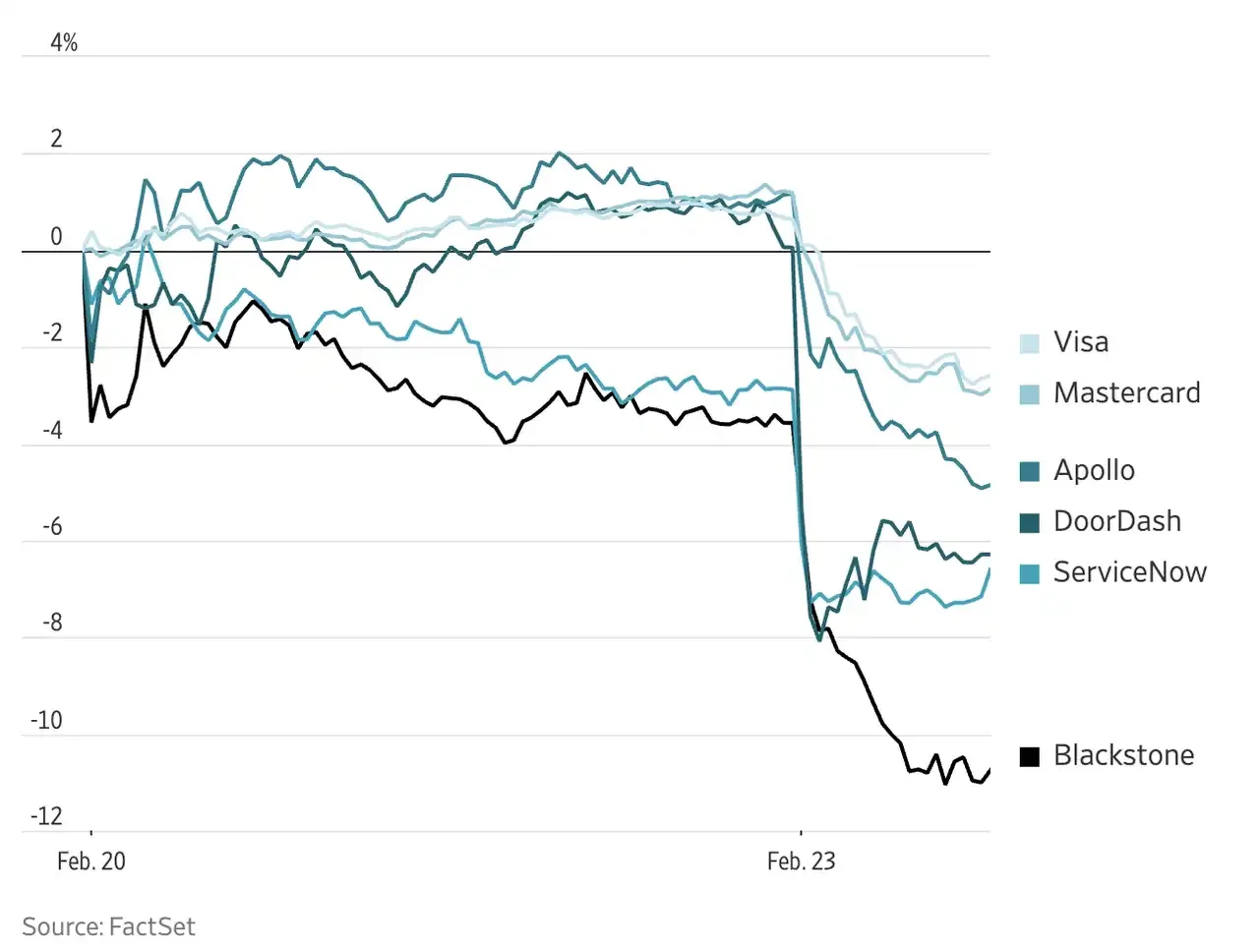
However, more noteworthy than the brief market panic is the widespread discussion this article has sparked over the past few days. From academia to investment circles, from Wall Street to the Chinese internet, over a dozen response articles from different angles have emerged. Perhaps, instead of trusting any single extreme conclusion, we can piece together a clearer future from the "disagreements and overlaps" of various viewpoints.
What Citrini Said
The logical thread in Citrini's article is not complex: leaps in AI capability lead to large-scale replacement of white-collar jobs → rising unemployment triggers consumer spending contraction → structured financial products with SaaS as underlying assets face a wave of defaults → credit tightening spreads to the broader financial system → the economy falls into a distorted state of "technological boom" coexisting with "social recession."
Each link in this causal chain is not unfounded. But connecting them end-to-end and extrapolating them seamlessly into a crisis requires a series of rather radical underlying assumptions.
There are many ways to deconstruct this chain. We might as well proceed along three core sub-arguments: the speed and scale of labor replacement, the transmission mechanism of demand collapse, and the possibility of a financial crisis, examining what different voices are actually debating around each link.
No Destruction, No Construction
The starting point of Citrini's simulation is the large-scale replacement of white-collar labor by AI. In his narrative, this process accelerates dramatically between 2026 and 2028, with practitioners in fields like law, financial analysis, software development, and customer service being the first affected.
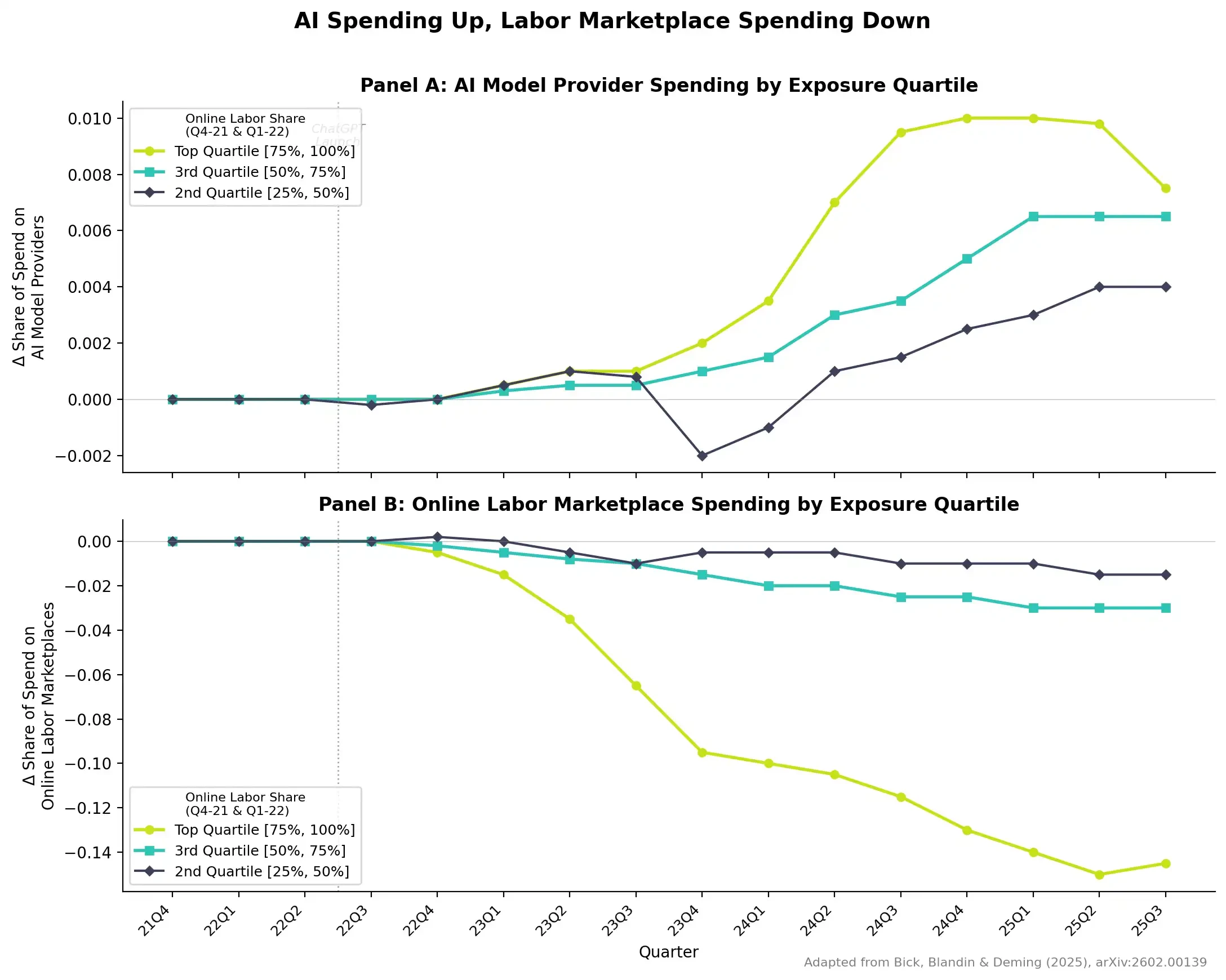 Change in corporate spending share on AI model providers and online labor platforms, grouped by industry AI exposure level
There is indeed evidence supporting Citrini's view. An empirical study based on corporate spending data by Bick, Blandin, and Deming shows that after the release of ChatGPT, firms with the highest AI exposure (i.e., those with the largest pre-existing spending share on online labor markets) significantly increased their spending on AI model providers while reducing spending on online labor markets by about 15%. Notably, this substitution is not a "dollar-for-dollar swap"—for every $1 reduction in labor market spending, firms increased AI spending by only $0.03 to $0.30. In other words, AI is completing equivalent workloads at a far lower cost than human labor.
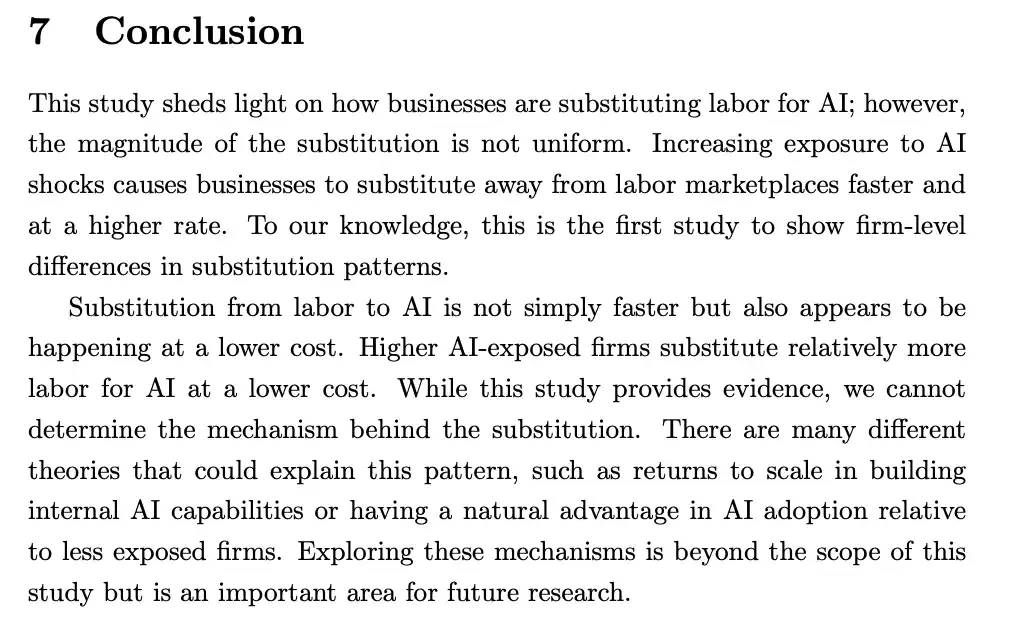
However, Citrini may have overestimated the speed of this transition. A rebuttal uses the U.S. real estate agent industry as an example; despite technology having long had the capability to drastically reduce the number of agents, the industry still employs over 1.5 million people today. Institutional inertia, regulatory barriers, and internal industry interest conflicts form a defense far more robust than technology. The critic argues that Citrini severely underestimates the resistance of "institutional momentum."
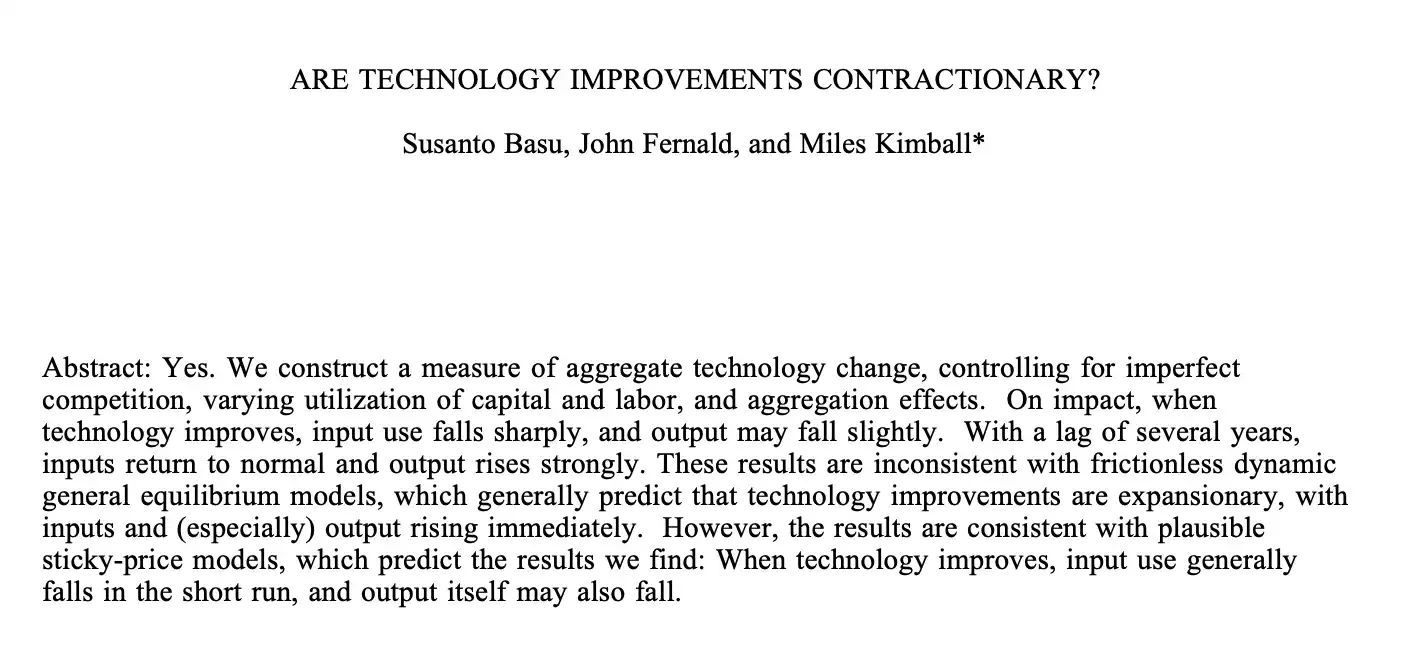
Another rebuttal cites a 1998 study by Kimball, Basu, and Fernald, pointing out that technological shocks in history have often been positive stimuli to the supply side—they may be accompanied by adjustments in employment structure in the short term, but in the long run, the output space they create is far greater than the jobs they destroy.
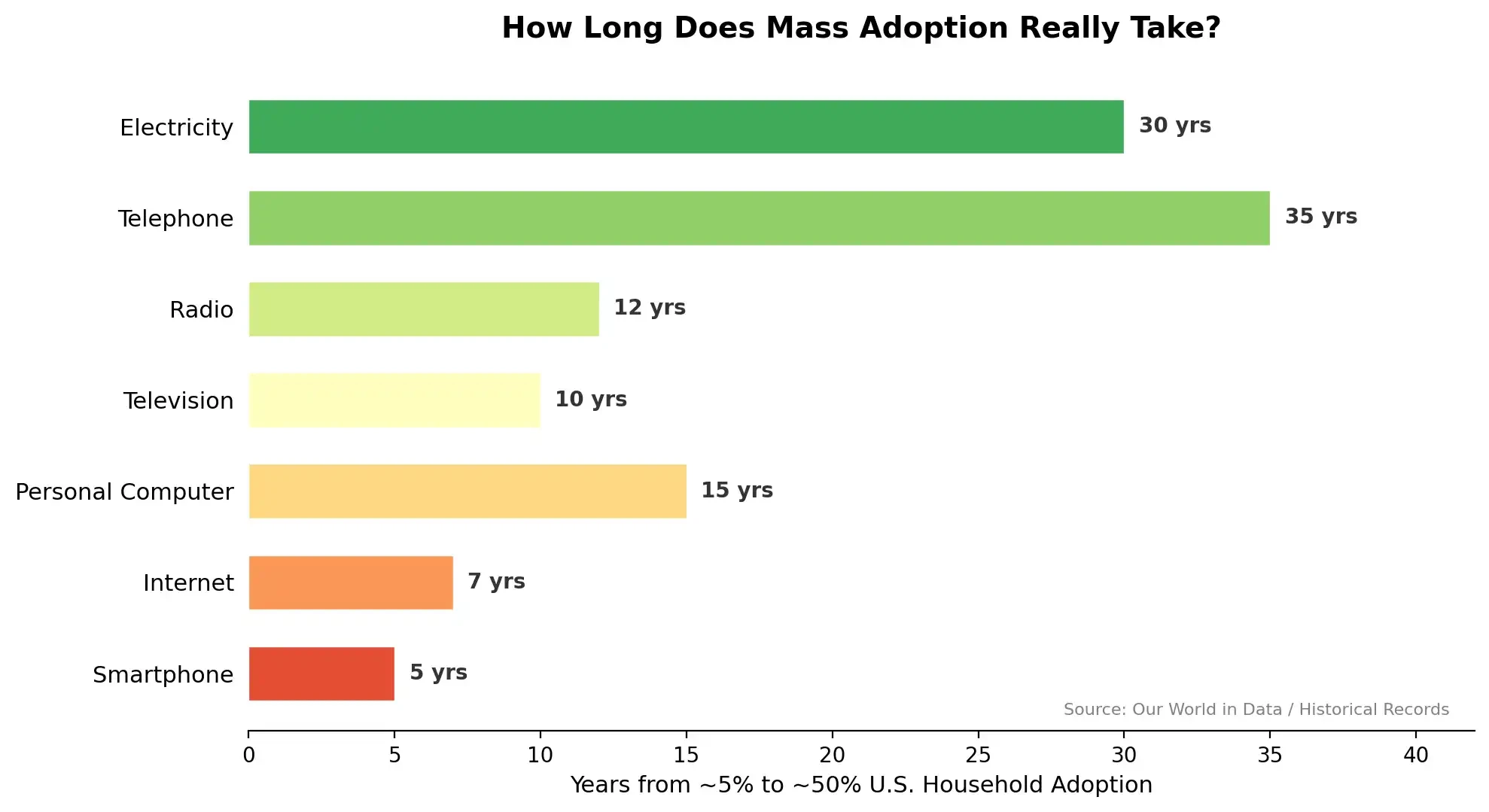
In fact, reviewing the diffusion of each round of General Purpose Technologies (GPTs) in history, the process from the lab to widespread penetration has always been much slower than the maturation of the technology itself. Electricity took 30 years to go from a 5% to a 50% household penetration rate, the telephone took 35 years, and even the fastest-diffusing smartphone took 5 years. AI's technical capabilities may already be sufficient to颠覆 many industries, but the gap between technical capability and institutional absorption has never been bridged by capability alone.
The second key link in Citrini's narrative is the downward spiral on the demand side: unemployment → reduced income → consumption contraction → declining corporate profits → further layoffs.
Citrini confuses demand-side deflation with supply-side deflation in this link. The former implies a contraction in consumers' purchasing power, while the latter is technological progress lowering production costs—the price decline driven by AI is essentially closer to the latter, similar to the price trajectory of electronic products and communication services over the past few decades. An analyst argues that Jevons' Paradox will still hold: when AI drastically lowers the cost of services like legal consultation, medical diagnosis, and software development, demand that was previously excluded for a large population due to high prices will be unleashed, leading not to contraction but explosive growth in total volume. Simultaneously, Moravec's Paradox will also play a role. For machines, what is truly difficult is often not profound logical reasoning or massive data retrieval, but rather the physical movement, sensory perception, and emotional communication that humans take for granted. This means that manual labor and service jobs requiring fine perception may be more resilient than we imagine.
But Jevons' Paradox could also fail. University of Chicago economics professor Alex Imas proposes that if AI automates the vast majority of labor, and labor's share of total income plummets, then who will purchase these efficiently produced goods and services? This touches the distribution mechanism itself. When production capacity tends towards infinity and effective demand tends towards concentration, what we face might not be a recession, but an imbalance not yet fully discussed in economics textbooks—material abundance that remains out of reach.
A Glimpse Through a Tube
The most speculative part of Citrini's simulation is the transmission from employment shock to financial crisis. In his narrative, structured financial products with SaaS revenue as underlying assets (he calls them "Software-Backed Securities") suffer widespread defaults during the AI transformation wave, triggering a credit crunch similar to 2008.
However, commentators point out that compared to 2008, the leverage of the current U.S. corporate sector is far healthier, and the banking system, having undergone Dodd-Frank reforms and multiple stress tests, is much more robust than it was then.
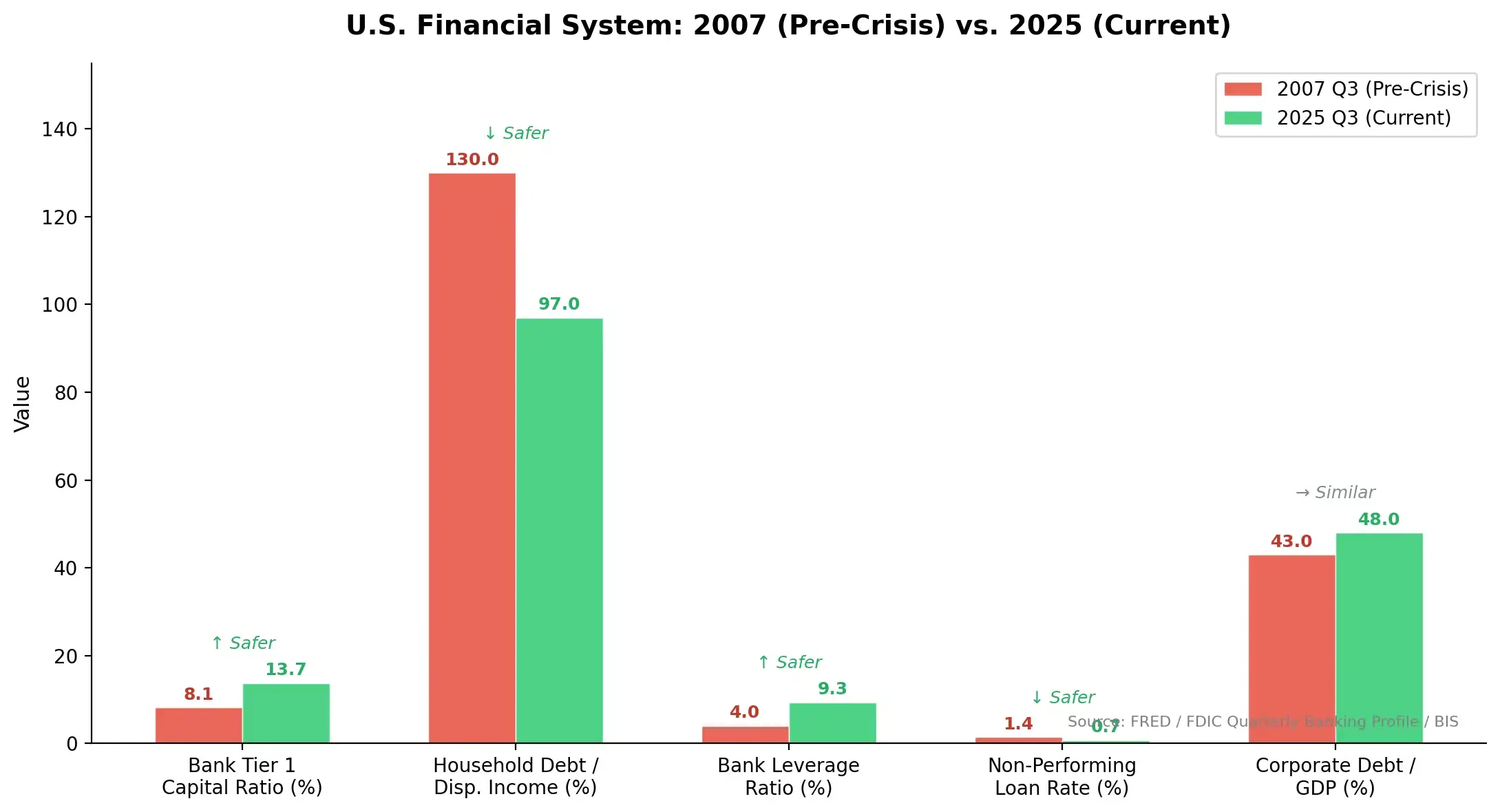
Relative to the eve of the 2008 financial crisis, various resilience indicators of the current U.S. financial system have significantly improved: bank Tier 1 capital adequacy ratio rose from 8.1% to 13.7%, household debt-to-disposable income ratio fell from 130% to 97%, and non-performing loan ratio dropped from 1.4% to 0.7%.
Even if some SaaS companies do face revenue declines, their scale is insufficient to trigger a systemic credit crisis. Former Bloomberg financial columnist Nick Smith believes Citrini made a common mistake in this link: linearly extrapolating a micro-level industry shock into a macro-level systemic risk. Regarding demand collapse, Smith's answer is fiscal policy. If unemployment truly rises sharply, the government is fully capable and willing to support demand through large-scale fiscal stimulus.
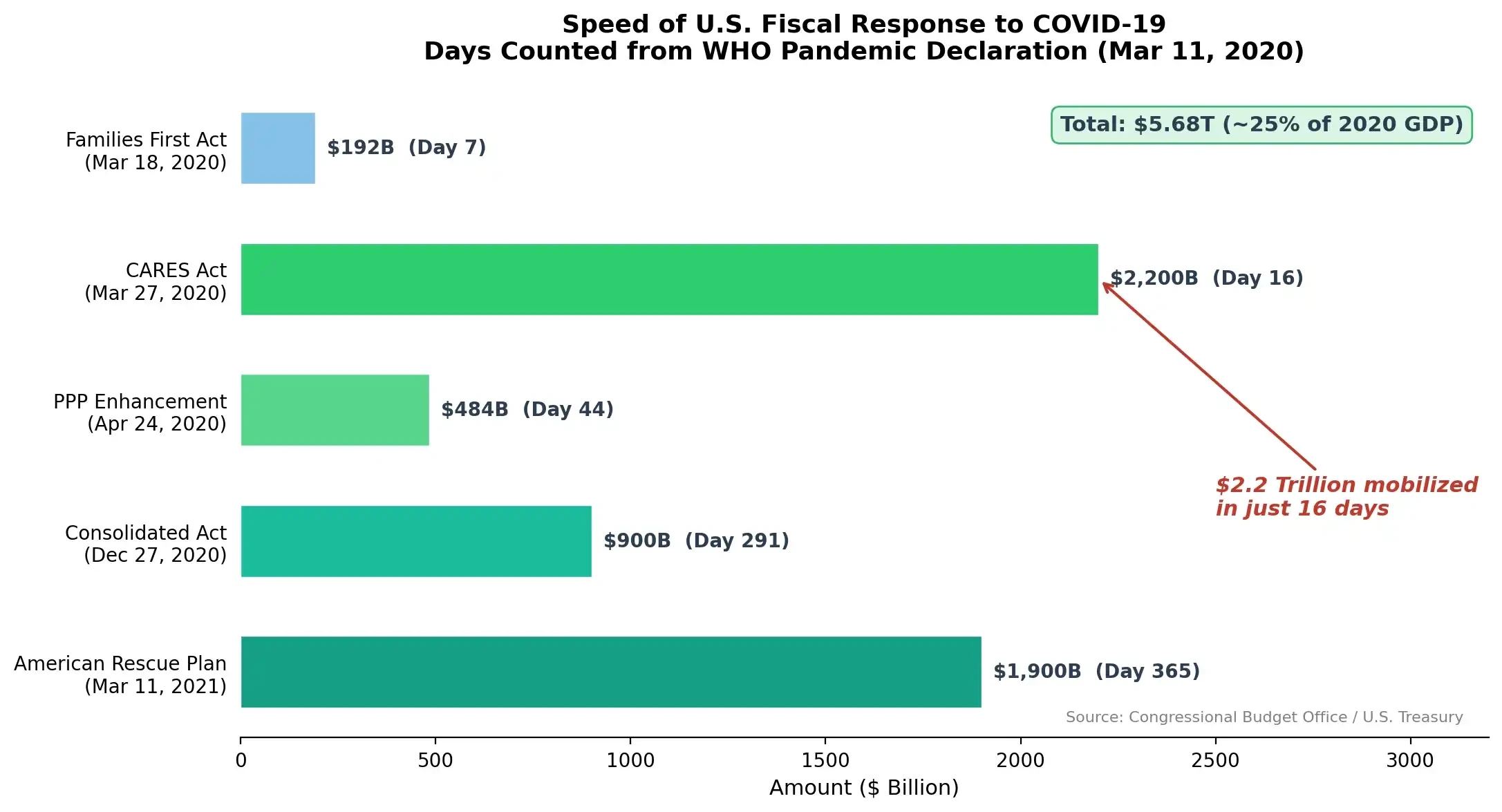
The responsiveness of institutions also seems underestimated. Taking policy responses during the COVID period as an example, on March 11, 2020, the WHO declared a pandemic, and just 16 days later, the $2.2 trillion CARES Act was signed into law. Within the following year, the U.S. rolled out a cumulative $5.68 trillion in fiscal stimulus, equivalent to about 25% of 2020 GDP.
If AI-driven unemployment truly occurs at the speed and scale described by Citrini, policy intervention is unlikely to be absent.
Another commentator questions from a more fundamental level. Technological doomsday scenarios generally stem from a lack of faith in humanity. Citrini's simulation treats the market as an unattended machine, allowing "causality" to unfold on its own until collapse. But real-world economic systems do not operate this way. Law, institutions, politics, culture, and ideology profoundly determine how the real world absorbs technological shocks.
Consensus and Divergence
We might try to outline some consensus and divergence.
That AI is and will continue to change the demand structure for white-collar labor is almost universally accepted; the divergence lies only in the speed and scale of change. Furthermore, the pain of the transition period is real and should not be obscured by long-term optimism. Also, the quality and speed of policy responses will largely determine the outcome.
Divergence exists at a more fundamental logical level. Some believe this technological shock may surpass historical precedents in speed and breadth, limiting the applicability of historical analogies; others place more trust in institutional adaptability and the repeatability of history.
Looking Up
Citrini's article has many issues: overly tight logical connections, systematic underestimation of institutional responses, and a lack of sufficient intermediate argumentation in the jump from micro-industry shock to macro-systemic risk. But its most fundamental problem might lie in an underestimation of human society: it assumes a static institutional environment where technology crushes everything at an almost unstoppable speed. Doomsday scenarios about technology have proliferated throughout history; they are often flawless in technical logic but almost invariably overlook the variable of "human beings." The complexity of human society, its friction, its redundancy, and its seemingly inefficient institutional arrangements precisely constitute a powerful, distributed shock-absorbing capacity. We have ample time to avoid the doomsdays that are simulated, provided we are not frightened by the simulation itself.
What about the optimistic narratives? "Jevons' Paradox" is an observation about long-term trends. "Moravec's Paradox" tells us manual labor is temporarily safe but doesn't tell us where the replaced white-collar workers should go. Historical analogies are instructive, but history never repeats itself exactly; it only rhymes. Optimistic narratives need time to be tested, and we are at the starting point of that test.
Doomsday scenarios are produced, and the anxious pay for them. Forge your own judgment, bear risks, manage your positions, rather than indulging in those "one glance sees the end" articles.


