






Deciphering the Ten Major Bearish Factors in the Crypto Market: How Severe Is This "Guangmingding" Siege?


- Core View: The current cryptocurrency market is undergoing a deep correction triggered by multiple bearish factors (regulatory tightening, geopolitical conflicts, internal selling pressure, sentiment collapse). However, most of these factors may transform into catalysts for industry maturity in the medium to long term, suggesting the market might be approaching a historic bottoming zone.
- Key Factors:
- Regulatory Tightening: The US plans to ban interest payments on stablecoins, and the OECD Crypto-Asset Reporting Framework takes effect in 48 countries, increasing compliance costs but paving the way for traditional institutional entry.
- Geopolitical Conflicts & Policies: Tensions in the Middle East and Trump's tariff policies strengthen the US dollar, draining market liquidity. However, historical patterns show retaliatory rebounds often follow such shocks.
- Significant Internal Selling Pressure: Selling or exit actions by key industry figures (e.g., Jihan Wu, Vitalik) and "smart money" are amplified in a weak market, exacerbating panic.
- Extreme Pessimistic Sentiment: Searches for "Bitcoin is dead" reach a cyclical peak, and stablecoins briefly depeg, damaging market trust mechanisms. Yet, such signals have historically often coincided with market bottoms.
- Technical Indicators Oversold: Multiple core market indicators (e.g., BTC oversold index, ahr999 index) are nearing historical extremes, indicating the market is severely oversold.
- Potential Turning Point Window: After the market digests bearish news, combined with key geopolitical events in late March (e.g., Trump's visit to China) may provide a reversal opportunity, but beware of black swan risks like failed negotiations.
Original Author: Shouyi
This is the toughest Lunar New Year for the crypto space: Bitcoin keeps falling, perpetual contracts keep getting liquidated, no one is sending red packets in group chats, and the collective sentiment has shifted from "buying the dip" to "playing dead."
This decline is not a simple technical correction but a simultaneous eruption of multiple pressures: global regulatory tightening, escalating geopolitical conflicts, industry leaders retreating, and retail investor confidence collapsing. These four forces are converging, staging a crypto "Siege of Mount Ming."
However, upon careful deconstruction of these ten major bearish factors, one finds that many "bad things" are actually necessary steps on the path to industry maturity. Below, Biteye analyzes them one by one. After reading, you'll know how to respond.
1. The Regulatory Iron Curtain: Stablecoins, Taxation, and Platform Regulation
1. Stablecoin Yield Generation is About to be Cut Off
🔗https://x.com/CryptosR_Us/status/2021523353769480336
Against the backdrop of a legislative deadlock for the U.S. "Clarity for Payment Stablecoins Act," the American Bankers Association (ABA) and major Systemically Important Banks (SIBs) are lobbying regulators to prohibit stablecoin issuers and intermediary platforms from paying interest to users. Violating institutions face administrative penalties of up to $500,000 per day.
Short-term Impact: The attractiveness of stablecoins will definitely decline. Coupled with a weakening dollar, some TVL will flow elsewhere.
Long-term Impact: A complete ban is unrealistic. The most likely outcome is a compromise solution of "limited rewards." Policies are expected to be finalized in Q2, and the market will gradually digest this expectation over the next 3-6 months.
2. The Global Tax Dragnet is Here
🔗https://x.com/Foresight_News/status/2010935974742937622
The Crypto-Asset Reporting Framework (CARF), led by the Organisation for Economic Co-operation and Development (OECD), has officially taken effect in 48 jurisdictions (including the 27 EU member states, the UK, Japan, South Korea, etc.). It requires exchanges to automatically exchange cross-border transaction data of users. The U.S. has simultaneously implemented Form 1099-DA.
Short-term Impact: Compliance costs increase significantly, triggering panic selling among retail investors.
Long-term Impact: Tax transparency is a prerequisite for traditional institutional entry. It is estimated that after full implementation in 2026, trillions in institutional capital may truly enter the market. This is just a period of growing pains.
3. Even Platform X is Starting to Restrict Advertising Qualifications
🔗https://x.com/nikitabier/status/2025337476391608540
Platform X has updated its advertising policy for prediction markets, requiring mandatory disclosure for all promotional content, effectively significantly raising customer acquisition costs for projects.
Short-term Impact: "Mouth farming" is completely dead; marketing and promotion on X are basically unworkable.
Long-term Impact: Good money drives out bad, helping to rebuild industry credibility. Frankly, there aren't many legitimate projects still advertising on X. This regulation is more symbolic; its actual impact depends on implementation.
2. Geopolitical Strangulation: War, Tariffs, and Summit Diplomacy
4. Conflict in the Middle East, Capital Fleeing to Safety
🔗https://x.com/StateDept/status/2026518216600858881
Trump is applying maximum pressure on Iran, threatening "a small fight first, then a big one." Safe-haven sentiment has pushed the U.S. Dollar Index (DXY) to soar to 97.7, the 10-year Treasury yield higher, and Brent crude oil above $65 per barrel. The Global Economic Policy Uncertainty Index has hit a record high since FRED database statistics began, with capital flooding into traditional safe-haven assets.
Short-term Impact: Liquidity in the crypto market was instantly drained. The most obvious sign is the disappearance of the USDT premium, which has even turned into a discount.
Long-term Impact: Geopolitical shocks often come and go quickly. Historical patterns suggest that suppressed buying pressure often leads to a retaliatory rebound 1-2 months later. Selling now to switch to USD will likely mean selling at the bottom.
5. Trump's 15% Tariff Hammer Falls
🔗https://x.com/baldwin_daniel_/status/2025246781592773073
After the Supreme Court rejected related relief requests, the Trump administration, under Section 122 of the Trade Act of 1974, raised the global baseline tariff from 10% to 15% on February 24th, effective for 150 days. This policy transmits through the chain of "tariffs → inflation expectations → stronger dollar." The crypto space, as a high-beta risk asset, bears the brunt.
Short-term Impact: Negative impacts typically peak at the initial stage of policy implementation. Referring to last April's tariff war, if subsequent negotiations between major powers break the ice, the suppression will quickly turn into a positive once lifted.
Long-term Impact: Trump is accustomed to maximum pressure before negotiations. TACO has become a classic model; he won't actually fight for the full 150 days.
6. The Market Awaits "Summit Diplomacy" Between China and the U.S.
🔗https://x.com/AJEnglish/status/2025111127110418517
The Trump administration announced plans to visit China from March 31st to April 2nd. However, before that, it may implement "pre-negotiation maximum pressure" through tariff escalation, technology blockades, and other means—a typical game theory strategy. The market must continue trading under policy suspense until the end of March.
Short-term Impact: This bearish factor artificially amplifies volatility, and the market will remain shrouded in policy uncertainty.
Long-term Impact: If the negotiations achieve substantive progress, global risk assets will enter a window of liquidity release. It is expected that this bearish news will be digested after the meeting results become clear by the end of March. Before that, "uncertainty" exists, and market volatility may increase.
3. Internal Bleeding: Liquidations, Selling, and Retreat
7. Jihan Wu Liquidates BTC, Fully Transitions to AI
🔗https://x.com/CupidMonday/status/2025956106833449279
Bitdeer (NASDAQ: BTDR), controlled by Jihan Wu, recently liquidated approximately 1,132 BTC (worth about $72 million at the time) and announced a full transition to AI Data Center (AIDC) business. The company's IR statement emphasized this as a "non-permanent zero position," essentially balance sheet management to cope with mining machine upgrade pressure (4nm/3nm chip upgrades) and capital expenditure needs for AI computing power infrastructure construction.
Short-term Impact: The panic sentiment of "miner selling" is further amplified. After all, if even a mining tycoon is selling, why should retail investors hold?
Long-term Impact: The integration of AI and crypto computing power is a trend of industrial upgrading, not a systemic industry crisis. It is expected that funds will flow back into crypto after the AI data centers are built.
8. Vitalik Buterin Continues Selling ETH, Selling Lower and Lower
🔗https://x.com/DeFiTracer/status/2018698179277963356
Ethereum co-founder Vitalik Buterin has recently been continuously reducing his ETH holdings through a multi-signature address, selling 1,869 ETH over two days, with cumulative sales exceeding 7,000 ETH (approximately $15.5 million). An official statement confirmed the funds are used to finance Ethereum Foundation R&D and long-term investments in biotechnology. Relative to his holdings of about $430 million, the reduction ratio is less than 0.36%.
Short-term Impact: In the current weak market, Vitalik's actions have precisely hit ETH bulls' confidence, creating a vicious cycle of "selling lower, and selling more as it goes lower." Many on X are starting to question if Vitalik is no longer bullish on ETH. This emotional contagion is scary.
Long-term Impact: A normal operation where a founder cashes out to feed back into the ecosystem, just at an unfortunate timing.
9. Major KOLs Collectively Call for Exiting, Smart Money Leaves
🔗https://x.com/dotyyds1234/status/2026097439850303512
High-influence trader KOLs in the community, represented by "憨巴龙王," have publicly announced reducing on-chain positions by 30%-50% and released bearish remarks. In a market with thin liquidity, such voices are amplified through social media, creating emotional contagion. People in group chats are already posting screenshots of empty positions, showing clear signs of follow-on panic selling.
Short-term Impact: Bearish remarks from on-chain whales and traders have a noticeable impact on the market.
Long-term Impact: When the market's recognized "smart money" collectively and publicly exits, it often constitutes an excellent contrarian bottom indicator. Of course, whether this time is an exception, no one can say for sure. Some KOLs may later delete posts and turn bullish. You can use the @xhunt_ai plugin to check deletion records.
4. Emotional Nuclear Explosion: "Bitcoin is Dead," Depegging, and Trust Crisis
10. FUD Erupts Fully, "Bitcoin is Dead" Floods Screens
🔗https://x.com/XHuntCN/status/2025963293920342134
Google Trends data shows searches for "Bitcoin is dead" have reached a peak since the FTX collapse in 2022; the USD1 stablecoin briefly depegged to 0.98 USDT due to FUD; on-chain detective ZachXBT previewed that he will disclose evidence of insider trading by "the most profitable enterprise in the crypto industry" on February 26th.
Short-term Impact: In this environment, the trust mechanism has been severely damaged, triggering indiscriminate selling.
Long-term Impact: "Bitcoin is dead" search volume peaking is often the strongest signal of a market bottom—this was the case in both 2018 and 2022. It is expected that ZachXBT's exposure will trigger safe-haven flight in the short term but will be beneficial for clearing out industry toxins and fostering new growth in the long run.
5. Technical Data: It's Bad, But It Might Be Nearing the Bottom
Looking at the data, it's indeed bad. Three core indicators (BTC oversold index, ahr999 bottom-buying index, extreme fear index) are approaching historical extreme levels. The indicators show that the current market's oversold condition is nearing historical limits but hasn't broken the longest record yet. The search for a bottom with volatility may continue for another 1-2 months.
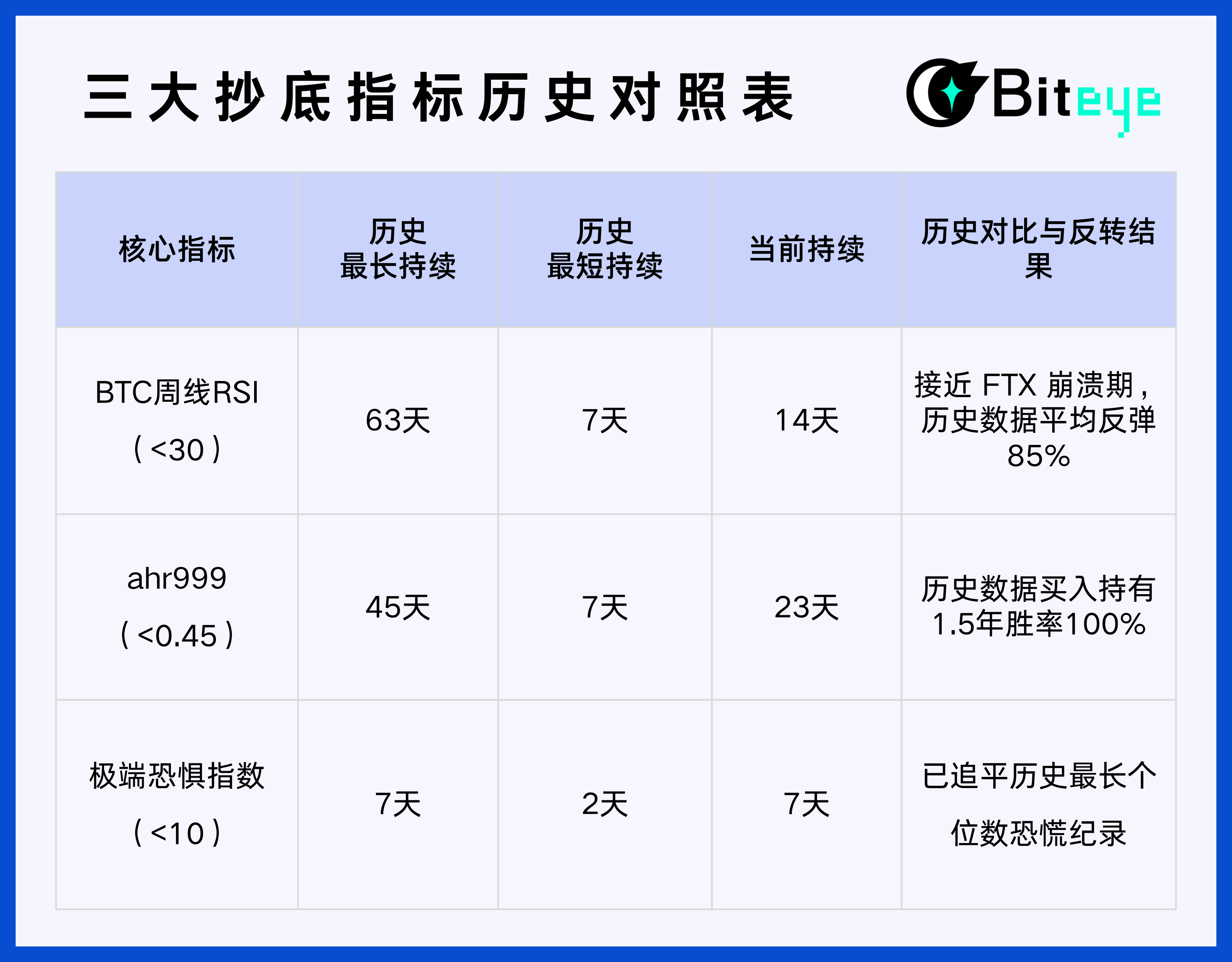
Optimistically, historical data shows that "despair often breeds new life." After exiting such extreme indicators, BTC's 90-day return rate has averaged above +50%. Combined with Trump's visit to China schedule at the end of March, the earliest reversal window may open in March.
Pessimistically, if Trump's visit to China at the end of March fails, or if ZachXBT really drops a bombshell (e.g., Tether's reserve falsification being confirmed), all the above "bottom signals" may become invalid. It is recommended that users decisively remove leverage in the short term and closely monitor ZachXBT's爆料 and the progress of Trump's visit to China.
Market Advice: Surviving is More Important Than Calculating Returns
Reviewing the recent ten major bearish factors, 60% come from regulation and geopolitics, and 40% from internal selling pressure and emotional collapse. It seems all bearish, but upon careful consideration, about 70% of these bearish factors will turn into bullish factors in the medium to long term—the regulatory iron curtain builds a compliance moat for traditional capital, and low sentiment is often the darkest hour before dawn.
The "buy the dip" and "short" discussions on Twitter are mostly emotional. When the real bottom hits, group chats should be eerily quiet, not like now where people are still arguing "is this the bottom?"
The "Siege of Mount Ming" is not the endgame for crypto—more important than how much profit is made is staying at the table.





