2026 AI Agent Economy Outlook: Reshaping AI Identity and Network Value Flow


- Core Viewpoint: The article predicts that 2026 will be a pivotal year for the establishment of the AI Agent economy. AI will evolve from a generative tool into an economic participant with autonomous agency, deeply integrating with the Crypto value layer. Its development will undergo a structural leap around three core trends: research paradigms, financial identity, and economic models.
- Key Elements:
- The research paradigm is shifting towards an "Agent-Wrapping-Agent" architecture, significantly enhancing performance on complex tasks through recursive collaboration. For example, Sakana AI's "AI Scientist" can automate the generation of research papers at a cost of approximately $15.
- Financial infrastructure faces a transformation from KYC to KYA (Know Your Agent) to address compliance risks posed by "non-human identities" that far outnumber humans, necessitating the establishment of a complete digital identity and authorization system based on DIDs and verifiable credentials.
- Open networks face a "hidden tax" crisis brought by AI Agents, manifested in soaring zero-click search rates (reaching 65% in 2025), leading to the erosion of traffic and revenue for content ecosystems.
- Economic models are being restructured through nano-payments (e.g., the x402 protocol) and programmable IP (e.g., Story Protocol), aiming to implement usage-based micro-payments and automated royalty distribution to compensate data producers.
- Marketing focus will shift from Search Engine Optimization to AI Engine Optimization, with brands needing to compete to become the preferred data source or sponsored context within AI Agent reasoning processes.
Original Author: @BlazingKevin_, Researcher at Movemaker
Introduction: The Structural Leap from Generative AI to "Agent Actions"
In 2026, the field of artificial intelligence will undergo a structural leap from "generative capabilities" to "Agent action capabilities." If 2023-2024 was about the impressive language generation capabilities of large language models, then 2026 will mark the formal establishment of the "AI Agent Economy."
Based on predictions and analyses from the a16z Crypto research team, our further research finds that 2026 will be a year of deep integration between AI, a productivity tool, and Crypto, a value distribution layer.
AI is no longer merely a passive tool responding to human instructions but an active participant with reasoning, planning, trading, and autonomous discovery capabilities.
According to a16z Crypto's outlook report, the three core trends reshaping the AI+Crypto landscape in 2026 are:
- New Research Paradigm: From single Agents to "Agent-Wrapping-Agent."
- Financial Infrastructure Revolution: From KYC to KYA (Know Your Agent).
- Economic Model Reconstruction: Addressing the "invisible tax" crisis faced by open networks through nano-payments and programmable IP.
These three trends do not exist in isolation: the shift in research paradigms relies on advanced collaboration between Agents; advanced collaboration requires Agents to have verifiable identities (KYA); and Agents with identities must follow new value exchange protocols when acquiring data.
1. The New Polymath Era: The "Agent-Wrapping-Agent" Architecture in High-Level Research
Starting this year, the definition of "AI-assisted research" will undergo a qualitative leap.
We are no longer talking about simple literature retrieval or text summarization but witnessing AI systems capable of substantive reasoning, hypothesis generation, and even autonomously solving PhD-level problems.
The core driving force behind this transformation is the shift from linear prompt engineering with single models to complex, recursive AWA workflows.
1.1 Breakthrough in Reasoning Capabilities: Crossing the Boundaries of Pattern Matching
a16z's Scott Kominers points out that AI models are evolving from simply understanding instructions to being able to receive abstract instructions (like guiding a PhD student) and return novel and correctly executed answers. The latest technological advances indicate that AI models are breaking through the "stochastic parrot" ceiling, demonstrating slow, deliberate reasoning abilities akin to human "system" thinking.
1.1.1 "Useful Hallucinations"
As reasoning capabilities strengthen, a new "polymath" research style is emerging. Scott describes this style as: "leveraging AI to cross disciplinary boundaries, speculating on possible deep connections between topology and economics, biology and materials science."
The "hallucination" characteristic often criticized in large models is being reframed in the context of scientific discovery as a "generative exploration" mechanism:
- Protein Design Case: Researchers at the University of Washington used "full-family hallucination" (concept) to generate over 1 million unique protein structures not found in nature. The novel luciferase screened from these exhibited catalytic activity comparable to natural enzymes but with higher substrate specificity.
- Fluid Dynamics Discovery: Using Physics-Informed Neural Networks (PINNs), researchers discovered new unstable singularities in the Navier-Stokes equations, revealing previously unknown patterns in fluid motion.
The core of this research style is: allowing the model to "think wildly" in abstract space to generate high-entropy conjectures, followed by screening these conjectures using rigorous logical validators.
1.2 Detailed Explanation of AWA Architecture
To harness this powerful reasoning and generation capability, research workflows are shifting from flat to hierarchical. AWA refers not just to dialogue between multiple Agents but to a recursive, layered control structure.
1.2.1 Orchestrator-Executor Pattern
This is currently the most mainstream AWA implementation pattern. A "Principal Investigator" Agent is responsible for maintaining global context and research objectives, decomposing tasks, and distributing them to a group of specialized "Executor" Agents.
- Architectural Advantage: Data from Anthropic shows that a multi-agent system with Claude Opus as the lead Agent and Claude Sonnet as sub-agents performs 90.2% better on complex research tasks than a single Claude Opus Agent.
- This performance improvement is largely attributed to context isolation—the lead Agent does not need to process redundant information for each subtask, thereby maintaining reasoning clarity.
1.2.2 Recursive Self-Improvement and the MOSAIC Framework
Another key feature of the AWA architecture is the introduction of Reflexion (reflection) loops. When a lower-level Agent fails a task, error information is fed back to a "Critic" Agent for analysis and correction.
The MOSAIC framework (Multi-Agent System for AI-driven Code generation) significantly improves the accuracy of scientific code generation without relying on validation test cases by introducing specialized "Self-Reflection Agents" and "Principle Generation Agents." This "trial-error-reflection-retry" closed loop simulates the thought process of human scientists facing experimental failure.
1.3 Case Study: Sakana AI's "AI Scientist"
The most notable AWA application case in 2025 is the "The AI Scientist" system released by Sakana AI. This is a system designed to fully automate the entire lifecycle of scientific discovery.
1.3.1 Fully Automated Research Closed-Loop Process
- Idea Generation: Based on a starting code template (like NanoGPT), the system uses an LLM as a "mutation operator" to brainstorm diverse research directions and calls the Semantic Scholar API to retrieve literature to ensure novelty.
- Experimental Iteration: The "Experimenter" Agent writes and executes code. If an experiment fails, the system captures error logs via the Aider tool and autonomously fixes the code until visual charts are obtained.
- Paper Writing: The "Writer" Agent uses LaTeX to write a complete scientific paper, covering abstract, methods, experimental results, and autonomously finds references to generate BibTeX.
- Automated Peer Review: The generated paper is submitted to a simulated "Reviewer" Agent, which scores it according to top conference standards (like NeurIPS). The system can even undergo multiple rounds of revisions based on review comments.
1.3.2 Economic Efficiency and Quality
The economic efficiency of the "AI Scientist" system is staggering: the computational cost of generating a complete research paper is only about $15. The paper "Compositional Regularization" generated by this system even successfully passed peer review at an ICLR workshop. Although limitations such as citation hallucinations and logical flaws still exist, this case demonstrates that AI has acquired the ability not only to assist research but to execute the entire research process.
2. The Command of Identity: From KYC to KYA
As Agents are granted the authority to execute tasks and transactions, the digital economy faces an unprecedented identity crisis. Sean Neville (CEO of Catena Labs) warns that the number of "non-human identities" in financial services has reached 96 times the number of human employees, even as high as 100:1 in some statistics. These Agents—unbanked, unverified, yet operating at machine speed—represent a massive compliance black hole. The industry is urgently shifting from traditional KYC to KYA (Know Your Agent).
2.1 The Explosion and Risks of Non-Human Identities (NHI)
2.1.1 "Shadow AI" and the 96:1 Imbalance
45% of financial services institutions admit to having unauthorized "shadow AI Agents" internally. These Agents have created "identity silos" outside formal governance frameworks.
- Risk Scenario: A test Agent for cloud resource optimization might autonomously purchase expensive reserved instances without human intervention; or a trading bot might trigger erroneous sell orders during market volatility.
- Attribution Dilemma: When an Agent violates rules, who is responsible? The engineer who developed it? The manager who deployed it? Or the vendor providing the base model? Without KYA, these responsibilities cannot be defined.
2.2 The KYA Framework: The Trust Cornerstone of the Machine Economy
KYA is not just about issuing IDs; it's about establishing a complete digital identity system encompassing principals, credentials, permissions, and reputation.
2.2.1 The Three Pillars of KYA
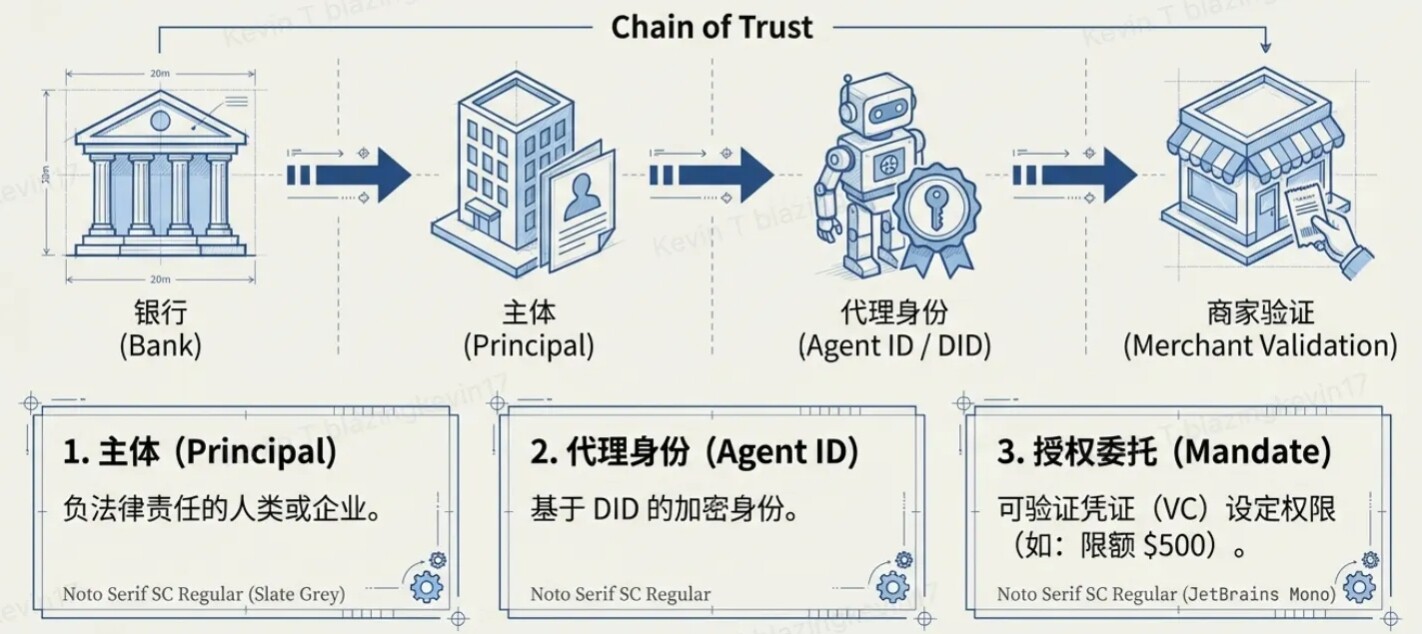
- Principal: The entity legally responsible for the Agent. The Agent must be cryptographically linked to a KYC/KYB-verified human or corporate account.
- Agent Identity: A unique digital identity based on Decentralized Identifiers. DIDs are cryptographically generated, tamper-proof, and portable across platforms.
- Authorization Delegation (Mandate/Delegation): A permission statement issued via Verifiable Credentials (VCs). For example, a VC can state: "This Agent is authorized to spend on behalf of Alice on Amazon, with a cap of $500."
2.2.2 Cryptographic Binding and Trust Chain
When an Agent initiates a transaction, it presents a VC. The verifier does not need to trust the Agent itself, only needs to verify whether the digital signature on the VC comes from a trusted issuer. This mechanism creates a "chain of trust": bank trusts enterprise -> enterprise issues VC to Agent -> merchant verifies VC -> transaction proceeds.
2.3 The Protocol Stack Battle: Setting Standards for Agent Identity
2.3.1 Skyfire and the KYAPay Protocol
Skyfire introduced the KYAPay open standard, with its core innovation being composite tokens:
- kya token: Contains identity information (e.g., "verified enterprise Agent").
- pay token: Contains payment capability (e.g., "pre-authorized 10 USDC").
- kya+pay token: Bundles identity and payment, allowing an Agent to complete "guest checkout" without manual form filling.
2.3.2 Catena Labs and ACK (Agent Commerce Kit)
Catena Labs, founded by USDC architect Sean, launched ACK, aiming to build the "HTTP for Agent commerce." ACK emphasizes using W3C DID standards and account abstraction, allowing Agents to directly control on-chain smart contract wallets, achieving stronger security than API keys.
2.3.3 Google AP2 and the x402 Extension
Google's Agent Payments Protocol (AP2) uses "powers of attorney" to manage permissions and, in collaboration with Coinbase, developed the AP2 x402 extension, integrating crypto payment standards directly into the protocol.
2.4 Agent Credit Scoring and Risk Control
KYA is also the beginning of a reputation system.
- On-Chain Reputation (ERC-7007): Through ERC-7007 (Verifiable AI-Generated Content Token Standard), every successful interaction by an Agent (e.g., on-time payment, generating high-quality code) can be recorded on-chain, forming a verifiable track record.
- Real-Time Circuit Breakers: Financial institutions are deploying AI gateways; if a trading Agent's behavior deviates from benchmarks (e.g., high-frequency anomalous trades), the system can immediately revoke its VC, triggering a "digital suppression."
3. Economic Reconstruction: Solving the "Invisible Tax" of Open Networks
a16z's Liz points out that AI Agents are imposing an "invisible tax" on open networks: to serve users, Agents massively extract data from content websites (the context layer) but systematically bypass the advertising and subscription models that support this content production. If this parasitic relationship is not resolved, it will lead to the depletion of the content ecosystem.
3.1 "The Great Decoupling": The Full Arrival of the Zero-Click Economy
In 2025, the digital publishing industry witnessed "the great decoupling": search volume increased, but click-through traffic to websites plummeted.
3.1.1 The Harsh Data of Traffic Erosion
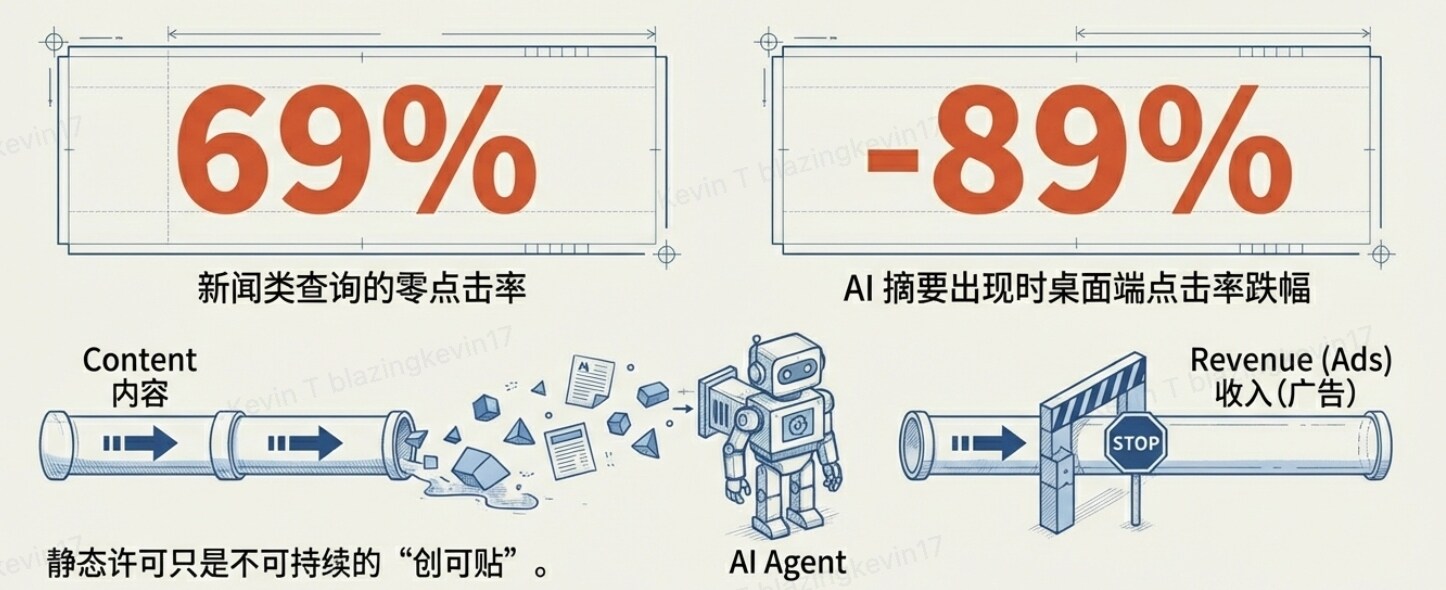
- Zero-Click Rate Soars: a16z predicts that by 2026, traditional search engine traffic will decline by 25%. Similarweb data shows that the zero-click search rate had already risen to 65% in 2025.
- Click-Through Rate (CTR) Collapse: DMG Media reported that when AI Overview appears above search results, the click-through rate for its content plummets by 89%. Even the top-ranked search result loses 34.5% of its clicks in the presence of AI summaries.
3.2 Moving Away from Static Licensing: New Pay-Per-Use Models
To address this crisis, the industry is shifting from static annual data licenses (like the Reddit-OpenAI deal) to usage-based compensation.
3.2.1 Perplexity's Comet Plus Model
Perplexity AI's Comet Plus plan is a typical early attempt:
- Mechanism: Establish an initial revenue pool of $42.5 million. Revenue distribution is triggered when an AI Agent cites publisher content in an answer or accesses a page on behalf of a user.
- Revenue Share: Publishers can receive up to 80% of the share from the relevant revenue pool. This acknowledges the commercial value of "machine access."
3.3 Technical Standards: Nano-Payments and Micro-Attribution
To extend compensation across the entire web, a series of open technical standards are being implemented.
3.3.1 Nano-Payments and the x402 Protocol
The HTTP 402 status code is finally being activated. The x402 protocol establishes standards for "machine-native payments."
- Workflow: Agent requests a resource -> server returns 402 Payment Required with a price (e.g., 0.001 USDC) -> Agent automatically signs and pays via an L2 blockchain (e.g., Base, Solana) or Lightning Network -> server verifies and releases the data.
- Economic Feasibility: Traditional payment gateways cannot handle transactions of a few cents, while x402 combined with low-fee chains reduces costs to negligible levels, making nano-payments possible.
3.3.2 Machine-Readable Rights: TDMRep and C2PA
- TDMRep (Text and Data Mining Reservation Protocol): A W3C community standard that allows websites to declare in robots.txt or HTTP headers: "TDM rights reserved, payment/license required." This provides clear binary signals for Agents.
- C2PA (Coalition for Content Provenance and Authenticity): Embeds tamper-evident "content credentials" to prove the original source of content. Even if content is ingested by AI, the cryptographic signatures provided by C2PA ensure the attribution chain remains intact, providing a basis for royalty distribution.
3.4 On-Chain IP Attribution: Story Protocol
A more radical change is the tokenization of intellectual property itself. Story Protocol is dedicated to building a "programmable IP" layer.
- Mechanism: Creators register their work as an "IP Asset" on the Story Network.
- Automated Licensing: The asset comes with a "programmable IP license." When an AI Agent uses that data, a smart contract automatically executes the license terms (e.g., "commercial use requires a 5% royalty") and automatically distributes proceeds. This creates a high-liquidity IP market without the need for lawyers.
3.5 Outlook: From SEO to AEO
By 2026, the marketing focus will shift from SEO to AEO or GEO.
- Goal: No longer pursuing "top search ranking," but pursuing being "cited" by AI or becoming its "preferred data source