






Understanding ZUNO: Its Competitive Position in the Solana Meme Space



- Core Viewpoint: This article analyzes the Solana Meme token ZUNO. Its core narrative is not about application functionality but emphasizes the transparency of token allocation and a fixed supply structure. However, its market performance remains highly dependent on liquidity, unlocking schedules, and overall market sentiment, with its speculative nature unchanged.
- Key Elements:
- Token Structure: Total supply is fixed at 100 billion tokens. Minting and freezing permissions have been disabled, aiming to eliminate risks of additional issuance and management intervention.
- Tokenomics: Tokens are gradually released through a preset unlocking schedule (monthly/quarterly, over a 12-24 month cycle) and staking rewards, meaning the circulating supply will continuously increase.
- Market Dependence: The project has not built its own application ecosystem and primarily relies on XT.com and Solana on-chain DEXs (such as Meteora, Jupiter) to provide trading and liquidity.
- Core Risks: Price is highly volatile and driven by narratives; continuous unlocking may bring selling pressure; liquidity depth is sensitive to capital flows.
- Competitive Landscape: Within the Solana Meme space, ZUNO's transparent structure is a differentiating narrative. However, its long-term competitiveness depends on attention acquisition and liquidity retention, not the structure itself.
In the Solana meme token arena, projects often win through speed. Faster narratives, more concentrated sentiment, and earlier liquidity often capture market attention. However, for such assets, what is truly scrutinized repeatedly is often not the story itself, but whether the token structure can withstand market digestion.
OFFICIAL ZUNO (ZUNO) entered the scene against this backdrop. It does not focus on application functionality or long-term vision but instead places token configuration and distribution mechanisms at the core of its narrative: a fixed total supply, disabled token authorities, and a publicly trackable unlock schedule. These designs do not change the speculative nature of meme assets, but they establish a clear premise—how the market will interact with this token.
This article will deconstruct ZUNO's token configuration, the path for supply to enter circulation, the infrastructure supporting trading and staking, and where risks are more likely to emerge, from both structural and market perspectives. Through these dimensions, we attempt to answer a more practical question: in the highly liquidity- and attention-dependent Solana meme market, where exactly does ZUNO stand?
TL;DR Quick Summary
- ZUNO is a Solana-based SPL meme token with a fixed total supply of 10 billion tokens.
- The token's mint and freeze authorities have been disabled, preventing additional issuance or manual intervention.
- The circulating supply will be gradually released through predetermined unlock and staking reward mechanisms.
- Participation methods also include periodic events launched by the trading platform, such as the ZUNO Lucky Draw.
- Market performance is primarily influenced by factors like liquidity depth, unlock pace, and attention cycles.
ZUNO Token Overview
Core Configuration
OFFICIAL ZUNO (ZUNO) is issued under the Solana SPL token standard, with the following core configuration:
- Max & Total Supply: 10,000,000,000 ZUNO
- Mint Authority: Revoked
- Freeze Authority: Disabled
- Token Metadata: Immutable
The above configuration prevents additional issuance at the token contract level and limits operational flexibility on the management side. From a structural perspective, these settings clarify what can and cannot be modified after the token's deployment.
Trading Access
ZUNO is listed in the Innovation Zone of XT.com under the MEME category and trades against USDT in the spot market. On-chain liquidity primarily comes from Solana decentralized exchanges, with trading routes typically executed through aggregators like Jupiter and within liquidity pools provided by Meteora.
Structural Interpretation
ZUNO positions itself as a meme token that emphasizes token configuration and information disclosure rather than relying on application-layer functionality or product form. While these structural constraints help clarify uncertainties regarding supply control and token governance, they do not alter the speculative nature inherent to the asset itself. Its market performance remains primarily influenced by liquidity conditions, market sentiment, and the overall Solana meme token environment.
From a market structure perspective, revoking mint authority and disabling freeze authority have become common configurations in Solana meme tokens, not unique advantages. The core function of such settings is to define the scope of what can be changed after token deployment, rather than determining how supply is allocated or how the token trades in the secondary market.
Simultaneously, it is necessary to distinguish between fixed total supply and fixed circulating supply. Although ZUNO's configuration prevents new issuance, the circulating supply will continue to increase as the unlock schedule and reward distribution progress. Therefore, price performance is often more sensitive to liquidity depth and unlock pace than to the nominal supply cap.
ZUNO Tokenomics
Distribution Model
ZUNO employs a predetermined token distribution and release mechanism, entering the market through gradual release rather than relying on subjective or ad-hoc issuance arrangements. Although the total token supply remains fixed, the circulating supply will continuously increase over time as unlocks and reward distributions proceed.
Its core features include:
- Total Supply Cap: 10,000,000,000 ZUNO
- No New Minting Mechanism: No path for additional issuance exists.
- Tokens enter the market via a predetermined unlock schedule.
- Multiple allocations unlock monthly or quarterly over periods of 12 to 24 months.
Token Allocation Structure Overview
Allocation Category % of Total Supply Unlock Method Initial Liquidity 7% 100% unlocked at TGE Liquidity Reserve (Locked) 10% Quarterly unlocks over 24 months Liquidity Management Wallet 3% Fully unlocked Marketing & Promotion 10% Monthly unlocks over 12 months Founders & ZunoCo Allocation (I) 22.50% Monthly unlocks over 24 months Founders & ZunoCo Allocation (II) 22.50% Monthly unlocks over 24 months Founders & ZunoCo Allocation (III) 7.50% Quarterly unlocks over 24 months Development Fund 10% Monthly unlocks over 12 months Service Providers 0.50% Monthly unlocks over 12 months Staking Rewards 7% Monthly unlocks over 24 months
Structural Interpretation
Although ZUNO employs a fixed total supply design at the protocol level, the circulating supply is not static. The monthly and quarterly unlock arrangements constitute a continuous source of token release. Therefore, compared to the nominal supply cap, the unlock pace and market liquidity depth have a more direct impact on actual market performance.
Unlock Pace and Circulating Supply Dynamics
ZUNO's distribution mechanism introduces multiple supply sources at different time points, affecting the market in various ways. Generally:
- Monthly unlocks are more likely to bring gradual increases in circulating supply.
- Quarterly unlocks may result in more concentrated supply releases at specific stages.
The market impact of these unlocks often depends less on absolute quantity and more on the prevailing liquidity conditions and trading activity.
Furthermore, some fully unlocked allocations (e.g., the Liquidity Management Wallet) introduce additional variables. Such allocations are typically used to support market depth or operational needs but also concentrate a degree of release decision-making power. During periods of liquidity contraction or heightened volatility, addresses associated with these allocations often become focal points for market attention.
Against this backdrop, circulating supply should be viewed as a dynamic variable. The unlock schedule, liquidity growth, and market sentiment continuously interact to shape short-term price performance. The fixed total supply only provides a theoretical upper limit and does not determine how the market digests new supply at any given moment.
Ecosystem / Core Applications
Infrastructure-Based Ecosystem Model
ZUNO does not build a comprehensive proprietary application ecosystem. Instead, it chooses to integrate with mature Solana infrastructure to support market participation, liquidity management, and token distribution. This infrastructure-centric model is relatively common among meme tokens where liquidity acquisition is a priority.
By leveraging existing Solana protocols, the project can reduce development complexity and focus its efforts on token distribution, exchange coverage, and market presence. The corresponding trade-off is limited differentiation at the application layer, with user participation primarily centered around trading and staking activities.
Trading and Liquidity
- Liquidity pools are primarily deployed on Meteora.
- Trading routes are typically executed through aggregators like Jupiter.
- No proprietary decentralized exchange or customized liquidity protocol has been established.
For ZUNO, its ecosystem is better understood as a set of Participation Rails rather than a use-case-driven platform. The project has not launched native applications for generating protocol revenue or sustaining on-chain activity. User participation mainly revolves around market trading, liquidity provision, and predetermined token distribution events. This structure also aligns ZUNO with a category of meme tokens where the market itself serves as the primary interface for interaction.
Transparency-Related Tools
Beyond trading, ZUNO's ecosystem emphasizes information disclosure over application functionality:
- Publicly accessible project documentation and repositories.
- Third-party audit results for verifying token configuration.
- On-chain identity and address references for information verification.
Overall, these elements collectively form an ecosystem centered on participation mechanisms and transparency, rather than being primarily driven by application-layer features or product experience.
How to Participate and Acquire ZUNO
How to Participate and Acquire ZUNO
ZUNO is listed on XT.com and can be traded via the official spot market through the ZUNOUSDT spot trading pair. As an asset in the Innovation Zone, Official Zuno may exhibit relatively higher volatility and potentially lower liquidity levels compared to mature assets during the initial trading phase.
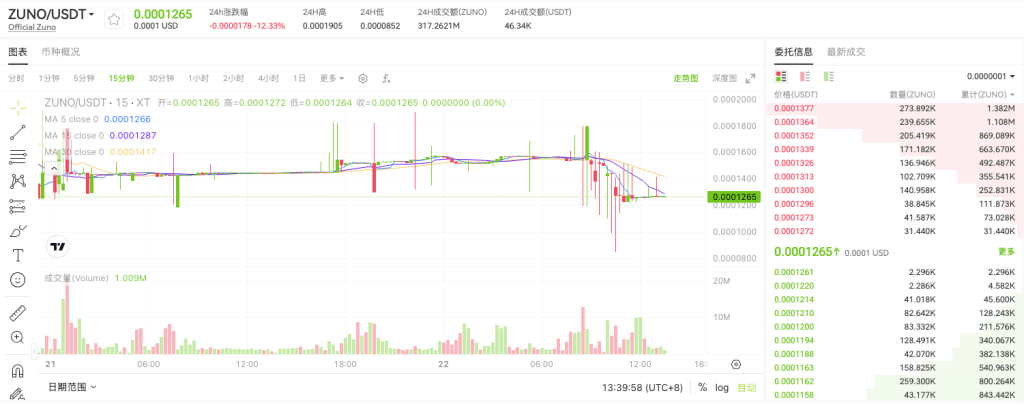
ZUNO/USDT spot trading is now open on XT.com.
Other Participation Methods
XT periodically launches event-based participation mechanisms around listed tokens. For ZUNO, the platform has introduced limited-time trading events such as the ZUNO Lucky Draw, distributing corresponding rewards based on predetermined participation rules. Such events are optional and independent of spot trading itself, with specific rules and cycles detailed in each event announcement.
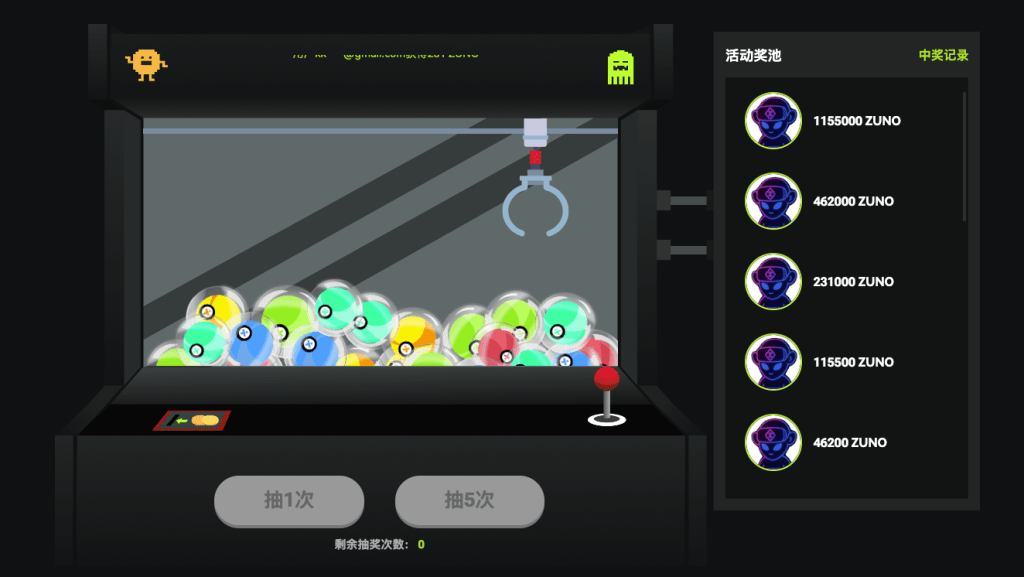
The OFFICIAL ZUNO Lucky Draw event is scheduled to end on January 29, 2026.