Bitcoin 2026 Outlook: Macro Risks and Predictions, Market Sends Cautious Signals


- Core View: The article posits that Bitcoin is transitioning from an asset reliant on internal narratives to one influenced by macro liquidity, politics, and cross-asset rotations. Combining macro signals with prediction market analysis, it is anticipated that 2026 may see Bitcoin enter an adjustment phase characterized primarily by consolidation and volatility, rather than a trend-driven breakout.
- Key Factors:
- Precious metals (gold, silver) hitting record highs reflect market hedging behavior in the late stages of a cycle, while Bitcoin's price remains stable below $100,000, indicating a divergence in their trajectories.
- The integration of Bitcoin with traditional finance has reduced its volatility, aligning its trading increasingly with overall liquidity conditions and shifting its drivers towards macroeconomically sensitive risk assets.
- The 2026 U.S. midterm elections could introduce policy uncertainty, potentially prompting institutional investors to reduce exposure to policy-sensitive assets in advance, leading to systematic de-risking in assets like cryptocurrencies.
- Global AI capital expenditure may peak around 2026. If accompanied by tightening liquidity and valuation pressures, this could trigger capital outflows from risk assets, posing constraints for Bitcoin.
- Data from prediction markets (e.g., Polymarket) shows traders assign an extremely low probability to Bitcoin breaking above $105,000 in the near term, with expectations leaning more towards a range-bound market.
Gold and silver are sending clear macro signals. Gold prices have surged to around $4,700 per ounce, and silver is approaching $94 per ounce, both hitting record highs. These moves reflect end-of-cycle hedging behavior amid persistent monetary uncertainty and rising political risks. In contrast, Bitcoin is still digesting the impact of the recent flash crash, currently stabilizing around $92,000, well below the psychological $100,000 level.
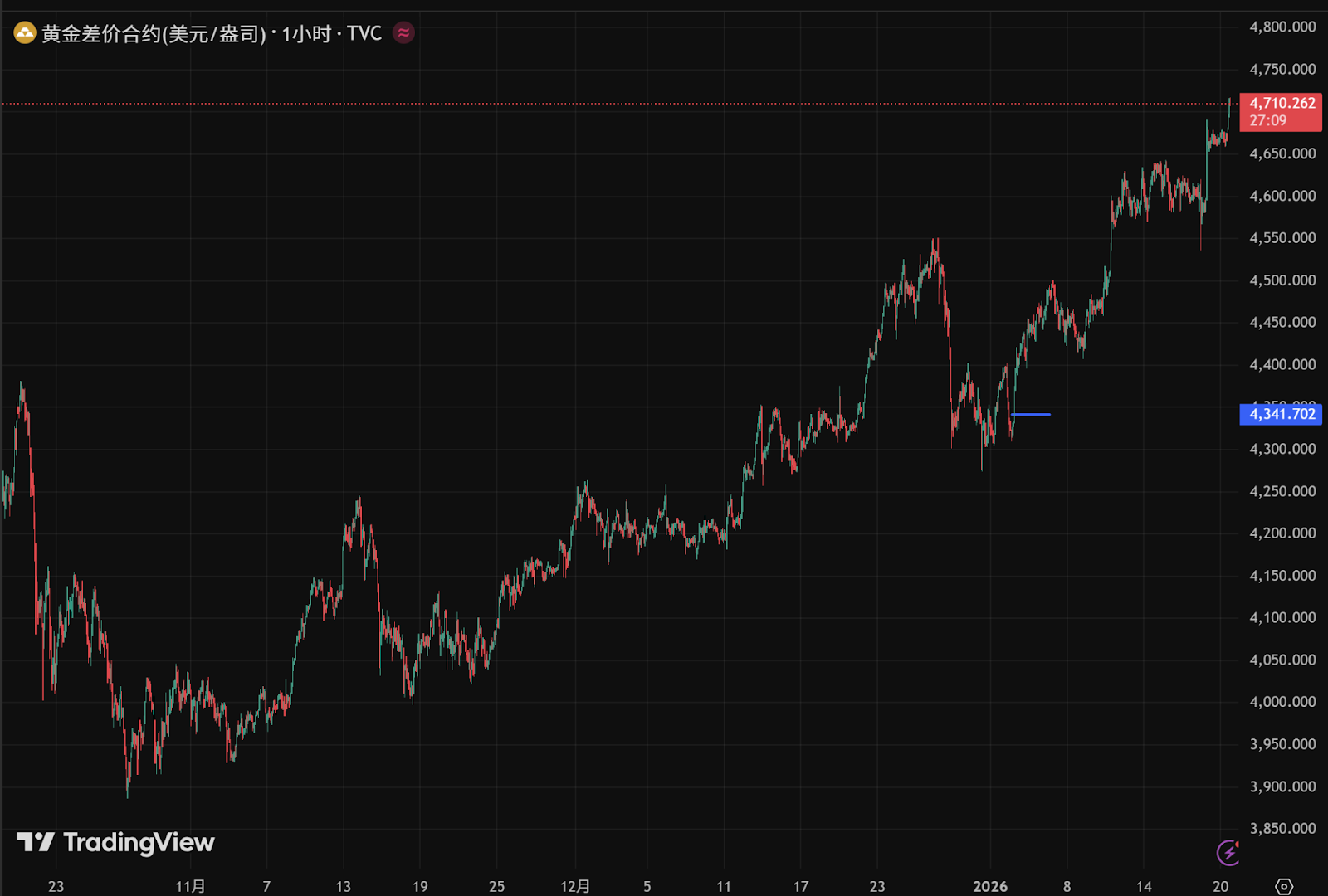
This divergence is not accidental. Instead, it highlights Bitcoin's evolving role within the global macro system. Bitcoin's trading is no longer solely dependent on internal crypto narratives but is increasingly influenced by liquidity conditions, political incentives, and cross-asset capital rotation. In this context, combining selected insights from Galaxy's 2026 outlook with macro signals from prediction markets can provide a useful framework for understanding Bitcoin's near-to-medium-term trajectory.
Bitcoin's Macro Transformation and the Fading Four-Year Cycle
For most of Bitcoin's history, price action was interpreted through a relatively simple four-year halving cycle. Supply shocks, speculative leverage, and inherent market psychology drove dramatic boom-and-bust cycles. As Bitcoin's market capitalization grew and institutional participation increased, this explanatory framework began to lose its potency.
Bitcoin's deepening integration with traditional financial infrastructure—including spot ETFs, institutional custody, and regulated venues—has gradually reduced its volatility. Recent cycles have seen shallower peak-to-trough drawdowns and improved liquidity during stress events. These developments suggest Bitcoin is transitioning from a purely reflexive asset to one that behaves more like a macro-sensitive risk asset.
Consequently, Bitcoin's trading increasingly aligns with overall liquidity conditions, showing higher correlations with tech stock indices during periods of monetary tightening or easing. This shift hasn't eliminated volatility but has changed its drivers.
Bitcoin's 2026 Price Structure: A Gold-Like Pattern
Bitcoin's current situation can be analogized to gold during periods of macroeconomic transition. Historically, when real interest rates begin to decline but uncertainty remains high, gold prices often experience an initial decline or prolonged consolidation before resuming their long-term uptrend.
Applying this pattern to Bitcoin suggests near-term risks remain skewed to the downside or sideways. Galaxy's analysis highlights a critical zone between $100,000 and $105,000. If Bitcoin cannot sustainably break and consolidate above this range, it may remain in a post-halving adjustment phase for much of 2026.
Such phases are typically characterized by choppy price action, fading speculative interest, and deleveraging rather than sudden crashes. In past cycles, this environment lasted for months, during which prices stabilized before sentiment recovered.
Bitcoin, Politics, and the 2026 US Midterm Elections
Among the macro variables influencing Bitcoin's 2026 outlook, one of the most underappreciated is US domestic politics. The US midterm elections are scheduled for November 3, 2026, and financial markets rarely wait for the results to adjust their positions.
In 2025, the crypto industry benefited from a relatively favorable policy environment, with regulatory restructuring and clearer legislative signals boosting institutional confidence. However, as the midterms approach, the risk of political reversal or legislative gridlock increases.
Historically, institutional investors often begin reducing exposure to policy-sensitive assets three to six months before midterm elections. If this pattern repeats, a systematic de-risking of speculative assets, including crypto, could occur by mid-2026. This process is often driven more by risk management limits than fundamentals, supporting Galaxy's view that 2026 could see choppy, range-bound action rather than clear directional moves.
Bitcoin and Macro Liquidity: The AI Capex Cycle
Beyond politics, global liquidity dynamics—particularly those related to artificial intelligence—constitute another key constraint. Major financial institutions forecast that global AI infrastructure capital expenditure will peak in 2026, following years of aggressive investment in data centers and supercomputing capacity.
Over the past two years, AI has absorbed a disproportionate share of global risk capital, diverting funds that might otherwise have flowed into crypto. As AI infrastructure matures, the market focus is shifting from investment scale to monetization and returns.
A capex peak itself isn't negative, but it often coincides with liquidity tightening. If revenue growth fails to justify prior spending, valuation compression and balance sheet pressure can follow, prompting a flight to cash and government bonds.
Bitcoin, Balance Sheets, and Risk Asset Correlations
A significant secondary effect of the AI investment boom lies in accounting. Major hardware investments made in 2024 and 2025 will begin generating substantial depreciation expenses in 2026. Even though these are non-cash charges, they significantly impact reported earnings and investor sentiment.
During periods of balance sheet stress, correlations among risk assets tend to rise. Bitcoin, despite its unique history, is unlikely to be immune. Unless Bitcoin is widely perceived as a cash-flow-generating asset, its price will remain sensitive to broad liquidity squeezes.
Bitcoin Price Expectations in Prediction Markets
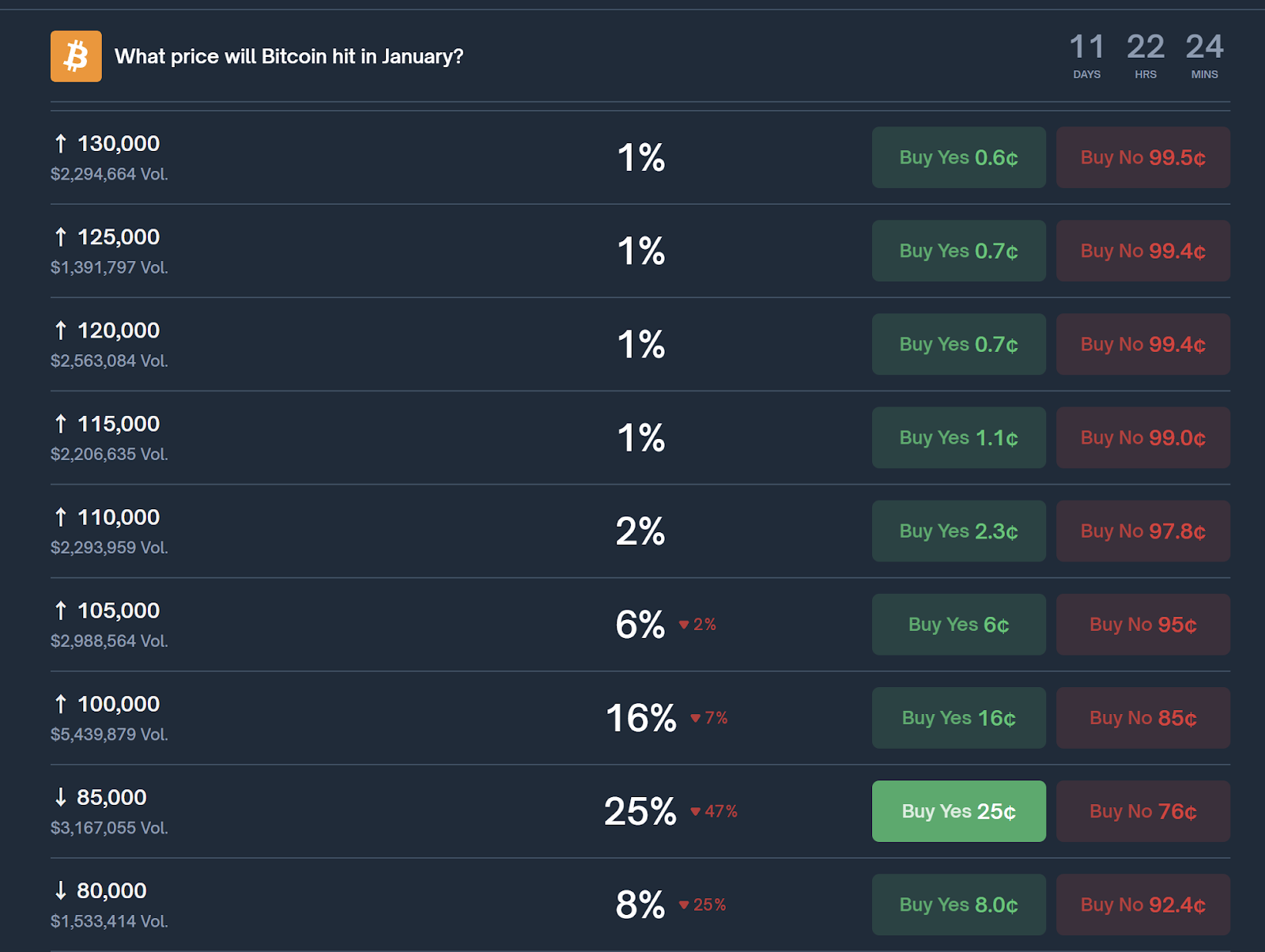
These macro dynamics are increasingly reflected in prediction markets. On Polymarket, contracts for Bitcoin's January price have seen significant repricing due to recent volatility spikes. The probability of Bitcoin touching $100,000 in January has fallen to around 15%, while probabilities for higher targets like $105,000 or $110,000 are in the single digits.
Unlike sentiment surveys or analyst forecasts, prediction markets require participants to express views under strict settlement rules. Here, outcomes depend on whether Bitcoin reaches a specific price level (even briefly), calculated based on Binance's BTC/USDT one-minute highs. This mechanism penalizes vague optimism and rewards realistic assessments of volatility and liquidity.
The current probability distribution suggests traders expect range-bound action with a downside bias. This doesn't imply a structural bear market but reinforces the view that early 2026 is more likely to feature consolidation than breakout.
Bitcoin in 2026: From Narrative to Probability
Taken together, macro signals, Galaxy's framework, and prediction market pricing form a coherent picture. Precious metals breaking to new highs reflect end-of-cycle risk hedging. Bitcoin stabilizing below $100,000 indicates constrained risk appetite. Prediction markets confirm that when forced to quantify expectations, traders see limited near-term upside.
This convergence doesn't negate Bitcoin's long-term thesis but refines its timeline. Bitcoin appears to be entering a phase where patience, balance sheet awareness, and the macro environment matter more than narrative momentum. In this sense, the current environment may feel frustrating but is structurally consistent with the maturation of an asset class.