Understanding NYC Token in One Article: How Political Narratives Influence Meme Market Liquidity



- Core Viewpoint: NYC Token (NYC) is a typical case of a narrative-driven Meme token. Its market performance is primarily determined by political association, internet culture, and liquidity structure, rather than technical or application value. The key to evaluating such assets lies in distinguishing their public narrative from verifiable on-chain behavior and market structure.
- Key Elements:
- NYC is built on Solana. Its market attention stems from political topics and internet culture, not technical applications, making it a typical narrative-driven asset.
- Its early price volatility was intense, mainly due to low circulating supply, limited liquidity, and potential concentration, which amplified the impact of market buying and selling actions.
- The evaluation focus should be on structural factors such as token identity verification, circulation ratio, token holder concentration, liquidity depth, and transparency of information disclosure.
- NYC's current primary "application" scenarios are trading and community interaction; it does not function as a core utility token supporting any decentralized applications.
- Main risks include liquidity risk, token holder concentration risk, brand confusion and scam risks, and uncertainty arising from insufficient information disclosure.
- Its future prospects depend on whether it can transform short-term attention into sustainable liquidity management and verifiable execution capabilities. Otherwise, it may follow the common lifecycle of Meme tokens characterized by high volatility and cyclical trading.
NYC Token (NYC) is a Solana-based meme token that entered the market spotlight almost immediately upon launch. Its attention stems not from technological innovation, but from its unique intersection of political discourse, internet culture, and high-speed on-chain liquidity. For readers, the key to understanding NYC lies not in dissecting complex protocols, but in distinguishing the project's public statements from its observable market behavior and assessing whether its token structure can support its narrative.
This article uses NYC as a case study to analyze the operating logic of the contemporary meme market: how attention translates into liquidity, how limited circulating supply amplifies price volatility, and why early liquidity decisions often dictate market direction more than marketing narratives. We will systematically examine NYC's core identity, tokenomics claims, its actual activity patterns within the current ecosystem, and the rational path users should follow when considering participation. The article aims to provide a reusable analytical framework to help readers evaluate more narrative-driven crypto assets in 2026, rather than sensationalizing the event itself.

TL;DR Quick Summary
- NYC Token (NYC) is a Solana-based meme token whose attention primarily stems from political association, media exposure, and internet culture, rather than technical application value.
- Early trading performance shows that in politically-themed meme markets, low circulating supply and concentrated liquidity easily amplify price volatility.
- The key to evaluating NYC lies in separating the political narrative and public communication from observable on-chain behavior and market structure.
- Currently, NYC's primary activities are concentrated at the trading participation and community interaction level, rather than application-level use cases.
- It is recommended to examine NYC from a structural risk perspective, focusing on token identity verification, liquidity depth, token concentration, and transparency of information disclosure.
NYC Token Overview
NYC Token (NYC) is a crypto asset natively deployed on Solana, which quickly gained public attention upon market entry and achieved relatively fast price discovery. On mainstream data platforms, NYC is typically categorized as a meme-type token, not as infrastructure or application-layer assets. This distinction is crucial, as its market performance is driven more by narrative propagation and liquidity structure than by product usage or developer ecosystem.
From a user perspective, identity verification is the first step. The name "NYC" itself is highly replicable, and there are historical projects in the market using identical or similar tickers. Before participating in any liquidity pool or trading market, users should confirm the correct Solana mint address through trusted data platforms or block explorers.
NYC's market image is also heavily influenced by its early trading behavior. In meme markets, the initial liquidity size and the control of that liquidity often influence price trends more than long-term roadmaps. When liquidity is limited or highly concentrated, even relatively small capital inflows or outflows can trigger significant price swings. This is why NYC is more often viewed as a market structure case study rather than a technological milestone.
In practical evaluation, NYC is better seen as a narrative-driven asset. The focus of judgment should be on structural factors such as token identity, circulating ratio, liquidity depth, token concentration, and the quality of information disclosure.
NYC Token Tokenomics
NYC Token (NYC) is typically described as a token with a fixed total supply, with only a portion entering circulation at launch. It's important to note that the total supply itself is just basic information; the truly valuable tokenomics questions for analysis lie more in the distribution structure, control rights, and liquidity behavior than in the sheer number.
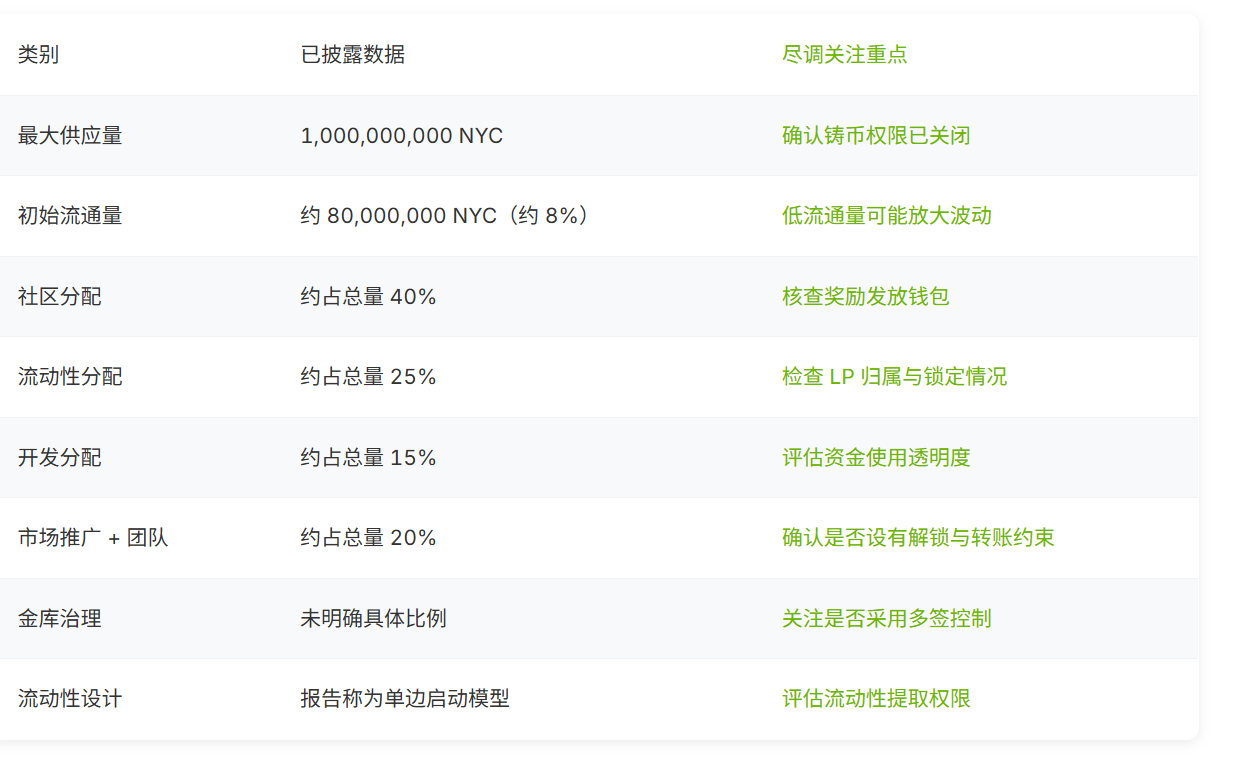
When analyzing NYC's tokenomics, three perspectives are particularly critical.
Supply and Circulating Ratio.
When the circulating supply is low relative to the total supply, the market becomes more sensitive to buying and selling activity. In the early stages of trading, even small-scale capital movements can trigger noticeable price volatility.
Allocation Claims and Verifiability.
Most meme projects announce allocation percentages for community, liquidity, development, marketing, and team. This information is useful for reference but insufficient for a complete judgment. What truly matters is whether the relevant wallets are traceable, whether there are clear unlock or vesting rules, and whether liquidity and treasury assets are managed through transparent mechanisms like multi-signature wallets.
Liquidity Provision Mechanism.
Within the Solana ecosystem, projects can inject initial liquidity in various ways, with single-sided launch models being common. This design helps facilitate a quick market launch, but if liquidity can be rapidly adjusted or is centrally controlled, it may also increase structural fragility.
For XT Blog readers, tokenomics should be treated as a due diligence checklist. Public data is just the starting point; on-chain verifiable information is the key to judging its true market behavior.
NYC Token Core Use Cases
Currently, NYC Token (NYC) does not possess the functional roles typically undertaken by traditional ecosystem tokens. It is not used as a core element of any application or protocol system for paying transaction fees, staking for security, executing trades, or on-chain governance, which clearly differentiates it from infrastructure or DeFi tokens. In contrast, NYC's current primary "application layer" is more concentrated in the market itself, including trading pools, liquidity venues, and market participation driven by community narratives.
This does not mean NYC completely lacks an ecosystem; rather, its ecosystem is composed of familiar market components:
- Wallets and User Tools. Solana wallets, asset tracking tools, and block explorers used for holding and viewing NYC.
- Trading Channels. Decentralized trading pools, aggregators hosting trading activity, and centralized exchange spot markets that list NYC.
- Social Propagation. Online communities and communication channels that sustain attention and participation. In meme markets, these channels often constitute the core growth driver.
When a project emphasizes goals like education or public affairs, the evaluation criteria shift towards "verifiability." In function-oriented ecosystems, progress is typically measured by active users, fee revenue, or developer activity; in narrative-driven ecosystems, credibility stems more from transparent treasury disclosures, traceable on-chain expenditures, and auditable tangible outcomes.
At this stage, a more accurate positioning is: NYC is an attention-driven token whose primary sphere of influence is at the market infrastructure level. Any broader mission or vision should be judged based on observable execution, not solely on brand narrative.
How to Participate and Acquire NYC Token
Participating in NYC Token (NYC) should follow the principle of safety first, focusing on identity verification and liquidity conditions.
On-Chain (DEX) Path.
Users can acquire NYC through Solana-based decentralized exchanges, using a trusted wallet and reserving a small amount of SOL for network fees. Transactions should be completed via mainstream DEX interfaces or aggregators. Before executing a trade, always verify the Solana mint address through reliable data platforms to avoid mistakenly purchasing other tokens due to similar names.
Centralized Exchange Path.
NYC is also available for trading on XT.com via the NYC/USDT spot trading pair, providing a centralized entry point for users who prefer custodial trading. Before participating, it is recommended to check the exchange's official listing information to confirm the correct trading pair, supported network, and relevant trading details.
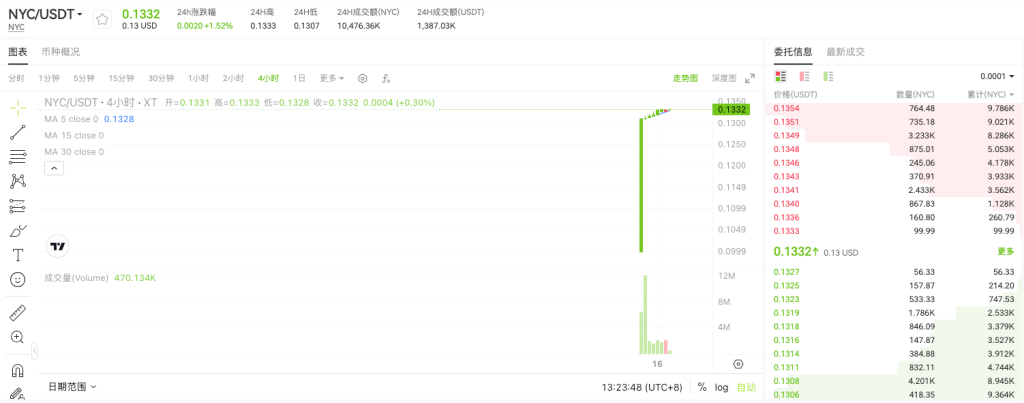 XT.com NYC/USDT Spot Trading Pair
General Tips.
NYC is a narrative-driven asset, and price volatility can be significant. Participation should involve controlled position sizing, with continuous attention to liquidity depth, especially during the early trading stages. The content of this article is for informational purposes only and does not constitute any investment advice.
NYC Token Competitive Landscape
The differentiation in the segment where NYC Token (NYC) operates stems more from narrative propagation and distribution capabilities than from functionality or technology itself. Comparable assets can be roughly divided into three categories, each reflecting different aspects of NYC's positioning and risk profile.
- The first category is meme tokens associated with public figures or political themes. These assets often attract significant capital inflows when attention surges rapidly, but liquidity can also rotate quickly as narratives change.
- The second category is event-driven Solana meme projects. Their momentum typically originates from specific moments, such as news events or viral moments, with ultimate performance highly dependent on liquidity design and token concentration.
- The third category is tokens related to cities or public brands. These projects have a certain level of name recognition but also face higher risks like brand overlap and ticker confusion.

From a practical standpoint, NYC's main advantage lies in attention itself; its core weakness is that attention lacks long-term stability. Without a clear application loop or sustained, verifiable execution capability, narrative-driven tokens often become marginalized in competition, with liquidity eventually concentrating on a few assets with enduring appeal.
NYC Token Risks and Considerations
The risk profile of NYC Token (NYC) is primarily manifested at the structural level, not the technical level. For market participants, the following aspects are particularly noteworthy:
- Liquidity Risk. When liquidity is shallow or highly concentrated, prices are more prone to sharp volatility. Even in the absence of large-scale selling, changes in liquidity depth can trigger rapid price retracements.
- Token Concentration. If token supply is controlled by a small number of addresses, the market becomes more susceptible to influence from concentrated distribution actions. This phenomenon is relatively common in early-stage meme assets.
- Information Disclosure and Accountability Mechanisms. Many meme projects publish high-level tokenomics models but often lack verifiable details regarding unlock schedules, governance mechanisms, or treasury oversight. Narratives involving real-world scenarios or public goals should demand a higher level of transparency.
- Brand Confusion and Scam Risks. "NYC" is a highly generic name, easily replicated. During periods of high attention, the market may see counterfeit tokens, fake liquidity pools, or impersonator accounts.
- Execution Risk. When liquidity is insufficient, trading slippage can increase significantly, especially during heightened market volatility, negatively impacting trade execution quality.
For XT readers, a more pragmatic approach is: when evaluating NYC, focus on identity verification, position management, and liquidity conditions, rather than making judgments based solely on narrative hype.
NYC Token