






2026 Decentralized AI Landscape Analysis: Five Core AI Crypto Infrastructure Projects


- Core Viewpoint: The article points out that by 2026, artificial intelligence has become critical infrastructure, but its centralized architecture has led to structural contradictions such as concentrated control and limited innovation. This is driving decentralized AI, leveraging blockchain technology, to move from the conceptual stage to large-scale implementation.
- Key Elements:
- AI development faces practical constraints due to the high concentration of control over models, data, and computing power, leading to the accumulation of systemic risks and limitations on innovation pathways.
- Blockchain technology offers AI a new organizational model based on open collaboration, verifiable execution, and permissionless participation to address centralization issues.
- Bittensor (TAO) has built a decentralized AI model marketplace, directly linking model output quality to economic rewards through a "Proof of Useful Work" mechanism.
- The Artificial Superintelligence Alliance (FET) aims to address the fragmentation problem in decentralized AI by coordinating agents, data, and computing power through ecosystem integration.
- Render Network (RENDER) provides a decentralized GPU computing power marketplace, with its token demand directly tied to real AI and rendering workloads.
- NEAR Protocol (NEAR) positions AI as a core tool for enhancing blockchain usability, focusing on lowering development and usage barriers.
- Internet Computer (ICP) explores a full-stack architecture that natively supports AI services running on-chain, emphasizing auditability and censorship resistance.
By 2026, artificial intelligence has quietly undergone a transformation in its identity. It is no longer just a cutting-edge technology confined to laboratories, nor merely a competitive asset for internet companies. Instead, it has gradually evolved into a type of infrastructure, deeply embedded within market operations, content production, software development, and decision-making systems.
However, behind this wave of AI proliferation, a structural contradiction is emerging. Control over models, data, and computing power is highly concentrated, training processes are opaque, APIs are closed, and the cost of migrating between platforms continues to rise. The more important AI becomes, the deeper the dependence of developers and enterprises on a handful of platforms, leading to an accumulation of systemic risk.
By 2026, these issues are no longer theoretical discussions but real-world constraints. Tight computing power supply is beginning to directly impact product development cycles, closed ecosystems are limiting innovation pathways, and users continuously contribute data and feedback yet have almost no participation in value distribution. The scaling of AI is exposing the limitations of its centralized architecture.
It is precisely against this backdrop that cryptographic technology is being re-examined. Not as a speculative asset, but as a coordination tool. The mechanisms of open collaboration, verifiable execution, and permissionless participation provided by blockchain offer a possibility for an alternative organizational model for AI.
Entering 2026, decentralized AI has moved beyond the conceptual stage. A number of AI × Crypto projects are operating in the form of infrastructure, with real users, clear use cases, and sustainable ecosystem expansion. Based on real adoption, this article will systematically review the five core projects leading the development of decentralized AI in 2026.

TL;DR Quick Summary
- AI has become critical infrastructure, but control over models, data, and computing power remains highly concentrated.
- Decentralized AI leverages blockchain to achieve open collaboration, verifiable execution, and permissionless participation.
- The five projects selected in this article are based on real usage, adoption, and infrastructure value, not market narratives.
- Each project leads a different critical layer within the decentralized AI tech stack.
- Overall, decentralized AI is moving from the conceptual stage to scaled implementation in 2026.
From Narrative to Execution: Selection Criteria for the Five Projects
The AI × Crypto sector is rapidly becoming crowded. New tokens are constantly emerging, often gaining attention through macro AI narratives but struggling to deliver actual functionality and long-term value. By 2026, measuring influence solely by market capitalization is no longer meaningful.
This ranking focuses on "execution" rather than narrative hype. The evaluation criteria revolve around the following four core dimensions:
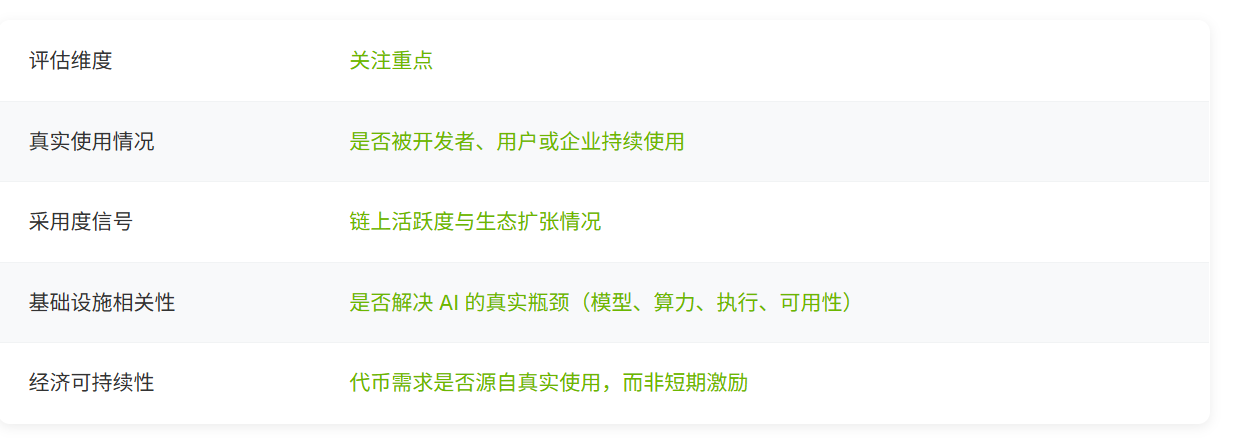
It is important to emphasize that this article defines "decentralized AI" broadly, encompassing the following three directions:
- AI-native networks centered on models or agents
- Decentralized computing power and underlying infrastructure layers
- General-purpose blockchains that deeply integrate AI at the execution or user experience level
Within this framework, the five projects have established clear positioning within their respective layers:
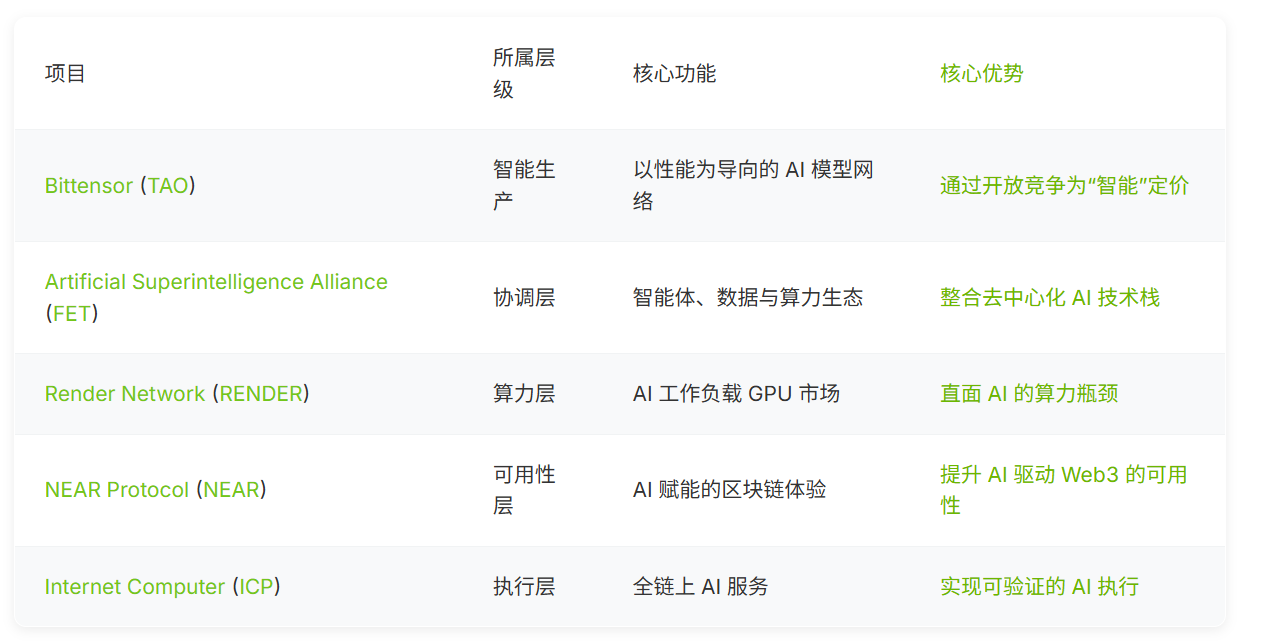
Bittensor (TAO): Establishing a Market-Based Pricing Mechanism for AI Intelligence
Bittensor's Core Positioning
Bittensor (TAO) is a decentralized network where AI models can compete, collaborate, and earn rewards based on actual performance. Unlike concentrating intelligence within a single institution, Bittensor organizes and prices "intelligence" as an open market.
Its goal is intuitive and bold: to decentralize the production, evaluation, and ownership of AI.
Why Bittensor is Considered a Representative AI-Native Network
Bittensor is fundamentally designed as an AI-native network from the ground up, not by "layering" AI concepts on top of an existing blockchain. Its core mechanism incentivizes "useful intelligence," rather than relying on narratives or brand premiums.
AI Use Cases Currently Covered by Bittensor
The types of AI services supported by Bittensor continue to expand, primarily including:
- Decentralized model training and inference
- Task-specific AI services, such as language, vision, ranking, and data filtering
- AI outputs that can be directly called by developers and applications
Unlike a single general-purpose model, Bittensor allows multiple highly specialized models to exist in parallel and compete within the same network.
Overview of Bittensor's Technology and Incentive Mechanism
- Operates on an independent blockchain with a fixed token supply
- Utilizes a subnet architecture, with each subnet focusing on a specific AI task
- Node performance is continuously evaluated and compared
- Employs a "Proof of Usefulness" mechanism to reward models with higher output quality
This design establishes a direct link between AI output quality and economic reward.
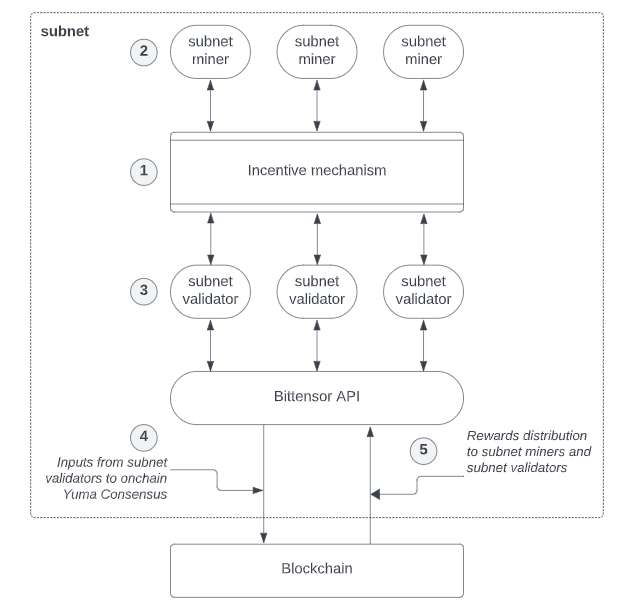 Image Source: Bittensor Docs
Signs of Ecosystem Adoption and Growth
- Rapid growth in the number of active subnets
- Sustained participation from developers across multiple AI verticals
- Significant increase in demand for decentralized inference services
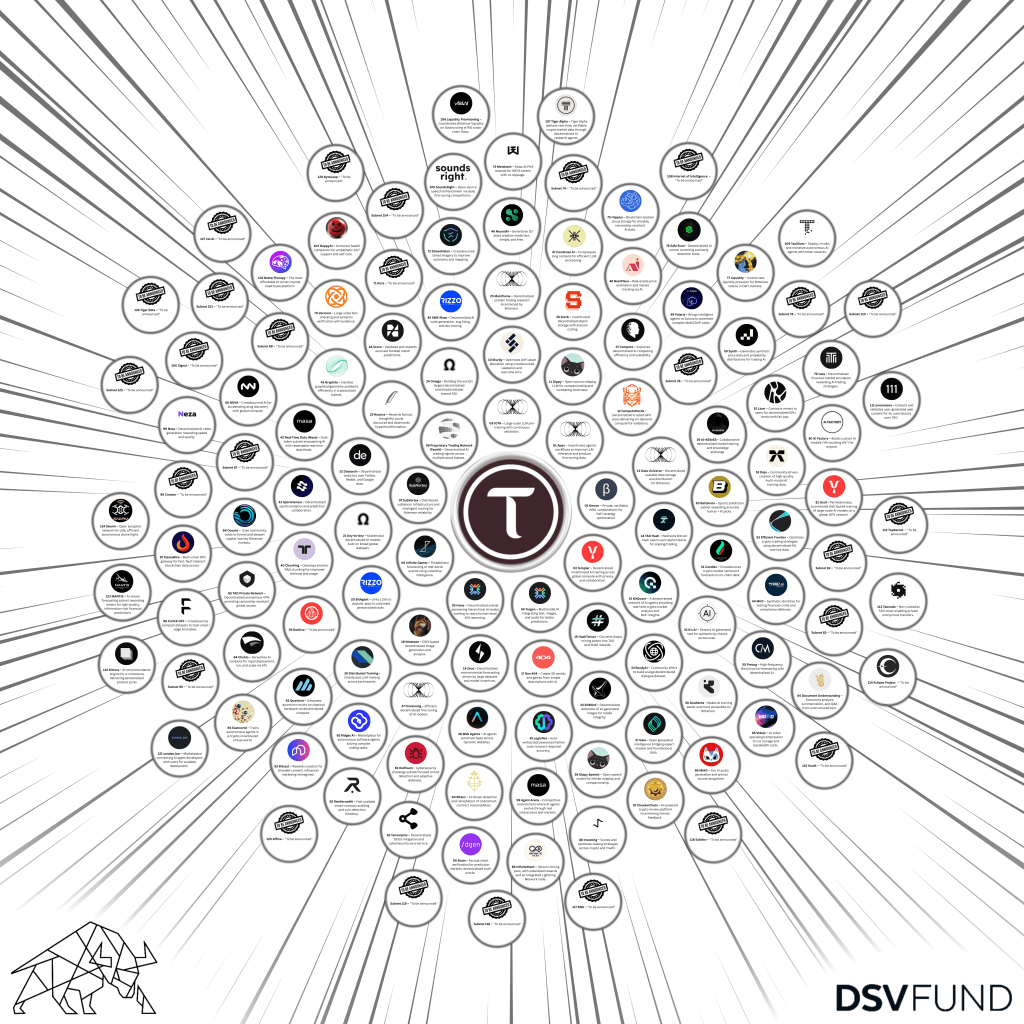 Image Source: Subnet Alpha
Strategic Significance:Bittensor redefines how "intelligence" is organized, transforming it from a platform feature into a market element that can be priced and competed over. By directly linking economic incentives to model output quality, Bittensor demonstrates the real possibility for decentralized AI to compete with, and even surpass, centralized systems in specific scenarios.
Artificial Superintelligence Alliance (FET): An AI Alliance Integrating Agents, Data, and Compute
ASI Alliance's Basic Positioning
Artificial Superintelligence Alliance (FET), abbreviated as the ASI Alliance, is an ecosystem driven by mergers and acquisitions, aiming to bring multiple AI × Crypto projects under a single collaborative framework. Its scope includes:
- AI Agents
- AI Service Marketplaces
- Data Infrastructure
- Decentralized Compute
Unlike focusing on a single module, ASI's goal is to systematically coordinate and integrate the entire lifecycle of decentralized AI.
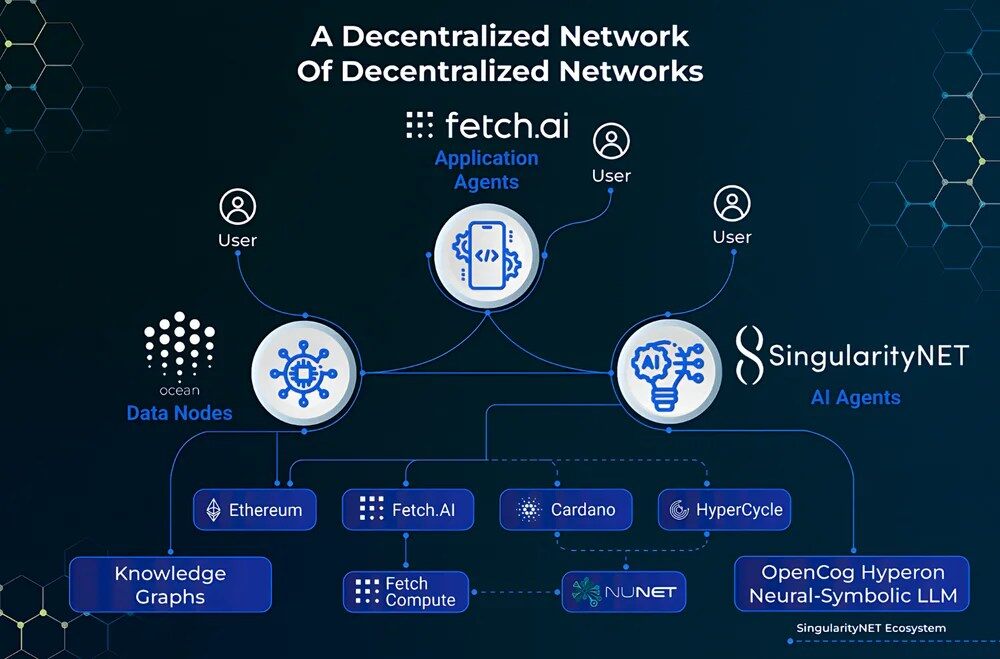 Image Source: Datawallet
Why ASI Chose Ecosystem-Level Integration
Most AI crypto projects address only one segment of the tech stack, while ASI has taken a distinctly different path. It views decentralized AI as an "ecosystem-level problem," rather than a single protocol or product issue, emphasizing cross-module synergy over isolated optimization.
Forms of Practical Applications within the ASI Ecosystem
Within the ASI ecosystem:
- Autonomous AI agents can perform real-world tasks
- Developers can call various AI services through an open marketplace
- Data providers can monetize their data for training purposes
- Agents can collaborate across chains and applications
This modular design encourages highly specialized AI capabilities to be combined, rather than relying on a single, closed large model system.
Technical Foundation Supporting Ecosystem Synergy
- Multi-chain architecture supporting interoperability
- Orchestration layer for coordinating multiple agents
- Emphasis on composable, reusable AI service design