






From Manus Xiao Hong: Those Crypto Interns Who Made It to the Table


- Core Viewpoint: Early crypto internship experiences shape industry leaders.
- Key Elements:
- Xiao Hong: Former intern at Yibit, now Vice President at Meta.
- Ge Yuesheng: Former intern at Bitmain, became an early-stage investor.
- Wang Hui: Employee No. 1 at OKCoin, the company was later acquired by Binance.
- Market Impact: Highlights the value of early entry and understanding in the industry.
- Timeliness Note: Long-term impact.
Original Title: "From Manus' Xiao Hong, Those Crypto Interns Who Made It to the Table"
Original Author: Lin Wanwan, Dongcha Beating
On the last day of 2025, the biggest news in the tech world came from Meta: Mark Zuckerberg spent tens of billions of dollars to acquire Manus, an AI company less than a year old. This is Meta's third-largest acquisition ever, trailing only WhatsApp and Scale AI.
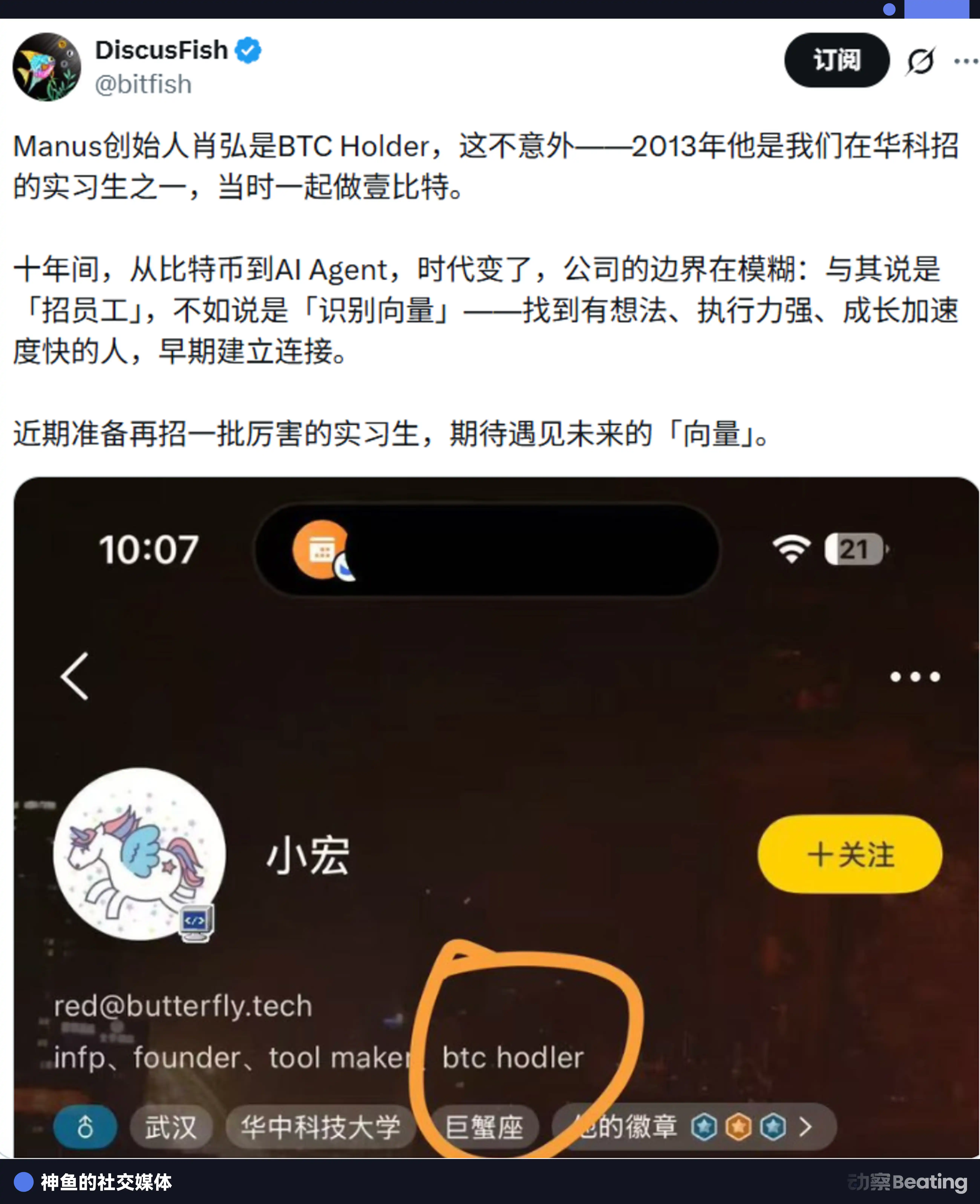
A few days after the announcement, people noticed his bio now stated: BTC Holder.
A tweet appeared on Twitter. The poster, using the handle 'Shenyu' (real name Mao Shixing), is one of China's earliest Bitcoin miners, with a net worth long surpassing ten billion:
"Manus founder Xiao Hong being a BTC Holder is no surprise—in 2013, he was one of the interns we recruited at Huazhong University of Science and Technology (HUST), working together on 1BTC."
2013. 1BTC. HUST intern.
Xiao Hong, born in 1993, hails from a small town in Ji'an, Jiangxi. Before becoming a Meta VP, his most widely known identity was as the founder of the AI products Monica and Manus. But few know his first proper internship was at a Bitcoin media company called 1BTC.
That year, he was just a sophomore at HUST's Qiming College, tinkering with various student projects: WeChat Message in a Bottle, WeChat Wall, campus second-hand trading platforms. As deputy team leader of the student innovation team, he was already a somewhat famous tech geek among his peers. But Bitcoin was still a whole new world to him.
1BTC was one of China's earliest Bitcoin vertical media outlets, based in Beijing's Galaxy SOHO. The founding team included Shenyu and several other equally young idealists. Their work was simple: translate foreign Bitcoin news, write科普 articles, trying to help more Chinese understand this new thing mainstream media then called a "Ponzi scheme."
What exactly Xiao Hong did at 1BTC is hard to verify now. But looking back twelve years later, the significance of that experience has long transcended the internship itself.
The Bitcoin circle in 2013 was a club for early participants in a grand social experiment. No regulation, no pricing anchor, no成熟的 business models—just a group of young people believing in "code is law," huddling for warmth amidst mainstream society's mockery. Those who entered at that time were either gamblers or those who truly understood something.
Xiao Hong clearly belonged to the latter. Decentralization, permissionless, code autonomy. These concepts seemed like geek self-indulgence back then, but they formed an underlying framework for understanding the world. Twelve years later, as AI began reshaping the boundaries of human-computer interaction, this framework might have become traceable.
From Bitcoin to AI Agent, the technological forms are vastly different, but the underlying logic is consistent: both are about making machines run autonomously, establishing collaboration in trustless environments, replacing intermediaries with code. Those who understood Bitcoin in 2013 needed almost no extra cognitive load to understand AI Agent in 2025.
Shenyu used a term in that tweet: "identification vector."
"Over a decade, from Bitcoin to AI Agent, the times have changed, company boundaries are blurring. It's less about hiring employees, more about identifying vectors..."
What is a vector? Direction multiplied by speed. Xiao Hong in 2013 was a sophomore willing to bet his time on an "unreliable" field. That choice itself was a filter—screening out those who only see immediate certainty, leaving those willing to pay for long-term possibility.
12 years later, this vector pointed to the position of Meta VP.
In the cryptocurrency industry, where wealth creation myths coexist with overnight wipeouts, there is a hidden path to success: following the right person in your early twenties. Around 2013, a wave of the smartest, most daring young people flooded into this野蛮生长的 world. Some had just dropped out, some hadn't graduated yet, following the era's most疯狂 entrepreneurs, doing the most基层 work at exchanges, mining pools, media companies.
They were betting on a certain kind of cognition. This cognition allowed them to识别 opportunities faster than their peers in every subsequent technological wave a decade later.
Warren Buffett once said: "Life is like a snowball. The important thing is finding wet snow and a really long hill."
The cryptocurrency industry in 2013 was that wet, long hill. And those who stepped onto that hill in their early twenties have been rolling their snowball for twelve years.
Xiao Hong is one of them. But he's not the only one.
An Intern on a Cap Table
One day in 2013, in an office building in Beijing's Zhongguancun, two young men were discussing something疯狂.
Wu Jihan, 27, double major in Psychology and Economics from Peking University, had just left a venture capital firm. For the past two years, he had been doing Bitcoin investment and evangelism—his Chinese translation of the Satoshi Nakamoto whitepaper remains the most widely circulated version to this day.
Sitting across from him was Zhan Ketuan, 34, with a bachelor's from Shandong University and a master's from the Institute of Microelectronics of the Chinese Academy of Sciences, possessing over a decade of integrated circuit development experience,公认 as a chip design expert in the圈子.
But this story has a third protagonist.
Ge Yuesheng, 21, had graduated from Huzhou University just a year prior. Before joining Bitmain, he and Wu Jihan were colleagues at a private equity fund in Shanghai; he was an intern there, both doing investment analysis. Influenced by Wu Jihan, Ge Yuesheng began接触 Bitcoin.
Among these three, Ge Yuesheng was the most不起眼的. He lacked Wu Jihan's industry insight and Zhan Ketuan's technical background.
But he had one thing: money. Specifically, family business resources—capital, mining farms, electricity.
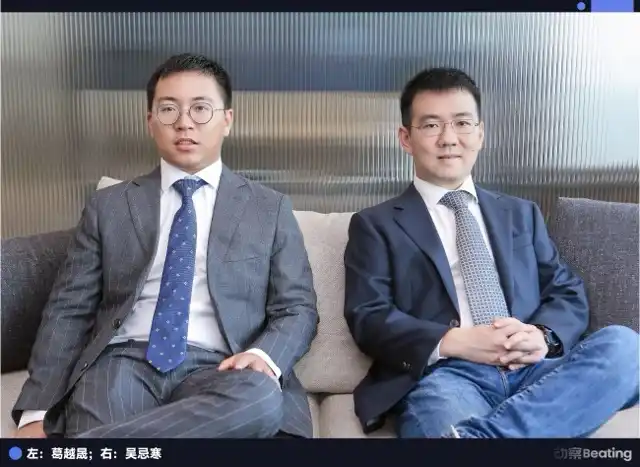
At the time, neither Wu Jihan nor Zhan Ketuan had much money. According to later revelations from former Bitmain executives, Ge Yuesheng's family invested a significant amount of money early on, with several family members becoming shareholders. Wu Jihan's decision to found Bitmain was largely influenced by Ge Yuesheng's investment and assistance; this intern could be considered Bitmain's earliest angel investor.
The division of labor was clear: Wu Jihan负责 industry judgment and market, Zhan Ketuan负责 chip R&D, Ge Yuesheng provided capital and resources.
To persuade Zhan Ketuan to join, Wu Jihan made a惊人的 condition: Zhan Ketuan would receive no salary, but if he could develop an ASIC chip capable of efficiently running Bitcoin's encryption algorithm in the shortest time, he would receive 60% of the equity.
Zhan Ketuan took only six months to develop the 55nm Bitcoin mining chip BM1380 and the first-generation Antminer based on it.
In October 2013, Beijing Bitmain Technology Co., Ltd. was officially established. Business registration data shows that in the earliest shareholder structure, Zhan Ketuan held 59.2%, and Ge Yuesheng held 28%—Wu Jihan's name wasn't even on the founding shareholder list at the time.
This detail has been反复解读. Why did the 21-year-old Ge Yuesheng get 28% equity?
Bitcoin in 2013 was far from mainstream. In April that year, Bitcoin price first broke $100; in November, it surged above $1,000; then in December, the price halved, beginning a two-year bear market.
Most people涌入 during the price surge and fled during the暴跌. Many people have family money, but Ge Yuesheng chose to enter the industry at its earliest, most chaotic stage and bound himself to that ship.
This required not just money, but also a certain intuition for trends and the courage to bet in the face of uncertainty.
The subsequent story is well-known: In less than five years, these three built Bitmain into the world's largest mining machine company, at its peak controlling over 70% of global Bitcoin算力, with a valuation once as high as $15 billion. On the 2018 Hurun Blockchain Rich List, Wu Jihan, with a net worth of 16.5 billion, became the "post-85s self-made新首富," and Ge Yuesheng, with 3.4 billion, became the "post-90s新首富."
In 2019, he left Bitmain together with Wu Jihan to co-found Matrixport. Ge Yuesheng became the CEO of Matrixport, a role he holds to this day.
A 27-year-old evangelist, a 34-year-old technical genius, and a 21-year-old intern angel investor, bound together at the right time by the same vision.
The First Batch of "OKCoin黄埔军校" Cadets
If Ge Yuesheng's story is a classic case of an intern becoming a co-founder, the next story showcases another possibility: from employee number one to being acquired at a high price by a former employer's competitor.
One day in 2013, a young engineer named Wang Hui walked into an office in a Beijing office building.
The office was small, sparsely furnished, looking more like a temporary base for a startup. A whiteboard hung on the wall, covered in system architecture diagrams and flowcharts. A few desks pushed together, with less than ten people sitting there.
This was all OKCoin had.
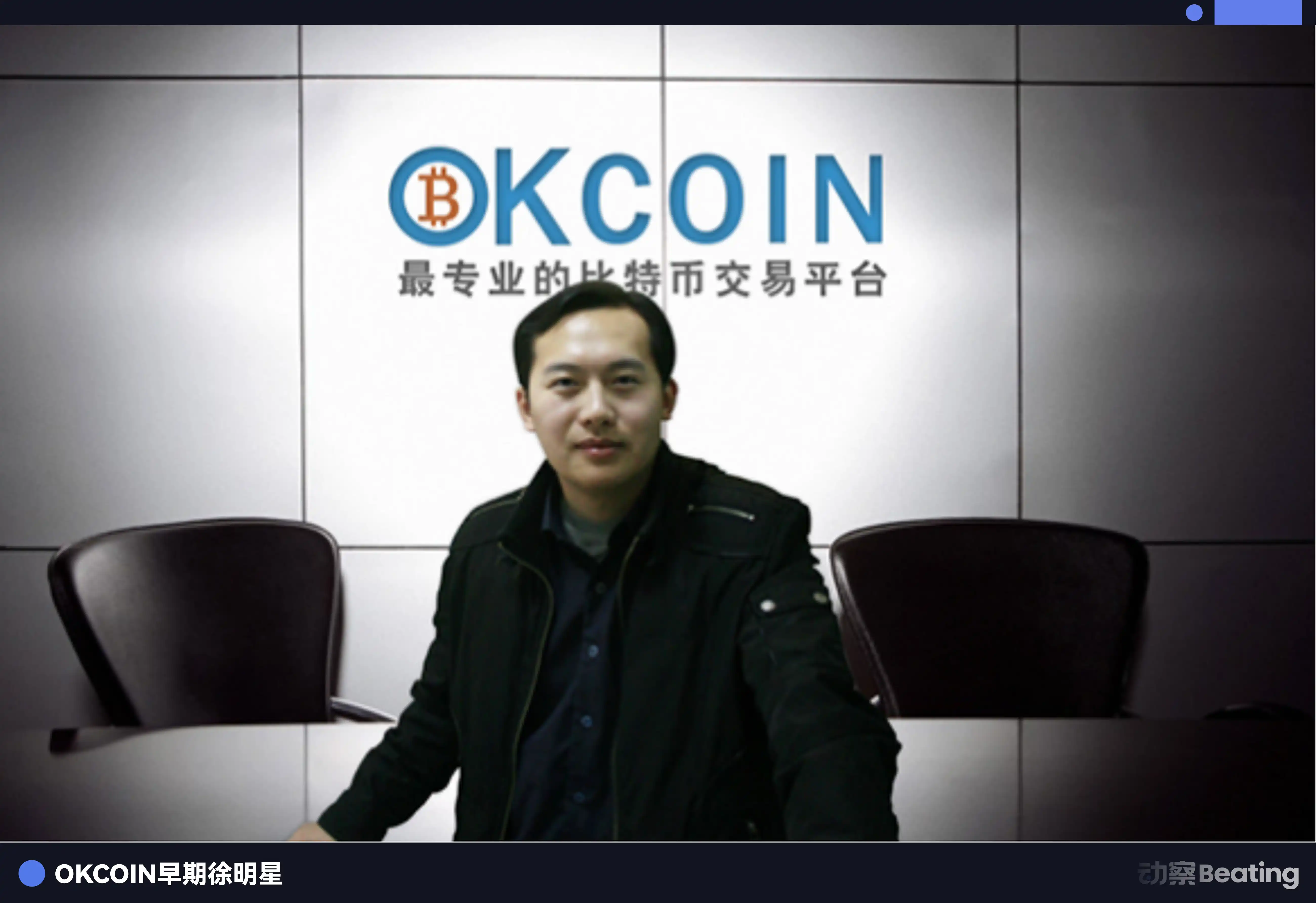
Founder Xu Mingxing was struggling to hire people. Bitcoin in China was still a gray area back then; mainstream media coverage labeled it either a Ponzi scheme or a "money laundering tool." Engineers willing to放弃 big company offers to join a "crypto trading company" were almost impossible to find.
Wang Hui was the first willing to take the risk.
As OKCoin's employee number one, he needed to build the entire technical architecture from scratch. No ready-made solutions to copy, no成熟开源 projects to use, not even many competitors to参考. Everything was blank.
This meant巨大 challenges, but also巨大 opportunity: if he could pull this off, he would become one of the most technically knowledgeable people in the industry.
Over two years, Wang Hui几乎 single-handedly built OKCoin's core trading system. The performance of that matching engine was碾压级 in the industry at the time. "Many trading platforms' systems couldn't even handle basic concurrency," he later recalled. "A few more people trading simultaneously and it would freeze."
More importantly, he cultivated the entire technical team from zero. Many core technical personnel at OKCoin (and later renamed OKEx, OKX) were trained by him.
But by 2016, Wang Hui chose to leave.
There were many rumors in the圈子 about the reasons: disagreements with the founder on理念, internal factional斗争, dissatisfaction with the company's direction... Wang Hui himself never publicly responded to these claims.
But one thing is certain: he took with him all the experience and connections accumulated at OKCoin.
His first stop after leaving was a brief collaboration with another former OKCoin executive. That person was Changpeng Zhao (CZ), who later founded Binance and became the global cryptocurrency首富.
In early 2018, Wang Hui and two former colleagues co-founded JEX, focusing on cryptocurrency options trading. The timing was微妙. In January 2018, Bitcoin price had just started its暴跌 from the all-time high of $20,000, with the entire industry哀鸿遍野. Most were fleeing, but Wang Hui chose to enter against the trend.
JEX received investment from Huobi and Jinse Finance. Just a year later, in 2019, Binance announced the全资 acquisition of JEX, with the reported transaction amount据说 reaching several hundred million RMB.
This was a颇具戏剧性结局: OKCoin's employee number one had his company acquired by Binance.
兜兜转转, these people all came from the same place.
Hence, a saying persists in the crypto圈: OKCoin is the "黄埔军校 of the cryptocurrency industry."
Vectors, Windows, and Survivors
Now, let's return to Xiao Hong.
In 2013, he was just a sophomore interning at 1BTC. This internship might occupy only a small篇幅 in his life履历—after all, his later主线 was WeChat ecosystem entrepreneurship: Yiban, Weiban, Nightingale Tech, eventually sold to Minglue Tech.
But some things leave traces.
Xiao Hong introduces himself as a "BTC Holder." This means that from 2013 to today, he has至少 maintained关注 and participation in cryptocurrency. In a market where price fluctuations are measured in multiples of hundreds, holding for twelve years本身就是 a kind of ability, or信念.
More importantly, that brief internship in 2013可能 shaped a certain方法论 in him: not pursuing zero-to-one technological颠覆, but善于 finding缝隙 on existing large platforms, using product能力 to create value.
From 1BTC to the WeChat ecosystem's Yiban and Weiban, to the AI browser plugin Monica, and finally to the general AI Manus, the underlying logic of this path might be consistent: find a large platform that is exploding, and build the most useful tool on that platform.
The stories of these three interns reveal some common patterns:
First, timing is more important than effort. They all entered the cryptocurrency industry between 2013-2017. That was the industry's "混沌期." Early enough that most people hadn't yet realized the opportunity existed; but not so early that infrastructure was completely absent. Those who entered during this window期 gained disproportionate成长空间. By 2020 onwards, the industry had become relatively成熟, making it much more difficult for newcomers to replicate the same path.
Second, choosing who to follow is more important than choosing what to do. Ge Yuesheng followed Wu Jihan, Wang Hui followed Xu Mingxing, Xiao Hong followed Shenyu. These大佬 weren't necessarily the most famous, but they were among the most discerning and execution-oriented people of their time.
The benefit of following the right person isn't just learning things; more importantly, it's entering a high-quality network. Wang Hui's ability to quickly secure investment and get acquired by Binance after leaving OKCoin was largely due to the声誉 and人脉 he accumulated in the圈子.
Third, the ability to bet in the face of uncertainty is scarce. Joining a Bitcoin company in 2013,坚守 in a bear market DEX project in 2018,放弃 stable jobs to创业 in 2020—these choices all seemed充满风险 at the time.
But risk and reward are对称. Those willing to bear uncertainty ultimately received回报 commensurate with the risk they承担.
Of course, these are all stories of survivorship bias.
Most of the young people who entered the crypto圈 around 2013 did not become billionaires. Many left during bear markets, missed bull runs, got wiped out in暴涨暴跌. But this doesn't prevent us from extracting something valuable from the survivors' stories.
On the last day of 2025, Xiao Hong tweeted: "To build good products in a globalized market, there are many烦恼 not来自 the business itself or user value. All of this is worth it."
From a 1BTC intern in 2013 to a Meta VP in 2025, Xiao Hong took 12 years.
In those 12 years, his former boss Shenyu transformed from a 23-year-old研究生 dropout entrepreneur into an industry教父 with a ten-billion fortune. Shenyu's former partner Wu Jihan went from an evangelist to the缔造者 of a mining empire, left after internal斗争, re-founded a company, and rose again.
The pace of this industry is too fast. Fast enough for a decade to complete one's蜕变 from intern to billionaire, and fast enough for a giant to fall from its peak and东山再起 within a decade.
So, be kind to every intern around you. Because you never know who you'll need to请吃饭 ten years from now.


