






Infinex Public Sale Cools Off: Mechanism Deviates from User Needs, FDV and Lock-up Controversies Unresolved



- Core Viewpoint: Infinex adjusts token public sale rules to boost sales.
- Key Elements:
- Removes individual investment cap, shifts to fair distribution.
- Original rules were complex with a one-year lock-up, raising only 8% on the first day.
- Suspicious bets appeared on prediction markets before the rule adjustment.
- Market Impact: Highlights the importance of project token sale mechanism design.
- Timeliness Note: Short-term impact.
Original Author: ChandlerZ, Foresight News
On January 5th, during the mid-point of the public sale of INX tokens on Sonar by the cross-chain aggregated DeFi platform Infinex, the team publicly admitted on the same day that "the sales mechanism was done wrong" and announced three key adjustments to the rules: removing the $2,500 maximum investment cap per user, allowing users to decide their own contribution amount; shifting from a random allocation to a "max-min fair allocation" to ensure equal distribution for all participants until supply is exhausted, with any excess contributions being refunded; while maintaining priority for Patron holders, the specific details of the priority allocation will be determined after the sale concludes.
In the announcement, the team attributed the problem to their attempt to simultaneously cater to existing patrons, new participants, and fair distribution, which resulted in almost no interest. "Retail consumers hate lock-ups, whales hate caps, and everyone hates complicated rules."
Infinex's Sales Mechanism
Infinex is a crypto product project launched by Synthetix co-founder Kain Warwick. Its initial positioning was more akin to a unified DeFi entry point/front-end layer. Through iterations, Infinex's positioning has gradually converged into a non-custodial wallet super-app and a chain abstraction/intent-driven multi-chain experience, placing greater emphasis on achieving a CEX-level user experience.
This Infinex token sale on Sonar will run from January 3rd to 6th, offering 5% of the token supply. The fundraising target was reduced from $15 million to $5 million, and the FDV dropped from $300 million to $99.99 million. User registration opened on December 27th, and the sale commenced on January 3rd. Additionally, the official team will sell an extra 2% of tokens to the Uniswap CCA.
A significant portion of the sale allocation will be reserved for Patron NFT holders, while another portion will be distributed via a lottery to non-Patron holders. Each Patron NFT grants the holder the right to receive 100,000 INX tokens at TGE. Holders of liquid Patron NFTs will receive corresponding allocation rights based on the number of Patrons they own.
According to Infinex, one Patron qualifies for $2,000 worth of tokens, five Patrons correspond to $15,000, 25 Patrons can allocate up to $100,000, and 100 Patrons unlock a maximum allocation of $500,000. Participants without Patron NFTs can still participate in this sale through a separate lottery pathway. Their quota is capped at $5,000 per person, with a minimum purchase amount of $200.
In October 2024, Infinex raised $67.7 million last year through the sale of Patron NFTs. Participants included billionaires, top Silicon Valley investor Peter Thiel's Founders Fund, Wintermute Ventures, Framework Ventures, and Solana Ventures, as well as angel investors like Ethereum co-founder Vitalik Buterin, Solana co-founder Anatoly Yakovenko, and Aave founder Stani Kulechov. Infinex stated that this fundraising model sold Patron NFTs to venture capitalists, angel investors, and the community.
Furthermore, it sold approximately 43,244 Patron NFTs across the Ethereum, Solana, Arbitrum, Base, Polygon, and Optimism blockchains. On Monday, these NFTs were distributed to buyers on the Ethereum blockchain and are now available for purchase on OpenSea and Blur NFT marketplaces.
Why the Change? Less Than 10% Fundraising Progress on Launch Day
Following the release of the sales rules, the community was embroiled in controversy. The most concentrated criticism focused on the "one-year lock-up for a public sale targeting retail investors." Many believed this contradicted the liquidity expectations typically associated with a public sale, especially in a cautious macro environment where capital prefers quick entry and exit, as a long lock-up inherently increases opportunity cost.
Additionally, many questioned the FDV as being excessively high. At a stage where the project is not yet fully validated and its revenue and cash flow lack stable, quantifiable projections, conducting a public sale with a fully diluted valuation approaching nine or even ten figures essentially asks participants to prepay for several years of execution and growth.
Consequently, in the actual sale, Infinex's token sale launched on Sonar raised just over $400,000 on the first day, representing about 8% of the $5 million target. The INX token sale is scheduled to last for 7 days. Currently, the probability of the public sale exceeding $5 million on Polymarket has dropped to 25%.
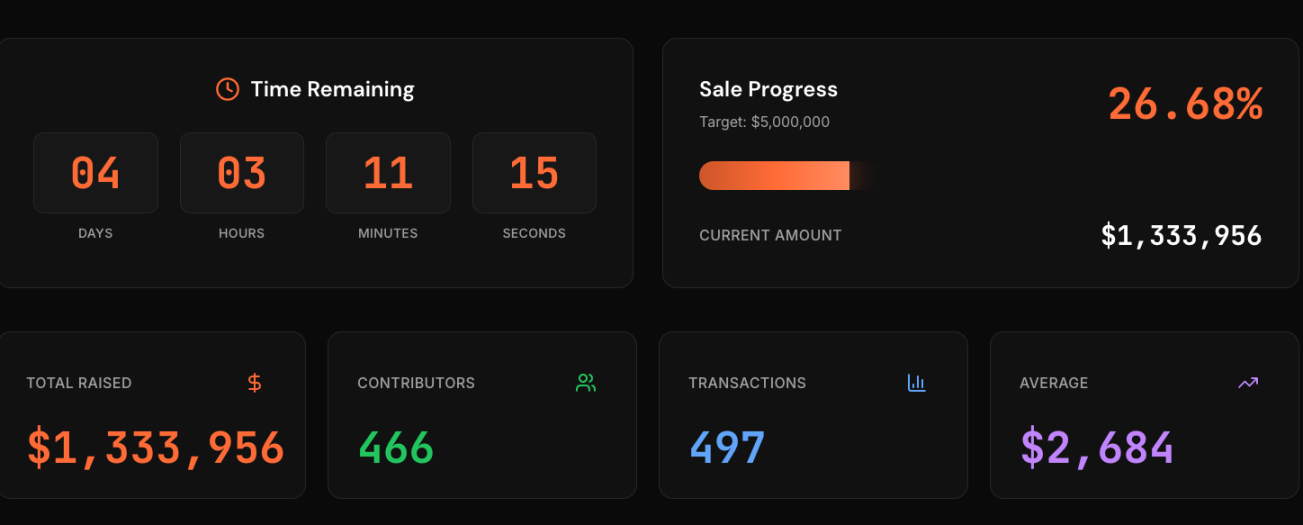
After the rule changes, the relevant webpage shows Infinex's sale amount has exceeded $1.33 million, accounting for 26.68% of the $5 million target, with 466 participating addresses and a total of 497 transactions.
Suspicious Bets Appear Simultaneously on Polymarket
Beyond the controversy surrounding the sales rules themselves, a more sensational clue emerged concurrently from prediction markets. Some community members noticed that before Infinex officially announced the removal of the individual fundraising cap and the adjustment of the allocation mechanism, there was a front-running style of buying on Polymarket contracts related to this sale's fundraising thresholds.
@sanyuanVC discovered that before the official announcement of the cap removal rule, a total of $61,800 was deployed on Polymarket, with floating profits of approximately $30,900. This address only bet $7,000 on the safer "over $2 million" contract, while betting $51,000 on the higher-risk "over $3 million" and "over $5 million" contracts. This address also had no prior transaction history.
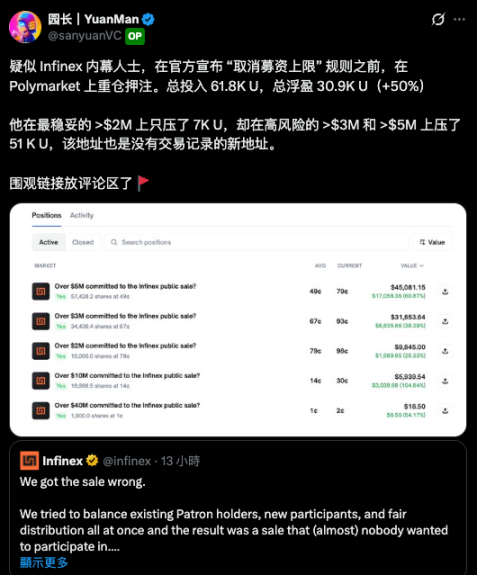
While some commentators speculated about insider trading or information leaks based on this, there is no conclusive evidence, and the project team has not responded.
As of press time, the probability on Polymarket for Infinex's public sale total subscription exceeding $2 million has risen to 98%. The probability for exceeding $3 million is 93%, and for exceeding $5 million is 78%. The cumulative trading volume for this event has reached $3.25 million.





