






When Saturn Retrograde Meets Bitcoin: The Collective Healing Behind the Cryptocurrency Mystic Craze


- 核心观点:币圈玄学流行是交易员对不确定性的心理补偿。
- 关键要素:
- 加密市场高波动性催生对“虚假确定性”的需求。
- 认知偏差(如确认偏差)使玄学“看起来”有效。
- 玄学已成为低门槛的社交货币与共鸣话题。
- 市场影响:可能影响短期交易情绪与社群行为。
- 时效性标注:短期影响。
Original author: Umbrella, Deep Tide TechFlow
AI fortune telling is nothing new; it can predict everything from facial analysis to choosing seats while playing mahjong.
But the way things work in the cryptocurrency world is different; it directly incorporates the outcome into candlestick charts.
On December 13th, @0xSakura, a blogger who creates content on crypto-mystic topics, released something new: an app called "Life K-line".
Enter your birth information, and AI will generate a candlestick chart from age 1 to 100 based on your birth chart, with red and green candles depicting your life's fortune.
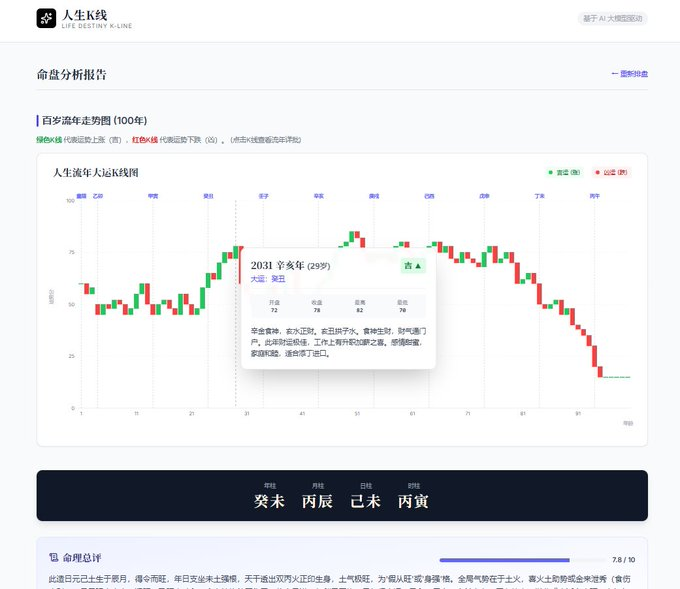
This thing went viral on Twitter. The initial tweet garnered over 3.3 million views, and within three days, the website and API were called over 300,000 times. People started sharing screenshots like crazy, with many saying the generated candlestick charts closely matched their past life trajectories.
Even more bizarrely, within 24 hours of its launch, this tool, which was clearly labeled "for entertainment purposes only," saw the emergence of a copycat token with the same name.
Why would an entertainment-oriented fortune-telling tool resonate so strongly within the cryptocurrency community?
Behind this lies a long-standing undercurrent of trading mysticism, and also a concentrated release of collective anxiety within the cryptocurrency community.
The Mystic School in the Trading Industry
It's not surprising that cryptocurrency traders believe in metaphysics. The same goes for Wall Street.
WD Gann was one of the most famous market analysts of the 20th century and one of the people on Wall Street who combined mysticism and technical analysis most deeply, using astrology to predict market trends and make trades.
In "The Alchemy of Finance," Soros admits that he judges market risk based on the severity of his back pain. When the market is about to reverse, his back will ache intensely.
However, these stories have long remained at the level of "legends," and few people openly admit to using metaphysics to guide their trading.
You can set up feng shui formations, wear lucky beads, or consult a master in private, but you can't let your peers know, otherwise you will be considered unprofessional.
The cryptocurrency world has broken this taboo.
In this industry that is inherently mysterious, metaphysics seems to be a natural fit. Some people use their birth charts to predict the fortune of BTC in the coming year, while others use today's fortune to decide whether to place an order.
Furthermore, discussions about metaphysics in the crypto industry seem to have increased in recent years, with more and more people joining the ranks of metaphysical trading either out of trust or curiosity. A large number of cryptocurrency bloggers on Twitter have also emerged with metaphysical analysis as their personal style.
The explosive popularity of "Life K-line" is a prime example of this.
Many users in the community exchange and discuss their "life trajectory" with attitudes that are either serious or joking. They do not feel that they are "superstitious". They are just using a more interesting way to communicate their feelings about uncertainty with their peers.
The status of metaphysics among traders has changed; it has gone from being a secret on Wall Street to a public topic on cryptocurrency social media.
Why is metaphysics more popular in the crypto industry?
Why do crypto traders need metaphysics?
The answer to this question can be roughly divided into the following three reasons.
Psychological compensation for anxiety about uncertainty
The crypto market is a perfect environment for creating anxiety.
Trading is available 24/7, 365 days a year, with no circuit breaker mechanism; sharp rises and falls can happen in an instant.
Here, a single tweet from a prominent influencer can cause a cryptocurrency's market value to evaporate by hundreds of millions or even billions of dollars in an instant, and the founders of various well-packaged projects may disappear and abscond overnight.
Traders face "unknown risks" at all times, and the most terrifying thing is not the "risk" itself, but the "unknown".
As economist Frank Knight pointed out in 1921, risk is a quantifiable probability (like rolling dice), while uncertainty is an unquantifiable unknown (like whether a war will break out tomorrow).
Humans are naturally afraid of "uncertainty," and when humans cannot quantify risk, they will instinctively create "false certainty" to alleviate anxiety.
Metaphysics is precisely the best vehicle for this kind of false certainty.
When you're feeling lost, checking today's trading calendar can at least give you a clear direction.
Within the cryptocurrency community, crypto astrologer @AstroCryptoGuru, with 51,000 followers, uses Bitcoin's "birth chart" (genesis block time January 3, 2009) combined with planetary cycles to make predictions:
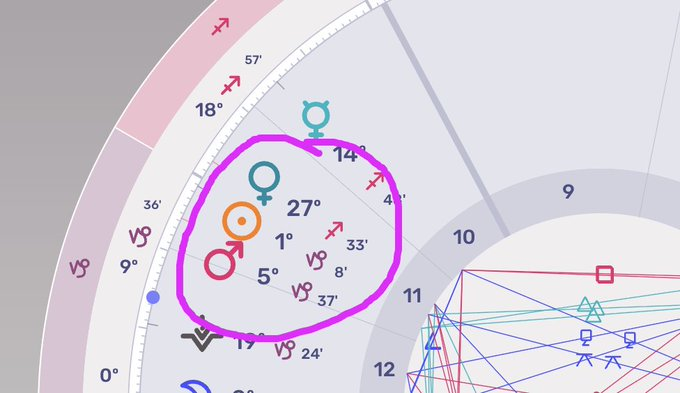
Saturn signals correspond to bear markets, and Jupiter signals correspond to the top of bull markets. He claims to have successfully predicted the bull market peak in December 2017, the bear market in 2022, and the BTC stage high in 2024.
This method of forecasting, which links specific dates to celestial events, provides traders with a clear "wait signal" when market conditions are uncertain, even if that signal comes from outer space.
The predictions such as "Don't place orders during Mercury retrograde," "A full moon will cause a sharp drop," and "Your natal chart indicates a BTC bull market next year" don't require complex technical analysis or reading obscure white papers; you just need to believe in "destiny."
A 2006 study by the University of Michigan found that stock markets in 48 countries returned 6.6% less during a full moon than during a new moon.
This isn't because the moon actually influences the market, but because collective superstition influences traders' behavior. When enough people believe that "a full moon will cause a crash," they sell in advance, and then the crash actually happens.
In the cryptocurrency world, this collective anxiety is even more intense, especially during a bear market. All "fundamental analysis" and "value investing" become a joke, while mystical analysis seems more reliable.
Therefore, traders need metaphysics, not because it is accurate, but because it provides an explanation, even if the explanation is false, it is easier to accept than uncertainty that cannot be seen at a glance.
Cognitive bias leads to self-reinforcement
Why does metaphysics always "appear to be effective"?
The reason why metaphysics continues to be popular in the cryptocurrency world is not only because it relieves anxiety, but also because it "seems to really work".
This is not because metaphysics itself is accurate, but because the brain's cognitive biases are reinforcing themselves.
The most typical example is confirmation bias : when you believe "a full moon will cause a crash," you'll remember all the cases where a crash occurred after a full moon, while ignoring those days of surges or sideways movement after the full moon. When your "life chart" shows that this year is a bull market, you'll attribute every small rise to "the chart coming true," while explaining crashes as "short-term corrections that don't affect the overall trend."
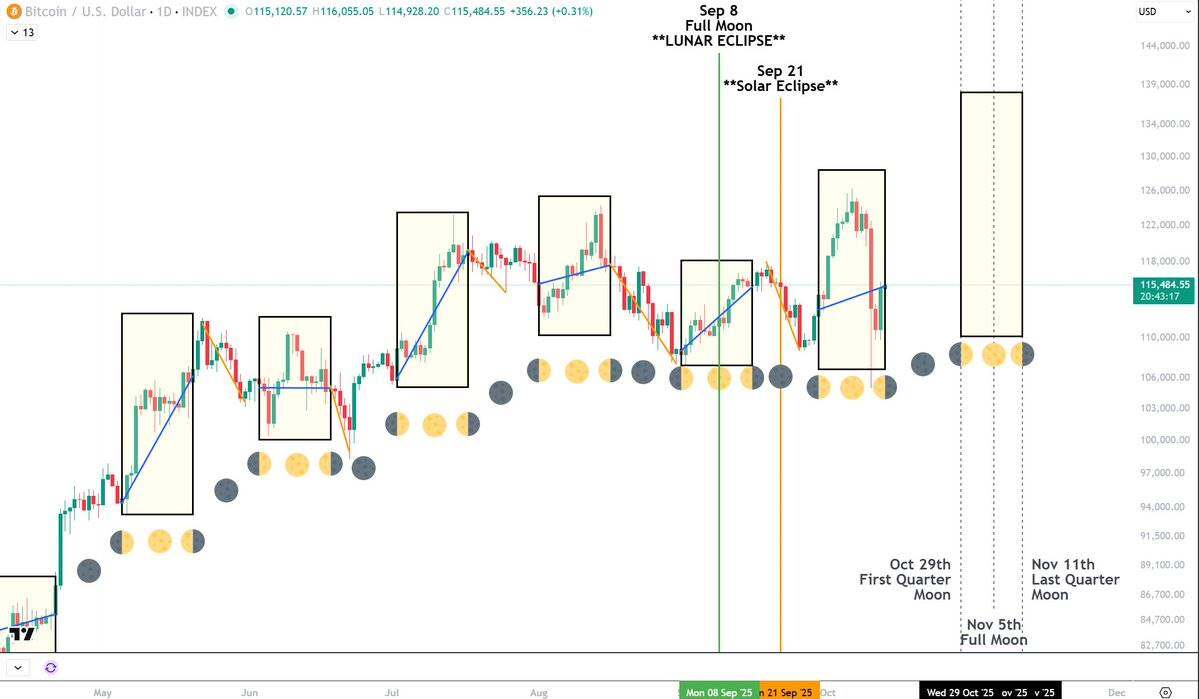
Image source: @Drazzzzz
The social media environment within the cryptocurrency world amplifies this bias many times over.
A tweet like "I followed the tarot card advice to go long on ETH contracts and made 20% in three days!" is likely to be widely forwarded, liked, and screenshotted.
However, traders who lose money based on tarot card tips will not post about it, and their posts will not be seen.
As a result, the information flow of the entire community is filled with cases of metaphysical fulfillment, while the cases of failure are filtered out.
Similar cases are common on Twitter. For example, when @ChartingGuy predicted the blood moon in March of this year, there was always room for explanation regardless of whether the market went up or down: "early peak", "delayed fulfillment", "requires coordination with other planetary angles".
If BTC does indeed pull back during that period, this tweet will be repeatedly cited as a "prophetic prediction."
When BTC crashes, traders desperately need a reason. We look at social media: technical analysts say it "broke through support levels," macro analysts say it's "Japan raising interest rates," but these explanations are too complex and uncertain.
Metaphysics offers a simple and clear answer: "Saturn retrograde means the cryptocurrency market is entering a bear market cycle."
This explanation requires no understanding of market trends, policies, or data; it simply requires the belief that celestial movements influence the market. As a result, it spread rapidly and became the consensus.
More importantly, the ambiguity of metaphysics means it can never be disproven.
The master advised against trading during Mercury retrograde. If you lost money, it's because you didn't heed his advice; if you made money, it means your birth chart is special and suited for counter-trend trading. The tarot cards indicate significant volatility in the near future, and this prediction holds true regardless of whether the price goes up or down.
This characteristic of being able to be interpreted in any way makes metaphysics an invincible force in the cryptocurrency world.
So traders aren't superstitious; rather, their brains are processing information in the most energy-efficient way: remembering what's useful, ignoring what's useless, and replacing complex analysis with simple explanations.
Metaphysics is not popular because it is accurate, but because it always appears to be accurate.
The social attributes of metaphysics
Another reason why metaphysics is popular in the cryptocurrency world is that it has become a kind of social currency.
Discussions about technical analysis may lead to disagreements, but discussions about metaphysics have no right or wrong, only resonance. The question "Is your life's K-line accurate?" is widely discussed not because people genuinely believe it, but because it's a topic anyone can participate in, requiring no professional expertise.
Here is an example that perfectly demonstrates the existence of the demand for metaphysics.
Previously, our readers kept asking if we could add a horoscope feature. After so many people asked, we actually created a "Today's Horoscope" section on the website.
We don't necessarily rely on it to make decisions, but we all want a common topic, a daily ritual for mental well-being.
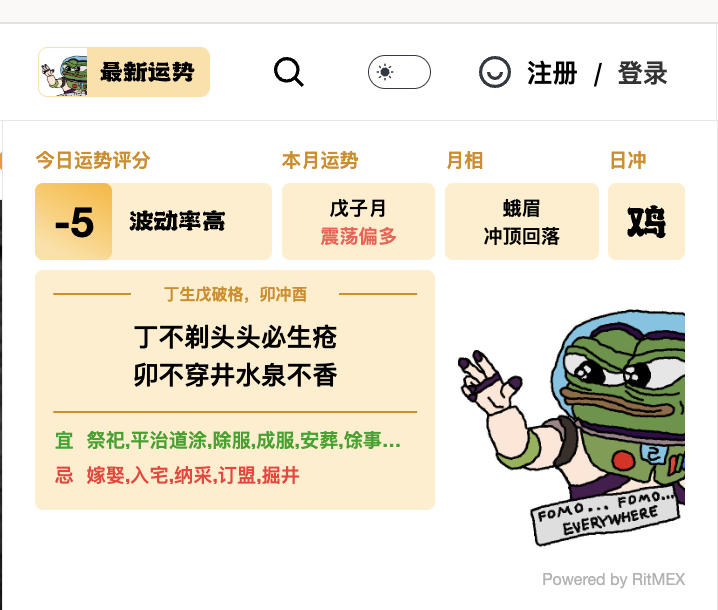
Image source : TechFlow official website
When you say in a group, "Mercury retrograde today, I'm not making any trades," no one will question you, "That's not scientific." Instead, someone will reply, "Me too, let's get through this together."
The essence of this interaction is actually to confirm that each other's anxieties are justified.
A 2025 survey by Pew Research showed that 28% of American adults consult astrology, tarot, or fortune telling at least once a year.
Metaphysics is no longer a fringe culture, but a universal psychological need. The cryptocurrency community has simply transformed this need from "private use" to "public display."
In a market without authoritative answers, metaphysics offers not answers, but companionship.
So, is your life's K-line accurate?
The explosive popularity of "Life K-line" lies in its use of cryptocurrency to express what every trader has in their heart but dares not admit: our sense of control over the market may be just as fragile as our sense of control over our destiny.
When you see your "life chart" indicating a bear market this year, you won't actually liquidate your entire portfolio and exit the market. But you'll feel less guilty when you lose money and more comforted when you miss out on gains.
"This is not my problem, it's that my birth chart cycle is wrong."
In this 24/7, year-round, and uncertain market, what we really want to predict is not our own life trajectory, but a kind of psychological support that allows us to stay at the poker table.


