






A Look Ahead at the New Fed Chair: Hassett, Coinbase Holdings, and Trump's "Loyal Doves"


- 核心观点:哈塞特或成美联储主席,利好加密与风险资产。
- 关键要素:
- 预测市场显示哈塞特胜率高达84%。
- 哈塞特是特朗普的绝对忠诚者与激进鸽派。
- 他持有大量Coinbase股票,是加密利益相关者。
- 市场影响:预示更宽松货币政策,利好加密与美股市场。
- 时效性标注:中期影响
On Tuesday, Eastern Time, the air following the White House cabinet meeting carried a sense that "the die is cast."
Trump jokingly remarked, "I guess there's a potential Fed chairman here too... I can tell you, he's a respected man. Thank you, Kevin."
And this Kevin was none other than Kevin Hassett, the director of the White House National Economic Council, who was present at the time.
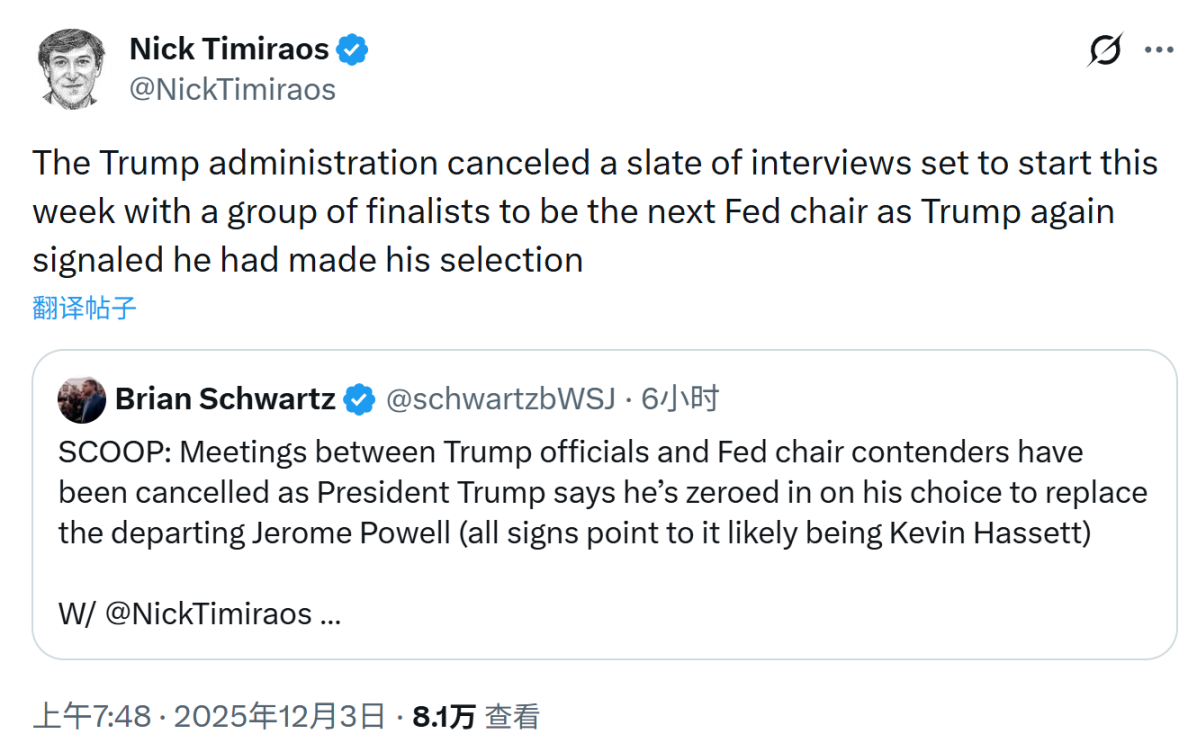
Meanwhile, Nick Timiraos, a reporter for The Wall Street Journal known as the "new Fed mouthpiece," revealed that the Trump administration has canceled a series of interviews for Fed chair candidates scheduled to begin this week, and all indications suggest that Trump seems to be leaning toward Hassett for the position.
I. Is a new Federal Reserve chairman about to emerge?
On the prediction market Polymarket, money has already voted.
As of December 3, the total amount wagered in the "Who will Trump nominate as Fed Chair?" pool had exceeded $13 million, with Hassett leading the pack with a win rate of approximately 84%.
In contrast, other previously highly touted competitors seem to have become mere "runners-up":
- Former Federal Reserve Governor Kevin Warsh was once a leading candidate, but his current winning percentage is only 7%.
- Although current Treasury Secretary Scott Bessent is favored by Trump, he has privately stated that he has no intention of running for office.
- Other members of the establishment, such as BlackRock executive Rick Rieder, current Federal Reserve Governor Christopher Waller, and Michelle Bowman, all have a winning percentage of less than 3%.
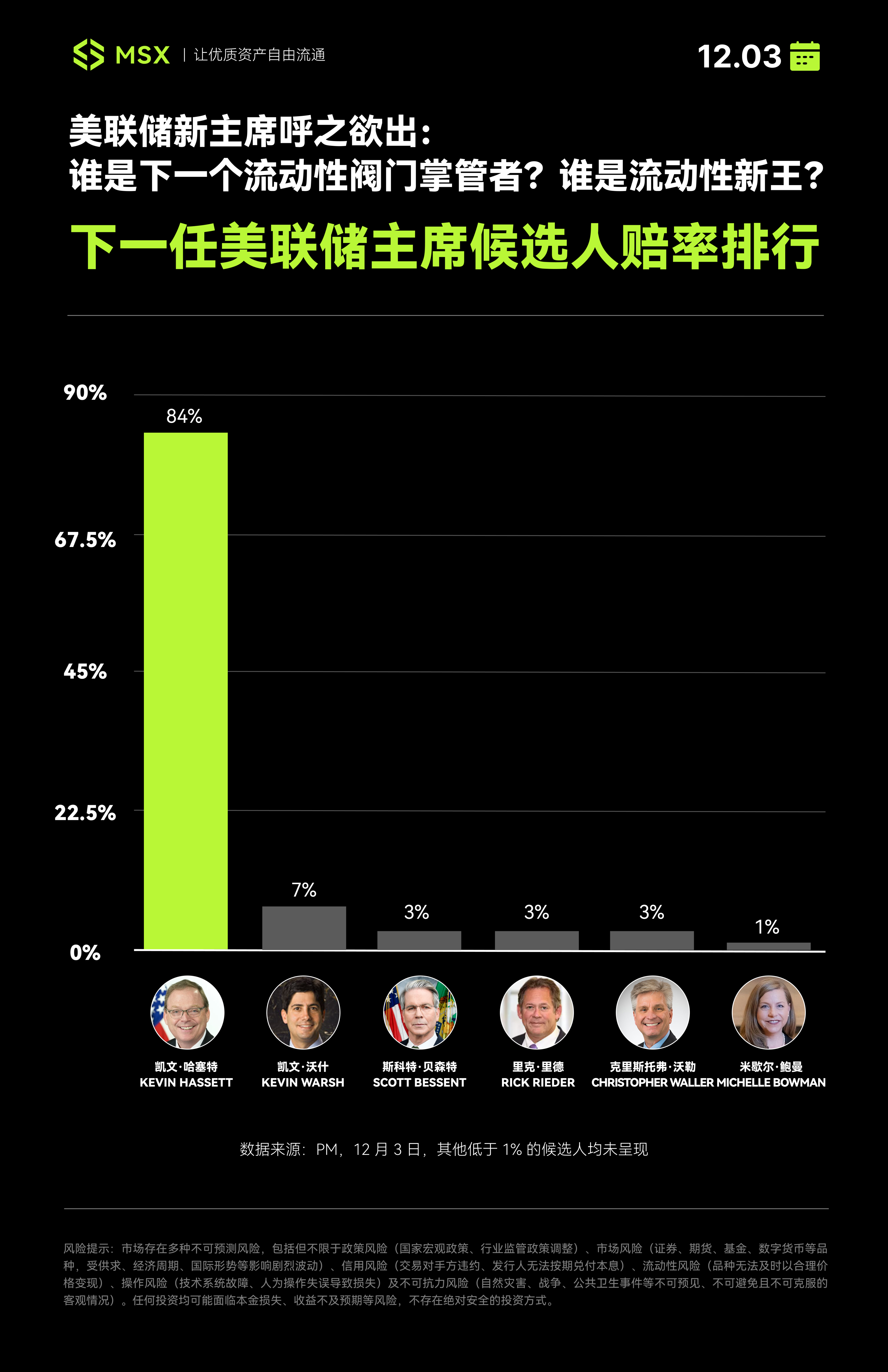
It could be said that Trump's almost explicit statement and Polymarket's overwhelming support both seem to point to the same name—Kevin Hassett.
According to sources familiar with the matter, Hassett met Trump's two most critical criteria for selecting a Federal Reserve chair: absolute loyalty to the president and professional credibility in the markets.
After all, Hassett is not a political novice. During Trump's first term (2017-2019), he served as chairman of the Council of Economic Advisers (CEA) and led the research on tax cut policies at that time. After the outbreak of the COVID-19 pandemic in 2020, he briefly returned as a senior advisor. When Trump returned to the White House in January of this year, he naturally became the director of the White House National Economic Council (NEC).
To some extent, he has been a key advisor and a crucial minority in Trump's economic decision-making agenda.
In the field of academic research, as an economist deeply involved in the market, Hassett's research spans tax policy, energy issues, and stock market investment. He has published numerous papers on capital taxes, dividend taxes, and tax reform. This academic background of "emphasizing public finance and understanding the market" also makes him more flexible than traditional academics when dealing with economic issues.
Of course, although Hassett seems to be on track for his "coronation," there are still uncertainties.
According to sources cited by The Wall Street Journal, the only person who could potentially derail Hassett's rise to power is still the current Treasury Secretary Bessant. Although Bessant has repeatedly stated that he will not run for office, Trump recently told allies privately that he still greatly admires Bessant and is still willing to consider him as a potential candidate for Federal Reserve Chair.
But this minor variable seems unable to stop the overwhelming momentum behind Hassett's 84% win rate.
II. Hassett's Underlying Character: A Radical Dove with "Absolute Loyalty" to Trump
If you had to sum up Hassett in one sentence, it would be a radical dove who is "absolutely loyal" to Trump.
As we all know, in the past few years, the current Federal Reserve Chairman Powell has often used phrases such as "relying on data" and "making decisions on a meeting-by-meeting basis," which has led to him being jokingly referred to as a "data-dependent" chairman. If Hassett succeeds him, we are very likely to have a "White House-dependent" chairman.
Objectively speaking, during Trump's first term, even as chairman of the Council of Economic Advisers, Hassett was a staunch defender of the Federal Reserve's independence. However, in 2024, in order to align with Trump's campaign, he transformed into one of Powell's most scathing critics.
This is also the factor that has drawn the most attention from the market and pleased Trump the most: Hassett's dramatic shift in his stance on the Federal Reserve, and this shift is not merely verbal; for example, he has publicly accused the Fed's decisions of being "full of partisan bias."
- The Federal Reserve has been slow to cut interest rates because "the Democratic administration wants to shift the blame for runaway inflation onto external factors."
- The Federal Reserve's sudden interest rate cut before the 2024 election was intended to increase Harris's chances of winning.
- During this summer and just this past November, he repeatedly criticized the Federal Reserve for not cutting interest rates large enough or quickly enough.
"I think the American people can expect Trump to choose someone who can help them get lower car loan rates and make it easier to get mortgages at lower rates. The market's reaction to the rumors about me proves this point." It can be said that although the above statements were collectively refuted by the Federal Reserve decision-makers, they won Trump's favor. This unconditional political alignment also earned him loyalty points that other competitors (such as Warsh) could not match.
However, Hassett's "compliance" has also raised concerns among his former colleagues, including some who helped him garner congressional support. They are uneasy about his public politicization of the Federal Reserve, and Wall Street is even more concerned about whether Hassett has the backbone to say "no" when inflation picks up again and Trump demands further interest rate cuts.
Currently, the answer seems to be no.
But precisely because of this, for risky asset markets that crave liquidity, a Federal Reserve chairman who is "easily influenced" may be exactly the kind of positive factor they've been dreaming of.
III. If elected, who will benefit?
Although the Federal Reserve does not directly regulate securities or commodities and cannot directly intervene in the SEC's regulatory affairs, it controls the "master switch" of global funding costs.
If Hassett takes office, it won't be as simple as just cutting interest rates; we may be welcoming the most amicable Federal Reserve chairman in the history of cryptocurrencies and the US stock market.
The most direct impact is undoubtedly on interest rates.
Hassett's rise to power can be considered "very positive" for the market's expectations of interest rate cuts. After all, he has publicly criticized the current interest rates as too high and advocated for larger and faster rate cuts, especially in response to Trump's economic expansion policies. Once in power, the Federal Reserve may tolerate higher short-term inflation in exchange for a more relaxed liquidity environment.
This is exactly the scenario that risk assets crave. Lower interest rates typically mean a weaker dollar, lower funding costs, and a sharp rise in market risk appetite.
- For US stocks: Low interest rates will directly boost the valuation models of technology stocks (especially the AI sector), and the Nasdaq may usher in a new period of expansion.
- For Crypto: As the most liquidity-sensitive asset, the abundance of US dollars has historically been the foundation for Bitcoin's rise;

Secondly, Hassett can be considered an "insider" in the Crypto industry, with real money at stake.
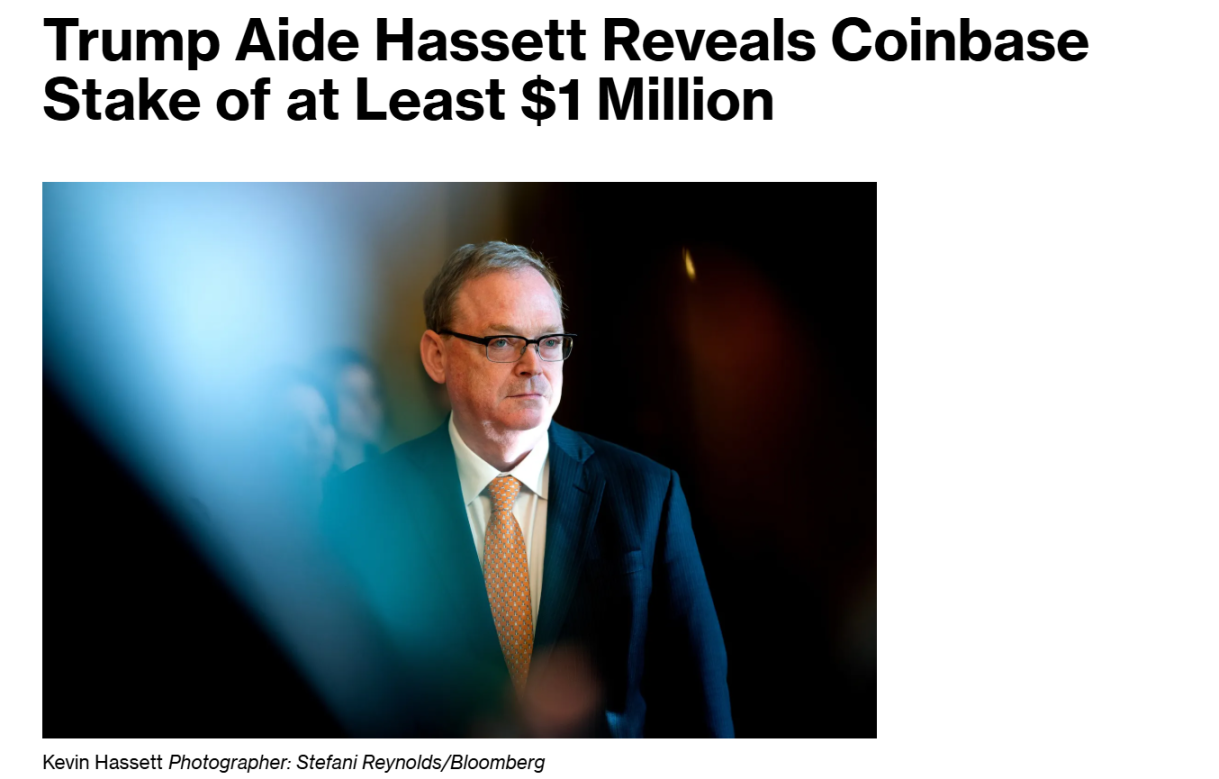
Back in June, Bloomberg reported that Hassett disclosed holding at least $1 million (and up to $5 million) in Coinbase shares and receiving at least $50,000 in compensation for his role on Coinbase’s academic and regulatory advisory committee.
Interestingly, the disclosure documents show that Hassett's family assets total at least $7.6 million. This means that the Coinbase stock, which is between $1 million and $5 million, undoubtedly accounts for a significant portion of his personal wealth. This also indicates that he is a true stakeholder. Such a "bond of interests" is rare for a potential Federal Reserve Chairman.
Finally, Hassett's loyalty was not only reflected in his verbal attacks, but also in his absolute implementation of Trump's new policies.
For example, shortly after Trump returned to the White House, he issued an executive order to establish the "Digital Asset Markets Working Group" within the National Economic Council (NEC). The core task of the working group was to make regulatory and legislative recommendations to promote the United States' leadership in the fields of digital assets (crypto) and financial technology. As the director of the NEC, Hassett was a key driver of this agenda.
The group clearly believes that Crypto technology is an important variable in the future structure of the US economy. This means that Hassett not only understands traditional finance, but is also the core executive in incorporating Crypto into the national economic strategy.
In conclusion
In short, if Polymarket's prediction comes true, we are about to welcome an "atypical" Federal Reserve Chairman:
He holds millions of dollars in crypto assets, he believes in the magic of low interest rates, and, most importantly, he heeds the call of the White House.
For traditional economists who uphold the "independence of the Federal Reserve," this may be a nightmare, but for Crypto and US stock investors who crave liquidity, Hassett's rise to power may mean that the "main valve" of the liquidity frenzy is being reopened.


