LBank's Zero Fee Rate Practical Notes: The Core Anchor Point for Retail Investors to Steadily Grasp Market Trends



- 核心观点:零手续费交易环境显著提升散户策略执行与学习效率。
- 关键要素:
- LBank现货0手续费活动免除所有交易成本。
- 零成本使高频微利交易和策略试错成为可能。
- 增强赠金与奖励池机制进一步降低亏损风险。
- 市场影响:或推动交易平台优化费率结构,吸引用户。
- 时效性标注:短期影响。
For most retail investors, the talk of the town often revolves around market trends and strategies, but what truly influences our actions is not the price itself, but the unseen transaction costs. Commissions, slippage, spreads, rebalancing losses... these numbers may seem insignificant on their own, but after dozens or even hundreds of trades, they accumulate into a burden that crushes confidence.
I've always been a typical retail investor. My capital isn't large, and my investment style is conservative. It's less about "trading" and more about figuring out the ins and outs of the financial world. Even so, my monthly transaction fees are still considerable. Sometimes, even when I'm on the right track, frequent trial trades, exiting with minimal profits, and slippage can cause costs to eat into my gains. This frustration is worse than losing money. Over time, I've developed a typical retail investor mentality: I avoid trading unless absolutely necessary, and I avoid rebalancing unless absolutely necessary. Every decision requires careful calculation: can this profit cover both transaction fees? If the market is volatile, should I continue adjusting my positions? Are small trial trades just testing a strategy or contributing to the platform's fees?
Until recently, LBank launched a zero-commission spot trading promotion. I participated immediately, thinking, "Since there are no commissions, I might as well give it a try." During the promotion, I made a few small-scale position building and adjustment transactions. Unexpectedly, this seemingly casual participation completely opened up my trading rhythm, and my understanding of strategies and operating habits changed significantly in a short period of time.
A simple comparison: cost is the real enemy.
This happened quite by chance. Recently, the market fell back to my psychological level for averaging down, so I simultaneously bought a small position on four platforms. The amount wasn't large; it was just a routine adjustment, and I also wanted to do a small test. After all the transactions were executed, I checked the transaction details one by one: the records on the other platforms still showed the familiar Maker/Taker fees, plus slight slippage due to market fluctuations; but in the LBank column, the fees were all zero.
At first, I thought it was a system update delay or a page bug. After clicking in to confirm, I realized the platform was running a zero-fee promotion on spot trading, with all Maker and Taker tokens free. This wasn't limited to a few specific cryptocurrencies, nor was it a new user exclusive; it was a truly zero-fee promotion across the entire market for a period of time.
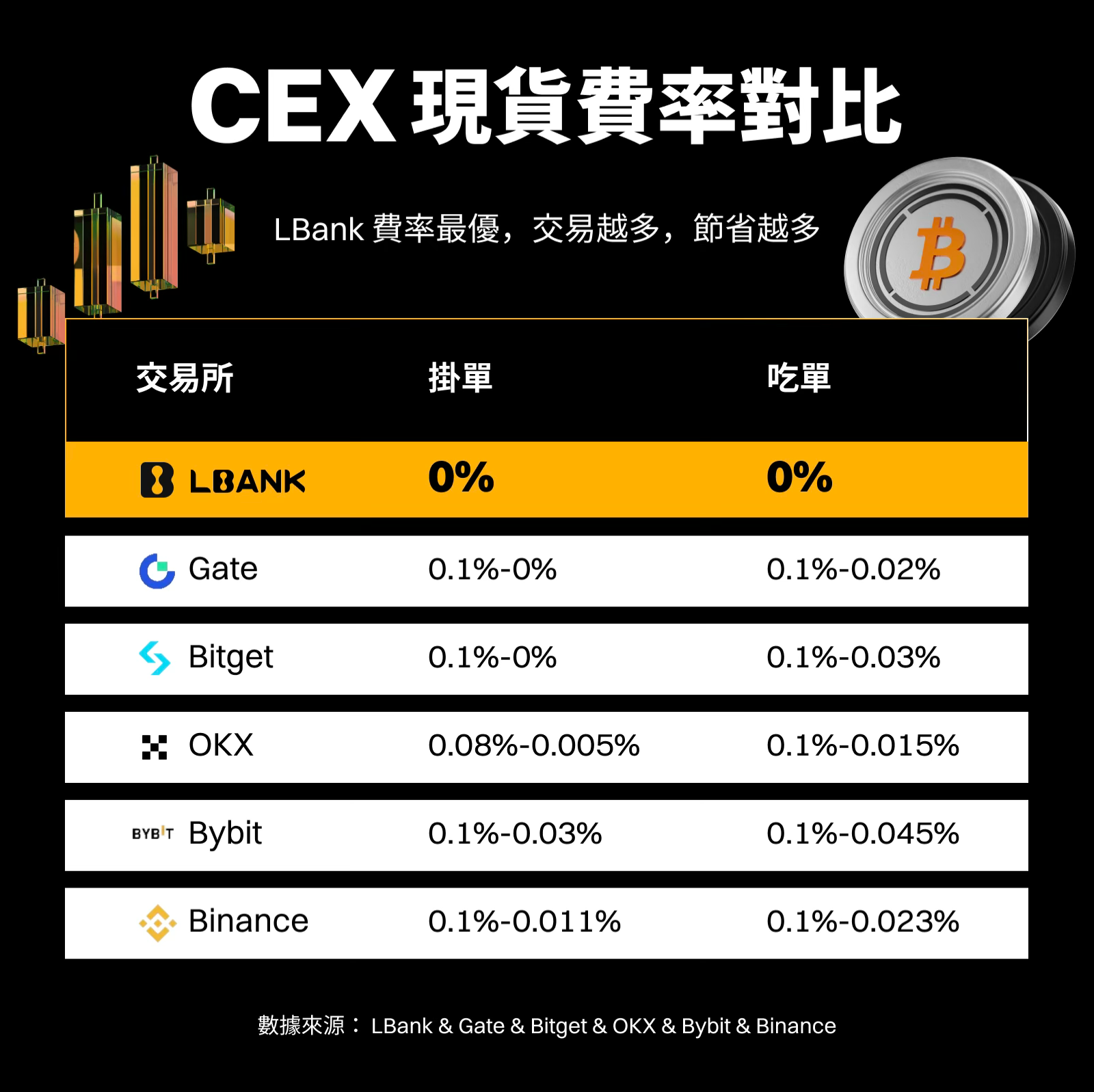
It was only when I compared the two that I realized the same averaging down would incur a total cost of seven or eight dollars on other platforms, but on LBank, it was completely free. This "zero cost" meant that for the first time, I didn't need to repeatedly calculate gains and losses before each order; my strategy could unfold naturally according to my own logic. For a small-account user like me, this difference was even more crucial than the market conditions themselves.
Only when costs disappear do the strategic possibilities truly open up.
After trading for several days in this zero-fee promotion, I found that the changes were far more than just "saving money." More significantly, the rhythm of my trading and the way I executed my strategies were completely reinvented.
Previously, I might only make 2 to 3 trades a day because each entry and exit incurred costs. However, during this period, my average number of trades per day has increased to over 10. I can now execute phased entry and exit strategies precisely according to the established rhythm, without needing to consider additional losses. Short-term opportunities can also be seized directly, such as capturing micro-fluctuations of 0.3% to 0.5%. On other platforms, such profits would be largely eaten up by transaction fees, but on LBank, 0 transaction fees mean that these small profits can be truly realized.
In the past, I almost never touched small-scale arbitrage, but during this period I was able to achieve a small positive cycle with a net profit of $5 to $10 each time. Don't underestimate the small number, but this experience of "costs not eating up profits" is something I have never had before.
In just a few days, I actually accumulated more effective trading samples than I had in a month, and I was able to identify my trading problems more quickly through high-frequency review. It's fair to say that once transaction fees were eliminated, the efficiency of strategy testing, trial and error, and the speed of trading learning were all directly elevated to a new level.
It was then that I truly understood: the slow growth of retail investors is never due to a lack of intelligence, but rather the absence of a "low-cost, trial-and-error" environment. Only when costs cease to be an obstacle can trading enter a true learning cycle. In just a few days, the market insights and strategic understanding I gained even surpassed what I had accumulated over the past few months.
The enhanced bonus and event rewards gave me a pleasant surprise; I lost a little but gained a lot.
The combination of enhanced bonuses and reward pools is the true heart of this LBank campaign.
Besides the most attention-grabbing "0% commission on spot trading", this event actually consists of two overlapping reward mechanisms, and the structure is more direct and easier to trigger than I expected.
The first part is a prize pool consisting of zero transaction fees across the entire spot market. The platform will pool the transaction fees saved by users each day into a prize pool and return it to the participants. In other words, the costs that would have been incurred are not only saved, but will also be returned to you in the form of rewards.
The second part is the 100% enhanced bonus after depositing. I initially thought it was just a common trial voucher, but after using it, I discovered that it's a genuine bonus that can be used to participate in trading, offset losses, and maintain the flexibility of your principal. It's equivalent to directly improving capital efficiency without increasing risk. My principal increased from 2,400 USDT to 4,800 USDT, effectively doubling the capital efficiency, but without increasing the actual risk.
In this environment, changes in trading results are almost immediately apparent. For example, in one short-term trial position, the market fluctuated quite rapidly, and the principal was initially showing a floating loss of -42 USDT. However, the settlement result was completely different from what I was used to: the reward pool returned 16 USDT that day, and the enhanced bonus deducted another 28 USDT, turning what was originally a sure-fire loss into a small profit of +2 USDT, something that would have been impossible before.
What was even more noticeable was a sudden price fluctuation. The market surged dramatically, and my principal position instantly dropped by -180 USDT. In the past, I would have had to bear this loss; but with this promotion, the bonus directly absorbed 110 USDT of the loss, and the actual net loss was only -70 USDT. The impact was much smaller, and my mindset was much more stable.
This relaxed and focused state was something I had never experienced in my long trading career. During this time, I even had a feeling that I had finally "gotten it."
The change brought about by this experience is not a short-term benefit, but a long-term cognitive upgrade.
I carefully reviewed my operations over the past period, and my most profound feeling was not "more profits," but a deeper shift in my understanding:
It turns out I wasn't incapable of trading; rather, I had never learned in an environment that allowed me to experiment and make mistakes. No matter how realistic a demo account is, it can't replace the pressure, feedback, and emotional fluctuations of live trading. Only when you're actually trading with your own money can a strategy be thoroughly validated and habits truly established.
This zero-cost window at LBank allowed me to see the framework, rhythm, and growth potential of my own strategy for the first time. It made me realize that the key to retail investor growth is not betting, but reducing the pressure of each trial and error.
Many people say that retail investors are always the ones who get exploited, but my experience has made me realize that when the cost burden decreases, the tolerance for error increases, and the space for trial and error opens up, retail investors can also build their own trading systems.
This wasn't a get-rich-quick experience, but rather an experience that made me understand "learning speed can be accelerated"; it wasn't a huge profit, but the first time I felt that I was proactive, rather than being driven by the market.
LBank's zero-fee spot trading promotion was like a window that briefly opened for me, allowing me to see my potential in a near-ideal environment for the first time. No one can predict how the market will change in the future, but the growth I've experienced during this period will have a long-term impact on my understanding of trading.