Is this a good time to buy at the bottom? In-depth analysis of DeFi tokens with "real returns".


- 核心观点:“真实收益”代币需甄别,并非都具投资价值。
- 关键要素:
- ENA费用虽高,但盈余微薄,依赖补贴。
- PENDLE业务萎缩,TVL暴跌,价格下跌合理。
- HYPE收入强劲但正降费促增长,估值已反映预期。
- 市场影响:提醒投资者需深入分析基本面,谨慎抄底。
- 时效性标注:短期影响。
Too long, didn't read (TL;DR)
We examined star DeFi projects with “real yields”—Ethena (ENA), Pendle (PENDLE), and Hyperliquid (HYPE)—and raised a core question: As token prices fall, do their fundamentals remain strong, or is the yield itself under pressure?
The answer is a mixed bag:
- ENA incurred huge costs, but almost all of these costs were recycled to subsidize TVL, so the agreement’s actual “surplus” was negligible.
- Pendle 's fundamentals deteriorated along with its price. With TVL plummeting to approximately $3.6 billion, the current sell-off is not a divergence between price and value, but rather a rational market reaction to business contraction.
- HYPE is a giant money-printing machine, generating over $1.2 billion in annualized revenue, almost all of which is used for token buybacks—but its price already reflects winner expectations and it is currently maintaining growth by reducing fees.
From a broader perspective: the market does offer better entry points, but the "real yield" narrative needs careful scrutiny. ENA is over-subsidized, HYPE is cutting take-rates, and PENDLE is experiencing significant user churn. It's premature to declare this the time to "buy any real yield token on dips."
The “Real Benefits” Framework: What Should It Measure?
When filtering for "real yield tokens", it's easy to oversimplify and look for:
"Increased fees + decreased coin price = a good entry point."
On-chain data allows us to see deeper. For each protocol, we ask four key questions:
- Fees: Are users still paying, or has the activity level peaked and started to decline?
- Agreement Revenue: What percentage of these fees actually belong to the agreement?
- Earnings vs. Incentives: How much is left after deducting token incentives and subsidies?
- Valuation: What multiple of revenue/earnings are we paying at the current price?
DefiLlama conveniently lists the fees, protocol revenue, token holder revenue, and incentives for each protocol.
Based on this, we will evaluate Ethena (ENA), Pendle (PENDLE), and Hyperliquid (HYPE) – not to find the “healthiest” one, but to show where there are real price-fundamental divergences and where “revenue” is being embellished by fee reductions or incentives.
Ethena (ENA): High fees, meager profits, and heavy subsidies.
Ethena is trading at approximately $0.28–0.29, with a market capitalization of $2.1 billion. Its total value locked (TVL) of $7.3 billion generates annualized fees of approximately $365 million. However, since the vast majority of these fees are recycled for incentives to maintain high yields, the protocol's actual annualized revenue is only about $600,000, leaving almost no net surplus for holders. Buying on this dip is not a value investment based on current profit/loss (P/L), but rather a structured bet that Ethena will eventually normalize subsidies without causing a collapse in its user base.
Fees and Revenue Overview: Ethena's merged USDe contracts on Ethereum currently hold approximately $7.3 billion in TVL. On DefiLlama's fee dashboard, Ethena looks like a machine:
- Annualized cost: ≈ US$365 million
- Total costs: ≈ US$616 million
But the key line to look at is "Agreement Revenue":
- Annualized income: only about $600,000
- 30-day income: approximately $49,000
As for incentives? This is where the gap comes from: most of the cost stream is actually circulated into user revenue and incentives, leaving very little net benefit for ENA holders relative to the high cost of the title.
Pendle (PENDLE): A Reasonable Sell-Off
PENDLE is trading at approximately $2.70, down about 64% from its all-time high (ATH) of $7.50. Its free float market capitalization is approximately $450-460 million, and its fully diluted valuation (FDV) is approximately $770 million.
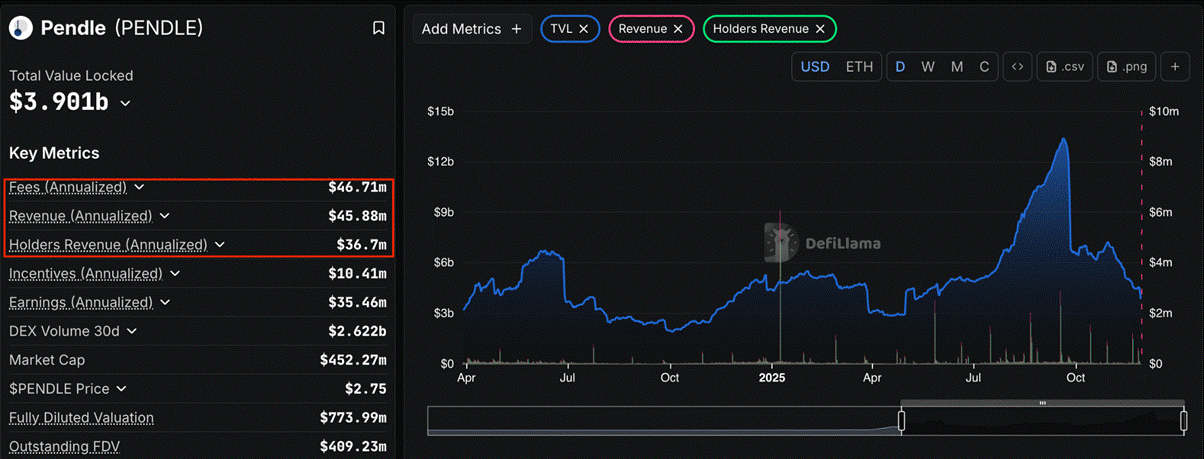
Fees and Revenue Overview: Pendle's core business is tokenizing revenue and allowing users to trade PT/YT pairs. According to DefiLlama's data today:
- Annualized cost: ≈ US$45.7 million
- Annualized contract revenue: ≈ US$44.9 million
- Annualized income per holder (vePENDLE): ≈ $35.9 million
- Annualized incentives: ≈ US$10.8 million
Although commission rates remain strong (almost all fees are converted into revenue), the absolute figures are shrinking.
The collapse of TVL : For Pendle, the most critical data point is the rapid contraction of its asset size. Although its total TVL was previously high, recent data shows it has dropped significantly to approximately $3.6 billion .
This represents a significant reduction in the capital base that generates revenue-related expenses. This is not a divergence between falling prices and growing business, but rather a convergence: the price crash is due to a drop in TVL (TVL). This is perfectly normal market behavior.
The pitfall: Pendle's cyclical realization of yield relies on on-chain yield monetization. We are now seeing a downward cycle in this model. As LSD/LRT yields compress and stablecoin arbitrage profits flatten, the demand for locking in yields and trading is rapidly shrinking.
The significant drop in TVL indicates that capital is fleeing yield trading. Given that revenue is a function of TVL, a 64% price decline is rational. With the business metric (TVL) falling by nearly two-thirds from its peak, going long on Pendle is strongly discouraged in the current environment. The market has correctly identified that the growth phase has temporarily ended.
Hyperliquid (HYPE): A machine with over $1 billion in revenue, now cutting rates.
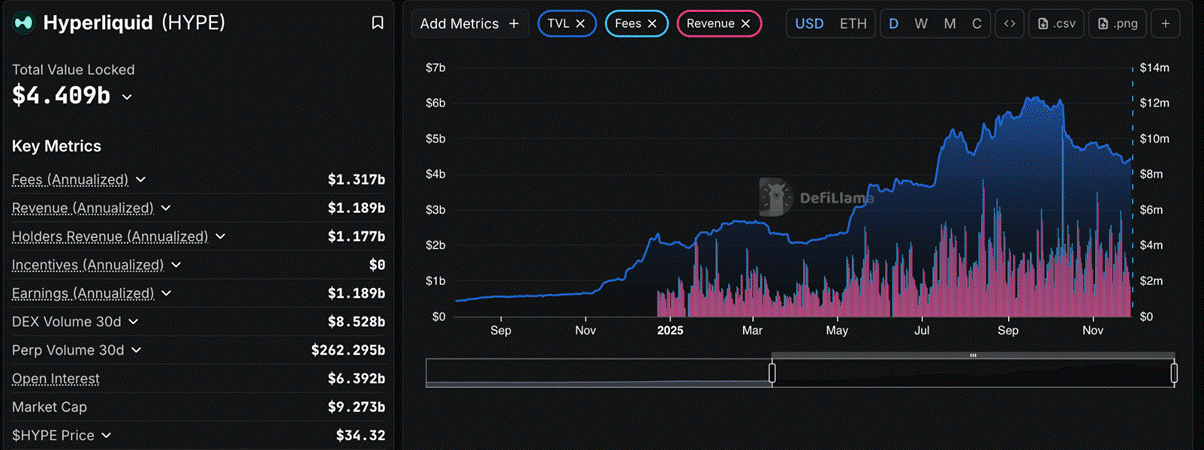
Hyperliquid is trading at approximately $35–36 , with a market capitalization of approximately $9 billion–$10 billion . Its massive engine generates approximately $1.21 billion in annualized revenue with zero incentive emissions . However, the investment logic is shifting from "pure cash flow" to "aggressive growth" as the team cuts taker fees by up to 90% in new markets to dominate the long tail. Therefore, HYPE's current pricing is already a winner's valuation (approximately 8–10 times price-to-sales ratio ), and future returns will depend on whether these fee cuts successfully drive a large-scale expansion of trading volume.
Hyperliquid is now the largest perpetual contract trading venue among on-chain metrics:
- Annualized cost: ≈ $1.34 billion
- Annualized revenue: ≈ $1.21 billion
- Annualized holder income: ≈ $1.2 billion
- Annualized incentive: $0 (Airdrop not yet confirmed)
We believe:
- The income is real .
- There is no clear incentive for emissions erosion profit and loss statement; the user's main focus is on using the product, rather than simply for agricultural airdrops.
- Almost all of the revenue was designated for the buyback and destruction of HYPE through the aid fund.
Based on DefiLlama's current data, compared to its market capitalization of approximately $9 billion to $10 billion, this represents a P/S ratio of roughly 8 to 10 times —not absurd for a rapidly growing exchange, but certainly not undervalued to the point of being "halved."
New growth areas
The key difference this quarter is that Hyperliquid is no longer simply "letting revenue soar and then buying back shares." It's now taking proactive steps:
- HIP-3 opens up a licenseless marketplace where marketplace deployers can share in the revenue; and
- For the new HIP-3 market, taker fees will be reduced by up to ~90% to drive trading volume in long-tail perpetual contracts (equities, niche assets, etc.). HIP-3's public posts and trading documents outline the fee arrangements for this "growth model."
In summary: What was mispriced?
After reviewing the facts, we have drawn some preliminary conclusions:
1. "Real profits" alone are not enough. ENA proves that fees ≠ surplus. The protocol showed hundreds of millions of dollars in annualized fees, but after paying TVL costs and user revenue, almost nothing was left for token holders. HYPE shows that revenue is endogenous: when teams compete for market share by lowering fees, revenue and its multipliers change with decisions made, not just with user demand. Any "bottom-fishing" screening that stops at "fee increases" will systematically misjudge these projects.
2. Pendle is a "value trap," not a value buy . Data shows a clear collapse in fundamentals.
- TVL has collapsed to approximately $3.6 billion.
- Income shrinks along with the asset base.
- The token has fallen significantly, but core business usage is also declining sharply. This is not mispricing; it's repricing. The market has correctly discounted the token because the protocol is facing a severe contraction in demand.
3. Even winners face pressure . The most important lesson about market timing:
- HYPE lowers fees to grow new markets
- ENA's maintenance of extremely high subsidy levels to keep USDe attractive suggests that even leading protocols are feeling the pressure of the current environment. If the leaders are adjusting their fee rates and incentives, and former darlings like Pendle are facing massive capital outflows, then we may not be in a period where we can blindly buy any fee-revenue token.
Conclusion
Yes, there are indeed divergences, but not all of them are bullish. PENDLE looks like a project whose business is rapidly shrinking, validating the bearish price action. HYPE and ENA 's revenues are still holding up well—but their own decisions (fee reductions, subsidies) indicate that the environment remains fragile.