MSTR's Tribulation: Short Selling and Palace Intrigue


- 核心观点:MSTR暴跌反映美国新旧货币体系权力斗争。
- 关键要素:
- 摩根大通等机构系统性做空MSTR。
- MSTR高杠杆债务结构面临流动性风险。
- 其股价高溢价依赖“发债买币”叙事。
- 市场影响:标志加密与传统金融冲突加剧。
- 时效性标注:中期影响。
Original author: Lin Wanwan
Those who hold MSTR (Strategy) are probably having trouble sleeping lately.
This once-revered "central bank of Bitcoin" has seen its stock price suffer a bloodbath. As Bitcoin rapidly corrected from its all-time high of $120,000, MSTR's stock price and market capitalization shrank dramatically in the short term, plummeting by more than 60%, and Strategy may even be removed from the MSCI stock index.
The price correction and the halving of stock prices are merely symptoms. What truly alarms Wall Street is the growing evidence that MSTR is being drawn into a power struggle over currency.
This is not an exaggeration.
Over the past few months, many seemingly unrelated events have begun to connect: JPMorgan Chase has been accused of abnormally increasing its short selling of MSTR; users have experienced settlement delays when transferring MSTR shares out of JPMorgan; the derivatives market has seen frequent actions to suppress Bitcoin; and discussions on policy fronts regarding "treasury stablecoins" and "Bitcoin reserve models" have rapidly intensified.
Moreover, these are not isolated incidents.
MSTR stands on the fault line between two US monetary systems.
The power struggle is unfolding on one side: the old system – the Federal Reserve, Wall Street, and commercial banks (centered around JPMorgan Chase); and on the other side: a new system taking shape – the Treasury, a stablecoin system, and a financial system with Bitcoin as long-term collateral.
In this structural conflict, Bitcoin is not the target, but rather the battleground. MSTR, on the other hand, is a crucial bridge in this conflict: it transforms the dollar and debt structures of traditional institutions into Bitcoin exposure.
If the new system is established, MSTR is the core adapter; if the old system is stable, MSTR is the node that must be suppressed.
Therefore, the recent plunge in MSTR is not a simple asset fluctuation, but rather the result of three combined forces: the natural adjustment of Bitcoin prices; the fragility of MSTR's own risk structure; and the spillover of conflicts caused by the power shift within the dollar system.
Bitcoin has strengthened the Treasury's future monetary architecture and weakened the Federal Reserve's. Governments face a difficult choice: to maintain the opportunity for low-price accumulation, they need to allow the JPMorgan Chase to continue suppressing Bitcoin.
Therefore, the methods used to hunt down MSTR are systematic. JPMorgan Chase understands these rules of the game all too well, because they set the rules. They dissect MSTR, clearly distinguishing its veins (cash flow), skeleton (debt structure), and soul (market belief).
Here we dissect the four "death postures" that MSTR may face, which are also the four death warrants carefully prepared for MSTR by the old order.
Strategy 1: Taking advantage of someone's misfortune
This is the most intuitive and the most discussed model in the market: if BTC keeps plummeting, MSTR leverage will increase, the stock price will keep falling, leading to a loss of refinancing ability, and finally a chain reaction collapse.
The logic is simple, but it's not the core issue.
Everyone knows that "if BTC drops too much, MSTR will be in trouble," but few people know exactly how much it will drop before MSTR goes from "as stable as a rock" to "unstable."

MSTR's balance sheet structure has three key figures:
Total BTC holdings exceed 650k coins (approximately 3% of the total Bitcoin supply).
Average cost of positions: approximately $74,400
Some debt carries implicit price risk (although not a forced liquidation, it still affects net assets).
Many stories about "MSTR going to zero" are thought to be similar to the forced liquidation style of exchange contracts, but in fact: MSTR does not have a forced liquidation price, but it has a "narrative forced liquidation price".
What's the meaning?
Even if creditors don't force him to liquidate his position, the market will liquidate his stock price. When the stock price falls to a certain level, he will no longer be able to issue bonds or convertible bonds to continue replenishing his position.
JPMorgan Chase and its old guard are colluding to short MSTR through the US stock options market. Their tactic is simple: take advantage of Bitcoin's pullback to dump MSTR shares and create panic. Their sole objective is to shatter the myth of Michael Saylor.
This was MSTR's first major setback: the price of Bitcoin plummeted to the point where outsiders were no longer willing to give him money.
Method Two: Debt Collection by Visiting the Customer's Home
Before discussing convertible bonds, we first need to understand how MSTR CEO Michael Saylor's "magic" works.
Many beginners mistakenly believe that MSTR is simply about using profits to buy cryptocurrencies. This is incorrect. MSTR involves an extremely daring "leveraged arbitrage game."
Saylor's core tactic is to issue convertible notes, borrow US dollars, and buy Bitcoin.
MSTR has raised a staggering $20.8 billion this year, a scale extremely rare for an annual fundraising by a U.S. listed company. The funds came from $11.9 billion in common stock, $6.9 billion in preferred stock, and $2 billion in convertible bonds.
It sounds ordinary, but the devil is in the details.
These bonds offer investors extremely low interest rates (some even less than 1%), so why would investors buy them? Because these bonds include a "call option." If MSTR's stock price rises, the bondholder can convert the bond into stock and make a large profit; if the stock price doesn't rise, MSTR will repay the principal and interest upon maturity.

This is the famous "flywheel": issue bonds to buy cryptocurrency, the price of cryptocurrency rises, MSTR stock price soars, bondholders are happy, stock premium is high, so issue bonds again to buy more cryptocurrency.
This is what is known as "spiral ascent". However, wherever there is a spiral ascent, there is bound to be a death spiral.
This kind of collapse is called "forced deleveraging under liquidity depletion".
Imagine that in some future year, Bitcoin enters a long period of sideways trading (no need for a crash, just sideways movement). At this time, old bonds mature. The creditors find that MSTR's share price has fallen below the conversion price.
Creditors are not philanthropists; they are Wall Street vampires. At this point, they will never choose to convert bonds into stocks; they will coldly say, "Pay back the money. Cash."
Does MSTR have cash? No. Its cash is all in Bitcoin.
At this point, MSTR faced a desperate choice: either borrow new money to pay off old debts, or, due to the depressed price of the cryptocurrency and poor market sentiment, the interest rates on the newly issued bonds would be exorbitantly high, directly devouring the meager cash flow from its software business.
Alternatively, sell the cryptocurrency to pay off the debt.
If MSTR is forced to announce that it will "sell Bitcoin to pay off its debts," it will be like launching a nuclear bomb into the market.
The market will panic: "The die-hard bulls have surrendered!" Panic causes the price of the coin to fall, the price of the coin to fall causes the MSTR stock price to plummet, the stock price to plummet causes more bonds to be unable to be converted into shares, and more creditors to demand repayment.
This is a "Soros-style" sniping moment.
This type of collapse is the most dangerous because it doesn't require a Bitcoin crash to trigger it; it only needs "time." When the debt's due date coincides with a period of market quiet, the sound of the funding chain breaking will be even more resounding than shattering glass.
Strategy Three: Destroy the Spirit to Kill
If the second approach is "I'm broke," then the third approach is "Nobody believes me anymore."
This is currently the biggest hidden danger of MSTR, and also the blind spot that is most overlooked by retail investors: the premium rate.
Let me break it down for you. You buy one share of MSTR, let's say for 100 yuan. But of that 100 yuan, only 50 yuan is actually worth of Bitcoin. What's the remaining 50 yuan worth?
It's air. Or, to put it more nicely, it's a "faith premium."
Why are people willing to pay double the price to buy Bitcoin?
Before the emergence of spot ETFs, such as BlackRock's IBIT, compliant institutions had no choice but to buy stocks. After the emergence of spot ETFs, people still bought them because they believed that Saylor could outperform simple cryptocurrency holding by issuing bonds to "grow the cryptocurrency."
However, this logic has a fatal flaw.
MSTR's stock price is based on the narrative that "I can borrow cheap money to buy coins." Once this narrative is broken, the premium will revert to its original value.
Imagine if Wall Street continued to pressure MSTR, and the White House forced MSTR to hand over its assets? What if the SEC (Securities and Exchange Commission) suddenly issued a document saying that "listed companies holding cash is non-compliant"? In that instant, everyone's faith would collapse.
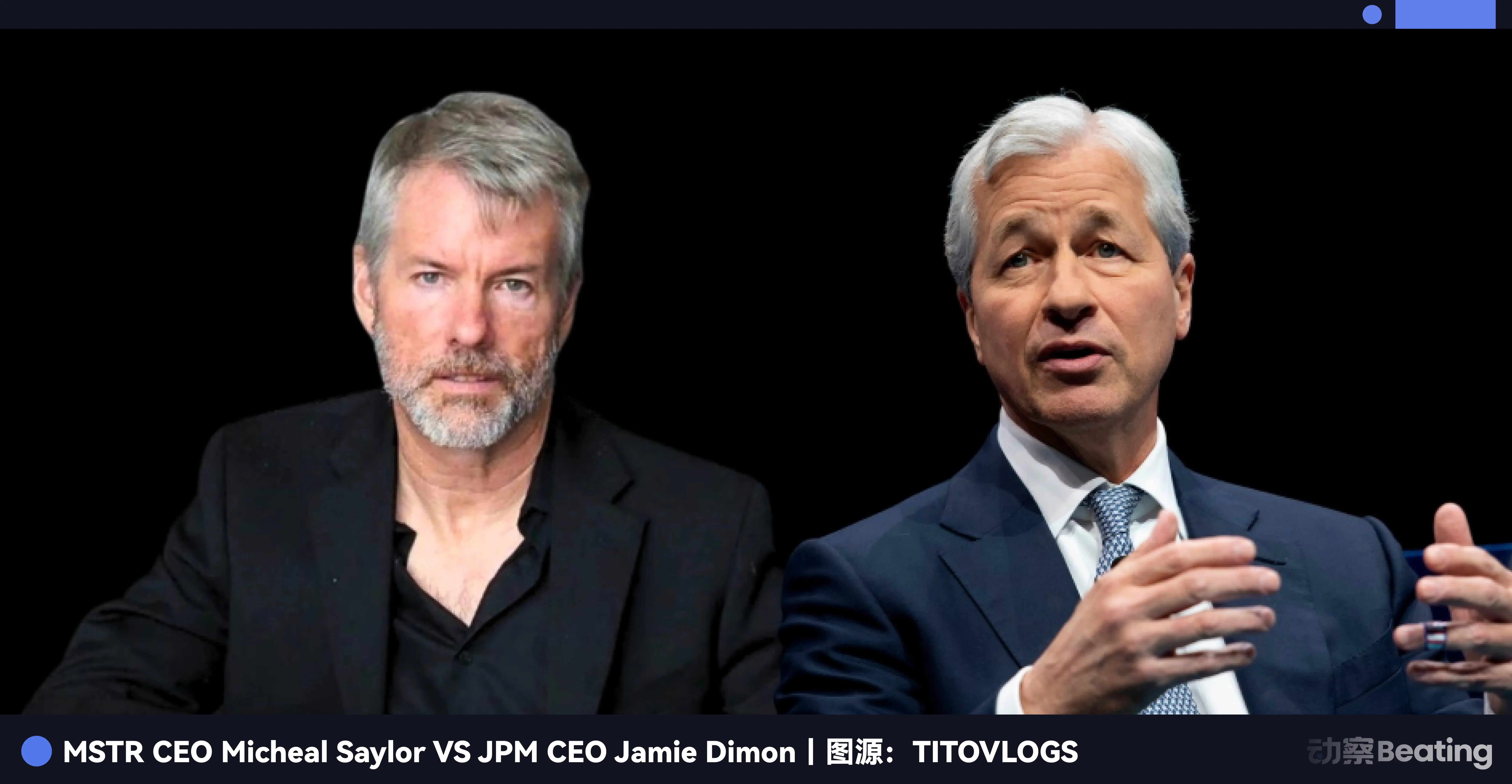
This explosive move is called the "Davis Double Kill".
In that instant, the market will ask itself a fundamental question: "Why should I spend 2 dollars to buy something that costs 1 dollar? Wouldn't it be better to buy BlackRock's ETF? It's still 1:1."
Once this idea becomes a consensus, MSTR's premium will quickly return from the current 2.5 or 3 times to 1 times, or even drop to 0.9 times (discount) because it is a corporate entity with operational risks.
This means that even if the price of Bitcoin doesn't drop at all, MSTR's stock price could be halved.
This is the collapse of the narrative. It's not as bloody as a debt default, but it's more psychologically damaging. You see your Bitcoin holdings haven't fallen, but your MSTR in your account has shrunk by 60%, and you'll start to question your existence. This is called "valuation killing."
Posture 4: Close the door and beat the dog
The fourth posture is the most hidden, the least known, but also the most ironic.
What is MSTR doing now? It is desperately trying to increase its market capitalization and squeeze into more indices, such as the MSCI stock index and the Nasdaq, which it has already squeezed into, and the S&P 500.
Many people cheered: "With it in the S&P 500, trillions of dollars in passive funds will have to buy it, making the stock price a perpetual motion machine!"
As the old saying goes, fortune may be the harbinger of misfortune.
Because of its inclusion in the US stock index, MSTR is no longer just a manipulated stock; it has become a cog in the US financial system. Wall Street is shorting MSTR with one hand and releasing news of its potential removal from the index with the other, inducing panic selling among retail investors.
MSTR is now caught in a bind. It wanted to use Wall Street's money, but ended up being locked down by Wall Street's rules.
It wants to use Wall Street rules to rise to power, but it may also die because of Wall Street rules.
Epilogue: Palace Intrigue and Fate
Michael Saylor was a genius, and a madman. He saw through the essence of fiat currency devaluation and seized the opportunities of the times. He transformed an ordinary software company into a Noah's Ark carrying the dreams of millions of gamblers.
However, the amount of Bitcoin he holds far exceeds the company's capacity to handle it.
Many in the market are already speculating that the US government may directly invest in MSTR in the future.
The methods include either directly exchanging MSTR's equity for US Treasury bonds, supporting MSTR in issuing state-backed preferred shares, or even direct administrative intervention to forcibly improve its credit rating.
The climax of this grand drama is not yet over; the power struggle between the old and new financial orders in the United States continues. The structure of MSTR is fragile, with volatility for long positions and time for short positions.
If Wall Street were to loosen any one of the screws in MSTR, then the four scenarios mentioned above—price collapse, debt default, disappearance of premiums, and index strangulation—would all cause a short-term imbalance in MSTR's structure.
Conversely, when the entire chain is in operation, it can become one of the most explosive targets in the global capital market.
This is the allure of MSTR, and also its danger.