






Aptos龙年首场中文AMA回顾:回首2023,展望2024


On February 26, Aptos, in collaboration with Odaily, held the first Chinese Space event of the Year of the Dragon. Aptos Labs, together with leading ecological projects Aries Markets, SuperPosition, Amnis Finance, Townsquare, and Pontem Network, gathered together to review the achievements of the rapid development of the ecosystem in 2023 and share the latest updates and plans of Aptos and mainstream applications on the blockchain.
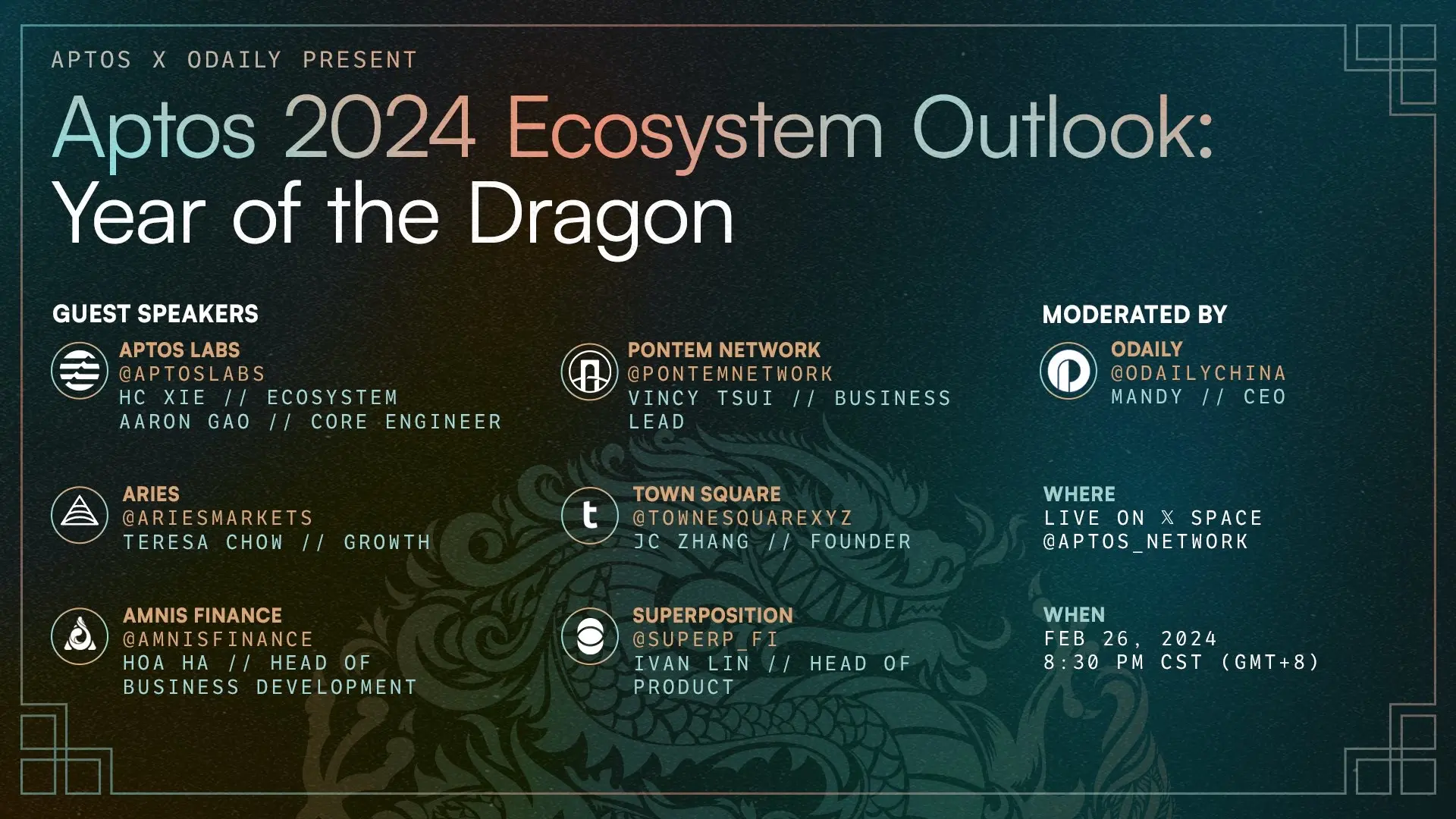
The following is a transcript of the community dialogue, compiled by Odaily:
Odaily: First, please introduce yourselves and share your experience in the Aptos community.
HC: Hello everyone, I am HC, responsible for the Aptos Asia-Pacific market. Most of the guests here are old friends on Aptos because we have been developing together for one to two years. I strongly encourage everyone to click on their avatars, visit their websites, and test every product. Our ecosystem is very diverse, covering various fields such as DeFi, social, and identity verification. Thank you all for listening, and now I'll hand it over to you. Thank you!
Teresa Chow: Hello everyone, first, let me briefly introduce Aries Markets. We are the first lending protocol launched in the ecosystem on October 26, 2022, and launched simultaneously with the Aptos mainnet. Currently, we have the highest Total Value Locked (TVL) in the ecosystem, with a TVL of over 85 million US dollars. According to user data, we have had over 85% new users in the past month, indicating that users are very satisfied with using our protocol.
Ivan Lin: Hello everyone, I am Ivan Lin, the product manager of SuperPosition. A lot has happened in the past year, and we have been working hard with all of you in this market. Our team has been focusing on developing core capabilities, aiming to connect with smart contracts in the simplest way possible and provide an infrastructure that can make a qualitative leap for the entire Defi industry. Our project may seem complicated, but we believe that with time and refinement, the product will definitely bring a good experience to everyone.
Hoa Ha: Hello everyone, I am Hoa Ha from Amnis Finance. It's great to be part of today's AMA, and we have achieved some amazing milestones. Two months after the launch of the Aptos mainnet, our platform has attracted a large number of users, with over 100,000 users and a total value exceeding $16.3 million.
JC Zhang: Hello everyone, I'm JC from Townsquare and Cred. After several months of development, we have made significant progress. As the social incentive layer native to Aptos, CRED's on-chain scoring system now has over 300,000 registered active addresses, and the on-chain records can be clearly seen on SocialGraph.
Vincy Tsui: Hello everyone, I am Vincy Tsui from Pontem Network. In the past year, we have experienced many exciting moments. For Pontem, we have two core products: Pontem Wallet and Pontem Forge. Personally, my favorite is the local aggregation feature of Pontem Wallet. For example, if I want to do a swap or a borrowing operation, I can directly perform it on the interface of Pontem Wallet without the need to switch or open a webpage, which is very convenient. As for Pontem Forge, I believe everyone is very familiar with it. In the past period of time, we are very pleased to see that the daily trading volume of Pontem Forge accounts for approximately 50% of the entire Aptos ecosystem, which indicates that everyone likes and continues to use this product.
Odaily: 2023 will be a year of rapid development for Aptos. Please share your projects, the main achievements in 2023, and the plans for 2024.
HC: For us, 2023 is a year of accumulation and development. We have spent a lot of time cultivating our core ecosystem projects and corporate partnerships. According to a third-party research report by ToElectricCapital, Aptos has the most mobile developers actively writing code and debugging, making it the largest mobile developer community.
Currently, there are over 250 projects on Aptos, covering various fields including Defi, AI games, social applications, middleware, and cross-chain applications. In addition, we have partnered with African company Jmboo to launch a mobile phone. We are expanding collaborations globally, especially in the African market. Whether it's wallets or other Aptos ecosystem applications, we hope to work with all ecosystem projects to achieve widespread industry adoption. Additionally, we are collaborating with some middleware projects. In the past two months, our Defi TVL has more than doubled. Our ecosystem has seen significant growth in Defi over the past year.
I believe that 2024 will be a crucial year for the entire Aptos ecosystem. Recently, we have formed official partnerships with some of the world's largest partners, including Google, Amazon, and Alibaba Cloud. In these collaborations, we are collaborating with Alibaba Cloud to build a project called aCurve, dedicated to creating a global developer community that provides documentation, video tutorials, and global training for mobile developers, with a focus on promoting smart cities and universities. We are also partnering with SKT and Lotte Group in South Korea. Additionally, the AI sector is booming. In August last year, we became the only Web3 enterprise to collaborate with Microsoft, which will drive the development of the entire Web3 and AI industries, offering many opportunities for the future.
2024 will see more project opportunities and value discovery. For example, there will be many projects on Aptos for asset issuance or NFT issuance, providing more opportunities for user participation.
Teresa Chow: 2023 is a year of rapid growth for Aries Markets. We have achieved many accomplishments, which can be divided into three aspects.
First, Aries Markets' TVL has exceeded $85 million and ranks first among all access agreements in the Aptos ecosystem.
Second, in terms of user data, we have over 30,000 weekly active users, 85% of whom are new users. We have seen a rapid increase in user numbers, particularly in the United States. Therefore, this year we have also started recruiting new partners to develop the Asian market, including China and Vietnam.
In terms of products, besides our core lending products, we have also helped the NFT project of Aptos launch an NFT governance platform called OlderDoor, where different NFT project parties can use their NFTs to vote for or against protocol proposals.
Looking ahead to 2024, we have many new developments. First, our incentive program provides incentives for both deposits and withdrawals, and even offers the opportunity for interest-free loans and additional rewards. We are also actively developing a mobile client application, especially in collaboration with Jambo, which recently joined forces with Aptos. We are actively working with Jambo's project parties.
Finally, the most important point is that we are actively developing the PointSystem, which will also be our core project in the near future.
Ivan Lin: This year, our focus is on building the infrastructure for Superposition. We will be conducting code consolidation this week. By next week at the latest, we will update our testnet and provide a reward system to prioritize testing of our products and accumulate points to help us discover vulnerabilities.
Before the mainnet goes live, we will refine the points accumulation system so that all borrowers and lenders can accumulate points. We want everyone to enjoy our products and have fun, just like playing a game. The mainnet launch is, of course, a major event, and our team is fully committed to making it a success. After the launch, we will continue to communicate with everyone.
At the same time, we will also work with Aptos to strive for different development directions and achieve significant results. We hope to accelerate the launch of more convenient leverage strategy products and collaborations with other leading projects after the mainnet is launched. Through leverage products, we aim to strengthen and amplify the effects. We also hope to attract capital-rich companies through focused screening and work together for ecosystem growth.
Hoa Ha: In the coming year, we will bring new innovation to the Chinese market and strive to achieve our own development goals.
First of all, we are very excited to introduce new features, especially the upcoming token map feature, which will enhance the user experience on our platform.
Secondly, in the second quarter, our futures software will undergo TGE, and we invite everyone to join our digital plans and become part of our development path.
Third, we will expand our technical partnership and collaborate with KOLs.
JC Zhang: Currently, we are the largest all-encompassing on-chain data social scoring system on Aptos. Users can not only see their comprehensive scoring history on our Socialgraph platform, but also connect their Twitter and link their apps to Aptos domains. Users can complete certain social tasks based on their scores.
In the next few months, we will release a social graph protocol closely integrated with the mobile end. Users can directly see their relevant scoring information. At the same time, we will become the first web-native social app on Apple, with many new features. We are in discussions with teams inside and outside the Apple ecosystem for collaboration.
In addition, we previously released a mobile linking tool that supports interaction between mobile apps on Apple, making Aptos the only project in the non-EVM ecosystem with mobile linking. Therefore, we expect to see more wallet-based apps released in the ecosystem.
Vincy Tsui: In the next year, the development of Pontem can be divided into the following parts:
Social Platform Development: We believe that social platforms will play an important role in the Web 3 ecosystem. Similar to how Chinese users cannot live without Xiaohongshu and Weibo, WebStreet will also have its own social products. We will strive to improve the social experience and provide better social services.
Enhancement of Wallet Functionality: We will provide more support for wallet functionalities such as voting, purchasing, and trading. In the future, we will also add more features such as Staking and search to enable users to complete all operations within the wallet.
Liquid Sport Development: We have just released the latest version of the CLMM model, aiming to provide a better experience for both retail and institutional users.
Pontem AI: Currently, Pontem AI is still in the internal testing phase. We will continue to improve this AI assistant product throughout this year and open it to all users within the Pontem ecosystem. Whether you are a beginner or someone interested in Pontem but unsure how to get started, you can get help and learn how to explore the entire Pontem ecosystem through this assistant.
Lumo Launch: Lumo will be launched this year to help Pontem ecosystem better attract users from the medical field and achieve better development together.
Odaily: The latest Aptos has held multiple developer-related events in the Asia-Pacific region. Can you share with us the plan for Aptos' developer ecosystem in the Chinese market?
Aaron Gao: Hello everyone, I am Aaron. Currently, my main responsibility is to work on the system framework construction for the Aptos team, including establishing standards and participating in the development of Aptos features, such as event handling. I am mainly dedicated to providing building blocks and tools for developers based on the Aptos Move language.
Regarding developers, we have several systems in place. First is the learning system, where we have launched Aptos Learn, an interactive learning tool that helps people understand and learn Aptos. We also constantly update our documentation based on user feedback. At the same time, we have organized hackathon events to help engineers improve their skills. We also have core team members personally guiding developers and providing advice to solve their problems in Smart Contract development. We also have a channel called Aptos Improvement Plan, where we accept suggestions for product improvement from users and the developer community, including standards and development frameworks.
In terms of the developer ecosystem in China, we discovered many excellent Chinese developers during last year's event in Singapore. They were eager to learn and try the Aptos chain and the new smart contract language. Therefore, we hope to attract developers from around the world to participate in our hackathon events, both online and offline. We have many team members who can speak Chinese, and we welcome everyone to provide feedback and suggestions through online platforms such as Telegram groups, Discord, Twitter, etc.
HC: Next, we have some activities planned for the Chinese developer community, including hackathons and content sharing. Recently, we announced a one-month online workshop teaching how to use the Move language. We will also organize some hackathon events. The selected teams will have the opportunity to participate in the Hackhouse event held in Shenzhen. In addition, we have launched hackathon activities, and currently, more than a hundred global teams have registered, hoping to explore applications based on blockchain upgrades in gaming and other fields. We are very excited to see these new use cases.
Odaily: Aptos has had multiple collaborations with Web2 or traditional giants, such as Jambo, Microsoft, and Universal. We look forward to attracting users from outside the circle through better platforms and products, which can bring significant growth to Web3. Can you share some cases and experiences with us?
HC: First of all, we believe that the financial and DeFi fields, including our own CeFi project, have great potential in terms of compliance and regulation. This includes the exploration of stablecoins and the development of payment channels, which can solve many pain points of Web2. We are also actively expanding into regional compliance markets. For example, we have just announced that the APT token is now listed on a compliant exchange in Japan. Japanese users can use yen to purchase APT, paving the way for our ecosystem projects to enter the Japanese market.
In addition, we are actively exploring the field of AI. The combination of AI and Web3 is just beginning. We are partnering with Microsoft to explore the integration of AI with Web3 products. Together with our ecosystem partners, we are discussing the combination of AI and Web3. Today, we had a discussion with a project team and I found an interesting perspective that I want to share with everyone. In the past, the main trend of Web3 was decentralization, involving areas such as decentralized finance and applications. However, AI may be the only field in history that has simultaneously developed in both the Web2 and Web3 timelines. The founders of Web2 and Web3 are contemplating what kind of products and forms can serve the ultimate ToB and ToC users.
In addition, we have many other initiatives, such as in the gaming sector. In the future, we hope to bring these Web2-level gaming users into Web3 and allow them to participate in the entire gaming economy system through a more sustainable token economic system. This will enable them to not only enjoy the game, but also participate in the token economy system.
Aaron Gao: In terms of technology, our main innovation is to reduce the learning curve for users. For ordinary users, using a wallet may be challenging, such as difficulties with signature operations. Therefore, we will introduce the PassKey technology, which is a system that allows users to directly log in through their smartphones. It will automatically sign transactions for users and generate wallets on their phones. The whole process will be seamlessly integrated for users, with no difference in experience compared to regular mobile applications. Additionally, private keys can be synchronized between different accounts, for example, through Apple Account or Android's Passace System, which lowers the barrier for users entering this field.
At the same time, we are also referencing the technologies of OpenID and ZKP, and developing a login system based on OpenID and ZKP. Users can use their Google or Twitter accounts, and the system will generate wallet addresses and sign them through authorization from the Google address. This way, users don't need to understand how to store private keys, they only need to master their Google account to operate it like a regular wallet. For ordinary users, regardless of which solution they choose, there is no difference in using Web2 applications or Web3 applications. The only difference may be the need to click on the sign and authorize transaction button, and we are also considering whether this process can be further simplified.
Furthermore, we are considering merging these two solutions. Its function is to authorize the wallet to perform different operations within a certain period of time without user intervention. Once these two functionalities are merged, the user experience will be almost indistinguishable from using a regular Web 2 application. We hope to greatly reduce the cost for users to use Web 3, especially the cost of using Web2, and also make the signing environment for more products (such as games and trading platforms) more flexible, resembling traditional Web 2 applications. This is the work we are currently striving to achieve, and SK has already been merged into our main code. It is expected to be launched in the first half of this year, attracting more users to join our network.
Teresa Chow: We have adopted a simple and user-friendly interface. When users enter our platform, we will detect if they have experience using other on-chain wallets, such as MetaMask. If users have experience with other blockchains, we will pop up a small window reminding them that they can transfer assets from other blockchains to our platform through Layerzero and other cross-chain bridges to earn rewards or better engage in lending.
At the same time, we will also collaborate with partners to write more tutorials on maximizing the use of our platform. In addition to lending, we also provide other functionalities such as cross-chain bridges, aggregators, and order book exchanges, allowing users to perform diversified operations.
Ivan Lin: For us, the primary goal is to launch our product on the mainnet. However, in terms of user experience, we hope to leverage the strength of the entire ecosystem and make use of the proposed functionalities to achieve more efficient operations. For example, we will deepen integration with wallets to provide a better lending experience, eliminating the need for users to switch between multiple markets. Additionally, for some new leveraged strategy products, we will offer direct execution methods, allowing users to quickly apply various leverage strategies.
Based on the shared content, we will consider different directions for product development. If we can mutually apply and benefit from each other's products in an ecosystem manner, bringing about quicker benefits, then we will primarily move in that direction.
JC Zhang: The social track is the most traffic-oriented entry point. In our product, we want the user experience to be as good as, or even better than, Web 2 products. Currently, we are partnering with Magic link to provide a very smooth social login operation. On Quiite, we already have 17,000 users who connect through Discord and Twitter and use Social link on their accounts. This 17,000 users account for about 15% to 20% of the total user base, and the conversion rate is very high. In terms of protocol revenue, we have many ideas in the pipeline, including composability NFT discussions with the Quiupdox team and collaboration with the Apple ecosystem.
We have invested a lot of resources and time in user experience, and URUX design is also derived from the experience of big companies. We hope to bring a good experience to everyone on various levels. We also hope that after the launch of the ENFT technical standard, outstanding projects in the existing ecosystem will adopt our standard and release their applications on our Superapp, thereby opening up new user acquisition channels on a non-WebUI interface and expanding their services and revenue.
Vincy Tsui: Recently, we have been very focused on the Web 2 domain, such as applications like Traingary, which is similar to the Indian version of TikTok but combines many good elements. Users can have their own wallets in this application and participate in activities such as sports.
In addition, we attach great importance to the gaming field, for example, by providing a one-click connection function. Suppose I am playing a game and want to purchase skins or tools, but I do not have project tokens. I can use the one-click connection to the Pantem wallet and use LiquidSpoth to purchase tokens, and then purchase the required skins or tools. We are also exploring the social application field and supporting it through Ninkstore.
Overall, we are building the infrastructure for Web2 applications through these two products. In addition, our wallet has already been launched on Android and Apple systems, so you can try downloading and using it. This is also a convenient entry point to use the Pantem wallet anytime and anywhere. Additionally, we mentioned Pantem AI, which is a great assistant to help us attract Web2 users into Web3.
Odaily: What important events and sectors should we pay attention to in the coming year for Aptos?
HC: First of all, I have just shared many developments and collaborations with some companies. I hope everyone can pay more attention to Aptos's official account.
The second aspect is our ecosystem projects. Every participating ecosystem project is worth paying attention to. There may be some Alpha activities in the future to encourage user participation. There are also many projects that have not been mentioned, so please pay attention on your own. For example, Thala, Merkle Trade, Econia, etc., are all worth paying attention to. In terms of gaming, Sipervillain Labs, Castile, and others are also worth paying attention to.
The third aspect is our events, including the Wangxiang Conference in Hong Kong in April. We will participate in various Web2 and Web3 summits this year, such as the upcoming GDC in Silicon Valley, TNC in Japan, Token 2049 in Dubai, and so on. If you are interested in participating, you can sign up for our events. We really hope to have face-to-face communication with the community.
Aaron Gao: We pay great attention to Asia, especially the cultivation of the Chinese community. We will select outstanding projects from previous events and even consider cooperation or incubation.
Technically speaking, we will increase our efforts in ecosystem building, including technical support, funding support, and ecosystem assistance. The CoinStandard (AdaSer) project that I personally participate in will be updated to meet the needs of most projects and help them create a more user-friendly and low-threshold ecosystem. After the DeFi hackathon in April, we will also try our best to help everyone complete the migration from our first version of proxy system to the second version of proxy standards.
At the same time, we are also expanding our team and welcome capable people to join us, whether it is for business cooperation or technical aspects. We are also recruiting BD positions in the Asia-Pacific region. We are a friendly and free team, and we welcome people with aspirations to join us in building the ecosystem together. Finally, if you know someone who is bilingual in Chinese and English, good at marketing and developer relations, or know suitable candidates who have made contributions to our ecosystem, please recommend them. We are also looking for excellent Chinese partners to better support our Chinese ecosystem.


