






重新审视比特币Layer2:混乱是攀升之梯


Original Author: Jaleel, BlockBeats
Original Editor: Jack, BlockBeats
The definition of Bitcoin Layer 2 has once again sparked heated discussions in the community.
From the beginning of last year to the present, the Bitcoin ecosystem has gone through several downturns. After a year of fervor, it seems to be at a critical moment. The undeniable consensus in the market is that the Bitcoin ecosystem will still be the biggest hotspot for a long time to come. So now the market is looking for new opportunities in the BTC ecosystem, and many users at home and abroad believe that the breaking point will be Bitcoin Layer 2.
Therefore, in the past month, the excitement around Bitcoin Layer 2 has grown, and there have been no fewer than fifty projects in the market. Competing for TVL, stacking concepts, and daily gains of fifty times, Bitcoin Layer 2 has become one of the most exciting and chaotic tracks. And a big reason why this track is in such a situation is that Bitcoin Layer 2 has not yet been definitively defined.
Who Can Define Bitcoin Layer 2?
Unlike Ethereum Layer 2, the mysterious founder of Bitcoin has not made a definition of Bitcoin Layer 2 before "disappearing". In this mixed race track, what exactly is Bitcoin Layer 2? The community has not yet reached a consensus, and different researchers have different answers.
The "Canonical" of Bitcoin Magazine
The Bitcoin Magazine Editorial Committee recently clarified their position on reporting on Bitcoin Layer 2 in the article "BITCOIN MAGAZINE EDITORIAL POLICY ON BITCOIN LAYER 2S".
One of the points that has sparked community discussions is their three-point definition of Bitcoin Layer 2:
1. Using Bitcoin as the native asset: Layer 2 must be designed fundamentally in terms of Bitcoin, either using Bitcoin as its primary token or account unit, or as a mechanism for system payment fees. If it has tokens, they must be backed by Bitcoin.
2. Use Bitcoin as a settlement mechanism to enforce transactions: Users on Layer 2 must be able to exit the system through a mechanism, whether trusted or untrusted, to return control of their funds to Layer 1.
3. Demonstrate the dependency on Bitcoin's functionality: If a system continues to operate even if the Bitcoin network fails, it is not considered Bitcoin Layer 2.
Bitcoin Magazine, founded in 2012, can be said to be one of the oldest and most mature sources of Bitcoin information. Therefore, many community members believe that the definition provided by Bitcoin Magazine is the "original source".
According to Bitcoin Magazine's definition, many of the so-called "mythical creatures" in the market do not meet its criteria for Bitcoin Layer 2, and community KOLs and researchers have also expressed their opinions.
Well-known Bitcoin ecosystem KOL, 0x Sea, said: "If we strictly follow this definition, most projects in the market can hardly be considered Layer 2; most of them are 'sidechains'. The Layer 1 protocol Atomicalsxyz's AVM (technology) meets the above three points, but it doesn't have an independent running chain, so it can be considered Layer 1.5."
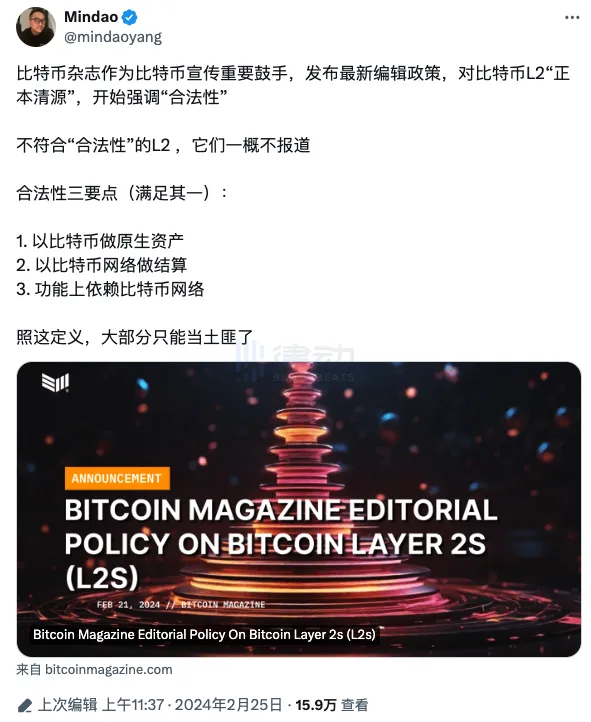
Mindao, founder of dforce, also believes that "Bitcoin Magazine, as an important promoter of Bitcoin, has published the latest editorial policy, emphasizing the 'legitimacy' of Bitcoin Layer 2. They do not cover Layer 2 projects that do not meet the 'legitimacy' criteria. According to this definition, most of them can only be considered bandits."
Furthermore, Mindao also stated: "While this standard may be difficult to achieve, it requires making many sacrifices in terms of economic models and architecture. Most projects simply have no intention of doing so. Many people believe that the 'ownerless' Bitcoin should not have the concept of orthodoxy, but orthodoxy is everywhere in terms of ideology, regardless of 'ownerless' or 'owned'. The emergence of this 'orthodoxy' is a fascinating phenomenon."
For Bitcoin Magazine's strict definition, some community members have also expressed their dissatisfaction, believing that the influence of Bitcoin Magazine, even if it is large, only represents the views and opinions of their magazine and editorial committee, and cannot represent the final authoritative definition.
For example, GP of AC Capital, CryptoSkanda, sharply commented, "Seriously no one cares, Bitcoin Magazine is just old and does not have the role of being the spokesperson for Layer 2 on Ethereum."
How VC investors define dozens of Bitcoin Layer 2 projects
Da Shan, the founder of Shuidi Capital, which has invested in dozens of Bitcoin Layer 2 projects, expressed his views on the definition of Layer 2 in a previous AMA.
He believes that in a broad sense, as long as it consumes BTC as Gas or uses BTC as the underlying asset and can be used as a DApp platform with better performance than BTC Layer 1, it can be considered Bitcoin Layer 2. This includes, but is not limited to, application platforms based on Indexer, EVM rollup, EVM crosschain, sidechains, Lightning Network, and RGB, etc.
In a narrow sense, for BTC Layer 2, it needs to meet at least the following two conditions:
1. Whether it shares security with BTC.
2. Whether it is censorship-resistant.
In more detail, if BTC crashes, can Layer 2 still function independently? The most that can still function independently is a sidechain. Are the nodes of Layer 2 or the cross-chain multi-signatures sufficiently decentralized? For example, if the multi-signatures are all controlled by a few relatives and the assets of users who have entered the system are lost when something goes wrong.
In addition, Da Shan also mentioned that for BTC Layer 2 to meet the Ethereum community’s standards, in addition to the narrow definition of Layer 2, two more criteria need to be added: whether Layer 1 can verify transactions on Layer 2, and whether Layer 1 assets can safely escape when Layer 2 collapses.
However, at that time, Da Shan also stated that this is only his personal opinion, and in fact, discussing "what is the definition of Bitcoin Layer 2" is meaningless. He pointed out that Satoshi Nakamoto would not personally come out to tell the community what his ideal BTC Layer 2 looks like, and no organization has the right to define this orthodoxy.
Bitcoin's early ecosystem KOL xiyu also said: "Now is the chaotic stage. The true Bitcoin Layer 2 shouldn't be defined by fixed standards, but should be determined by the market. That's what I learned on brc 20."
Chaos isn't a pit. Chaos is a ladder.
Currently, there are various solutions and forms for Bitcoin Layer 2, especially those involving ZK technology. This also reflects the disorderly nature of the Bitcoin Layer 2 track.
Projects in chaos
In January of this year, the Bitcoin ZK Rollup Layer 2 solution SatoshiVM caused a stir on Twitter, and its native token SAVM had an almost 50-fold increase on its first day of trading. Many people have made millions of dollars by selling SAVM.
《SAVM, nearly 50-fold increase in one day. Who developed SatoshiVM?》
However, while a group of big KOLs were aggressively promoting it, SatoshiVM was exposed by community members to be possibly the same team as Bool Network. Bool Network previously developed an AMT bridge contract called TokenBridge.sol, which uses the same function names and events. SatoshiVM version seems to be a direct implementation of it.
Bool Network was established at the end of 2020 and has long been committed to Bitcoin layer 2 solutions. In 2022, they published a relatedpaper, and their Github organization can be found here.
Check the Bool Network document, they have provided us with the address of the AnchorFactory contract on Sepolia, showing that the system was deployed in May 2023. The address for deploying AnchorFactory and deploying SatoshiVM Anchor is the same address: 0x66feD255e376c5E5495384A8aBc01a1AA65aFE8a.
If Bool Network only provides a technical solution for SatoshiVM, it can still be considered plausible without more direct evidence, after all, Bool Network currently focuses on the Bitcoin verification layer, which can serve all Bitcoin Layer 2.
But it doesn't stop there.
On January 25th, Ape Terminal, a platform that conducted the IDO for SatoshiVM, publicly quarreled with the SatoshiVM team, exposing each other's "scandals" due to "conflicts of interest."
MacnBTC, a well-known KOL with 500,000 followers who has been promoting SatoshiVM, claiming to be an advisor to SatoshiVM, publicly challenged Ape Terminal, accusing Ape Terminal of deceiving everyone and not conducting a fair sale. There were 200,000 wallet applications to participate in the IDO, but only 10 winners each time, and all the winners were members of the Ape Terminal team. Although the Ape Terminal team returned part of the IDO fees to the Satoshivm team, they made millions of dollars by selling front-running wallets.
In response to the accusations, Ape Terminal issued a statement counterattacking, stating that SAVM is a project founded by the well-known KOL MacnBTC. "SAVM is a bittersweet event for Ape Terminal. Mac and his KOL friends made more than 20 million US dollars in profits by dumping in their own community." Ape Terminal provided detailed information about their contact with Mac and the record of liquidating tokens through a Google document.
In the eyes of Ape Terminal, they have become the scapegoat for Mac.
In response to this, MAC stated that he himself is an advisor to the SatoshiVM team and has been closely collaborating with them. He introduced Ape Terminal to the SatoshiVM team. However, he has been unfairly attacked and accused after the success of the SatoshiVM team. He did not monopolize liquidity, but there are other parties involved.
Chaos is actually a good thing
The horse-catching incident of SatoshiVM is considered by many to be a symbol of chaos. However, in reality, this kind of chaos may be a prelude to the thriving development of the industry.
The Bitcoin Layer 2 track is in chaos, just like the chaotic period in 2013 when many altcoins forked from Bitcoin. It is in this chaotic community atmosphere and the years-long block size war that Vitalik, as a staunch supporter of big blocks, created Ethereum, laying the foundation for the prosperity of the subsequent era of public chains.
As mentioned in "Game of Thrones": "Chaos isn't a pit, chaos is a ladder." Chaos itself does not mean loss of control or disorder. On the contrary, it is a process of exploration and practice, a prelude to constructive development.
In any emerging technology or industry, the establishment of consensus usually requires a period of chaos. This is because at the beginning of something new, different parties will have their own views and understanding, which takes time to integrate and unify these perspectives and form a more widespread consensus. The Bitcoin Layer 2 track is no exception. The current discussions regarding its definition may appear chaotic, but it is a process where the community gradually converges through active exploration. This chaos is an inevitable part of development, a process of extracting a more comprehensive consensus from diverse viewpoints.
Currently, the cryptocurrency industry is deeply discussing the Bitcoin Layer 2 track. This kind of chaos is not negative, but indicates that the community is making efforts to re-examine this track, reflecting on possible "speculative behavior" and inaccuracies. This self-reflection and in-depth discussion are the driving force for the industry to move forward, in order to find projects with true potential and create a more favorable development environment for them. It is through such deep dialogue that the industry can stand out and move towards a healthier and more sustainable development in a highly competitive environment.
Different participants have expressed their unique opinions in this discussion, including capital, media, project parties, and the wider community. This diversity of voices enriches the discussion, allowing different parties to approach the issue from various perspectives and provide a more comprehensive outlook for the industry. Although there may be arguments and disagreements in this process, it is precisely this diversity and conflict that stimulate innovation and progress. It is a battle of ideas where minds collide, a process in which different parties gradually form a common understanding through communication, debate, and cooperation.
In this chaos, it also means that each participant in the industry is reflecting on their own roles and responsibilities. Investors are considering how to make investments more rational, the media is examining the objectivity in their reporting, and project parties are reevaluating the true value and feasibility of their projects. This is a necessary condition and a critical step for industry advancement.
Just as chaos is not a pit but a ladder, the chaos of the Bitcoin ecosystem will also be a path to higher-level development.


