Beosin Annual Report: Web3 Blockchain Security Situation and Encryption Industry Supervision Policies in 2023



Original author: Beosin research team Mario, Tian Daxia Donny
Original source:Beosin
Preface
This research report is produced byInitiated by the Blockchain Security Alliance and co-created by alliance members Beosin, Web3 Xiaolu, and Elven, it aims to comprehensively explore the global blockchain security situation in 2023 and key regulatory policies in the encryption industry.Through analysis and assessment of the current status of global blockchain security, the report will reveal current security challenges and threats and provide solutions and best practices. At the same time, the report will also examine the positions and policy orientations of governments and regulatory agencies in various countries on the regulation of the encryption industry to help readers understand the dynamic changes and possible impacts of the regulatory environment.
Through this report, readers will be able to more comprehensively understand the dynamic evolution of the Web3 blockchain security situation and the core points of regulatory policies. This will help readers assess and respond to the security challenges faced by the blockchain field and promote the sustainable development of the industry while complying with regulatory requirements. In addition, readers can also obtain helpful suggestions from the report on security measures, compliance requirements and industry development directions to help them make informed decisions and actions in this emerging field. Blockchain security and supervision are key issues for the development of the Web3 era. Through in-depth research and discussion, we can better understand and respond to these challenges and promote the security and sustainable development of blockchain technology.
1. Overview of Web3 Blockchain Security Situation in 2023
According to monitoring by the EagleEye platform of the blockchain security audit company Beosin,In 2023, the total losses caused by hacker attacks, phishing scams and project parties Rug Pull in the Web3 field reached 2.02 billion US dollars.Among them, there were 191 attacks, with a total loss of approximately US$1.397 billion; 267 Rug Pull incidents involving project parties, with a total loss of approximately US$388 million; and phishing scams, with a total loss of approximately US$238 million.
In 2023, hacker attacks, phishing scams and project party Rug Pull incidents have all dropped significantly compared with 2022, with the total amount falling by 53.9%.Among them, hacker attacks dropped the most, from US$3.6 billion in 2022 to US$1.397 billion in 2023, a decrease of approximately 61.2%. Phishing scam losses dropped by 33.2% compared to 2022, and rug pull losses dropped by 8.8% compared to 2022.
In 2023, there were 4 attacks with losses exceeding US$100 million, and 17 attacks with losses ranging from US$10 million to US$100 million.The total loss of the top 10 security incidents is approximately US$1 billion, accounting for 71.5% of the total annual attack incident amount.
The types of projects attacked in 2023 will be more extensive than in 2022.Including DeFi, CEX, DEX, public chains, cross-chain bridges, wallets, payment platforms, gambling platforms, encryption brokers, infrastructure, password managers, development tools, MEV robots, TG robots and many other types.DeFi is the project type with the highest frequency of attacks and the highest amount of losses. 130 DeFi attacks caused a total loss of approximately US$408 million.
The types of public chains where attacks will occur more frequently in 2023 willThere have been multiple security incidents involving theft on multiple chains. Ethereum is still the public chain with the highest amount of losses. 71 attacks on Ethereum caused losses of US$766 million, accounting for 54.9% of the total losses for the year.
From the perspective of attack methods,The 30 private key leak incidents caused a total loss of approximately US$627 million, accounting for 44.9% of the total loss. It is the attack method that caused the most losses.Contract vulnerability exploitation is the most frequent attack method. Among the 191 attacks, 99 came from contract vulnerability exploitation, accounting for 51.8%.
Approximately US$295 million of stolen funds were recovered throughout the year, accounting for approximately 21.1%, a significant increase from 2022.Approximately $330 million of stolen funds were transferred to coin mixers throughout the year, accounting for 23.6% of the total stolen funds.
Different from the significant decrease in on-chain hacking attacks, phishing scams, and project Rug Pull amounts, criminal data in the off-chain encryption field will increase significantly in 2023. In 2023, the amount of crime in the global encryption industry reached a staggering US$65.688 billion, an increase of approximately 377% from US$13.76 billion in 2022.The top three types of crimes involving amounts of money are online gambling, money laundering and fraud.
2. Top Ten Security Events in the Web3 Ecosystem in 2023
In 2023, there were 4 attacks with losses exceeding 100 million US dollars: Mixin Network (US$200 million), Euler Finance (US$197 million), Poloniex (US$126 million) and HTX Heco Bridge (US$110 million). The total loss of the top 10 security incidents is approximately US$1 billion, accounting for 71.5% of the total annual attack incident amount.
No.1 Mixin Network
Amount of loss: $200 million
Attack method: Cloud service provider database attack
In the early morning of September 23, the Mixin Network cloud service provider database was attacked by hackers, resulting in the loss of some assets on the main network, involving approximately US$200 million. On September 25, the founder of Mixin publicly explained the incident in a live broadcast, saying that the damaged assets were mainly Bitcoin core assets, and assets such as BOX and XIN were not seriously stolen. The specific attack situation It cannot be disclosed yet.
No.2 Euler Finance
Amount of loss: $197 million
Attack method: Contract vulnerability - business logic issue
On March 13, the DeFi lending protocol Euler Finance was attacked, resulting in a loss of approximately US$197 million. The root cause of the attack was that the contract did not properly check the number of tokens actually held by the user and the health of the users ledger after the donation. All stolen funds in this incident have been returned by the attacker.
No.3 Poloniex./a>
Attack method: Private key leak/APT attack
No.4 HTX & Heco Bridge
Amount of loss: $110 million
Attack method: Private key leakage
On November 22, Justin Suns exchange HTX and cross-chain bridge Heco Bridge were attacked by hackers, resulting in a total loss of US$110 million, of which Heco Bridge lost US$86.6 million and HTX lost approximately US$23.4 million.
No.5 Curve/ Vyper
Amount of loss: $73 million
Attack method: Contract vulnerability - reentrancy
In the early morning of July 31, the Ethereum programming language Vyper tweeted that Vyper versions 0.2.15, 0.2.16 and 0.3.0 have reentrancy lock vulnerabilities, and native ETH can adjust callbacks during transfers, resulting in these few The lp pool of the ETH group can be attacked by reentrancy. Then Curve’s official Twitter posted that many stablecoin pools (alETH/msETH/pETH) using Vyper 0.2.15 were attacked due to a failure in the reentry lock. The loss in this incident was approximately US$73 million.
No.6 CoinEx
Amount of loss: $70 million
Attack method: Private key leak/APT attack
On September 12, the crypto exchange CoinEX issued a statement stating that the risk control system detected suspicious large withdrawal activities in the hot wallet used to temporarily store the platform’s trading assets, and a special team was immediately established to intervene. The main issue in this incident was Involving token assets such as ETH, TRON, and Polygon, the amount stolen was approximately US$70 million.
No.7 Atomic Wallet
Amount of loss: $67 million
Attack method: Private key leak/APT attack
Beosins EagleEye security risk monitoring, early warning and blocking platform monitoring showed that Atomic Wallet was attacked in early June. According to statistics from the Beosin team, based on the known victim report information on the chain, the loss caused by this attack was at least approximately US$67 million. .
No.8 Alphapo
Amount of loss: $60 million
Attack method: Private key leak/APT attack
On July 23, the hot wallet of cryptocurrency payment service provider Alphapo was stolen, resulting in a total loss of US$60 million. The incident was carried out by the North Korean hacker group Lazarus.
No.9 KyberSwap
Amount of loss: $54.7 million
Attack method: Contract vulnerability - business logic issue
On November 22, the DEX project KyberSwap was attacked, causing a total loss of approximately US$54.7 million. Kyber Network stated that this hacking attack is one of the most complex attacks in the history of DeFi, and the attacker needs to perform a series of precise on-chain operations to exploit the vulnerability.
No.10 Stake.com
Loss amount: $41.3 million
Attack method: Private key leak/APT attack
On September 4, the crypto gambling platform Stake.com suffered a hacker attack. After the attack, Stake.com stated that unauthorized transactions occurred in its hot wallets on ETH and BSC, and that it is investigating and will resume deposits and withdrawals as soon as the wallet is completely re-secured. The incident was carried out by the North Korean hacker group Lazarus.
3. Types of attacked projects
Compared with 2022, the types of projects attacked in 2023 are more extensive, and the amount of losses is no longer concentrated on certain project types. In addition to common types such as DeFi, CEX, DEX, public chains, cross-chain bridges, and wallets, hacker attacks in 2023 will also appear on payment platforms, gambling platforms, crypto brokers, infrastructure, password managers, development tools, and MEV robots , TG robot and other project types.
Among the 191 attacks in 2023,DeFi projects accounted for 130 times (about 68%), making it the most attacked project type.The total loss from DeFi attacks is approximately US$408 million, accounting for 29.2% of all losses. It is also the project type with the largest loss.
The second largest loss was CEX (centralized exchange), with 9 attacks causing a total loss of US$275 million. In addition, 16 attacks occurred in the DEX (decentralized exchange) type, resulting in a total loss of approximately US$85.68 million. Taken together, exchange types will experience frequent security incidents in 2023, and exchange security is the second biggest challenge after DeFi security.
The third largest loss amount is the public chain.The amount of losses was approximately US$208 million, mainly due to the US$200 million theft of Mixin Network.
In 2023, cross-chain bridge losses ranked fourth, accounting for approximately 7% of all losses.In 2022, 12 cross-chain bridge security incidents caused a total loss of approximately US$1.89 billion, accounting for 52.5% of the total loss that year. Significant reduction in cross-chain bridge security incidents in 2023.
At number 5 is the crypto payment platform,Two security incidents (Alphapo and CoinsPaid) resulted in a total loss of approximately US$97.3 million. The hackers behind both incidents pointed to the North Korean APT organization Lazarus.
4. The amount of losses in each chain
Compared with 2022, the types of public chains where attacks occurred in 2023 are also more extensive, mainly due to the fact that multiple CEX private key leaks occurred in 2023, causing losses on multiple chains.The top five in terms of loss amount are Ethereum, Mixin, HECO, BNB Chain, and TRON; the top five in terms of number of attack events are BNB Chain, Ethereum, Arbitrum, Polygon, Optimism, and Avalanche (tied for fifth place).
The same as in 2022, Ethereum is still the public chain with the highest loss. 71 attacks on Ethereum caused losses of $766 million, accounting for 54.9% of the total losses for the year.
Mixin chain losses ranked second, with losses from a single security incident reaching US$200 million. In third place was HECO, with losses of approximately $92.6 million.
There have been 76 attacks on BNB Chain, accounting for 39.8% of the total number of attacks, which is the highest number of attacks among all chain platforms. The total loss on BNB Chain is approximately US$70.81 million, and the vast majority of events (88%) are concentrated below US$1 million.
5. Analysis of attack techniques
Compared with 2022, the attack methods in 2023 will be more diverse, especially a variety of Web2 attack methods will be added, including:Database attacks, supply chain attacks, third-party service provider attacks, man-in-the-middle attacks, DNS attacks, front-end attacks, etc.
In 2023, 30 private key leak incidents caused a total loss of US$627 million, accounting for 44.9% of the total losses, making it the attack method that caused the most losses. Private key leaks that caused large losses include: Poloniex (USD 126 million), HTX Heco Bridge (USD 110 million), CoinEx (USD 70 million), Atomic Wallet (USD 67 million), and Alphapo (USD 60 million).Most of these incidents are related to the North Korean APT organization Lazarus.
Contract vulnerability exploitation is the most frequent attack method. Among the 191 attacks, 99 came from contract vulnerability exploitation, accounting for 51.8%. The total loss caused by contract loopholes was US$430 million, ranking second in terms of loss amount.
Broken down by vulnerabilities, the ones that occur most frequently and cause the most losses are business logic vulnerabilities. About 72.7% of the losses in contract vulnerability incidents come from business logic vulnerabilities.Total losses were approximately US$313 million. The contract vulnerability with the second highest loss amount is reentrancy, with 13 reentrancy vulnerabilities causing approximately US$93.47 million in losses.
6. Analysis of attack techniques in typical cases
6.1 Euler Finance Security Incident
Event Summary
On March 13, Euler Finance, a lending project on the Ethereum chain, was attacked by a flash loan, causing losses of US$197 million.
On March 16, the Euler Foundation offered a $1 million reward for information leading to the arrest of the hackers and the return of stolen funds.
On March 17, Euler Labs CEO Michael Bentley tweeted that Euler “has always been a security-conscious project.” From May 2021 to September 2022, Euler Finance underwent 10 audits by 6 blockchain security companies including Halborn, Solidified, ZK Labs, Certora, Sherlock and Omnisica.
Starting from March 18th to April 4th, the attackers began to return funds one after another. During this period, the attacker apologized through a message on the chain, saying that he had disrupted other peoples money, other peoples work, and other peoples lives and asked for everyones forgiveness.
On April 4, Euler Labs tweeted that the attacker had returned all stolen funds after successful negotiations.
Vulnerability analysis
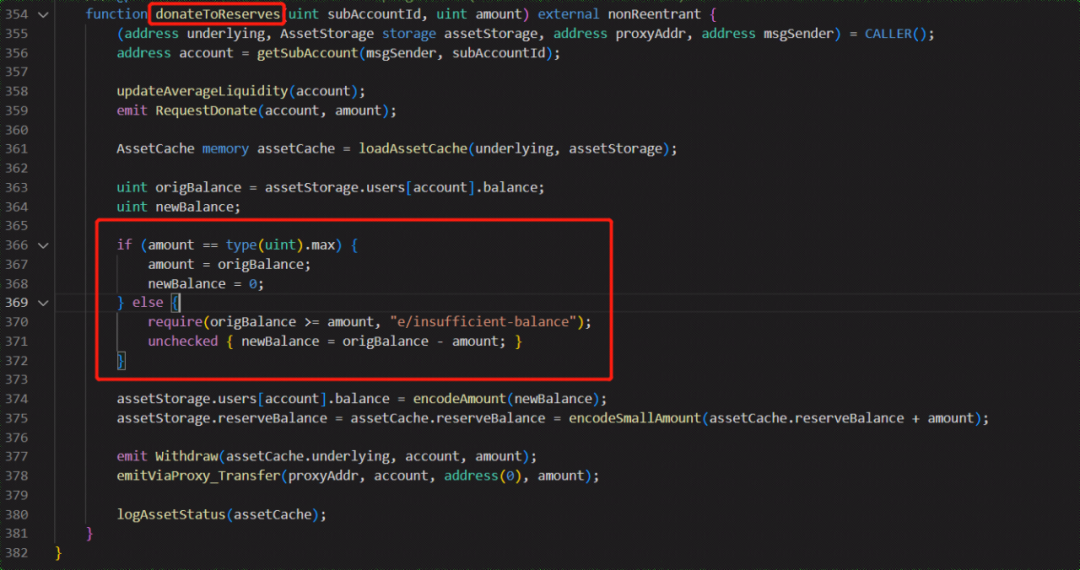
In this attack, the donateToReserves function of the Etoken contract did not correctly check the number of tokens actually held by the user and the health status of the users ledger after the donation. The attacker exploited this vulnerability and donated 100 million eDAI, while in fact the attacker only staked 30 million DAI.
Since the health status of the users ledger meets the liquidation conditions after the donation, the loan contract is triggered for liquidation. During the liquidation process, eDAI and dDAI will be transferred to the liquidation contract. However, because the amount of bad debt is very large, the liquidation contract will apply the maximum discount for liquidation. After the liquidation, the liquidation contract has 310.93 M eDAI and 259.31 M dDAI.
At this point, the health of the users ledger has been restored and the user can withdraw funds. The amount that can be withdrawn is the difference between eDAI and dDAI. But there is actually only 38.9 million DAI in the pool, so users can only withdraw this amount.
6.2 Vyper/Curve Security Incident
Event Summary
On July 31, the Ethereum programming language Vyper tweeted that Vyper versions 0.2.15, 0.2.16 and 0.3.0 have reentrancy lock vulnerabilities. Curve stated that multiple stablecoin pools (CRV/alETH/msETH/pETH) using Vyper 0.2.15 were attacked, with total losses reaching US$73 million, and approximately US$52.3 million had been returned by hackers afterwards.
Vulnerability analysis
This attack is mainly caused by the failure of the anti-reentrancy lock of Vyper 0.2.15. When the attacker calls the remove_liquidity function of the relevant liquidity pool to remove liquidity, he adds liquidity by reentrying the add_liquidity function. Since the balance update is not performed during reentry, add_liquidity function, causing an error in price calculation.
7. Analysis and review of typical anti-money laundering incidents
7.1 Atomic Wallet wallet theft case
According to Beosins EagleEye security risk monitoring, early warning and blocking platform, Atomic Wallet was attacked in early June this year. According to statistics from the Beosin team, based on the known victim reporting information on the chain, the attack caused a loss of at least approximately 6,700 yuan. Ten thousand U.S. dollars.
According to the analysis of the Beosin team, a total of 21 chains have been involved in this theft incident so far, including BTC, ETH, and TRX. The stolen funds were mainly concentrated on the Ethereum chain. in:
The Ethereum chain has identified the stolen funds as 16,262 ETH worth of virtual currency, approximately $30 million.
The known stolen funds of TRON Chain are 251335387.3208 TRX worth of virtual currency, which is approximately US$17 million.
The BTC chain’s known stolen funds are 420.882 BTC worth of virtual currency, equivalent to $12.6 million.
BSC Chain BSC Chain’s known stolen funds are 40.206266 BNB worth of virtual currency.
Rest of the chain
Let’s take an example of money laundering on the Ethereum chain
When hackers operate on stolen money, there are two main ways in which Ethereum is attacked:
Use Avalanche to launder cross-chain money after dispersing through contracts
According to the analysis of the Beosin team, the hacker will first exchange the valuable coins in the wallet into the main currency of the public chain, and then aggregate them through two contracts.
The contract address will package ETH into WETH through two layers of transfers, then transfer WETH to the contract used to disperse ETH, and transfer it to Avalanches wallet address for Cross Bridge through up to 5 layers of transfers for cross-chain operations. Cross-chain transactions do not use contracts and belong to Avalanches internal accounting transaction type.
The Ethereum link diagram is as follows:
Convergence approx. 1:
0xe07e2153542eb4b768b4d73081143c90d25f1d58 involved a total of 3357.0201 ETH
Change to WETH and transfer to contract 0x3c3ed2597b140f31241281523952e936037cbed3
The detailed map of the route for selling stolen goods is as follows:
Aggregation 2: 0x7417b428f597648d1472945ff434c395cca73245 involved a total of 3009.8874 ETH
The hacker changed to WETH and transferred it to contract 0x20deb1f8e842fb42e7af4c1e8e6ebfa9d6fde5a0
The detailed map of the route for selling stolen goods is as follows:
The two aggregation contracts are confirmed by agreeing on the source of the fee, and there is no transaction behavior address hiding. The handling fee path is as follows:
In addition, on the Ethereum chain, hackers also launder money through various cross-chain bridge protocols and exchanges. The current amount involved in this part is 9896 ETH, and this part will be collected through multiple collection addresses.
Throughout the incident, there were many channels for hackers to launder money, mainly through various exchange accounts. At the same time, money laundered directly into cross-chain bridge contracts. For analysis of capital flows on other chains, please click here:A wallet theft involving at least US$60 million, BeosinKYT takes you through hackers’ money laundering routines
Other anti-money laundering case studies:
8. Analysis of the Fund Flow of Stolen Assets
Of the funds stolen throughout 2023, approximately US$723 million remains in hacker addresses (including transfers through cross-chains and dispersion to multiple addresses), accounting for 51.8% of the total stolen funds. Compared with last year, this year hackers are more likely to use multiple cross-chains to launder money and spread the stolen funds to many addresses. The increase in addresses and the complexity of money laundering paths will undoubtedly make investigations more difficult for project parties and regulatory agencies.
Approximately US$295 million of stolen funds were recovered, accounting for approximately 21.1%. In 2022, only 8% of the funds will be recovered. The recovery of stolen funds in 2023 is significantly better than in 2022, with most of it coming from on-chain negotiated returns.
Approximately US$330 million of stolen funds were transferred to currency mixers throughout the year (approximately US$71.16 million was transferred to Tornado Cash, and another US$259 million was transferred to other currency mixing platforms), accounting for 23.6% of the total stolen funds. This proportion has dropped significantly from 38.7% last year. Since the U.S. OFAC sanctioned Tornado Cash in August 2022, the amount of stolen funds transferred to Tornado Cash has dropped significantly, and has been replaced by an increase in the use of other currency mixing platforms, such as Sinbad, FixedFloat, etc. In November 2023, the US OFAC added Sinbad to the sanctions list, calling it the main money laundering tool of North Koreas Lazarus organization.
In addition, a small amount of stolen funds ($12.79 million) were transferred to the exchange, and a small amount of stolen funds ($10.9 million) were frozen.
9. Analysis of project audit situation
Among the 191 attack incidents, the project parties of 79 incidents have not been audited, and the project parties of 101 incidents have been audited. The proportion of audited project parties this year is slightly higher than last year (the proportion of audited/unaudited projects last year was roughly the same).
Among the 79 projects that were not audited, contract vulnerability incidents accounted for 47 cases (59.5%). This suggests that projects without audits are more susceptible to potential security risks.In comparison, contract vulnerability incidents accounted for 51 (50.5%) of the 101 audited projects. This shows that auditing can improve project security to a certain extent.
However, due to the lack of complete regulatory standards in the Web3 market, audit quality is uneven, and the final results are far from expected. In order to effectively ensure the security of assets, it is recommended that the project must find a professional security company to conduct an audit before going online.As a world-leading blockchain security company, Beosin is committed to the safe development of the Web3 ecosystem and has audited more than 3,000 smart contracts and public chain mainnets, including PancakeSwap, Ronin Network, OKCSwap, etc.As a trustworthy blockchain security company, Beosin can provide project parties with excellent security audit services.
10. Rug Pull Analysis
In 2023, Beosins EagleEye platform monitored a total of 267 Web3 ecological Rug Pull incidents, with a total amount involved of approximately US$388 million, a decrease of approximately 8.7% from 2022.
In terms of amount, 233 (87%) of the 267 Rug Pull incidents were less than US$1 million, which is roughly the same proportion as in 2022. There are 4 projects involving more than 10 million US dollars, including Multichain (US$210 million), Fintoch (US$31.6 million), BALD (US$23 million), and PEPE (US$15.5 million).
Rug Pull projects on BNB Chain and Ethereum accounted for 92.3% of the total number, 159 and 81 respectively. A small number of Rug Pull events have also occurred in other public chains, including: Arbitrum, BASE, Sui, zkSync, etc.
11. 2023 Global Crypto Industry Crime Data
In 2023, the amount of crime in the global encryption industry reached a staggering US$65.688 billion, an increase of approximately 377% from US$13.76 billion in 2022. While the amount of on-chain hacking attacks has dropped significantly, crime cases in other areas of cryptocurrency have increased significantly. The largest increase was for online gambling, with the amount involved reaching US$54.9 billion. The following are money laundering (approximately US$4 billion), fraud (approximately US$2.05 billion), pyramid schemes (approximately US$1.43 billion), and hacker attacks (approximately US$1.39 billion).
With the improvement of the global encryption regulatory system and the in-depth crackdown on cryptocurrency crimes, in 2023, police around the world uncovered a number of major cases involving hundreds of millions of dollars. The following is a review of some typical cases:
No.1 In July 2023, the Hubei police in China cracked the country’s “first virtual currency case”, involving 400 billion yuan (approximately US$54.9 billion). More than 50,000 people were involved in this online gambling case. The server was located outside China. The principal culprit Qiu Moumou and others have been sent for trial in accordance with the law.
No.2 In August 2023, the Singaporean authorities investigated the largest money laundering case in history, with the amount involved reaching S$2.8 billion. The money laundering method was mainly through virtual currency.
No.3 In March 2023, the Jiangsu police in China launched a public prosecution against Ubank’s “coin speculation” scam, involving a pyramid scheme transaction volume of more than 10 billion yuan (approximately US$1.4 billion).
No.4 In December 2023, the co-founder of the virtual currency exchange Bitzlato pleaded guilty to $700 million in money laundering charges, according to a statement from the U.S. Attorney’s Office for the Eastern District of New York.
No.5 In July 2023, the Brazilian Federal Police busted two drug trafficking criminal gangs, transferring a total of more than 417 million US dollars and providing money laundering services through crypto assets.
No.6 In February 2023, according to an indictment in Oregon, the founder of Forsage was indicted in connection with a $340 million DeFi Ponzi scheme.
No.7 In November 2023, the police in Himachal Pradesh, India, arrested 18 people in a $300 million cryptocurrency fraud case.
No.8 In August 2023, Israeli police accused businessman Moshe Hogeg and his partners of defrauding investors of $290 million in cryptocurrency.
No.9 In June 2023, the Thai police uncovered a suspected cryptocurrency fraud case, involving a total amount of more than 10 billion baht (approximately US$288 million).
No.10 In October 2023, JPEX, a virtual asset trading platform in Hong Kong, was suspected of fraud. The police arrested a total of 66 people, involving an amount of approximately HK$1.6 billion (approximately US$205 million).
2023 is the year of a surge in cryptocurrency crimes. The frequent occurrence of fraud and pyramid schemes also means that the probability of ordinary users suffering asset losses has greatly increased.Therefore, it is urgent to strengthen the supervision of the cryptocurrency industry. We can see that global regulatory agencies have made a lot of efforts to regulate cryptocurrency this year, but there is still a long way to go before a complete, safe, and positively developing ecosystem.
12. Summary of Web3 Blockchain Security Situation in 2023
In 2023, on-chain hacking activities, phishing scams, and project party Rug Pull incidents have all declined significantly compared with 2022. The amount of hacker attack losses has dropped by 61.3%, and the most costly attack method has also changed from last years contract vulnerability exploitation to this years private key leakage. The main reasons for this shift include:
1. After last year’s rampant hacker activities, the entire Web3 ecosystem has paid more attention to security this year. From project parties to security companies, efforts have been made in all aspects.Such as real-time on-chain monitoring, paying more attention to security audits, and actively learning from past contract vulnerability exploitation incidents. This makes it harder than last year to steal funds through contract loopholes.
2. The strengthening of global supervision and the improvement of anti-money laundering technology. It can be seen that 21.1% of stolen funds will be recovered in 2023, which is significantly better than 2022.As currency mixing platforms such as Tornado Cash and Sinbad are sanctioned by the United States, hackers money laundering paths are becoming more complicated. At the same time, we have also seen news about hackers being arrested by local police, which has a certain deterrent effect on hackers.
3. The impact of the crypto bear market at the beginning of the year. The expected return for hackers to steal assets from Web3 projects has declined, thus weakening hacker activity. This has also led to hackers no longer being limited to attacking DeFi, cross-chain bridges, exchanges, etc., but turning to payment platforms, gambling platforms, crypto brokers, infrastructure, password managers, development tools, MEV robots, TG robots, etc. type.
Different from the significant decrease in on-chain hacking activities, there has been a significant increase in more covert criminal activities off the chain, such as online gambling, money laundering, pyramid schemes, etc. Due to the anonymity of cryptocurrencies, various criminal activities are more inclined to use cryptocurrencies for transactions. However, it would be one-sided to attribute the increase in virtual currency crime cases solely to the anonymity and lack of supervision of cryptocurrencies.The fundamental reason lies in the increase in global criminal activities, and virtual currency provides a relatively hidden and difficult-to-track funding channel for these criminal activities.In 2023, global economic growth slowed significantly and the political environment faced many unstable factors, which to a certain extent contributed to the surge in global criminal activities.Under such economic expectations, global criminal activities are expected to remain at a high level in 2024, which poses a severe test to global law enforcement agencies and regulatory authorities.
As a leading global blockchain security company, Beosin has established branches in more than 10 countries and regions around the world.The business covers one-stop blockchain security products + services such as code security audit before the project goes online, security risk monitoring, early warning and blocking during project operation, recovery of stolen virtual currency assets, security compliance KYT/AML, etc. ,The company is committed to the safe development of the Web3 ecosystem and has provided blockchain security technology services to more than 3,000 companies around the world, including HashKey Group, Amber Group, BNB Chain, etc., and has audited more than 3,000 smart contracts and public chain mainnets, including PancakeSwap , Ronin Network, OKCSwap, etc.