






Looking at the construction ideas of premium accounts from on-chain reputation exploration


Original author: MetoViews
Reputation: a license to excellence
Kevin Durant (KD), who played for the Thunder for nine years without winning a championship, made a shocking decision in 2016 to leave the Thunder and join the rival Golden State Warriors. Since then, he has often been called a softie and his loyalty has been questioned, but the negative reputation did not follow him for long. Within two years of joining the Golden State Warriors, he and his teammates won two consecutive NBA championships, and stood out at critical moments in the game. He won the FMVP honor, thus starting the road to repairing his personal reputation. After killing everyone on the court, KD endorsed African-American players in a high-profile manner, focused on social equality and racial justice, gave back to the community, and donated to youth basketball training programs. For a time KD quickly accumulated a very good reputation. The value of this reputation has brought him huge benefits at both the business and social levels: As of August this year, KD has earned a total of $358 million in his career, ranking third in NBA history. In addition to professional income, Durant also has endorsement income. His influence even extends to the business world, establishing a venture capital firm that has successfully invested in numerous start-ups, including cryptocurrency trading platform Coinbase.
Reputation originated from the implicit incentive mechanism in economics that motivates agents to be proactive (Holmstrom, 1999). The agents honest business behavior can provide it with a good reputation, which is conducive to obtaining more in the next round of the game. cooperation opportunities and higher price premiums. When it comes to individuals, it is reflected in the fact that people usually give up short-term opportunistic behavior and maintain a good reputation in order to obtain longer-term benefits. Members of society evaluate an individual based on various collected signals such as behavior, social media activities, professional achievements, etc., which constitutes the formation process of personal reputation. In this context, trust, competence and recognition are important elements that make up a good reputation.
How to measure a persons reputation? One method is to divide a persons reputation into cognitive reputation and emotional reputation. Cognitive reputation is the understanding, judgment and evaluation of personal behavior by stakeholders, and emotional reputation is the belief held by stakeholders about personal image. Complex experiences such as liking, respect, or disgust. In the physical world, a person is a social unit, but on the chain, a unit more often corresponds to a wallet address. A person (an identity) usually consists of one or more units (wallet addresses). The on-chain reputation of an identity can be composed of the stakeholders cognitive and emotional reputation for one or more wallet addresses that make up an identity.
Coinbase founder Brian Armstrong and Base Ecological Fund have both written articles announcing their optimistic track or on-chain construction directions. They believe that with the emergence of decentralized identity, the question now is how to determine who is trustworthy and how to build an individuals reputation on the chain. To this end, they proposed the idea of building an on-chain reputation-building protocol, believing that this would play a key role in the interconnection of decentralized identities and on-chain entities, creating more trust for users.
The value of personal reputation
The famous public relations company Dentsu once summarized the value of personal reputation. Their team believes that a good personal reputation is:
It’s your stepping stone;
Help you get off to a good start;
Contributes to the establishment of interpersonal relationships;
Promote contact and dialogue with others;
Get support;
Give you the greatest kindness;
When something goes wrong, fix it faster;
Give you a second chance;
Build reputation;
promote trust;
Attract customers to come back again and again;
Attract potential customers to contact you proactively;
narrow or even eliminate competition;
Ensure a warm welcome;
spread friendship;
Build a network;
Make compliments more real;
Make criticism more relevant;
Get promoted faster;
Helps promote a supportive cultural atmosphere;
Allow openness and candor;
Support teamwork;
build partnerships;
Make sure others respond to you;
Make it easier for you to find a new job;
Make your ideas more accessible to others;
Encourage others to take correct action;
Make it easier for you to gain the respect of others;
Build an atmosphere of integrity;
Get support for your values;
sets high standards of conduct;
demonstrate values;
Show motivation and determination;
Articulate your personal “brand”;
Let others get to know you before they meet you;
Pave your career path;
Get positive feedback;
discourage inappropriate behavior;
Get support for right behavior;
win the friendship and goodwill of others;
Drive you to succeed.
The combination of these benefits reminds us that a good reputation, although not the only factor that can drive your success, is definitely one of the most important factors because it can help you build a successful career and achieve a good life atmosphere in many ways. .
Specific to the Cypto world, personal reputation scores do not affect every aspect of our lives as they do in the physical world (from financial credit to borrowing an eraser from your deskmate), but there are many real use cases of reputation scores that have already occurred or are in progress. occur.
For example, the Superchain Faucet released by Optimism allows developers to use on-chain reputation data to obtain up to 20 times the testnet ETH;
Nomis, for example, already offers rewards for the reputation score of its platform. Their ScoreFront is a one-stop platform for Nomis score holders to leverage their on-chain reputation. ;
For example, Degenscores Cafe has three types of rights and interests derived from reputation on the Degenscore chain, such as early access to internal testing qualifications and product rights bonuses; obtaining corresponding display rights in Phi and Interface; and seeking job opportunities that match your skills.
For example, projects such as CreDA, SpectralFi, Repute_x, and RociFi can provide users with high reputation scores with services to increase leverage (loans and collateral), and even obtain loans without over-collateralization. An effective credit scoring system will increase the liquidity of the DeFi market because more users will be able to participate in lending activities with less collateral, which will greatly improve market liquidity and improve the efficiency of the entire ecosystem.
We can also imagine that in the bootstrapping phase (initial phase) of the reputation system, some reputation platforms can expand or shrink your voice in governance decisions by quantifying the contribution and impact you provide to the community; your on-chain reputation can also Match you with the corresponding social circle faster; and more directly, a certain kind of reputation certificate is adopted by preparatory airdrop projects as a quantitative standard for them to distribute rewards.
In short, the key value of future reputation systems can help search and discovery within communities or networks. As the onboarding phase matures, users can begin to use reputation scores to find the projects they need, and projects can use their reputation scores to provide them with more matching value and incentives. In the future, the on-chain reputation system may also affect traditional finance: off-chain commercial entities or financial entities can use a consumers reputation score to judge his on-chain behavior and provide him with corresponding services.
Current status of reputation building
If you agree with the importance of establishing a reputation system on the chain, then we can discuss some implementation-level issues together. At present, it seems that in the early stages of building reputation on the chain, it is difficult for us to find a comprehensive and accurate scale that allows everyone to implement a unified reputation standard on the chain, because different users and application scenarios may require different measurement scales. . But we can understand a more efficient reputation building model in the short term through the interaction between users, data, infrastructure and projects.
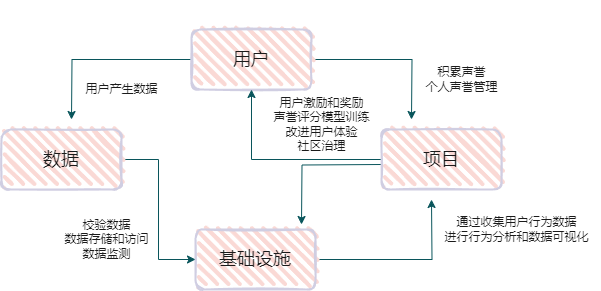
In terms of infrastructure, EAS built on Ethereum enables any entity to attest various things in the form of digital signatures. This is critical to building trust in information in a world filled with both true and false information online and on-chain. The design concept of EAS emphasizes the principles of decentralization and openness to ensure that the protocol layer is not controlled by a single stakeholder. Although EAS is a base layer, its flexibility allows it to provide comprehensive support for building trust, verification, and reputation systems. Op’s on-chain proof service now also uses EAS. Verax built by Linea further improves interoperability and can help developers issue attestations that are compatible with other standards, thus promoting the birth of more unified reputation evaluation standards. At the same time, Verax allows multiple reputation protocols to use the same attestations, and users can choose the reputation protocol that suits them based on their needs and preferences without worrying about being locked to a certain protocol. Additionally, with Verax, reputation protocols have greater flexibility in leveraging attestations to build comprehensive assessments of user, protocol, or dapp reputation. It also shows that Linea is proactively attracting potential reputation-building projects from the outset of building Verax.
In the realm of art, knowledge of who a person is and knowledge of their true record is crucial to judging their taste and appreciation of art. However, the value of artworks in the traditional art market is dominated by the opinions of a few experts. $RARE stake calls for using an on-chain reputation system to rebuild the traditional art market, making it more fair and transparent, and providing more individuals with opportunities to display and develop. They have introduced the concept of community pools and curated lists into their product, driving the creation of a platform where individuals can not only build an undisputed reputation in the fashion space, but also self-curate and showcase their talents in the Web3 creator economy and artistic platform for taste creation capabilities.
For users who want to receive the projects rewards for early contributors, it is also important that the wallet address has a good reputation to avoid being identified as a Sybil attack address. Before Arbitrum conducted the airdrop snapshot, it worked with Nansan to create an on-chain distribution model for token distribution. Among them, some addresses’ early participation in Arbitrum is believed not to be for practical purposes, but to focus on obtaining airdrops. Ultimately, Offchain Labs researchers identified possible witch wallets by using clustering algorithms on from_address/to_address transaction data from Nansen Query and integrating tracking and token transfer models on Arbitrum and Ethereum. In this case, the witch address and the real behavioral address may show exactly the same pattern on the chain, but the project side excludes the possibility of the witch address participating in governance based on motivation theory. At this time, on-chain reputation becomes a solution for you to prove that you are not a witch address. A good on-chain reputation has become a powerful screening tool, helping users ensure their authenticity and credibility to the project side, thereby indirectly providing energy for the security and reliability of the entire ecosystem.
The DeFi market is the area where reputation building is most likely to be practiced on a large scale in the short term. Because the DeFi industry can change the existing over-collateralization model by introducing an effective on-chain reputation scoring system. For example, an on-chain credit scoring system will allow DeFi platforms to more accurately assess a user’s credit risk rather than relying solely on collateral value. Users can also obtain lower interest rates and better borrowing terms by maintaining a good credit history.
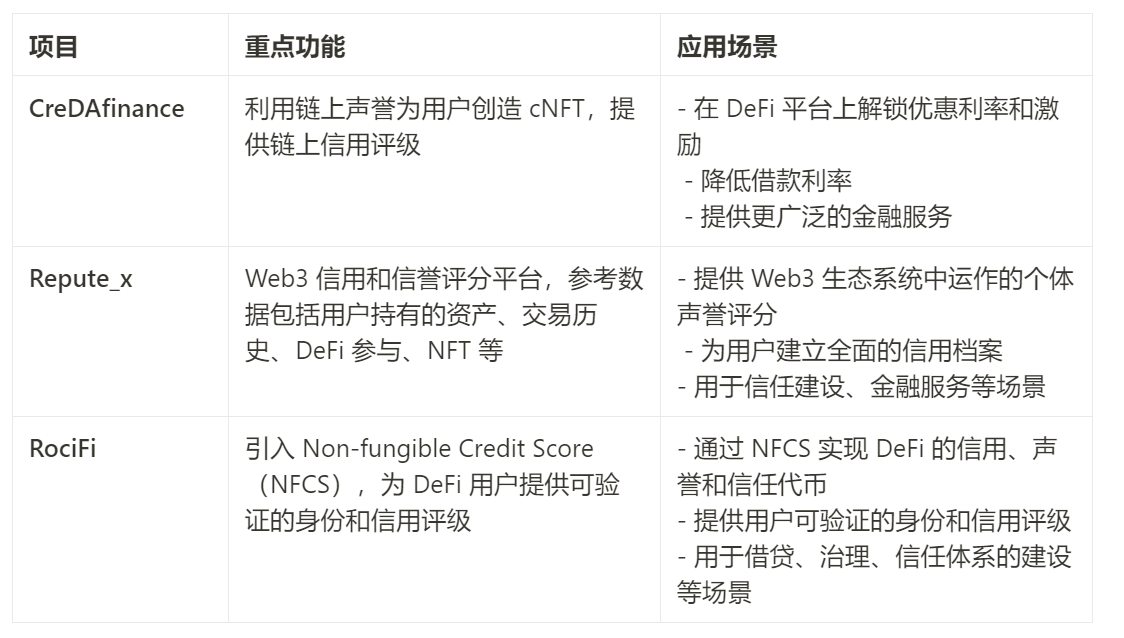
Similarities:
They all focus on using on-chain reputation to provide users with credit ratings in the blockchain ecosystem.
Provide on-chain identity and credit ratings to provide users with more financial and social opportunities.
the difference:
CreDAfinance: Creates user credit files in the form of cNFT, which is mainly used to unlock offers and incentives on the DeFi platform and reduce borrowing rates.
Repute_x: Focus on referencing multiple aspects of data to establish a comprehensive credit file, suitable for individuals in the Web3 ecosystem, for trust building and financial services.
RociFi: Introducing NFCS, focusing on implementing DeFis credit, reputation and trust tokens to provide users with verifiable identities and credit ratings, suitable for lending, governance, trust system construction and other scenarios.
The above projects all have a common feature, which is to use scores to correspond to the reputation value of users, which is exactly the same as real-world (off-chain) credit evaluation systems such as FICO, Experian, Equifax, TransUnion and Sesame Credit. Here we can’t help but ask, is there a more crypto-friendly way that can be used to help users build reputation?
We can consider using credentials to represent reputation. How do you determine the reputation of the person behind an address? Usually, the word reputation represents our image in the eyes of others. In this case, the most critical question is: What are other peoples opinions of us based on? And the simple answer to this question is: Our actions, or the way we behave. If you agree with your behavior can affect your reputation, then the on-chain behavior (set) of the wallet address you control will also represent the reputation of this address. On-chain behavior is complicated and abstract when reflected in the form of data, and upgradeable credentials label those data to a certain extent, allowing them to present your on-chain behavior in a more concrete form, thereby helping you Accumulate on-chain reputation.
Currently there is a project on Base that uses credentials to represent user reputation. Users can quickly discover the value of their on-chain interaction data accumulated in the Base ecosystem by applying for upgradable, human-readable credentials on Metopia, and add reputation XP to quantify the overall progress of all your interactions on the Base chain. . These credentials encapsulate a user’s on-chain history into a human-readable form to demonstrate the user’s participation and contribution throughout the ecosystem. This method focuses more on assisting users to reflect their personalized and dynamically changing reputation, allowing users to better perceive their progress on the chain and gain social recognition.
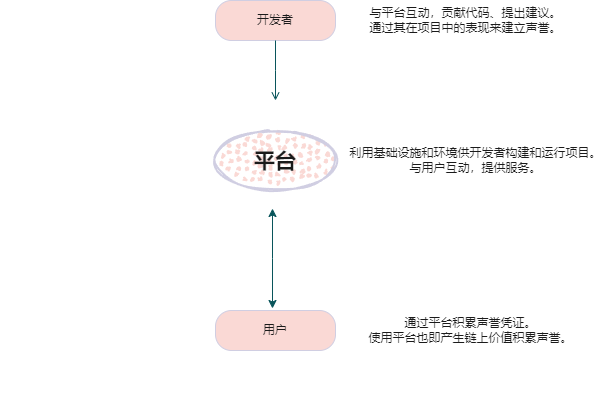
Building a Reputation: Contributing, Holding and Building
The core of personal reputation management is to establish a clear self-awareness, that is, what style you want your on-chain image to be and what qualities people see in you.
First, you need to envision how you want to be perceived by others on the chain. This may include personal attributes, professional abilities, social skills, etc. Then, enrich or adjust your behaviors and activities accordingly to ensure that they are consistent with the desired image. For example, the popular case of Celestia airdropping TIA in recent days. Unlike Arbitrum, which focuses on contributing to its own ecosystem, Celestia focuses on more complex data, including:
Multi-chain interaction data monitoring: Open interaction data between Ethereum mainnet, Optimism, and Arbitrum One. This includes information flow on the chain, transaction interaction, etc., which can provide a more comprehensive understanding of users’ activity and participation on different chains.
Gitcoin Donations: Celestia Airdrop also monitors participants’ Gitcoin donation records. This inspection point highlights the attitude of the community to participate in and support developers, and also provides strong support for social credibility and contribution.
Ens domain name: Examined user activities in the Ens domain name system, which reflects the identity and brand building of individuals in the decentralized network, further emphasizing the role of individuals in the blockchain ecosystem.
Address age and months active: Celestia Airdrop uses a snapshot of the age and months active of addresses, 6-9 months in advance. This helps identify long-term participants and active users, providing more accurate data support for airdrop weights.
This series of inspections shows that the maturity and complexity of your on-chain behavior help you be identified as a high-value user by the Celestia project team. Therefore, you must continue to contribute and build, so that your high-value behaviors can bring you a good reputation and gain recognition and rewards.
Secondly, we also need to have a deep understanding of where the risks lie. ____s ____ behavior on the chain that cares about me, the first blank space can be considered to be the organization, employer or project party, which we call individual stakeholders. The second blank space is our specific behavior on the chain, such as interacting and socializing, and it should also include whether there are any bad records on the chain. Understanding the expectations and concerns of these stakeholders can help individuals conduct more targeted on-chain reputation management. Our previous example of the project team excluding witch attack accounts is a typical example of personal reputations at risk - accounts considered by HOP to be witch attacks are still suffering the pain of being excluded in the first step a year or two later.
In addition, improving ones reputation also requires planning. Individuals can plan how to further improve the address value based on the current reputation status, which involves some systematic discussions on practical work. We can put forward some methodologies here for your reference. To accumulate a good reputation, you can do this in the following directions:
1. Hold: Participate in and hold project tokens for a long time to show confidence and support for the project. Not only does this help grow your personal finances, it also establishes your commitment to the stability of the ecosystem within the community.
2. Contribution: Further refine the contribution, including time, ability and money. Including but not limited to donations, participation in community building and management. Participate in open source projects, submit code, and provide valuable work (Build) to the community.
3. Educate and share: If you have professional knowledge, consider blogging, producing educational content, and sharing your insights and experiences about your ecosystem. Consider the Starknet Early Community Membership Program, which will reward individual contributors who encourage technical discussions, organize Starknet-related events, and regularly publish Starknet-branded content.
4. Support others: Help solve other peoples problems, provide valuable suggestions, and gain recognition from the community with a friendly and professional attitude.
Finally, I would like to say that the power of reputation comes from trust. Trust is a basic element of relationships, but with the development of globalization and informatization, the risks of a centralized trust model have become more obvious, and the Crypto world is trying to redefine social trust through a decentralized approach. Reputation as a concept that combines trust and responsibility still deserves great attention, but it also faces new and specific challenges. We hope that we can use reputation to create new trust on the chain as soon as possible, which means that we are about to create a new society through autonomous alliances.


