






Folius Ventures: Friend.Tech Explosive Logic and Future Evolutionary Trends


Original title: "Short Story: It's a Great Pleasure to Have Friends from Web3 - Friend.Tech Sounds the Assembly Call at the Intersection of Social and Cryptocurrency Chaos"
Original author: Jason Kam, Partner and Investment Manager at Folius Ventures
Original source: Folius Ventures
Review of Friend.Tech Development Experience
Within a month, standing on the shoulders of predecessors, solving pain points in the industry, and taking advantage of speculative effects for a cold start, Friend.Tech has solidified development expectations through rapid iteration and bundling with Paradigm.
• Seamless product integration: Choosing PWA fits well for lightweight social products, giving old technologies a new scene and bypassing the App Store, which is not friendly to Web3. Additionally, it integrates a Web2-like login method to lower the entry barrier, leverages Twitter account binding to gain initial traffic, and employs a joint curve design for convenient liquidity inflow and outflow. The combination of Base/OP Stack with a good trade-off between Social/Small amounts of security and ultra-low costs, as well as the maturity of offshore USDC, allows Friend.Tech to smoothly promote and monetize under the current limited Web3 infrastructure, successfully achieving a business model of "CT traffic, FT monetization".
• To some extent, solving pain points: Whether it's X, Discord, WeChat, or TG, the Web3 community lacks a well-designed platform like Zhi Shi Xing Qiu, De Dao, or expert consulting networks that can monetize attention and knowledge from highly valuable individuals in a one-way, low-noise, and comfortable manner. Friend.Tech has partially filled this market gap, making it possible for highly knowledgeable and profitable individuals to monetize their expertise.
• Overcoming cold start with speculative effects and early-stage KOL strategy: With the industry in a narrative vacuum, Friend.Tech initially attracted a large amount of traffic by directly giving cash to Twitter KOLs and sharing 5% of user-generated key revenue with hosts. User expectations for KOL appreciation and the wealth effect from price rallies have realized the project's first wave of cold start. The project's airdrop expectations and potential to break boundaries also attracted a group of die-hard users who continuously create content, maintaining a high DAU (Daily Active Users).
• Empowering with Paradigm's core secondary rocket: After the first wave of dividends receded, Paradigm's investment as the top institution in the industry laid a strong foundation for the project's development. The expectation of future coin airdrops has been solidified and valuation expectations have significantly increased, indicating that user willingness and amount of deposits will also increase substantially. The strong background of the investment company means that many small product issues and legal issues are likely to be resolved, greatly reducing the risk of running away and significantly boosting user usage and deposit willingness.
• Rapid Iteration on the Right Path: Friend.Tech, as a product, is below average in benchmarking within the Chinese/Asia-Pacific Web2 community. Fortunately, it is continuously iterating on the right path in terms of empowering homeowners with monetization options and providing users with the opportunity to earn money and enjoy a smooth experience. From the perspective of refresh speed, reply function, cross-chain and deposit functions, global comparison/ranking interface, image function, and other features, the capabilities of the 996 team are expected to continue to contribute to the continuous improvement of the product, ultimately reaching the passing line for Web2.
Friend.Tech's Point System and Airdrop Expectations Make Holding Key and Speaking a Form of Poo l2 Mining
Friend.Tech's point system and airdrop expectations make holding Key and speaking a form of disguised Poo l2 mining. It is also the only way to get exposure to it and currently offers a high potential return on investment.
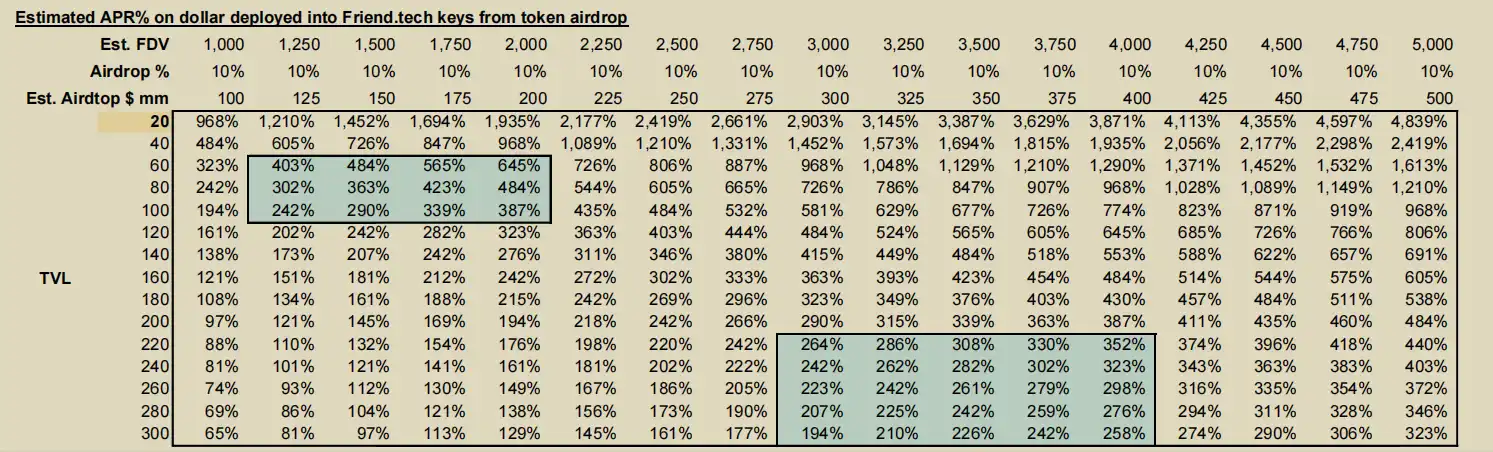
The current popularity of Friend.Tech is largely due to its token issuance expectations - for heavy participants, their cognitive framework is based on the belief that every 1 point may convert to a token airdrop worth $1-5, or participate in mining with an APR of 200-500% or even more based on the amount invested:
• Friend.Tech will distribute 100 million points over a period of 25 weeks. It is generally believed that points represent token airdrops and are strongly correlated with the total amount of Key invested, holding period, and in-app activity (such as clicks, duration, speaking, etc.).
• As shown in the table below, if Friend.Tech's token issuance FDV is ultimately 1.5 Bn, with 10% allocated for airdrops and an average TVL of 80 mm over 25 weeks, and the airdrop ratio is proportional to the participation TVL, the final annualized airdrop rate is approximately ~360%.
• Acquiring KEY, staying active, and the friction threshold of the product hinder the entry of large funds. However, we believe that with the improvement of industry awareness, product iteration, the development of supporting financial infrastructure, and the entry of Silicon Valley, Asia-Pacific, and traffic-oriented individuals, TVL and KEY prices may rise significantly.
• It is worth mentioning that currently, Friend.Tech refuses to engage with any VC except Paradigm. Therefore, we believe this is an opportunity for individual investors and secondary funds, and mining may be the only way to obtain exposure to the company.
About PMF: For ordinary professionals, rapid reputation monetization represents short-term earnings of $1,000 - $10,000.
• Subscription price = Sell price * 0.9 - Buy price * 1.1. In other words, when the price rises by 22%, users can subscribe for free. According to the conversion formula, if Keys holders increase their holdings by 1%, this user can "freeload".
• The final pricing should fall within the cost of multiple consultations by a single user ~= 20% of the price (in and out). Based on the current ether price and the industry consulting pricing of general hedge funds per hour ($500-$1,000), the number of top-paid consultants should be around 150-215, or a single Key price of approximately 1.4-3.0 ether. Interestingly, this number of Keys is, in fact, approximately equal to Dunbar's number, which is the maximum number of people a person can maintain relationships with easily. Therefore, we believe that the design of this equation (S^2 / 16,000 * 1) is intentional, and the price range of 1.5-3.0 ether for a single person is what we consider a normal price after the hype subsides in the industry.
• The public's perception of reputation and professionalism will quickly push the price into a reasonable range. The thrill of early discovery and profitability is addictive. And the high revenue share can give influencers a rapid sense of income, thereby further helping platform promotion and accelerating network effects. For an influencer, the royalties alone at the 50/100/150 Key levels are at least $200/$1,700/$5,600. If they can hold 3 Keys at a low price in the early stage, they can earn an additional $750/$3,000/$6,750 by selling the Keys at the 50/100/150 Key levels. For most professionals, the temptation of quickly acquiring $1,000-$10,000 is enough to engage in and promote daily.
• Users may lean towards holding on to Key because they want to freeload and maintain their status symbols. Additionally, we believe that opportunities to attract the attention of top industry professionals are extremely rare, and currently the cost of reaching top-level attention in terms of power and cognition is extremely low. For individuals in need, the price they can pay for attention and feedback is unlimited, opening up the ceiling for Key. However, there may be a problem later on with providing a continuous cash flow for influencers, which needs to be resolved.
Early explosive income and ongoing income problem - Friend.Tech must introduce a continuous payment mechanism
In the subsequent period, a decrease in the price of KEY+ tokens <-> users abandoning ship may lead to a death spiral.
We believe that Friend.Tech will inevitably face problems of high pricing by homeowners in the later stages, Key holders saturating and hoarding, and potential users lacking the willingness to buy due to insufficient funds, resulting in a shortage of sustained cash flow. After homeowners make a one-time profit through royalties and selling Key in the early stages, they will inevitably face a lack of momentum. We believe that for Web2 traffic core and high-end professionals, Friend.Tech must open up a continuous pay-per-use model for external and group participants:
• We believe its design needs to be accompanied by differentiated pricing for those with Key and those without Key, referral links / profit-sharing mechanisms for Key holders, and appropriate free disclosure based on unlocking time or other methods in order to achieve effective ongoing monetization for homeowners.
• Under the premise of not being able to achieve this smoothly, we believe that in the downward cycle after user saturation, the churn rate will increase significantly as KEY and tokens are sold off, further affecting the price of KEY and tokens, resulting in a two-way death spiral.
Given sufficient execution, Friend.Tech may still have at least two peaks of high DAU impact in the future
We predict that given sufficient execution, Friend.Tech may still have at least two peaks of high DAU impact in the future. After that, the product must create sufficient network effects and quality.
Potential participants in the future:
• Silicon Valley VCs + Silicon Valley entrepreneurs: Radiation through Paradigm and the current Web3 community
• Numerous VCs, founders, opinion leaders, coin traders, and tech professionals in the Asia-Pacific region: Radiation from west to east + wealth effect
• Non-Web3 professionals from various industries, especially in high net worth verticals: Continuously expand business and pay GTM fees through the company itself. It is crucial to attract opinion leaders with cash and tokens.
• Direct allocation of Web3 native liquidity funds to capture airdrop opportunities: We believe that when general liquidity funds can easily purchase keys similar to ETFs and directly enjoy potential airdrops, large amounts of capital will flow in.
• The wealth effect brought about by new users and TVL will increase token valuations and attract more existing users' funds. We believe that the strong anticipation of airdrops will keep the product hot until January-February 2024.
Necessary feature additions:
• Free preview: Increase potential user willingness to purchase and improve discoverability.
• Richer multimedia experience, especially videos and live streaming.
• Global page: Discover outstanding content locally and help influencers attract traffic. Advertising opportunities can be considered but are not essential.
• Referral rewards: Adding profit sharing can help influencers monetize faster and better.
• Extra encrypted or paid content in groups: Help influencers continue to monetize.
• Product details - can mimic features from WeChat and Telegram, such as voting, reactions to posts, pinning content, etc.
• Stronger transaction scenarios, such as sending keys, directly guiding whitelist or token/NFT purchases, etc.
• Significantly lower user entry and withdrawal thresholds, and greatly improve product fluency.
• Deeply consider joint curves and introduce multiple curves, while considering continuous incentives for active and holding users after token issuance.
There is still room for improvement in the joint curve - the team has made good choices in simplicity
There is still room for improvement in the joint curve - the team has made good choices in simplicity. We expect Paradigm to further improve it.
Currently, Friend.Tech has a pure and singular product form: a simple and understandable joint curve that is suitable for high-value KOLs who bring real money. However, it also has its limitations - when user profiles are expanded, not every user is suitable for this type, and even KOLs need to differentiate their user base. We believe that giving users the power to choose from several options (such as 3-4 different curve forms) and implementing it in a straightforward way will expand Friend.Tech's TAM:
• Monetization-oriented, fixed-price keys: Revenue primarily goes to the host, with a constant price instead of x^2 and most (around 90%) rather than 5% of the income. This way, key holders can expand to thousands of people, similar to OnlyFans. By adjusting the utility of keys, generalization can be achieved more rapidly.
• Key to the knowledge payment form and S-curve price: The price converges after reaching the marginal users (similar to S-curve) instead of x^2, which can stabilize the cost of acquiring the majority of users in the later stage while accommodating early speculative users and being more suitable for expert talent.
• Key to event-driven, multi-S-curve prices: Similar to the above, but there is room for price increase after breaking through different bottlenecks in user quantity, suitable for star hosts who can drive user referrals through Referral Links, thereby surpassing the platform period.
Fortunately, Paradigm's expertise in mechanism design and mathematics can greatly assist the Friend.Tech team.
Maximizing Points for Long-term, High-traffic, High-engagement, and High-value Hosts
If maximizing Points is the key logic for allocation, long-term, high-traffic, high-engagement, and high-value hosts who have continuously cultivated their products may be the most suitable.
Airdrops add value beyond knowledge consultation and identity validation. If we assume that the final token airdrop results are strongly correlated with Points, the allocation objective should be to maximize weekly Points. Although the team can fine-tune the equation each week, we dare to predict the conversion method will likely be as follows:
App activity (own + others) * Key comprehensive asset price (own + others) * Key holding duration
Considering this, before this formula is adjusted, the general guideline for maximizing weekly points may be as follows:
• Products should be frequently used and promoted by both own and other users. Key holders should be active users.
• Hosts with abundant ammunition should be given priority, as their ETH is likely to be converted into Key, thereby increasing their weight. Users with higher overall asset prices should also be given priority.
• It is worth noting that it is not easy to buy highly active KOLs at low prices immediately. Therefore, for users with ample ammunition and their own traffic, buying a sufficient amount of Key at the earliest opportunity may be one of the best parameter-boosting solutions.
• Considering that holding duration should be one of the weights, coupled with a 20% cost for each transaction, the best approach may be to early adopt and long-term hold users who are most willing to cultivate the product, rather than frequently buying and selling. Therefore, it is advisable to carefully select hosts who clearly cannot be severed or deeply participate, rather than purely following the trend.
• Therefore, in terms of configuration, a homeowner with high traffic, high stickiness, high net worth, and reasons and willingness to develop their own brand in the product in the long term should be the best choice for long-term holding to maximize Points. Interestingly, these users should have obtained quite good Points in the past four weeks, so perhaps it can also be used as a screening criterion.
Folius consumer-side product Web3 integration three elements have a good display on Friend.Tech
Folius consumer-side product Web3 integrates three elements: offshore fiat channel, low cash cost incentive customer acquisition, and reliance on external liquidity and economic depth tax collection, all have a good display on Friend.Tech.
We believe that in terms of product form, Friend.Tech has some features that we like to see when observing the Web3 transformation of consumer products. In other words, this product can fully utilize the characteristics of the Web3 value network to help it succeed:
Offshore fiat channel: support between different countries (e.g., Russians buying KEY from the Argentinian president, or Africans consulting Mexicans) and payments for attention/knowledge/content of specific industries (e.g., most high-risk and controversial industries) are unlikely to use traditional financial fiat payment channels, but can be easily achieved seamlessly on ETH/BASE through USDC. The last mile of fiat entry and exit is still a friction point, but the industry is constantly improving.
Low cash cost incentive customer acquisition to achieve economies of scale: Friend.Tech can quickly acquire highly loyal users at almost no cost within a certain period of time through its own speculation + wealth effects and the wealth expectations brought by airdrops. The potential for the token itself to be a multiple of potential cash flow is one order of magnitude higher than the intensity of acquiring new users with general cash. Of course, if the team fails to solidify itself before these benefits disappear, the users brought by the Web3 bonus will probably leave quickly; and as a social product that needs to quickly achieve economies of scale and is strongly related to monetization of attention/knowledge, it seems not to be such a bad choice.
Reliance on external liquidity and economic depth tax collection: In addition to the financial leverage brought by the airdrop expectations, Key itself also comes with a one-time payment multiplier. In other words, the current KEY is a combination of Friend.Tech's own equity and the multiplier of the homeowner's own cash flow value. Based on this, the intensity of the 5% income deduction exceeds that of general Web2 companies. In addition, we can fully anticipate the future tax collection for highly financialized products and the tax collection for pay-per-view tips. In addition, the intensity of diverting flow to other projects and even the water-drawing intensity as a traffic entrance after the company scales up is worth looking forward to.
Risks
As a social niche product with strong financial attributes, Friend.Tech has many risks in its development path:
• There is no need to issue tokens in the end, or to have an unprecedented airdrop. Therefore, it is very important for participants to get involved earlier and strictly control the loss of ETH value over multiple cycles.
• Cannot break out of the circle and collapse in advance: Currently, the product has a high coverage of Web3. If it cannot break out of the circle, all assets will have depreciation risks.
• Excessive fees: The fee for buying and selling is 10%, which is quite high. If the product development slows down and the user base expands, it may cause strong dissatisfaction.
• Significant risk of being defined as a security in terms of KEY regulation: This risk cannot be eliminated and must rely on Paradigm's legal team and clever design of the company itself.
• Significant execution risk of the product: In the company's growth process, due to its strong financial attributes, every step of feature updates and continuous rapid iteration/problem solving comes with significant risk of collapse. The team needs to handle everything very prudently. In addition, the product itself is still below the benchmark of Web2, with poor user experience. If it cannot be improved, there may be problems after the expected elimination in the future.
• Inevitable financial cycles caused by fluctuating DAU and prices: KEY itself will experience strong volatility and cyclicality with changes in airdrop expectations, user growth rate, and price itself. This comes with significant permanent loss risk, and the team must manage expectations and iterate steadily during these cycles.
• Long-term retention risk: Friend.Tech may become a niche product that cannot sustain a high FDV for the general public due to the high price of KEY after the tide has receded. The failures of Clubhouse and many other niche social products serve as a lesson.
• Private key and Web3 asset security risks: Wallets based on custody mechanisms and smart contracts have inherent hacking risks that must be considered.
• Anonymous team risk: The team does not have actual responsibility towards users. Of course, this is somewhat mitigated by Paradigm's involvement, but the reputation risk of a semi-anonymous founding team still exists.
• Content risk: It is obvious that this type of content platform has high risks of violating any country's laws. As the platform grows, it will inevitably face many challenges in terms of auditing and regulation. The team needs to have great patience and preparedness to meet all of these challenges.
Risk Disclaimer: Readers should not interpret the content of this presentation as legal, tax, investment, or other advice.


