






Everyone is talking about social networking, but this protocol layer is far underestimated


Original |
Author | Husband How
When it comes to social networking, you may immediately think of applications such as Twitter, Telegram, and WeChat, but few people pay attention to the underlying protocols these applications are based on. Most Web2 social platforms rely on powerful resources for overall technical architecture design, building social graphs, storage, databases and other components as a unity. Although the operation and cooperation between the various components are smooth, they are also closed like an iron bucket.
On the contrary, the decentralization and openness of Web3 determine that the social platform can be composed of different decentralized protocol combinations, such as social graph Lens Protocol, Gitcoin passport in DID, storage representatives IPFS and Arweave, etc. But one class of subdivision agreements is often overlooked.
The core function of WeChat is to send and receive messages, and the chat between people is realized through the IM (Instant Messaging) protocol. Usually IM protocols in Web2 are mostly run by centralized servers, such as Google Talks CMPP, etc., but in Web3, we expect the protocol layer and application layer to jointly capture value.As the underlying protocol, IM is as important as data storage, identity and other protocols. It has not yet emerged as a leader in the field. Most representative projects have not issued coins, leaving a lot of room for imagination.
To this end, Odaily took stock of representative projects in the field of Web3 IM protocol, and took everyone from point to surface, from a single project to IM ecology to find investment opportunities.
Basic introduction to IM (Instant Messaging) protocol
Before talking about IM, let’s briefly introduce the hierarchical position of Web 3 social projects, which are roughly divided into protocol layer and application layer.
The protocol layer can be subdivided into DID, social graph, storage, communication, content distribution, etc. The application layer is easy to understand, and users can intuitively feel and experience apps, websites, etc.
The IM protocol is a network protocol for instant messaging. It defines the rules and formats for transmitting messages between communication parties, allowing users to conduct personal or group communication in real time in the form of text, audio, video, etc., and supports message functions of sending, receiving, storing and forwarding.
At present, there are more than 150 projects integrated with related decentralized IM protocols, which serve as a communication bridge between projects and users, and users and users, and are distributed in Ethereum, Solana, Aptos, L2 and other chains. You may have unknowingly used product functions supported by the IM protocol, such as RSS3, CyberConnect, Lens, Coinbase, ENS, etc.
IM protocol represents the basic introduction and development status of the project
Web3 MQ (unissued currency)
Web3 MQIt is an open source decentralized communication protocol that becomes a cryptographic native communication infrastructure. It provides an efficient, secure, scalable social network and messaging network with fast speed and high scalability.
The sub-protocols of Web3 MQ include DAppMQ, PushMQ and SocialMQ, which are respectively aimed at decentralized applications, user push notifications and chats between users: DAppMQ bridges decentralized applications and supports signature routing and authentication; PushMQ integrates decentralized applications with User connection, which supports one-way notifications to users; SocialMQ connects users to users, and supports encrypted messaging via direct message (DM) or group chat, without the need for a third party.
From the perspective of public chain selection, Web3 MQ is constructed on the basis of Starknet and can be counted as L3, the social layer of Starknet. From a social network perspective, Web3 MQ counts as the IM layer and is responsible for messaging in social networks.
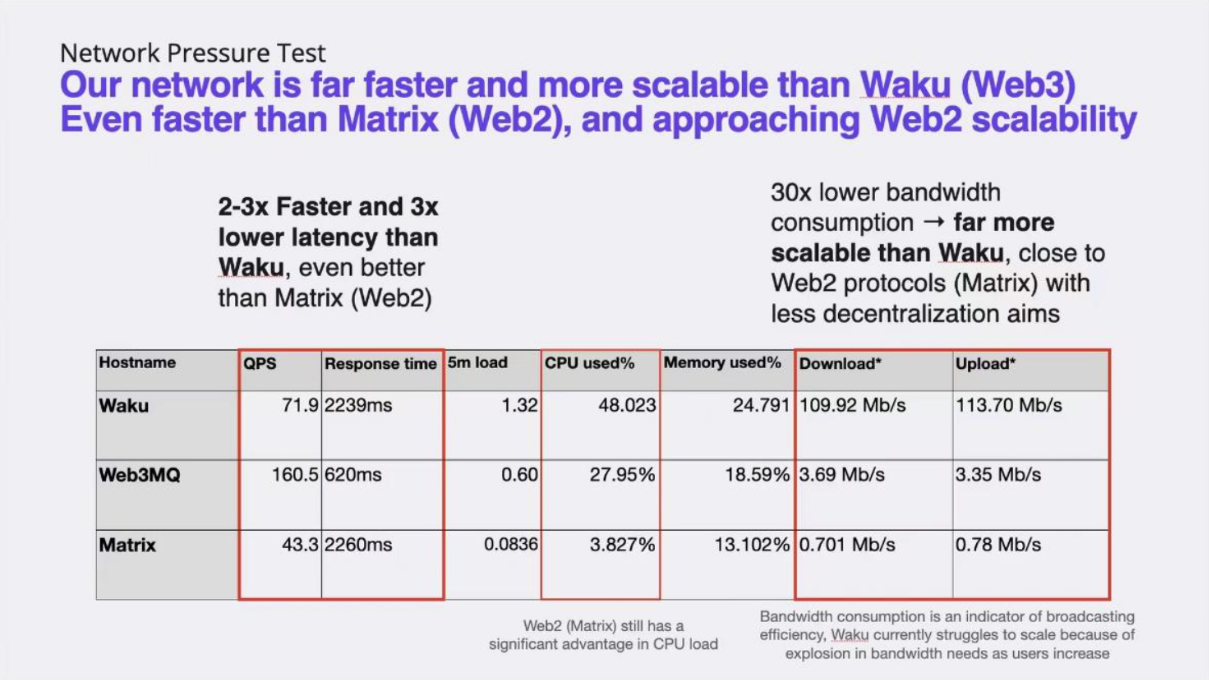
Currently, Web3 MQ service projects include RSS3, Mirror World, Spot, etc.
XMTP (unissued currency)
XMTPIt is a Web3 instant messaging protocol and infrastructure, evolved from Waku v2, supporting end-to-end encrypted communication between addresses on the chain, including authentication, end-to-end encryption, interoperable inbox and message relay Function.
The overall structure of XMTP is divided into three layers: network layer, client layer, and application layer.. The application layer integrates corresponding DAPPs. Each layer performs its own duties and cooperates with each other to form an XMTP ecosystem.
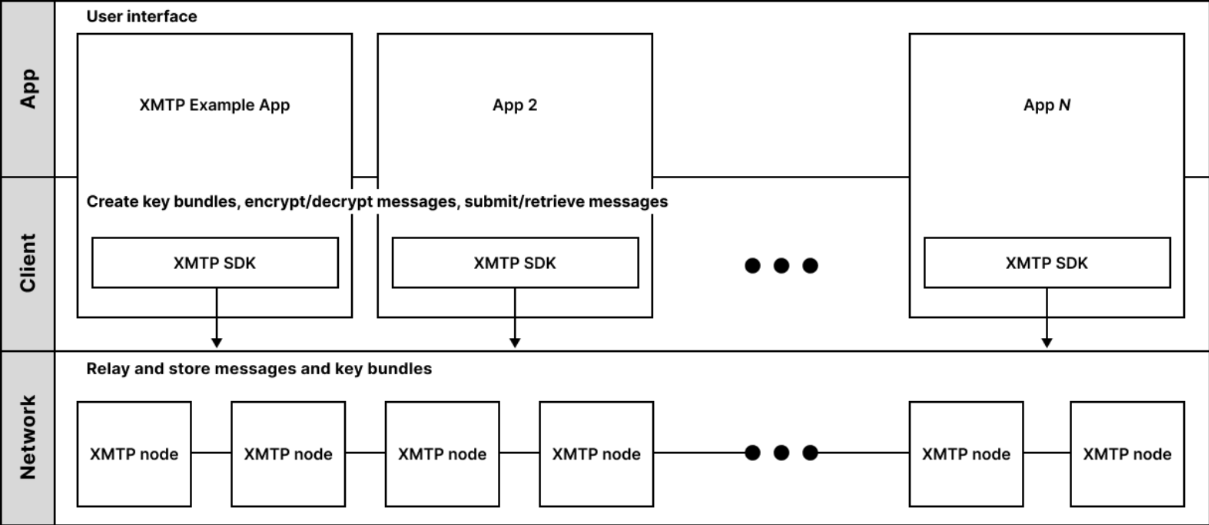
XMTP wants to build a basic communication infrastructure network that can break down communication barriers for projects connected to this network. Currently, participants in the XMTP ecosystem include CyberConnect, Lens, Coinbase, Converse, ENS, unstoppable domains, etc.
Waku (issued currency)
WakuIt is an instant messaging protocol and infrastructure based on Ethereum. It provides DAPP with a secure, private and efficient communication method. Waku uses a range of protocols and specifications, including Whisper (Ethereums peer-to-peer messaging protocol), among others.
At present, Waku has been developed and iterated to the V2 version. Waku V2 is a series of modular point-to-point protocols for secure communication. It implements Pub/Sub via Lib p2p and adds a set of features to it. These functions include:
● Retrieve historical messages from most offline devices.
● Adaptive nodes, allowing heterogeneous nodes to contribute to the network.
● Reserve bandwidth usage for resource-constrained devices.
As an earlier decentralized IM protocol, Waku originated from Whisper, and later developed Waku V2 on the basis of Lib p2p. The development team is the Status team. As a development team responsible for communication in the Ethereum community, it was funded by the Ethereum Foundation in the early days.
The Status team developed the communication software Status based on Waku V2. Although the Waku protocol has not issued coins, the native communication software has now issued coins.According to CoinGecko, on August 17, the market value was 90 million US dollars, ranking 261, which is currently the highest market value of the coins issued by the IM-related team.
Push Protocol (issued coins)
Push Protocol(formerly ENPS) is a general-purpose Web3 communication network that supports cross-chain notifications and messaging for DAPPs, wallets, and services.
Push Protocol was formerly known as ENPS. ENPS built a decentralized information push protocol in the Ethereum ecosystem, allowing users (that is, wallet addresses) to receive information notifications from various Dapps, smart contracts, and even centralized services. After the name change, the scope of Push Protocols radiation expanded to multi-chain. Currently supports Ethereum, Polygon and BNB Chain.
The operation process of Push Protocol is to integrate Push components through the server to form a channel of the corresponding project. Users can choose to subscribe to the push information function of the channel, and can follow the server in real time to push relevant information for users.
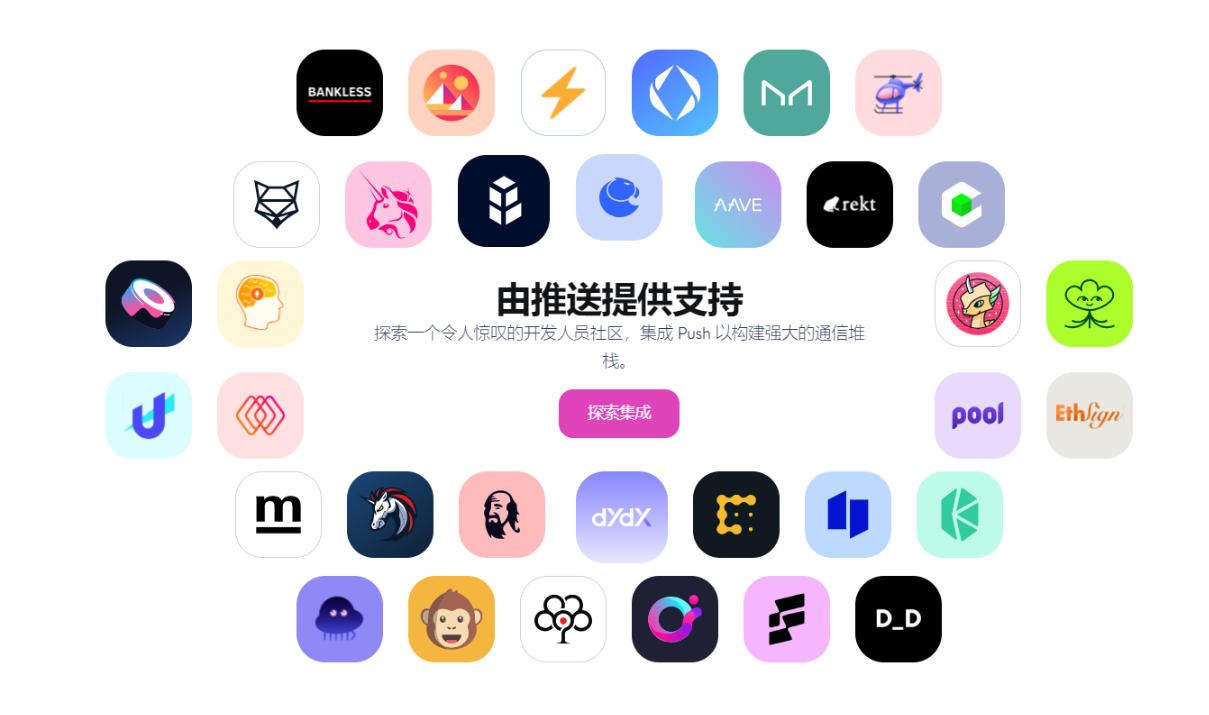
Currently Push provides communication support for more than 100 DAPPs and service providers, involving DeFi, NFT, games, development tools, etc.According to CoinGecko, on August 17, PUSH had a market value of US$8 million and ranked 1,002nd.
Dialect (unissued currency)
DialectIt is an information push protocol that can push protocol information in the ecosystem. Dialect uses the publish-subscribe (pub-sub) messaging function to implement information push on the chain, and attaches the data storage account to the stateless program account by creating a Program Derived Address (PDA). Relevant security can be ensured since no associated private keys are used.
Dialect launches consumer-level DAPP - Dial. Users can conduct private messages and group chats directly from the wallet, and its smart messaging standard signs transactions within messages without involving any Web2 identity.
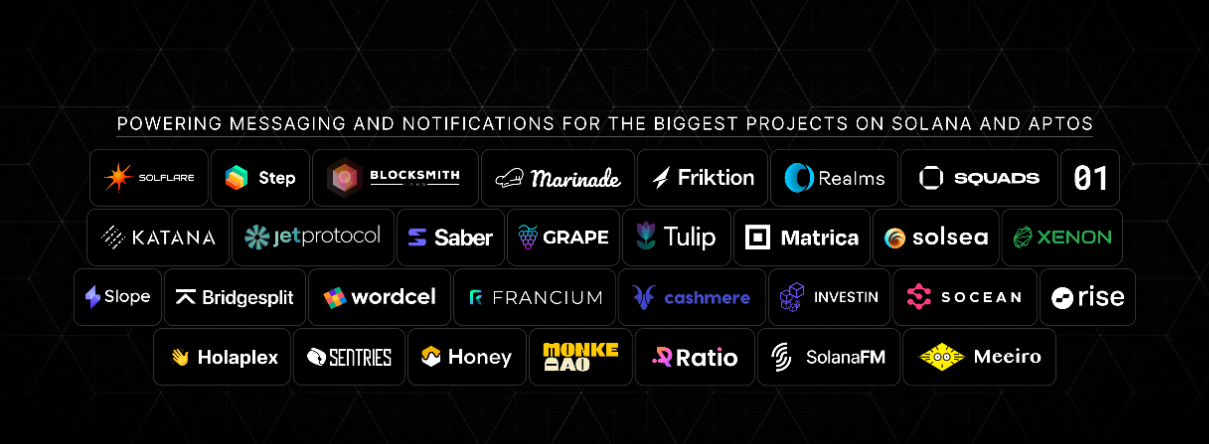
Dialect currently provides notifications and messaging for Solana, Aptos, 30+ DAPPs and wallets on some EVM chains.
Matrix (no coins involved)
MatrixIt is an open standard decentralized communication protocol and network designed to provide secure, private and interoperable instant messaging. It allows users to communicate across platforms and devices between different service providers, and supports messaging, audio and video calls, group chats and other functions.
The Matrix protocol architecture is based on chat rooms. Chat content is encrypted and supports embedding and displaying third-party applications. The server of each chat room is decentralized to ensure the confidentiality of chat content.
Matrix is widely used in Web2. It was incubated internally by the parent company Amdocs and later raised nearly $50 million in financing from Status, Protocol Labs and other institutions.
Matrix is operated by a centralized Web2 company, so it does not involve tokens, but it has many linkages with Web3-related protocols such as IPFS.
Currently, applications based on the Matrix protocol include Element, etc., and have been adopted by 12 national governments.
Why care about IM protocols
As a social track, people tend to pay more attention to products that can be directly experienced, that is, social applications, while ignoring the protocol layer that supports the application and the various components in between.
I prefer to think of social networking as a carrier with a combination of many protocol layers. Different protocols cooperate with each other to form a social platform with different business directions. Decentralized social networking is more in line with the public expectation that Web3 will break the island of information.
The IM protocol, as an important part behind the social platform, currently has no leading project.
The current development trajectories of IM protocols are different. Specifically: Web3 MQ has greater advantages in performance and functions; XMTP has a better background in capital and the importance of cooperation projects; The main development direction is the new public chain.
In terms of business model, most of the projects introduced above integrate token utility into product functions through independent development of to C applications; while XMTP focuses on to B to form a basic network.
The subdivision of decentralized IM is still in its early stages. It is still difficult for us to judge the pros and cons of the specific development model, but there may be certain value opportunities before the ecology is ready to flourish.
Related Reading
New Project | Dialect: On-chain message notification protocol in partnership with Solana Mobile
Who is XMTP, the social protocol that cooperates with Coinbase and Lens?


