






Five major disruptors: a comprehensive analysis of potential LSD track projects.


Source: Bankless
Translation: BitpushNews Mary Liu
Liquid Staking Derivatives (LSD) is one of the hottest topics in 2023. These protocols accept deposited ETH, stake it to ensure network security, and distribute staking rewards to LSD holders (minus some fees). This greatly simplifies the staking process for users and allows LSD to be used in other DeFi applications.
The leader in this market is Lido, which owes its dominant position largely to being "early and ubiquitous," it has been able to leverage its network effect to become the "safest" choice for users entering the ETH staking world.
So how do other protocols compete?
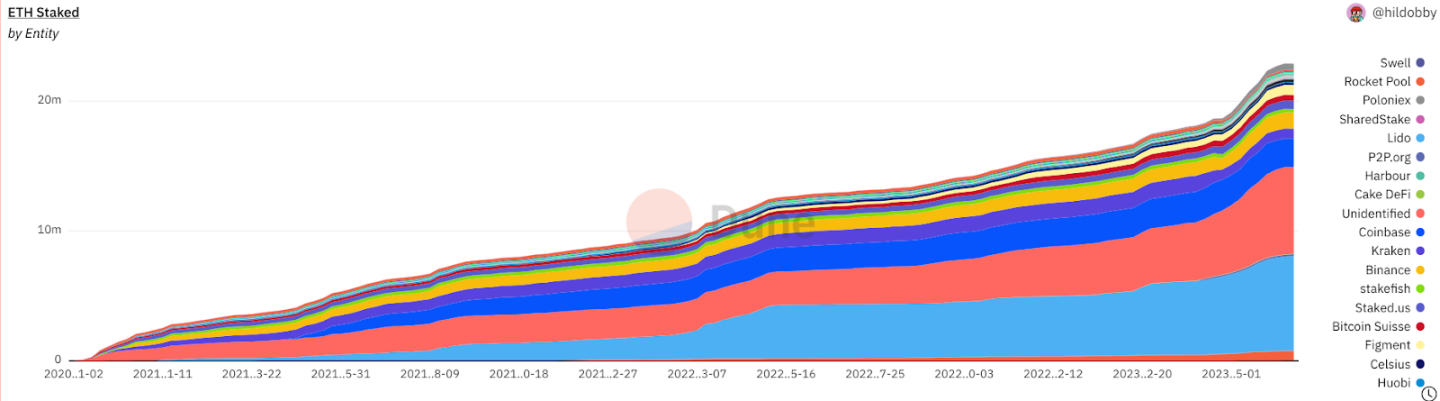
While some purists may want to believe this, market participants often choose platforms that best serve their own interests. In order to compete for market share (or even weaken its monopoly position), newcomers must offer something better or different than Lido.
In our view, these advantages could be:
Higher returns
Easier to use
Greater composability and/or security
Innovation
This article compiles five LSD projects that are most likely to have potential, exploring how they compete with market leader Lido in terms of technology, economics, and user experience, and become disruptors in the market by offering novel solutions.
1. Prisma
Prisma's first Mirror article caused a sensation, positioning itself as the "ultimate game of liquid staking tokens," with the goal of using Curve's flywheel effect to drive widespread adoption of its stablecoin (acUSD). Similar to projects like Gravita and Lybra, Prisma uses Liquity's model and makes adjustments to allow acUSD to be minted against any of the top five LSDs (Lido's stETH, Coinbase's cbETH, Rocket Pool's rETH, Frax's frxETH, and Binance's WBETH), with the weights and future integrations currently pending.
In theory, the desire to hold acUSD will incentivize more users to stake their ETH using liquid staking tokens.
In addition to transaction fees, acUSD liquidity providers will also receive CRV, CVX, and PRISMA tokens, as well as standard ETH staking rewards
With the launch on Curve, Convex, Frax, Conic, and LlamaNodes, Prisma has achieved collaborations with multiple heavyweight projects, starting off strong.
2.Swell
Swell's swETH LSD has gained widespread attention from the community due to its current Voyage incentive program, rapidly climbing in rankings with a TVL surpassing 50 million dollars. Swell positions itself as aligned with Etherean values, aiming to make the onboarding process easier for new users.
Users can directly purchase ETH from their applications through Google/Apple Pay, credit cards, or bank accounts
Partner integrations allow users to earn swETH rewards by providing liquidity
3.unshETH
unshETH aims to incentivize healthy competition in the LSD space, offering a diversified LSD composed of a basket of underlying LSD. The weights of these LSD are balanced through governance and currently include Lido's wstETH, RocketPool's rETH, Coinbase's cbETH, Frax's sfrxETH, Anker's ankrETH, and Swell's swETH. As arbitrageurs are incentivized to rebalance the weights of unshETH-based LSD, every governance decision will impact user behavior on the platform.
In addition to standard staking rewards from the basket of underlying LSD, unshETH can also generate additional revenue through rebalancing fees
Built on LayerZero means unshETH can be transferred natively across chains, enabling new liquidity strategies
Inclusion in unshETH will bring new buying pressure to emerging LSD projects, making unshETH a potential launching partner
4. Origin Ether
By combining automated yield generation strategies with native Ethereum staking rewards, Origin Ether can offer lucrative rewards to its depositors. Similar to the mentioned LSDs, OETH is backed by deposited ETH at a 1:1 ratio, which is distributed across various DeFi platforms to earn income. The current yield comes from (in weighted order):
ETH-OETH Convex liquidity pool
Rocket Pool's rETH
Frax's sfrxETH
Lido's stETH
High yield has enabled Origin Ether to accumulate approximately $35 million TVL in just one month.
In the past 30 days, the annual interest rate of Origin Ether has been about 9%, which is twice that of some competitors in the same track.
Origin's automatic yield strategy provides users with maximum convenience, eliminating the need to compare different platforms to find higher returns.
5. Diva
Diva aims to combine the composability of liquidity staking with the decentralization brought by distributed validation technology. In short, DVT allows for the verification of validator private keys through trust-minimized key sharing. In practice, users combine the composability of LSD with the decentralization advantages of running their own ETH node, without any minimum staking threshold.
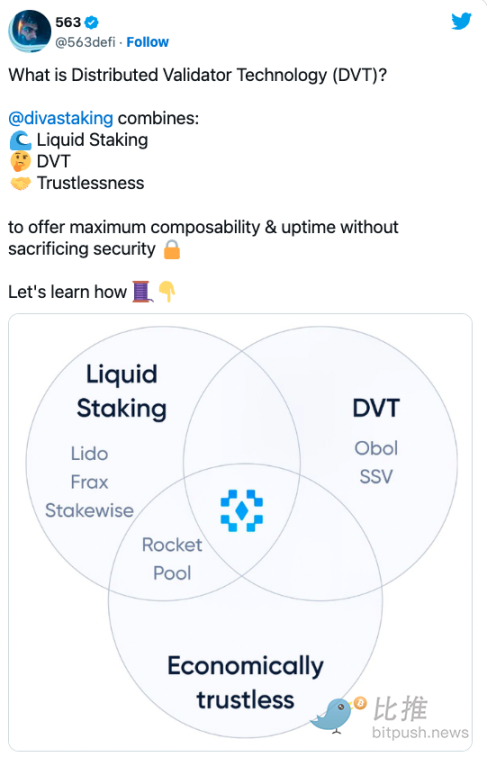
DVT is a new technology that brings further decentralization to ETH staking.
DVT allows for node redundancy and improved uptime, resulting in more stable returns.
The competition has not started yet
If we look back, the day of the merger hasn't been too long ago, and ETH staking is still in its early stages. Compared to other Proof of Stake (PoS) L1 networks, the percentage of ETH used for staking is still below 20%.
Assuming that ETH staking will eventually align with the PoS majority, the staking protocol has enough time to tap into its own market. This article only showcases a small portion of projects, each with their own unique features in the field of liquid staking derivatives, whether it's easier accessibility, new technology, new use cases, or simply higher annual interest rates, LSDfi has much potential to be explored.


