






Detailed Explanation of Grayscale Digital Asset Trust: Operation Mode and Premium Situation Overview


Original author: Matias Andrade Cabieses
Original translation: Deep Tide TechFlow
A major development in the field of digital asset investment is the upcoming launch of spot exchange traded funds (ETFs). The arrival of spot ETFs could greatly simplify the investment in digital assets, expanding the range of investment products, especially for US investors. Currently, investment options are primarily based on futures. These instruments have fixed expiration dates and predetermined term structures, which could bring unexpected costs to investors. Alternatively, investments can be managed through trusts, similar to Grayscale's products.
In this article, we will delve into how Grayscale's digital asset trusts operate and compare them to potential spot ETFs.
Trust products without asset trust
In the field of digital assets, the demand for exchange-traded products by investors is steadily growing for various reasons. One key reason is the difference between tax-advantaged accounts and asset self-custody. The self-custody process, while allowing for complete control of assets, involves significant complexity and requires extensive technical knowledge to ensure safe and successful implementation. In addition, investments made in this way will face considerable tax obligations, proportional to capital gains tax and income tax.
Currently, the main tax-advantaged accounts available to most US investors, including individual retirement accounts (IRAs), 401(k) plans, and health savings accounts (HSAs), do not allow direct investment in digital assets, although there are some notable exceptions, including Fidelity, publicly traded mining companies, and Microstrategy. This limitation hinders the ability to defer or offset tax liabilities associated with digital asset investments, which is a significant disadvantage for investors. Even for investors who choose self-custody, these accounts remain highly essential, as even a slight reduction in capital gains tax payments can have a significant impact on the overall performance of investments (especially when short-term capital gains tax rates apply, as shown below).
(TechFlow note: The blue line represents the short-term after-tax return rate, the gray line represents the long-term after-tax return rate, and the yellow line represents the net return rate of BTC itself.)
We can further consider that self-custody is simply not a viable option for most people, whether due to a lack of technical knowledge or because regulatory or legal restrictions interfere with this ownership, especially for corporate entities. Given these barriers, exchange-traded products are not only convenient alternatives but also important components of the digital asset investment field. They play a similar role as in other asset classes, where self-custody may be possible but not practical, such as precious metals.
However, it is important to understand that not all exchange-traded products are the same. Each product has unique characteristics that may have different impacts on investors' portfolios. In this case, we will focus on the product series offered by Grayscale. Our goal is to gain a deep understanding of the specific features of their products to better comprehend their subtle differences. By doing so, we can have a clearer understanding of why the potential introduction of a spot ETF has caused such a stir in the market.
Grayscale Trust Products
Grayscale offers a range of investment products that allow investors to gain exposure to individual digital assets like BTC, ETH, or various indices tracking multiple asset portfolios. All of Grayscale's products have one thing in common - they are structured as trusts, meaning the value of shares can fluctuate with the value of the underlying asset portfolio. Throughout its history, Grayscale's Bitcoin Trust (GBTC) has seen its share value exceed that of the underlying Bitcoin during the peak of the bull market in 2020-2021. At other times, the trading price of shares may be lower than the value of the underlying Bitcoin, even dropping to as low as 50% of its value. These fluctuations are commonly referred to as premiums and discounts.
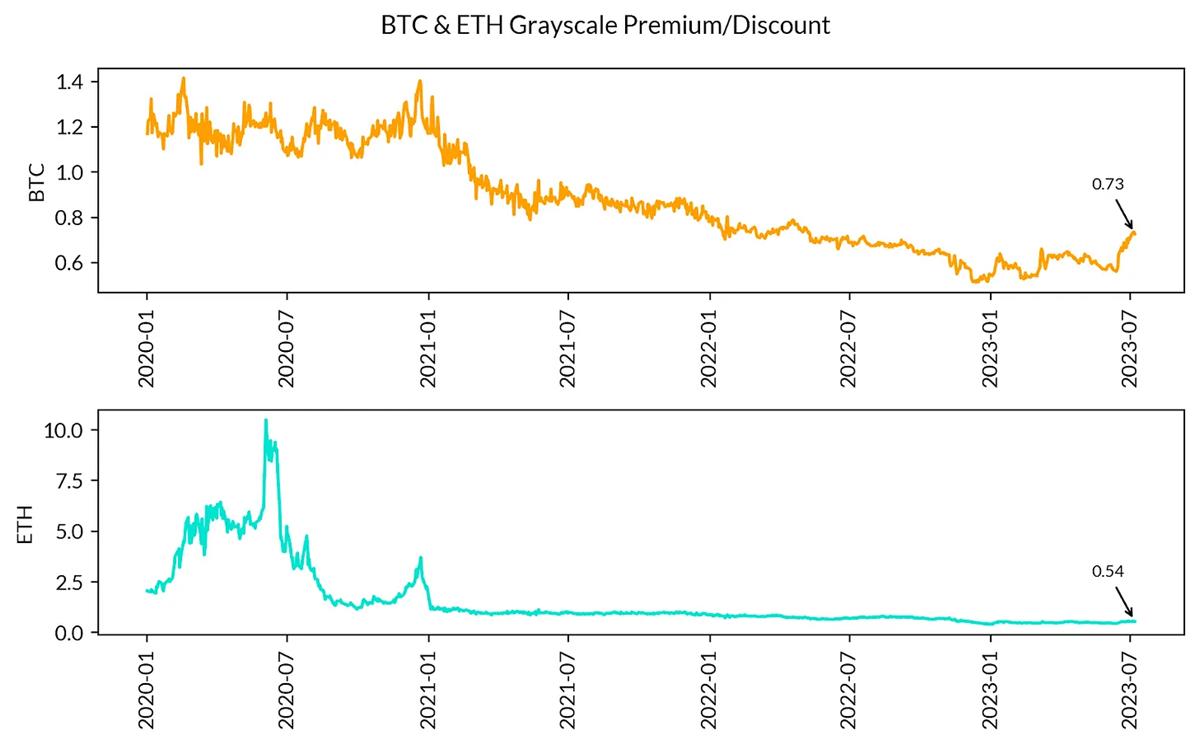
The dynamic value of these trust products is important for two main reasons. First, as an investor, you can purchase shares at the current market price. This means you may gain exposure to Bitcoin at a discount or premium, depending on the market conditions at that time, which can alter your investment risk allocation, especially compared to spot investments without an annual management fee. The second noteworthy reason is that savvy investors can profit from mispriced assets through arbitrage trading strategies. Thus, when GBTC trades at a premium to Bitcoin, risk-free trades can be made by selling or shorting GBTC while simultaneously buying Bitcoin in the spot or futures markets. Investors can profit from the convergence of prices between these two positions, achieving theoretical risk minimization.
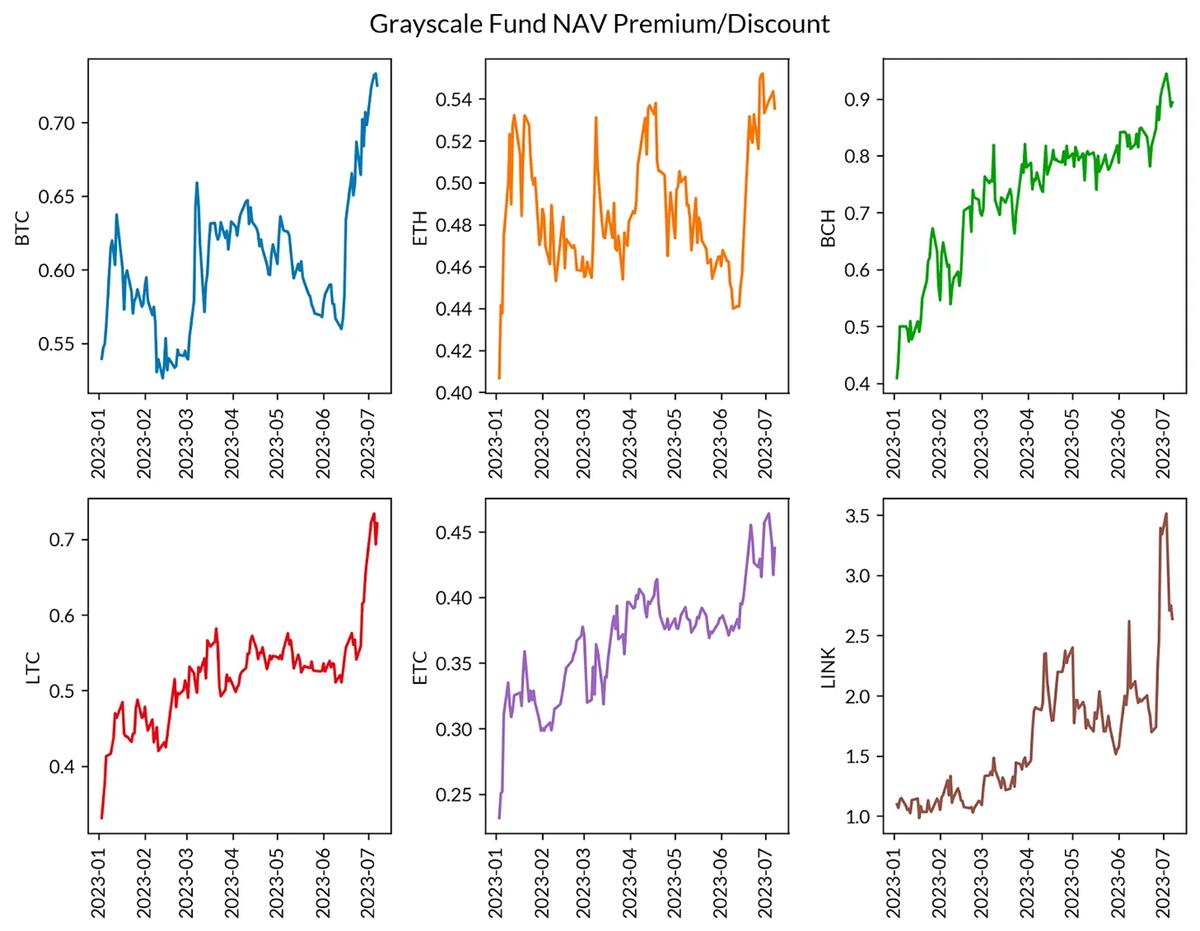
(Shen Chao Note: A summary of the net asset value (NAV) changes in different grayscale digital asset trusts, with the vertical axis representing the premium/discount ratio)
If we take a look at the chart above, we can see that the various trusts established for different assets have developed very differently. While the discount rate for ETH is around 50%, the trends for BTC, BCH, LTC, and ETC are closer to parity, and LINK is actually trading at a premium of 270%. This trend may be due to investors realizing that BlackRock has recently applied to create a spot bitcoin ETF, and if Grayscale also obtains approval to convert these funds into ETFs, the prices will match the parity. Although we might think this sounds somewhat far-fetched (as it means people are paying nearly three times the spot price), this situation is common for investment instruments with particularly poor liquidity, especially when speculative funds dominate. We can see the same behavior from other trusts provided by Grayscale below.
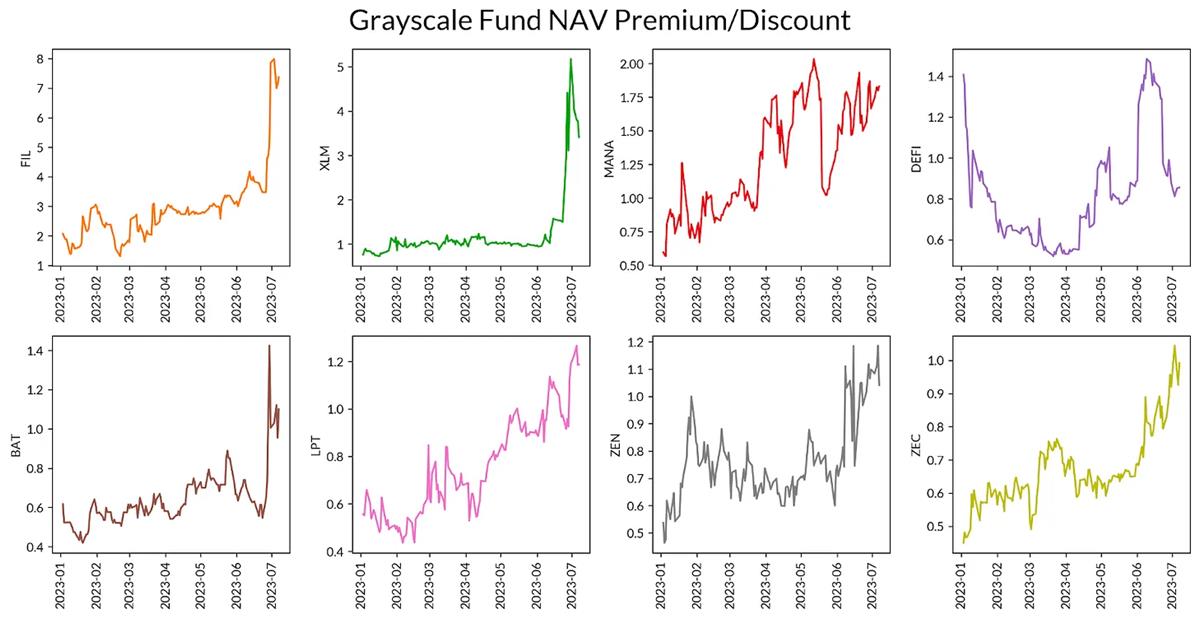
The trading prices of Filecoin (FIL) and Stellar (XLM) are 8 times and 4 times the spot prices, respectively. These significant price discrepancies indicate that these funds have very poor liquidity and limited access channels within the United States, making it easy for arbitrageurs to suppress premiums and profit. However, this also indicates that some people are willing to acquire these assets at a huge premium, which is an interesting observation.
Conclusion
In conclusion, the evolution of the digital asset investment landscape, especially the anticipated launch of spot ETFs, is expected to bring revolutionary changes. Currently, options such as futures and trust investments provided by entities like Grayscale face a series of unique challenges. However, the introduction of spot ETFs may simplify these complexities and provide investors with a more efficient and direct way to access digital assets. As we continue to explore this fascinating field of digital investments, the adaptability and innovation of investors, as well as regulatory progress, will undoubtedly play a crucial role in shaping the future of digital asset investments.


