






Learn about KuCoin's latest IEO project IMVU in one article: Leveraging Metajuice to release the value of the Metaverse


In 2013, JDN Dionisio published a paper titled "3D Virtual Worlds and the Metaverse: Current Status and Future Possibilities", which deeply discussed and summarized several development stages of the virtual world, which can be simply summarized as follows:
The first stage: a virtual world based on computer text
Phase 2: A virtual world with a 2D graphical interface and social elements
Phase 3: A virtual world with User-Created Content, 3D graphics, and open social interaction
Phase 4: A virtual world with a more complete economic system, UGC tools, and higher image quality and fidelity
Phase Five: A Virtual World of Decentralized Governance
Early virtual games have completed the early exploration of the first stage to the fourth stage, such as from Habitat, to Active Worlds, and then to the early virtual world practice of IMVU, Second Life, Roblox, Blue Mars, and Solipsis, which is providing a new foundation for this field. The foundation for future development was established.
From the fourth stage to the fifth stage, the perfect economic system and decentralized governance mentioned in it are providing virtual space
It is endowed with the characteristics of self-sustainment, which also coincides with the idea of the metaverse at this stage.
From our current understanding of the Metaverse, the Metaverse should be more oriented towards Web3. On the one hand, the Metaverse is a perpetually online world, and its establishment requires the support of various distributed resources and technologies (storage, computing power, etc.) wait). On the other hand, in order to be self-sustaining, it should be able to empower users to control identities, enforce property rights, and provide fair incentives. Infrastructure providers get the smallest percentage of value, and the rest of the value is created by creators and accumulated in the hands of creators (users), so as to promote more users to spontaneously participate in ecological construction.
In the real world, the law is the criterion for restricting human behavior and achieving fairness. The establishment of fairness, enforcement, rights confirmation, and governance systems in the metaverse is based on blockchain technology with the characteristics of decentralization and non-tampering. The development and construction of the metaverse should also be bottom-up. Of course, the long-term development of the Metaverse requires large-scale users to participate in co-construction to continuously promote the development and prosperity of the ecology.
In fact, most of the established Web2 virtual world platforms have accumulated a considerable number of users through years of operation, and have the potential to transform into a Metaverse ecosystem, but they do not have the experience and ability to expand to Web3. However, for some emerging ecologies that are positioned in the metaverse and have Web3 ideology, they do not have the ability to capture Web2 users on a large scale, and at the same time, native users in the Web3 field are limited. In this field, there seems to be a big gap between the Web2 world and the Web3 world.
IMVU is an old Web2 virtual world with a history of 19 years. With the help of Metajuice, it is entering the Web3 field more deeply to build a deep metaverse system and unlock the value of the metaverse for users. This is a very worthwhile Example for reference.
first level title
Metajuice Empowers IMVU's Exploration from Web2 to Web3
IMVU, launched by Together Labs (formerly IMVU Inc.), is one of the first batch of Web2 virtual worlds with 3D features. The platform has been on the market as early as 2004 and allows players to customize character appearance and clothing in the form of UGC Players can freely design avatars, chat and make various actions in nightclubs, beaches, gardens, mansions, KTV and other scenes.
IMVU also provides a virtual mall where users can purchase a variety of virtual goods, such as clothing, furniture and decorative items, to personalize their characters and virtual spaces, so that the virtual characters in the game can better convey the player's personal style and more.
IMVU has its own independent set of economic systems. In short, players purchase credits through PayPal or Venmo, etc., and spend in the virtual world. The credits will be converted into the seller's "developer tokens (developer tokens)" and then converted into for real income.
It is worth mentioning that on January 12, 2021, IMVU proactively launched the ERC-20 token $VCOIN based on Ethereum to further promote creators and traders to better extract value from the ecosystem. Tokens are initially sold for $1, or $0.004 per token.Before the launch of the token, the U.S. Securities and Exchange Commission (SEC) issued a "Letter of No Action", which actually granted IMVU permission to provide $VCOIN to users, which is also the earliest cryptocurrency in the Metaverse. compliance attempts.
image description
Source: Metajuice Official Twitter (https://twitter.com/themetajuice)
As a trending early virtual world, IMVU completed four rounds of financing between 2006 and 2009, and last year received a new round of US$35 million from NetEase’s joint investment company StructuredCapital and other investors. financing.
Together Labs also established its subsidiary Metajuice last year. Metajuice is helping IMVU better develop from Web2 to Web3 through technical means, so as to further unlock the potential metaverse value for users. Metajuice, as a Web3 facility under the same system of IMVU, has also attracted widespread attention after it was launched. Currently, Metajuice, which is backed by IMVU, already has more than 1.25 million independent encrypted account addresses.
Metajuice is helping IMVU build an economic system with Web3 characteristics, including governance tokens and NFT, and launching an NFT market in the MVU metaverse. On this basis, through cooperation, Metajuice is promoting more NFT assets with IP attributes to enter IMVU, giving IMVU users the ability to go from UGC (User Generated Content) to UGA (User Generated Assets).
Introduce well-known Web3 IP into IMVU, providing creators with more income opportunities
Previously, Metajuice and the creators of IMVU jointly launched a collection of wearable NFT series, which provided the basis for creators to obtain more income opportunities and directions in advance. Based on the early layout experience, Metajuice is also promoting cooperation including some well-known NFT IPs, such as Mocaverse, to promote their entry into IMVU.
In this way, Metajuice will help more Web3 aborigines enter IMVU to become "residents", promote more creators to use well-known IP such as Mocaverse to generate income, and is expected to explore more diversified Metaverse business scenarios, imagine The space is more abundant.
Metajuice is accelerating the trend of more Web2 and Web3 brands/users entering IMVU to jointly build new scenarios, helping IMVU unlock the potential metaverse value, and kicking off the early prelude to the deep integration of the Web2 and Web3 worlds.
Launch the governance token $VCORE to build a Web3 economy and governance system
Metajuice is also helping IMVU launch the governance token $VCORE to promote IMVU to further build the Web3 economy and governance system, so that the development of the ecology can be self-sustaining and sustainable.
IMVU compliantly launched the Ethereum-based encrypted asset $VCOIN token in 2021. Based on this asset, users can earn and convert it into cash on the platform without any additional membership. All users on IMVU can earn $VCOIN by providing services to other players and extract value based on that asset. On IMVU, users can earn and send $VCOIN based on various digital services such as badge creation, editing, streaming services, or just as a gift. $VCOIN is not bound to a single platform. Although it originated from the IMVU economy, users can also transfer it outside IMVU and convert it into cash, which also established an early foundation for IMVU to build an economic system.
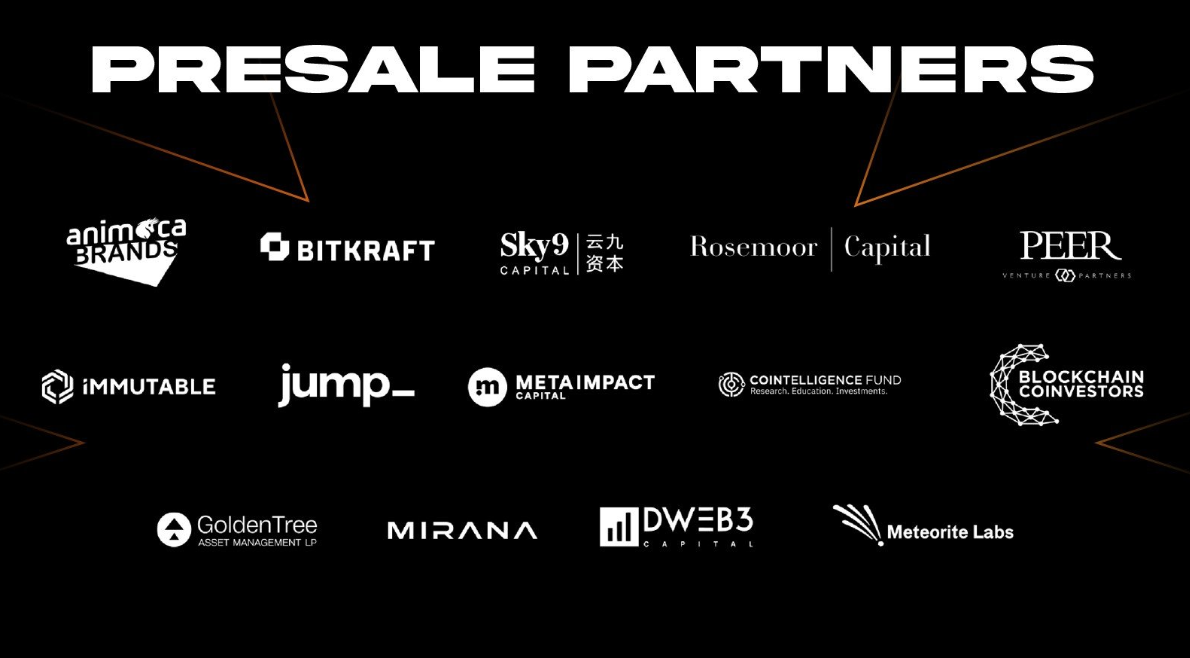
After the establishment of Metajuice, Metajuice recently helped IMVU launch the governance token $VCORE, which aims to promote user participation and contribution through incentives to power the economy of the virtual world. This asset will be able to be used to buy and sell digital items, rewarding the community, and enabling creators to earn income through $VCORE. $VCORE is unlocking digital ownership in the largest Web3 social metaverse, IMVU.
image description
Source: Metajuice Official Twitter (https://twitter.com/themetajuice)
As a governance token, $VCORE is deeply driving the development direction of Metajuice and IMVU in the Web3 world.
Before launching $VCORE, Metajuice also released equity NFT MetaCritters as a commemorative asset for the launch of $VCORE. MetaCritters is more like an NFT pet. This asset is expected to represent users in different Metaverse worlds in the future, and is expected to become a game character among Metajuice partners, and even be able to interact with other PFPs. Early exploration of interoperability between metaverse systems.
first level title
The potential metaverse value of IMVU is being unlocked
In the early stage, IMVU built a virtual world oriented to Web2, and built rich sub-social elements for it, including social, trade, UGC, etc., and built a relatively complete economic system, which made IMVU competitive base surface.
Metajuice introduces NFT elements into IMVU, by helping it build an NFT trading market, introducing a large number of Web3 assets, and empowering more creators to create assets in IMVU, all IMVU creators will be able to create, mint and sell NFT. Metajuice is enabling creators in IMVU to leap from readable and writable to ownable, verifiable and executable property rights.
The introduction of $VCORE is expected to weaken the absolute power of infrastructure providers, and through $VCORE, the execution power and rule-making power will be distributed to IMVU users in the form of DAO. Based on smart contracts and encrypted tokens on the chain, any contributing behavior will be rewarded with $VCORE, and more and more users will spontaneously participate in the contribution of ecological development, unlocking the largest Web3 social Digital Ownership in the Metaverse IMVU.
From the perspective of value distribution trends, the value that IMVU infrastructure providers can obtain is getting smaller, and the rest of the value is also being created by creators and accumulated in the hands of creators (users). Powered by Metajuice, IMVU is moving towards the next stage of "decentralized governance", self-sustaining.
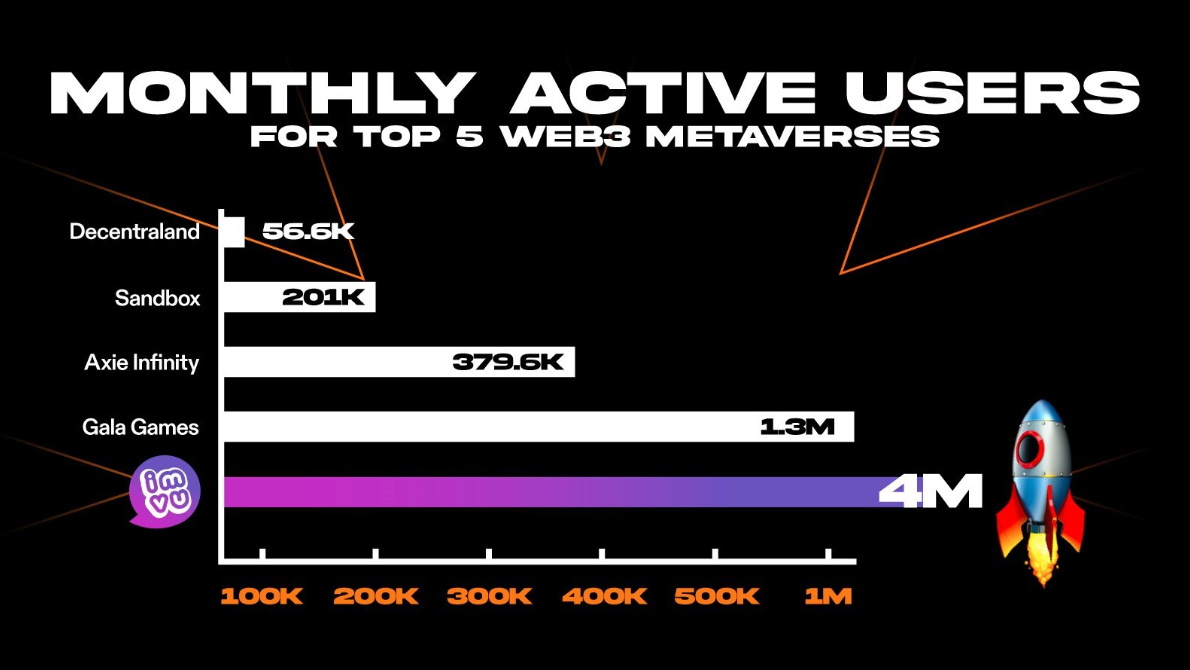
The early metaverse ecology faced the problem of lack of users, and they did not have the ability to capture users. One of the biggest advantages of IMVU is that it is backed by a large number of Web2 user groups, and large-scale user participation in co-construction is expected to continue to promote the development and prosperity of its ecology, so as to achieve a more long-term and sustainable development of the ecology.
On the other hand, with the new upgrade of IMVU ideology, IMVU is also bringing a huge influx of user groups into Web3 and becoming an online container where everyone can create, learn, own and shape the future. Here On the basis, it is expected to explore more application scenarios and business scenarios in its own metaverse ecology, and promote the organic integration of the physical world and the virtual world.
Driven by Metajuice, IMVU is becoming the only Web3 digital platform with a scale of millions of users, and the potential metaverse value of IMVU is also being deeply released.


