






Industry Interpretation: In the face of the serial "strangling" of the SEC, where will the encryption industry go?


first level title
01. Behind the SEC's heavy blow is the pursuit of power
On the evening of June 5, the encryption trading platform Binance Holdings Limited (hereinafter referred to as "Binance") and its CEO Changpeng Zhao (hereinafter referred to as "CZ") were arrested by the US Securities and Exchange Commission (hereinafter referred to as "SEC" or " Commission") to prosecute. This is the second time that Binance and its CEO CZ were prosecuted by the US Commodity Futures Trading Commission (CFTC) for allegedly violating trading and derivatives rules on March 28. This has triggered violent fluctuations in the cryptocurrency market.
On June 6, the US SEC sued the encrypted trading platform Coinbase in New York federal court, claiming that it operates an unregistered trading platform and its pledge service is unregistered.
The U.S. Securities and Exchange Commission (SEC) claims in the lawsuit that Coinbase has been earning billions of dollars in revenue but lacking the disclosures and protections required for registration. Coinbase has been operating since 2019 as an unregistered broker, including recruiting potential investors, handling client funds and assets, and charging transaction-based fees; and as an unregistered trading platform, including offering a marketplace that brings together multiple buyers and sellers crypto assets and match and execute these orders.
In fact, it can be seen from the accusation documents that the SEC has accurately grasped the gray area of "determining certain cryptocurrencies as unregistered securities" this time, and clearly pointed out that more than a dozen tokens are all top-ranked mainstream currencies. . It can be seen that after the FTX incident, the SEC is determined to regulate and conduct research on regulatory fields and policies.
From another perspective, if there is a reasonable regulatory policy, it is certainly a good thing for investor platform users. It regulates the behavior of exchanges, protects the safety of funds, and avoids the impact of thunderstorms like FTX on the financial industry. Then there needs to be the most authoritative and professional regulatory agency, and the SEC wants to play this role and have a greater say in the encryption world.
first level title
02. The dispute between SEC and CEX has a long history
Generally speaking, there are basically two ways for a CEX (cryptocurrency exchange) to have a dispute with the SEC. One good way is to get in trouble for running an illegal stock exchange (i.e. offering unregistered securities).
Back in April, the SEC filed a lawsuit against Bittrex Inc. for allegedly illegally operating a stock exchange; any reasonable reading of the Bittrex case makes it clear that similar cases would also be brought against Coinbase and Binance. In the view of the SEC, as long as it is a cryptocurrency exchange in the United States, it is illegal.
And another bad way is to get in trouble for stealing client funds. Last December, the SEC filed a lawsuit against a major cryptocurrency exchange, FTX Trading Ltd. This was the SEC’s allegation against FTX, as at the time FTX allegedly stole all of its customers’ funds. When exchanges steal funds, the SEC focuses on that; when not all funds are stolen, the SEC focuses on illegal stock exchanges.
So here comes the question: Is the SEC suing Coinbase and Binance because they are crypto exchanges, or because they are bad crypto exchanges? And, is the allegation here "you allow people to trade cryptocurrencies, which we consider illegal" or "you entice people to trade cryptocurrencies and steal their principal"?
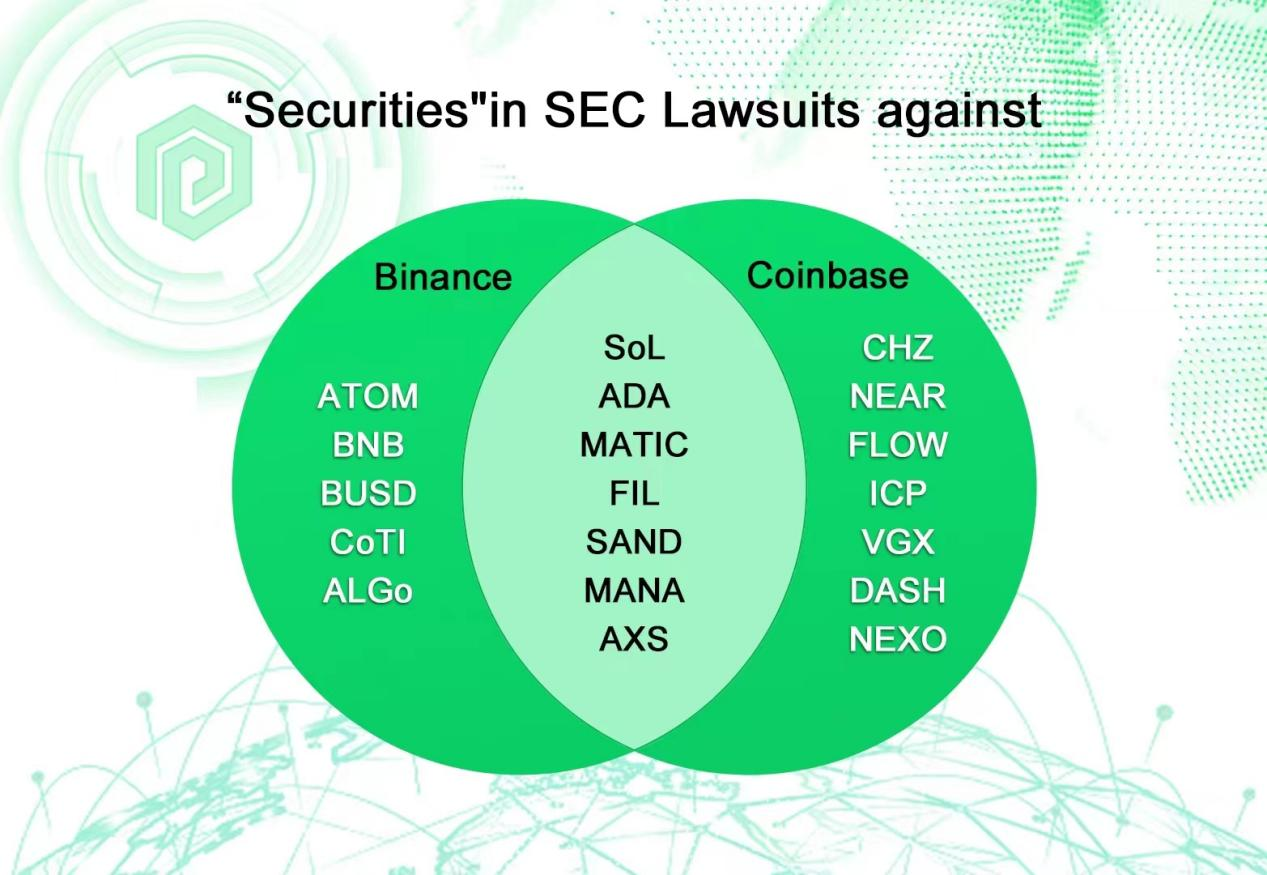
In addition, the SEC has clearly stated its point of view in the lawsuit: most Crypto Tokens—not all, except BTC, but most of them—are securities under U.S. law. Coinbase's view, of course, is that many of these tokens are not securities. In this question, the crux of the matter lies in some of the popular Crypto Tokens listed - the SEC cited a series of Tokens, including Solana's SOL, Cardano's ADA, Polygon's MATIC, Filecoin's FIL, Decentraland's MANA, Algorand's ALGO, Axie Infinity's AXS and Voyager Digital's VGX - Are They Securities?
Despite the regulatory FUD, Robinhood immediately stated that it would delist tokens defined as securities within a week. And Binance.US, which is facing an additional SEC asset freeze application, even delisted hundreds of Token trading pairs in one night. But in fact, it is difficult for the two lawsuits themselves to achieve any substantial results in the short term. This point, I believe the SEC itself is very clear, after all, even the Ripple case has been dragged on for several years, not to mention that this time it is the boss and the second in the industry.
In a hearing last week, Rostin Behnam, chairman of the Commodity Futures Trading Commission (CFTC), had said, “The SEC should have authority over assets that are classified as securities. But the fact that the largest coin, Bitcoin, is a commodity, is that.” Determined by US courts. And under US law, it is unregulated... and given that few crypto commodity assets listed on most trading platforms today are officially classified as commodities, there is an urgent need to give regulators Additional powers in the field of commodities."
It is worth noting that in this speech, Behnam did not use the term "Digital Asset" (Digital Asset), but "Digital Commodity Asset" (Digital Commodity Asset). Behnam acknowledged that the SEC has regulatory authority over all assets classified as securities, but he did not admit that digital currencies should be classified as securities. In his speech, Behnam also repeatedly hinted that only by letting the CFTC regulate cryptocurrencies in a commodity way can the current regulatory vacuum in the industry be resolved.
So whether the encrypted tokens listed by Binance and Coinbase are securities. If they are identified as securities, chances are that Coinbase and Binance (and Bittrex and every other exchange) are running illegal stock exchanges; if they are not securities, then all is well.
first level title
03. The standard of supervision is reasonable
Due to the sudden regulatory accusations from the SEC, and the accusations that Binance and Coinbase are important platforms in the currency circle, the shadow of FTX last year made investors extremely sensitive to risks.
According to statistics, on June 6th and 7th, the DEX transaction volume on the chain increased slightly. This is because investors stopped mining and pledged to avoid risks after the market turmoil, and kept a temporary wait-and-see state.
Many foreign media and big Vs in the industry have come out to support Binance Coinbase, expressing their trust and confidence in them. Many people were dissatisfied due to the noise in the market and the shock of currency prices.
The Blockworks direct column criticized SEC Chairman Gary Gensler, believing that he undermined the interests of the country and the people, and instead adopted radical policies to stifle innovation by exposing his inability to regulate cryptocurrencies. The big V media believe that digital assets are an inevitable trend. If the SEC adopts such a supervision method of "I suspect you are involved, I will accuse you first, but I have not disclosed direct evidence", it will simply drive the Web3 revolution out of the United States.
Coincidentally, on June 13, Senator Warren Davidson of the Ohio State House of Representatives posted on social media that he would legislate to remove SEC Chairman Gary Gensle. Warren tweeted: "US Capital Markets must be protected from the SEC Chairman's influence. That's why a single piece of legislation is being introduced to address the ongoing abuse of power and ensure the market's best interests are protected for years to come. Now is the time for real reform and the firing of SEC Chairman Gary Gensler."
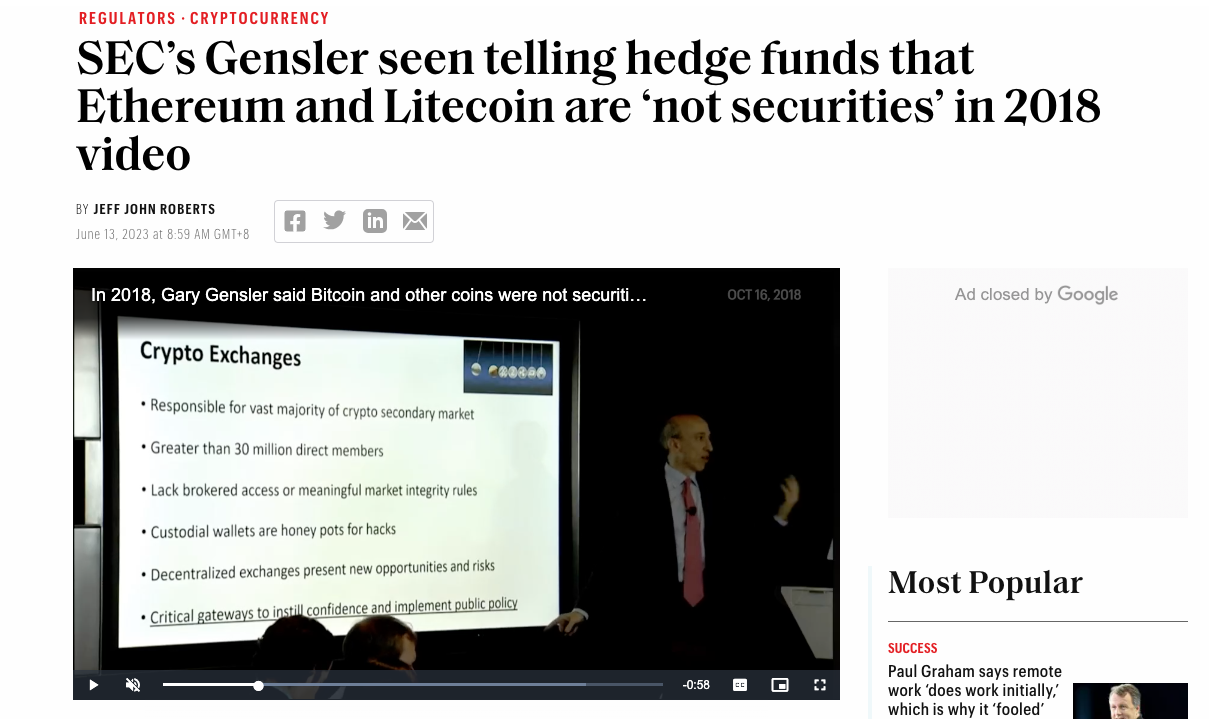
Today, the flames of war between the SEC and CEX have spread to the entire encryption industry, and some people even revealed that Gary Gensler once had a completely different view on cryptocurrencies. On June 13, according to "Fortune" magazine, Gary Gensler, chairman of the US Securities and Exchange Commission (SEC), said in 2018 when he attended an institutional investor event with the theme of cryptocurrency organized by Bloomberg and Fidelity, "Bitcoin (BTC ), Ethereum (ETH), Litecoin (LTC), Bitcoin Cash (BCH) are not securities.”
Although many people in the industry strongly oppose the SEC's "brutal" interference in the encryption industry, some market analysts say that this meaningful action by the SEC marks the beginning of the US's shift to a regulated cryptocurrency market infrastructure, which will help the industry to move towards a regulated cryptocurrency market infrastructure. before development.
Here, the author is not opposed to supervision, but I also hope that the SEC's supervision can be just right, rather than killing them all at once. After all, in the encryption world, there are still many high-quality projects writing their encryption stories, such as zkSync, Arbitrum, PlugChain, Optimism and other extremely emerging public chains, aren’t they just bit by bit for the “encryption world” Infrastructure" adding bricks and tiles?
Conclusion: Generally speaking, the SEC’s supervision is a good thing for the encryption industry. It prevents Binance from becoming the next FTX. The volume is too large. If the supervision cannot keep up, it will indeed cause unimaginable consequences. This should also be behind the logic of US supervision considerations. Obviously, supervision cannot kill Binance, and only Binance itself can kill Binance. As long as Binance has FTX-like behavior, relevant news will definitely be dug up.
On the contrary, as Nietzsche once said: "What does not kill me will make me stronger." For Binance, it may not be a test and an opportunity!


