Binance Research: Bitcoin ushers in a 'new era'


Original title: "A New Era for BTC"
Original source: Mac Naggar, Binance Research
key points
key points
Bitcoin has retained its dominance of the cryptocurrency market capitalization leaderboard despite smart contract Layer‑1 continual headlines.
Nonetheless, Bitcoin's sustainability is worth discussing. How will falling block rewards (halved every four years) and relatively low transaction fees affect Bitcoin's security model? While Bitcoin has maintained its lead, will this continue in the future without a Bitcoin-native smart contract market?
Ordinal numbers and inscriptions that appear in early 2023 may hold some answers. With this latest innovation, we have not only witnessed the birth of "Bitcoin NFTs", but also the resurgence of excitement and interest in the entire Bitcoin ecosystem.
Inscription has had a significant impact on Bitcoin’s on-chain metrics, with transaction fees trending upwards. Perhaps most importantly, the pace of innovation is picking up, with developers releasing updates left, right, and center.
As Bitcoin activity increases and a plethora of new use cases emerges, scalability issues naturally follow. How will Bitcoin handle increased traffic? Enter Bitcoin Layer 2.
While the Lightning Network continues to grow and focus on its payments use case, Stacks and Rootstock provide Bitcoin developers with an access layer to execute general-purpose smart contracts. Rootstock boasts EVM compatibility, and Stacks’ upcoming sBTC solution may finally provide a high trust-minimized way to move BTC from layer 1 to layer 2. Rollkit's take on sovereign bitcoin aggregation is also interesting and deserves careful attention.
introduce
introduce
While smart contract platforms like Ethereum, BNB Chain, and Solana continue to grab the headlines, a quick glance at the cryptocurrency market capitalization (“market cap”) makes one thing clear:
Bitcoin still dominates.
While Bitcoin's dominance is trending down from 60‑70% in 2020 and 2021, the cryptocurrency pioneer still holds the majority of the market. Considering the relative lack of smart contract functionality on the Bitcoin Layer 1 (“L1”) blockchain, this demonstrates the belief that Bitcoin HODL holders hold on to the asset. It will also indicate
Given the relative lack of DeFi, NFT, and infrastructure markets on the web, Bitcoin is more likely to be used for its original purpose as a form of hard money than for non-monetary use cases.
While we have seen a certain level of innovation, Lightning Network and Stacks being notable examples, nothing comes close to the level of the mentioned smart contract giants. While this may be by design, and due to the slow and cautious nature of the Bitcoin network (ultimately a major selling point), it's still worth noting. This is especially worrisome due to ongoing questions about Bitcoin’s security model.
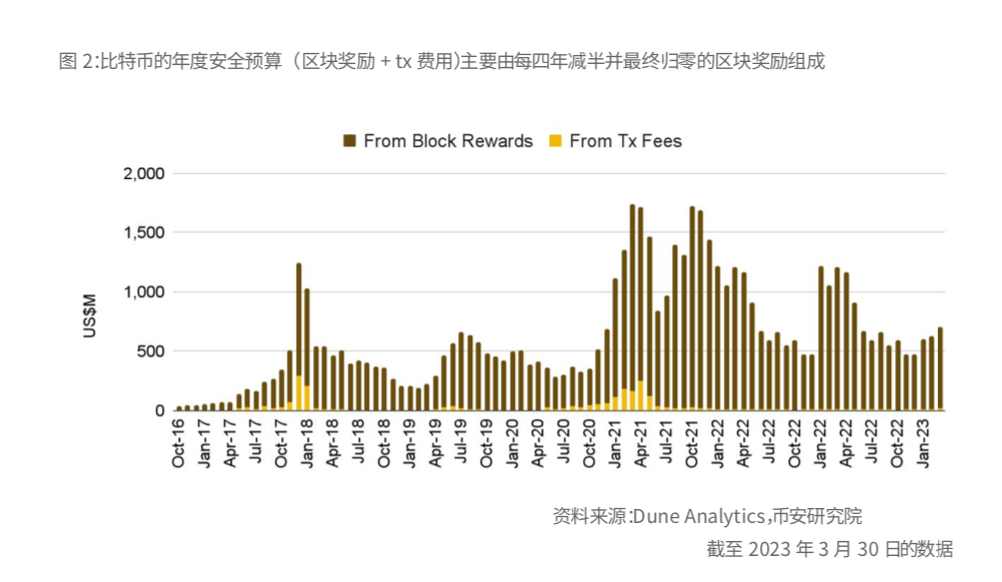
Bitcoin attracts miners through two economic incentives: coinbase rewards and transaction (“tx”) fees. Coinbase rewards, sometimes called block rewards,cut in halfAbout every four years, it will eventually decrease to zero. So, in the end, Bitcoin's transaction fees will be the only compensation to miners, the security budget of the L1 blockchain. Given Bitcoin's limited use cases, primarily for asset transfers, these fees represent a very small percentage of miner revenue and are of concern in the long run.
Things change all the time. In January of this year, the Ordinals protocol went live. Ordinals can record arbitrary data (images, videos, text, etc.) on the Bitcoin blockchain, creating digital artifacts or effectively creating NFTs. The total number of inscriptions is now over 600 K and growing rapidly. With this change, excitement around Bitcoin is running high again, with increased focus on projects built around the network and the addition of major players like Yuga Labs and Magic Eden. Not only has Bitcoin been affected through its mempool, transaction fees, and block size, there has also been a cultural shift in the way people view Bitcoin. Existing projects are gaining traction, while new builders are flooding the ecosystem. There seems to be a sudden organic demand for Bitcoin block space.
first level title
What happened to Bitcoin?
secondary title
On-chain indicators
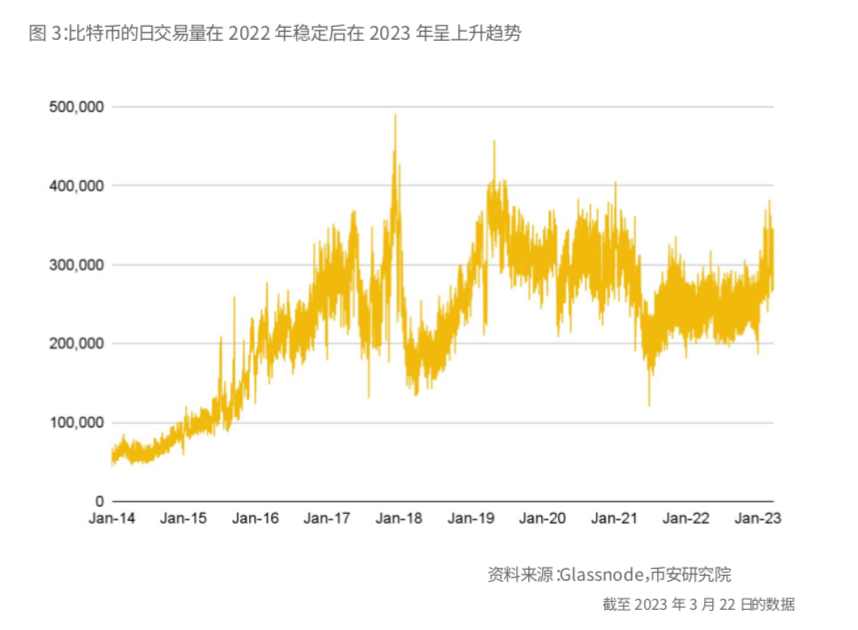
First, let's take a closer look at Bitcoin's daily transaction data. After easing off from the highs of the 2021 bull market (more than 300,000 trading days), trading activity remained around 250,000 per day for most of 2022. This trend was recently broken, and by 2023, daily transaction volumes are finally starting to rise. Daily transaction volume is now back above 300K at least in part due to the increased activity brought to the blockchain by ordinals and inscriptions (explored more in the ordinals, inscriptions and NFT section on Bitcoin)
How about daily active addresses? Similar to Bitcoin's daily transaction data, Bitcoin's daily active addresses have fallen sharply from their 2021 highs, peaking at around 1.2M. After the roughly 900,000 mark in 2022, Bitcoin's daily active addresses have increased slightly this year and are currently around 1 million per day.
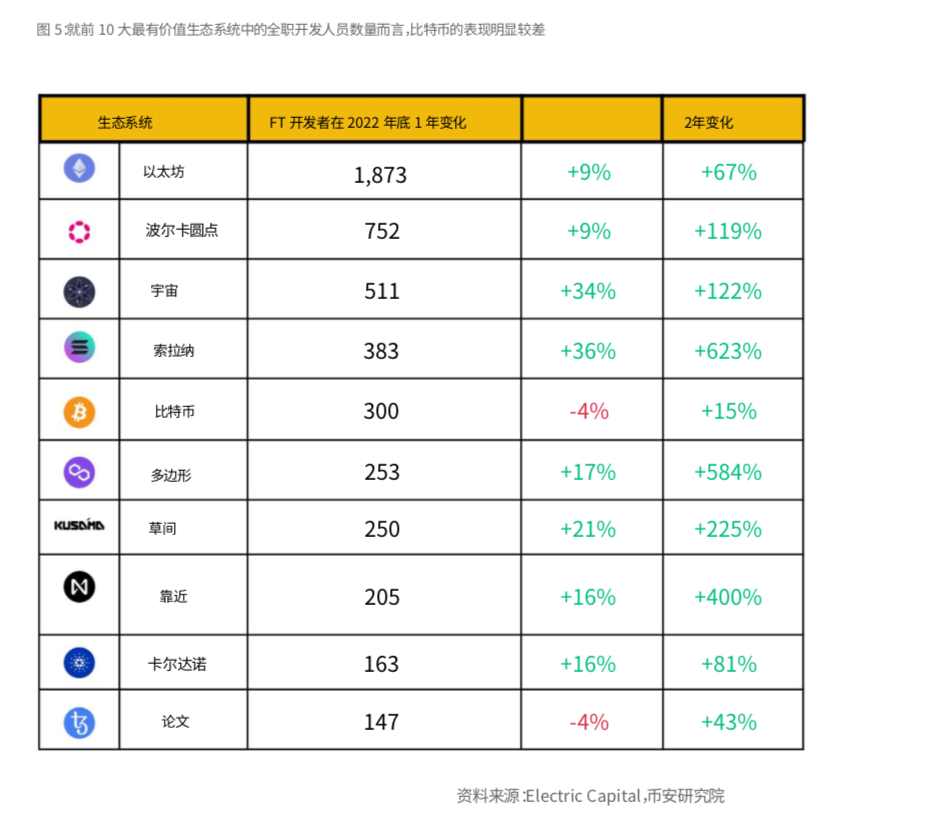
Another metric we can look at and seek to assess is development activity within the Bitcoin ecosystem. If we look at the full-time developer ("development") data for the top ecosystems, Bitcoin's recent history looks relatively benign. Among the top 10 most valuable ecosystems, Bitcoin ranks low in the number of full-time developers.
Between 2021 and 2022, the number of full-time Bitcoin developers will drop by 4%. This ties in with Tezos being the worst performer, with an average of +17% for the group.
Between 2020 and 2022, the number of full-time Bitcoin developers will increase by 15%. This is the lowest of the group, while the group average is +252%.
What does it mean?
What the first two charts show us is that Bitcoin maintains steady network activity in 2022. While steady network activity in a generally challenging year is commendable, it is worth noting that Bitcoin’s daily transactions have not shown significant strength, similar to the levels observed in 2017. Daily addresses show stronger consistent growth. Bitcoin has been very weak in terms of development activity, which is perhaps not surprising given the seeming lack of opportunity in the ecosystem.
One thing we should be keenly aware of, however, is that since January 2023, both daily transaction volume and daily active addresses have increased. While not reflected in the year-end developer data for 2022 in Figure 5, we are seeing renewed interest in developing on Bitcoin. A
first level title
mining
We assume you know the basics of mining, but if not, here is a quick overview.
Bitcoin mining has had quite an eventful year. Throughout 2022, miners have to deal with various triple whammy. Rising energy prices (affecting day-to-day operations of mining equipment), rising interest rates (increasing debt payments/making it more expensive to borrow to survive) and falling bitcoin prices (meaning less profit for miners to produce) have caused the bitcoin mining sector to struggle . While many miners went bankrupt, some were bought at low prices while others barely survived.
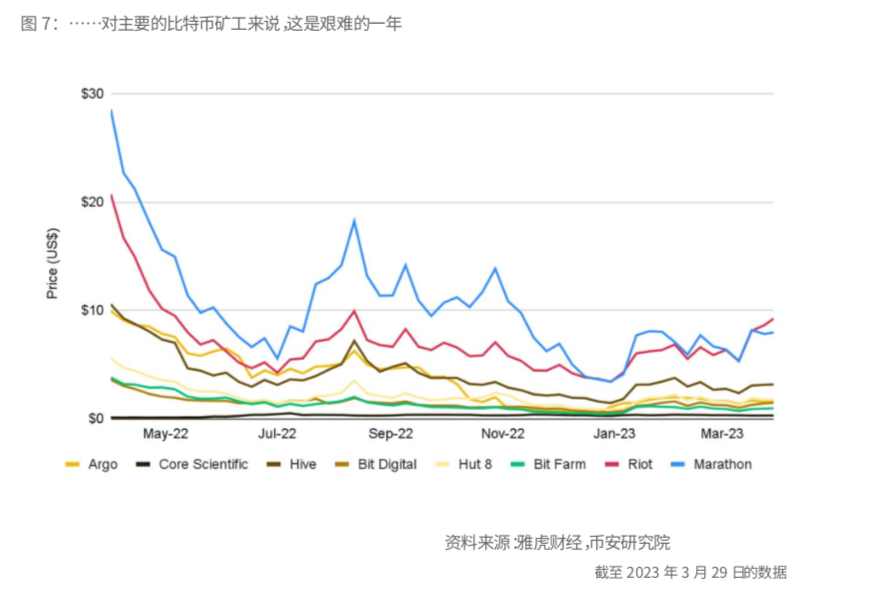
While traditionally, most miners sell some of their mined bitcoin to pay fees, many of them HODL in order to benefit from rising prices in the long run. Due to the difficult situation last year, many miners were forced to sell most of their Bitcoin inventory, further increasing the selling pressure, and it also meant that miners had to sell at extremely low prices.
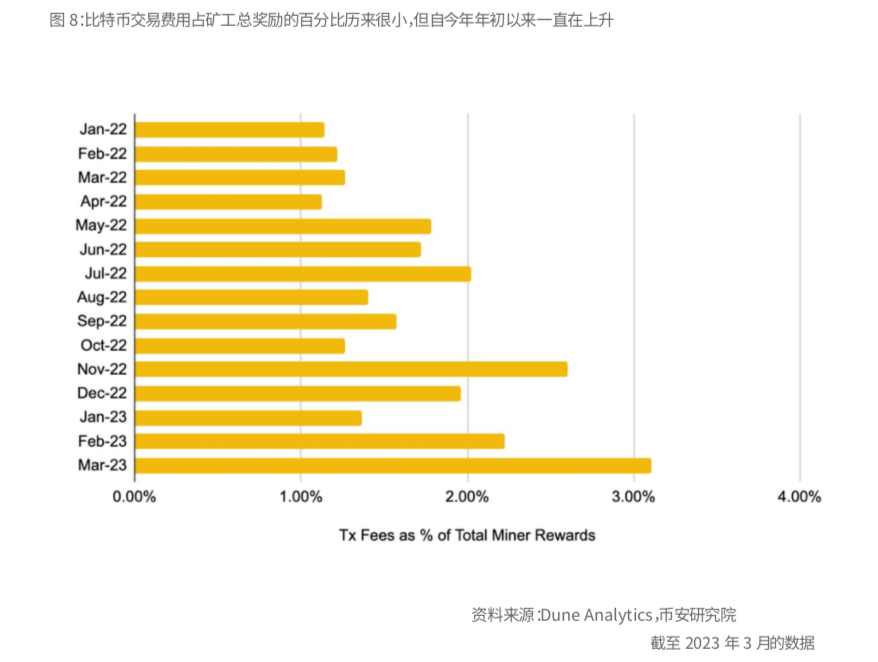
Still, the situation improves in 2023. While energy prices haven't really slowed down, bitcoin prices have been rising, boosting returns for miners who are still operating. Furthermore, as stated in the introduction, a central problem with Bitcoin's security budget is that the chain generates limited transaction fees. This means miners are almost entirely dependent on block rewards. In fact, as we see below, transaction fees have averaged only 1‑2% of total miner rewards over the last year. Note, however, that things have changed since the beginning of the year. Transaction fees are now trending towards 2 ‑ 3% of total rewards, and Hashrate Index data even shows some days when fees exceed 5%. While not a major move, it's definitely a change in the right direction. The extent to which this movement is due to ordinals and inscriptions is a matter of debate, although on-chain metrics suggest they are at least partially behind growth.
Recent Technology Upgrades
secondary title
Segregated Witness
SegWit is the Bitcoin of 2017soft forkupgrade. SegWit divides the transaction structure of Bitcoin into two parts: transaction data and Witness data. it also
secondary title
taproot
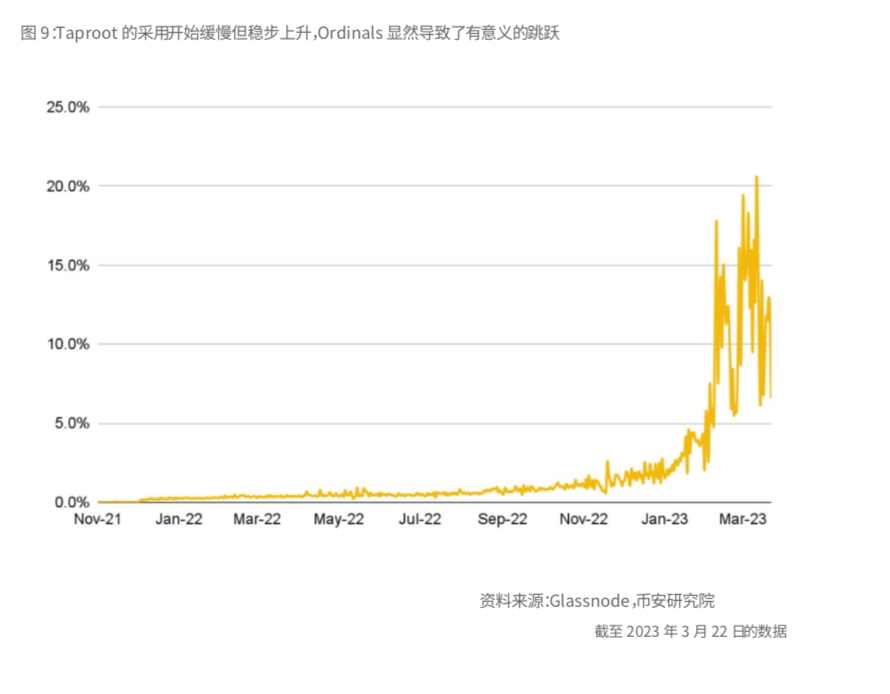
Taproot is an upgrade to Bitcoin in 2021 and a soft fork. Taproot consists of three distinct Bitcoin Improvement Proposals (“BIPs”); BIP 340, BIP 341, and BIP 342, which bring more privacy, scalability, and composability to the blockchain. The two main effects of Taproot are to allow advanced scripting in the Witness section of a block, and to remove the data limit between the two sections of a block, allowing up to 4 MB of data in the Witness section.
secondary title
short history lesson
It might be surprising to learn, but NFTs on Bitcoin actually predate NFTs on Ethereum (and, arguably, predate the invention of Ethereum itself!). The 2012 open-source project Colored Coins( 1 ) differentiated regular bitcoins from "colored" bitcoins. In hindsight, the project was clearly ahead of its time, and Lost , was the first of its kind and introduced a method that caught the attention of the relatively small crypto community in 2012-2014.
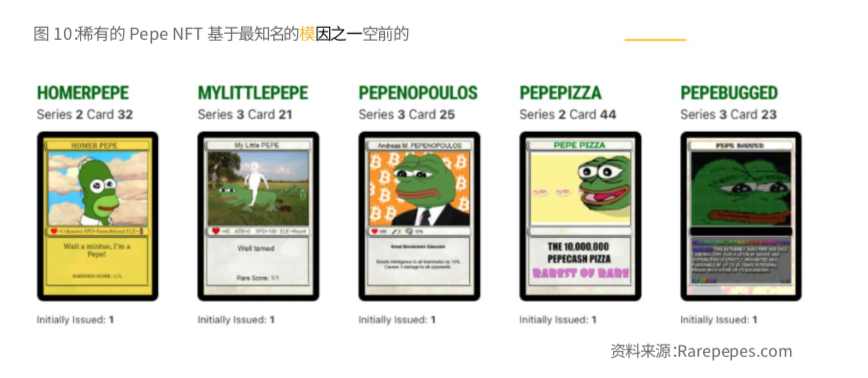
The next notable project worth mentioning is Counterparty. Founded in 2014, Counterparty is built on top of Bitcoin (somewhat similar to L2 solutions), allowing users to issue and trade Tokenized digital assets. Counterparty was responsible for launching a decentralized exchange (“DEX”) long before current market leaders like Uniswap and Curve, and the now famous Rare Pepe series. Released on Counterparty in 2016, Rare Pepes is probably the most famous Bitcoin NFT of all time.
Counterparty and Rare Pepes have certainly accelerated efforts to build infrastructure around NFTs, including wallets and marketplaces, and have played an important early role in the nascent NFT space.
After Counterparty and Rare Pepes NFT (and some other smaller series), the still very young NFT market moved to Ethereum. In 2017, we saw the birth of Cryptopunks, and later in the year we saw the introduction of Crypto Kitties by Dapper Labs.
Still, the real boom in NFTs began in late 2020 and early 2021, with the $69 million Beeple NFT sale in March 2021
(2) is a big plus. The next big move for Bitcoin NFTs will come in December 2022, when the first serial number inscription is minted.
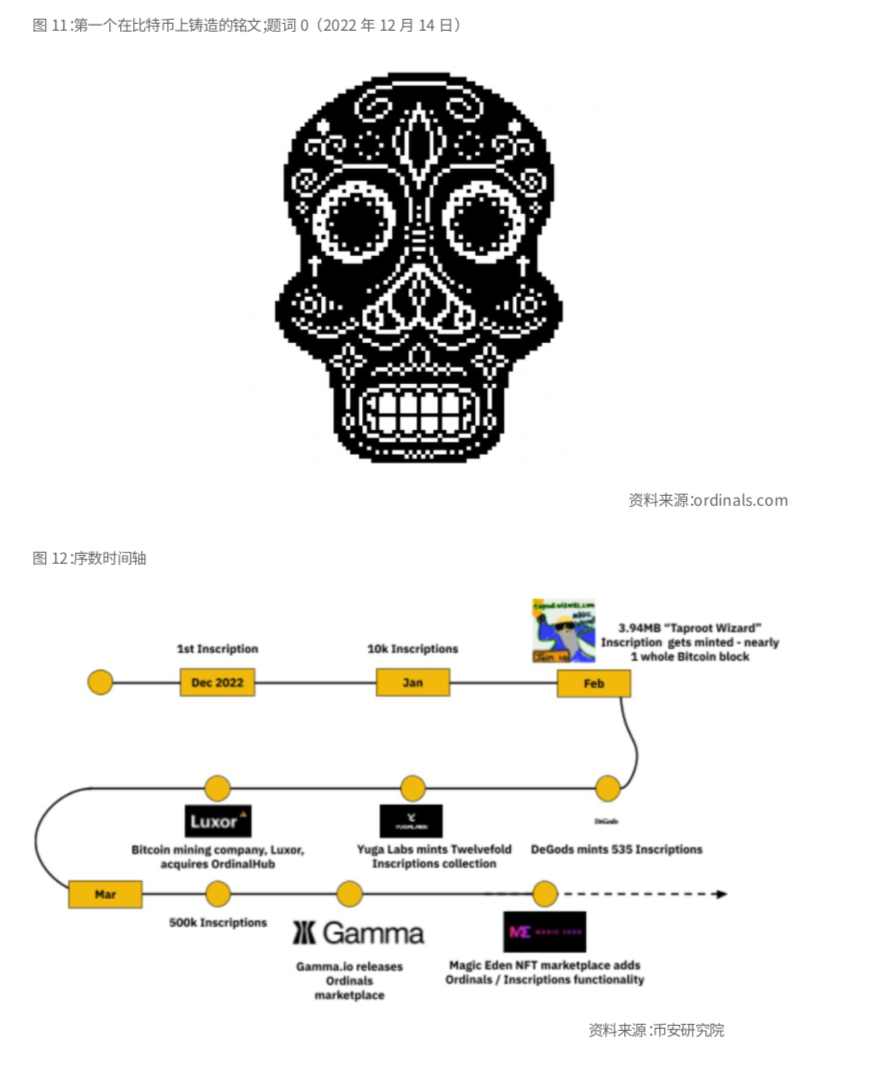
How do serial numbers and inscriptions work?
ORD, which is open-source software that can run on top of any bitcoin full node, can track individual Satoshis according to what founder Casey Rodarmor calls "the theory of ordinal numbers." Satoshis ("sats") are the smallest unit of the Bitcoin network, 1 bitcoin = 100,000,000 sats. Ordinal number theory assigns a unique identifier to every person on Bitcoin. Furthermore, these individual sats can be "inscribed" with arbitrary content, such as text, images, videos, to create "inscriptions", i.e. Bitcoin-native digital artifacts (3) can also be referred to as NFTs.
"Personal sats can be 'inscribed' with arbitrary content, such as text, images, videos, to create an 'inscription', a Bitcoin-native digital artefact, or NFT as it can be called. "
Earlier we talked about Bitcoin's recent technical upgrades: SegWit and Taproot.
secondary title
How does Inscription compare to the NFTs we're used to?
Fully wound up:Inscriptions are stored directly on the Bitcoin L1 chain. A common criticism of the most popular group of NFTs (i.e. ERC‑721 NFTs), many of which have their metadata stored on platforms like IPFS, Arweave, or sometimes fully centralized Web2 servers. These solutions may not be completely reliable and depend on external factors to survive. Inscriptions, on the other hand, will exist as long as Bitcoin exists. This adds a layer of durability; a quality that is very attractive to many types of collectors.
Immutable:Inscriptions are always guaranteed to be completely immutable due to being stored directly on-chain. While many current NFTs are immutable, many of them can also be modified or deleted by the contract owner. This is not possible with inscriptions and adds to their permanence.
Sort by:Given that inscriptions are inscribed on individuals using ordinal number theory, this means that each inscription is technically ordered. There is the 500th inscription and the 9999th and so on. This is a unique feature of most current types of NFTs and adds different levels of value; another feature that may be very attractive to collectors, such as those collecting inscriptions below 100k or the first post-block halving An inscription etc.
Scarcity/Size Limits:first level title
How Are Bitcoin Metrics Affected?
secondary title
Average block size:
Inscriptions and serial numbers ignited a demand for Bitcoin block space like never before. This is illustrated very clearly by the sharp rise in average block size in early February 2023 (from 1.2 MB in January to over 2 MB now).
Inscriptions and ordinal numbers ignite unprecedented demand for Bitcoin block space
Bitcoin mempool growth:If we look at Bitcoinmemory pool data, we can see a similar pattern. Remember that the mempool is essentially a waiting room for unconfirmed transactions to be put into a block.
secondary title
Impact on Bitcoin transaction fees:
As mentioned earlier in the mining section, Bitcoin's relatively low transaction fees have been and remain a long-term problem, as block rewards drop roughly every four years, every halving.
Serial numbers and inscriptions have a positive impact on Bitcoin transaction fees. As you can see below, Ordinal fees have been increasing steadily over the past few months, and increased by an average of about 10% over non-Ordinal transaction fees during the month of March.
In fact, the cumulative fees paid to mint Ordinals Inscriptions currently exceeds 150 BTC( 4 ). Assuming Ordinals continue to gain adoption, this could create a sustainable demand for Bitcoin block space and ensure that Bitcoin miners rely less on pure block rewards (given this additional revenue stream).
Significant spike in Bitcoin full node runners:As mentioned in How Ordinals and Inscriptions Work, the ORD software needs to enable tracking of individual sats in order to view the Bitcoin chain from an ordinal theory perspective. This means that while solutions like the Ordinals marketplace have emerged for casual users, for users to have full control over the entire Ordinal process and "mint" inscriptions, they must run a full Bitcoin node (not a lightweight node) . This factor (among others) caused a surge in the number of accessible Bitcoin nodes. The more active Bitcoin nodes, the more decentralized the Bitcoin network becomes. So while this may just be a one-off uptick, the upward momentum is certainly encouraging and positive for the Bitcoin network as a whole.
The pace of innovation within the Bitcoin ecosystem has accelerated Since the launch of Ordinals,The pace of innovation and improvement in Bitcoin infrastructure dApps is remarkable. like Hiro and
Xverse(5) quickly added Ordinals support and released products such as Ordinals Explorer mainly serving Stacks-based projects), Gamma recently released their(6). Bitcoin NFT Marketplace (formerly Ordinals marketplace(7). In addition to Besides incumbents like Magic Eden, they also followed up their Bitcoin NFT market the day after Gamma.
first level title
Arguments in the Bitcoin community
The emergence of Ordinals has sparked a debate within the Bitcoin community.
One camp argues that ordinal numbers should not exist on the Bitcoin blockchain; more specifically, they believe that Bitcoin's true purpose is to serve as hard money, not fiat money, and to facilitate trustless peer-to-peer payments. In the eyes of these Bitcoin enthusiasts, any departure from the currency/payment role would detract from Satoshi's original vision for the network. They argue that data-intensive sequential transactions will only congest the Bitcoin network, drive up fees, and ultimately hinder peer-to-peer transactions. Pundits in this camp point to the fact that Ordinal transactions are taking up a lot of block space, and the recent increase in transaction fees is evidence in support of their argument.
Transaction fees on the Bitcoin L1 network did increase, which we highlighted earlier. Specifically, the average Bitcoin fee per transaction increased by about 112% between January 30 and March 28 (8). However, this is not the problem we think. Conversely, as discussed, Bitcoin has long had issues with low transaction fees, and as block rewards continue to decline, what does this mean for Bitcoin's security budget. With transaction fees increasing miner revenue by increasing block rewards, we finally have a miner revenue stream that is not dependent on rewards, but rather organic use of the blockchain. Regarding the criticism that increasing fees would discourage those who need to conduct peer-to-peer transactions, the response is simple; they should not be using the Bitcoin L1 chain to send payments they should be using the Lightning Network (see the Lightning Network section for more info). As you can see below, Lightning Network fees have continued to drop over the past few months. Given that this is the fast and secure solution chosen by Bitcoin.
Peer-to-peer payments, cheaper fees are encouraging and show that higher transaction fees on Bitcoin L1 do not necessarily translate (at least not proportionally) to higher Lightning Network fees.
The opposing camp of the Bitcoin supremacist crowd also believes that in order to achieve mass adoption and continued innovation, new use cases for the Bitcoin network should be embraced. Proponents point to other major blockchains, such as Ethereum and BNB Chain, and the various businesses and use cases built on top of these networks. Why can't Bitcoin do the same in its unique way? They point to the increased usage of the network since Ordinals emerged, and the fact that developers have been releasing updates constantly, while also welcoming new entrants from other parts of the cryptocurrency such as Yuga Labs and Magic Eden.
Furthermore, discriminating against specific use cases of the network would be contrary to the neutrality of Bitcoin. It should be recognized that in any truly decentralized network such as Bitcoin, there will inevitably be arguments; decentralization makes the voices in the network louder, while creating an environment that is more prone to disagreement.
Over time, the Bitcoin network has remained secure through many different debates, such as the SegWit debate. Bitcoin only emerges when the debate intensifies, usually because of a change in the network that violates the core values or assets of a certain group of users
first level title
Bitcoin Layer 2
Bitcoin's proven security and network effects have attracted many developers, who see Bitcoin as a key blockchain base layer. These developers are building many different Layer 2 (“L2”) projects on top of the Bitcoin base layer.
Currently, the TVL of the Bitcoin L2 project is a fraction of Bitcoin's $500 B+ USD market cap. The most notable top four L2s in Bitcoin contain only about $352.65 million in TVL, or about .06% L2 market dominance. This seems to indicate that Bitcoin L2 is still in its infancy. This becomes even more apparent when comparing Bitcoin L2 market dominance to that of other chains. Binance Research's full-year 2022 report finds that on Ethereum, scaling-specific L2 alone has market dominance + 10%.
The relatively little value locked on L2 also suggests that use cases outside of peer-to-peer transactions have yet to find a product-market fit for Bitcoin. Since the Bitcoin base layer does not have a Turing-complete, expressive smart contract engine, such asEVMOn Ethereum, L2 is required to add this programmability to Bitcoin.
If users actively demanded to participate in Bitcoin's use case, rather than simpler peer-to-peer transactions, they would use Bitcoin's L2 and add value to it, but this has not yet been proven to be the case.
However, things have been developing behind the scenes. Lightning has been growing steadily, while Stacks has been working on major upgrades to help grow the Bitcoin smart contract market. Rootstock is also being upgraded all the time, and the addition of the sovereign rollup builder Rollkit is a great new feature.
secondary title
lightning network
Along the spectrum of the blockchain trilemma, Bitcoin's implementation optimizes decentralization and security over scalability. As a result, Bitcoin typically has slower throughput and higher transaction fees compared to other L1 networks like Ethereum or the BNB chain. To maintain dominance in the increasingly competitive L1 space and fulfill Satoshi Nakamoto's ambition of creating a practical payment system, Bitcoin needed to find a way to improve scalability.
The Lightning Network (9) was proposed by Joseph Poon and Tadge Dryja in 2016 to directly address Bitcoin's scalability problem. The Lightning Network consists of "payment channels," which are really just smart contracts with multi-signatures facilitating transactions between two users. By using payment channels, users can conduct off-chain transactions away from the Bitcoin blockchain. This means high throughput and low fees because users don't have to compete for block space or wait for L1 consensus to transact.
Ultimately, once Lightning users decide they want to go through a payment channel, they can choose to close the channel. Aggregated transactions summarizing off-chain activity are then settled on-chain to the Bitcoin network. In this way, the Lightning Network inherits the security of Bitcoin while allowing amortized transaction fees and unconstrained transaction throughput.
Due to its unique design, the Lightning Network has the theoretical capacity to facilitate over 40 million transactions per second. This is greater capacity compared to other blockchains or even traditional payment rails.
Additionally, the Lightning Network makes transaction fees negligible.
Lightning nodes are incentivized to route payment channel transactions by paying two types of fees: base fees and rates. At the time of writing, the median base fee for transactions via payment channels is just $0.000000572. The fee rate for sending a given amount of BTC over a payment channel is also negligible, with a median of $0.000000005735/Satoshi. As Figure 21 shows, both fees continue to decrease as Lightning Network usage increases and competition to run a Lightning Network node increases.
The potential of the Lightning Network to scale Bitcoin is being widely recognized. As Bitcoin usage has risen dramatically since 2016 (as shown in Figures 3 and 4), many users have flocked to the Lightning Network to minimize transaction fees and make Bitcoin transactions more practical. Therefore, the use of the Lightning Network is increasing.
As shown in Figure 26, the number of Lightning nodes has been on the rise over the past few years. Likewise, the number of channels created on the Lightning Network has also increased.
National-level and enterprise-level integration also facilitates the use of the Lightning Network. For example, after El Salvador made Bitcoin legal tender in 2021, the Lightning network received public endorsement from the government and was finally compatible with the government-commissioned Chivo wallet. On a corporate level, both Twitter and Cash App have added Lightning compatibility to their platforms.
The future of the Lightning Network seems bright, as many different projects and investors are working hard to build the layer 2 network.
For example, Jack Dorsey’s bitcoin-focused startup Block recently launched a new venture arm called “c=” that will focus on new funding tools and services on the Lightning Network. This is a significant expansion of the funding Block has already provided to Spiral, an open-source collaborative of developers who are working on a new implementation of the Lightning Network.
Spiral is building an implementation of the so-called Lightning Developer Kit (“LDK”) aimed at making the Lightning Network user experience more attractive to mainstream users.
Currently, the user experience of setting up a Lightning Network node is difficult. Additionally, to send a payment on the Lightning Network, the recipient must be online (their Lightning Network wallet is open). The LDK implementation addresses these issues and includes many other changes that will enhance the usability of the payment system.
Lightning Labs, the core team behind the Lightning Network, is also hard at work releasing a Taro update. Taro is an acronym for "Taproot Asset Representation Overlay", which will use Bitcoin's Taproot update to bring new assets to Bitcoin. More specifically, Taro leverages the Lightning Network, Bitcoin's UTXO ledger model, and Taproot to create a private network for non-BTC asset transfers. Ultimately, Taro will allow users to issue and transfer synthetic assets, Tokens and NFTs on Bitcoin.
secondary title
the stack
Stacks calls itself the "Bitcoin Layer". While it's definitely not a sidechain, it doesn't quite fit all the definitions of what most of us would call an L2 (more on that later). In short, Stacks is a blockchain that acts as a second layer to Bitcoin smart contracts. The Stacks chain uses STX Token to incentivize miners and collect transaction fees, and relies on a novel transfer proof ("PoX") (12) consensus mechanism. Through PoX, the Stacks blockchain settles transactions on Bitcoin L1, allowing Stacks transactions to benefit from the security of Bitcoin. STX Token can also be "stacked" to obtain BTC-denominated benefits.
Developers can build various dApps on the Stacks chain, with a special focus on DeFi and NFT. Stacks uses the Clarity programming language ( 13 ) for its smart contracts — designed for a number of reasons, including protection against some of the security risks common in Solidity, including reentrancy attacks.
Since the mainnet launch in January 2021, many differentprojectAlready built or deployed on top of the stack, including the Bitcoin Name Service (“BNS”), there is growing interest in it through 2022, with a notable spike this year.
secondary title
sBTC
This would introduce a trust-minimized, non-custodial two-way peg system that would allow users to "bridge" BTC from L1 to sBTC to the Stacks layer (pegged 1:1 with the BTC used to mint it). Users will be able to send BTC to a multisig wallet on L1 (controlled by a decentralized group of "stackers" that have locked their STX to secure the Stacks chain) and mint an equivalent amount of sBTC on Stacks. This sBTC can then be used in DeFi, NFT, etc.
Stacks see this as the final "piece" in their vision for a fully expressive Bitcoin execution layer and are looking to unlock US$500 B+ of capital in Bitcoin through this solution.
secondary title
Released by Satoshi Nakamoto
Nakamoto refers to the upcoming upgrade of the Stacks chain to implement sBTC.
In addition, Stacks will use 100% Bitcoin security to determine the finality of the Stacks layer after launch. In practice, this means that after the upgrade, in order to reorganize (“reorganize”) the blocks/transactions of the stack, the attacker will reorganize Bitcoin L1 itself. Given that Bitcoin is by far the most decentralized cryptocurrency, this is difficult to do, so being a Bitcoin layer adds a lot of security to Stacks.
While a detailed timeline has yet to be announced, the features could go live as early as the second half of 2023.
Stacks has seen a significant uptick in interest over the past few weeks, benefitting from the discussion surrounding Ordinals and what it means for increasing Bitcoin use cases.
Stacks has capitalized on this well, with co-founder Muneeb Ali recently doing multiple rounds of the top crypto podcast. Investors may also upgrade for upcoming Stacks
secondary title
rootstock
Rootstock ("RSK") serves as an EVM-compatible sidechain for general-purpose Bitcoin smart contracts. The RSK chain uses a unique variant of Bitcoin's Nakamoto consensus called Decor+. This enables RSK to merge mine with Bitcoin, which basically allows RSK to be mined at the same time as Bitcoin (historically 40 ‑ 50% of Bitcoin miners choose to merge mine RSK as well (14)).
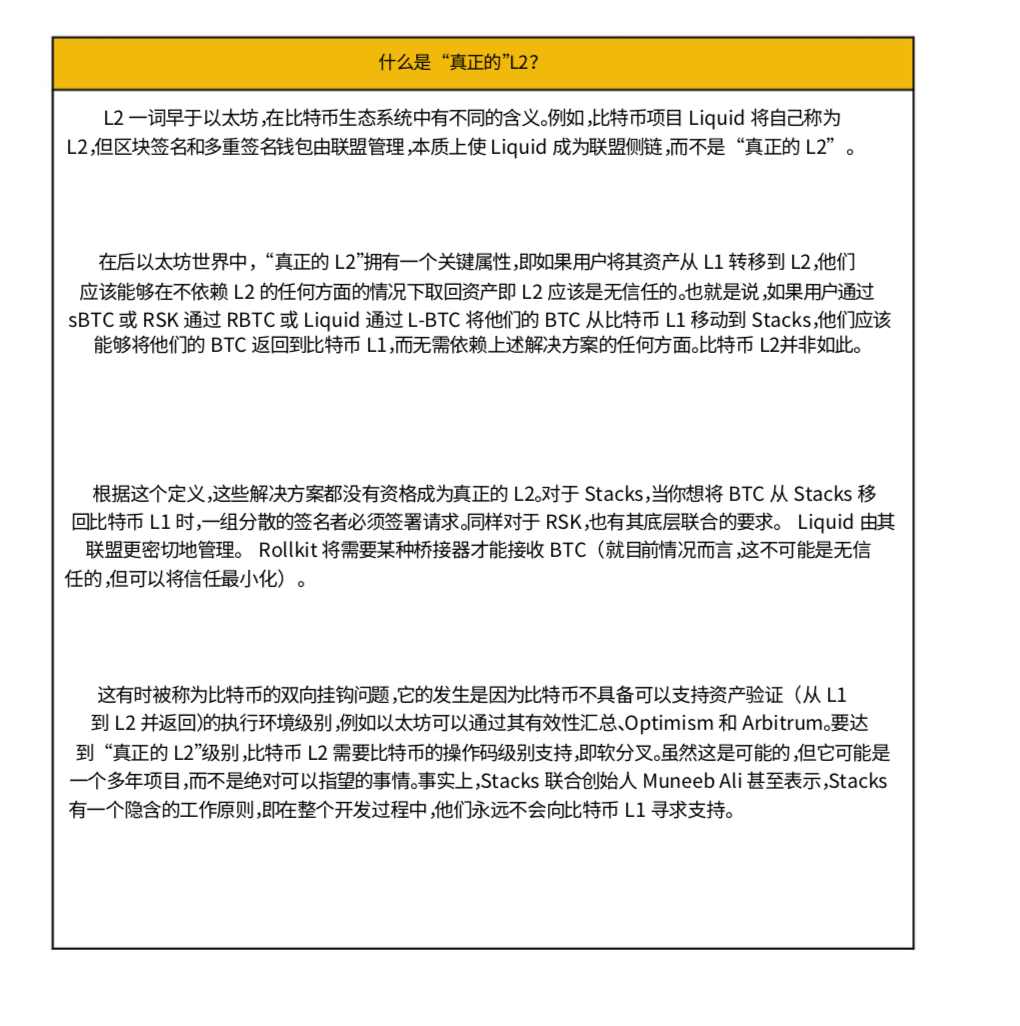
Smart Bitcoin (“RBTC”) is the native currency in RSK and is used to pay transaction fees. It is pegged 1:1 to BTC (meaning RBTC also has a hard cap of 21 M). Bitcoin L1 and RBTC are connected via "Powpeg" (15), a two-way bridge used to transfer bitcoins between the two chains, which is called "pegging in" and "pegging out". The bridge was initially managed by a consortium that manages multi-signature wallets (view our report, Wallets: An in-depth look at cryptocurrency custody, more details on the different types of wallets). RSK has since further decentralized the bridge, although the process still requires a level of trust, as pegging requests still require at least 51% of online signers. The coalition still manages part of the process (16), with members acting as notaries protecting locked BTC and holding other communication-related responsibilities. Nine members ( 17 ) currently support Powpeg.
first level title
About Stacks' sBTC and RSK's RBTC
While sBTC has not yet been released, the main difference between its planned design and RBTC is decentralization. One factor mentioned in (19) is that their pegging mechanism is not dependent on any centralized or pre-determined group of participants as the first paragraph of the sBTC white paper relies on, but rather on a decentralized sBTC setup that can be called a collateralized bridge. Although RSK has moved away from its centralization and economically incentivized signer groups. Stacks rely on federated origins, but there is still an element of trust in RBTC's architecture. Therefore, RBTC solutions can be closer to union bridges. This is in contrast to fully centralized solutions like WBTC and theoretical trustless effectiveness bridges like Arbitrum and Optimism on Ethereum.
secondary title
Liquid Network
Liquid Network is aside chainL2 is able to settle and issue digital assets such as stablecoins, security tokens and other financial instruments on top of the Bitcoin blockchain.
Unlike other L2 solutions mentioned so far, Liquid Network is relatively centralized and secures itself through a federated consensus mechanism managed by 60 functional members. Functional members are tasked with validating blocks and adding transactions to Liquid Network sidechains.
secondary title
Rollkit
Rollkit, developed by the Celestia team, is a modular framework for Bitcoin rollups. Today, many L1 chains, including Bitcoin, exist as a monolithic chain, meaning that consensus, data availability, and execution processes operate on the same layer. Rollkit renders Bitcoin as a modular framework, meaning that Bitcoin's consensus and data availability processes are decoupled from its execution environment.
This modular framework and Rollkit node software allow L2 Bitcoin developers to deploy a custom, Turing-complete execution layer on top of Bitcoin while being able to securely write to and read from Bitcoin's data availability layer.
How does it work? Rollkit allows developers to deploy "sovereign rollups". These use Bitcoin as a consensus and data availability layer (providing the same level of security as Bitcoin for aggregated transactions), and then provide an environment to execute complex transactions with your Bitcoins. These transactions, whether they are DeFi, NFT or infrastructure-related transactions, are bundled together and eventually sent to Bitcoin L1 so they can be included in the Bitcoin ledger. Rollkit also leverages the Taproot and Segwit upgrades that Ordinals and Inscriptions rely on. The execution environment is customizable and it is even possible to run the EVM on top of the Bitcoin network. Sovereign rollups are easy to start because they don't have to maintain their own consensus or validator set. In this way, Rollkit's so-called "sovereign pooling" retains and relies on the "sovereignty" of Bitcoin L1, while also adding scalability and Turing-complete programmability.
Even though Rollkit is a fairly new version of Bitcoin L2, it has already attracted attention considering it was only released in February. For example, Eric Wall, a well-known Bitcoin thought leader, shared his thoughts on Rollkit and its potential:
"It's unbelievable. Instead of putting JPEGs on Bitcoin, you can use the same storage that Ordinal Inscriptions use to put summaries on Bitcoin. This will allow any execution environment to run with the same * data availability guarantees and block ordering.”
An interesting concept to consider is a potential integration between Stacks' sBTC and Rollkit. Rollkit provides a platform for developers to build execution-level smart contracts for Bitcoin. Therefore, Rollkit needs a way to move BTC from L1 to L2. Given that sBTC is a trust-minimized way of getting BTC from L1 to another layer, it might be a reasonable idea to think about integration here. Users can transfer BTC from L1 to Defi's Rollkit rollup (for example), and then transfer it back using sBTC as the transfer medium.
secondary title
Bitcoin smart contract market
For years, Bitcoin has faced a lack of developer tools, slow and sometimes clumsy infrastructure, and seemingly relatively limited innovation relative to smart contract giants like Ethereum, BNB Chain, and Solana. Finally, things seem to be changing.
Builders finally have a relationship with their bitcoins. Developers are staying up late, updating sand shipping at a rate Bitcoin hasn't seen in a while All of this is driven by organic demand. This is the key part, when an ecosystem is going through a period where organic, real user demand essentially drives innovation and product development, a virtuous cycle ensues and things escalate rapidly.
Organic demand for product updates - product innovation - more attention from developers and users to the ecosystem - focus on big input names - create further organic demand, etc.
With names like Yuga Labs, DeGods, and Magic Eden entering the Bitcoin NFT space within weeks of Ordinals, and Celestia building Rollkit to scale Bitcoin, the wheels are definitely turning. The question we should be asking ourselves is; who will be the next major brand to enter Bitcoin? What new dApp will launch on Bitcoin L2 taking the space by storm? What killer use case is a team that got their attention from Ordinals working on right now?
We already have developers integrating Ordinals into wallets, creating Ordinal browsers, custom minting services, auction houses, and more. Still, it's early days in the infrastructure space. This presents a huge opportunity for developers looking to create on Bitcoin everything that is available on other smart contract platforms (including NFTs, and smart contracts more generally).
secondary title
The Case for Bitcoin Aggregation
It feels like Ordinals and Inscriptions have re-engaged and captured the attention of large segments of the community. With on-chain activity increasing and Bitcoin L1 blockspace continuing to grow in value, the case for Bitcoin L2 is self-evident. All signs point to this, from increased block sizes, mempools, fees, to the innovation and excitement surrounding the Bitcoin ecosystem.
The key development to watch is whether there is any progress on Bitcoin’s two-way peg issue. As mentioned earlier, for a fully trustless bridge to exist between Bitcoin L1 and any L2, support at the opcode level is required, known as a soft fork. This will take time, and is likely just a function of demand.
secondary title
about to halve
Part of Bitcoin's appeal is its fixed, programmable monetary policy. Unlike the monetary policy of traditional central banks, Bitcoin's future monetary path is predetermined and fixed in open-source code. This provides Bitcoin users and miners with more predictability about future BTC issuance and prevents the typical inflationary pressures common in most traditional economies.
More specifically, Bitcoin follows a monetary policy and a fixed issuance schedule until the maximum supply in circulation is 21 million Bitcoins. Since the genesis block, miners have been rewarded with newly issued bitcoins. The amount of BTC issued is determined by the formula shown in Figure 32; every 210,000 blocks, the block reward is halved, which means that BTC issuance decelerates over time.
Currently, the block reward, or the number of new BTCs issued per block, is 6.25 BTC.
It is estimated that Bitcoin will have its next "halving event" sometime in March 2024 (that is, the time when 210,000 blocks have been mined since the last halving event in May 2020). At that time, the block reward and the number of new BTC issued per block will be halved to 3.125 BTC.
As mentioned earlier, miners are primarily compensated through block rewards for securing the Bitcoin blockchain. If one holds the purchasing power of Bitcoin and the current fee market is fixed, each halving event means miners effectively lose half of their income. Under these assumptions, a halving event in this manner could be detrimental to miners and the security of Bitcoin in the long run.
first level title
conclusion
The serial number and inscription have brought new life to the development of Bitcoin, instilled a new set of stakeholders with different voices and perspectives, and ultimately injected energy and enthusiasm into the ecosystem, which is built on monkey NFT and permanent exchange The era of DeFi driven by blockchain has been somewhat lagging the market.
An increase in transaction fees paid to miners ultimately incentivizes the security of the blockchain, and means that inscriptions and innovations based on them increase Bitcoin's long-term sustainability.
Regarding "what Bitcoin should or shouldn't be used for", at the end of the day, there is no such social contract in the code, and if transactions are paid and consensus-based, who's to say they aren't "What? Bitcoin is for"?
refer to
refer to
1) https://en.bitcoin.it/wiki/Colored_Coins
2) https://www.theverge.com/2021/3/11/22325054/beeple‑christies‑nft‑sale‑cost‑everydays‑ 69 ‑million
3) https://docs.ordinals.com/digital‑artifacts.html
4) https://dune.com/dgtl_assets/bitcoin‑ordinals‑analysis
5) https://www.xverse.app/blog/how‑to‑inscribe‑ordinal‑bitcoin‑nfts‑ 5 ‑easy‑steps
6) https://www.hiro.so/blog/introducing‑the‑ordinals‑explorer‑and‑ordinals‑api
7) https://twitter.com/trygamma/status/1637862676402503681? s= 20
8) https://studio.glassnode.com/metrics? a=BTC&c=native&m=fees.VolumeMean&reso
Original link
10) https://www.coindesk.com/tech/2023/03/28/zebedee‑debuts‑global‑payment‑ser vice‑powered‑by‑bitcoins‑lightning‑network/
11) https://www.coindesk.com/tech/2023/03/28/zebedee‑debuts‑global‑payment‑ser vice‑powered‑by‑bitcoins‑lightning‑network/
12) https://assets.website‑files.com/5 fcf 9 ac 604 d 37418 aa 70 a 5 ab/6007 2d bb 3 2d 416 d 6 b 3806935 _ 5 f 1596 b 1 2b cc 0800 f 3d cadcd_pox.pdf
13 )https://docs.stacks.co/docs/clarity/#introduction
14)https://blog.rsk.co/noticia/rsk‑bitcoin‑merge‑mining‑is‑here‑to‑stay/
15) https://dev.rootstock.io/rsk/architecture/powpeg/
16) https://developers.rsk.co/kb/faqs/
17) https://rootstock.io/powpeg/
18) https://blog.rsk.co/noticia/rootstock ‑expands‑bitcoins‑defi‑functionality‑with‑remo val‑of‑the‑powpeg‑bridge‑locking‑cap/
19) https://stx.is/sbtc‑pdf
20) https://twitter.com/ercwl/status/1632461930437681153