






Talking about the governance development process and important turning points of dYdX


Original author: Xijiaxiang, ChainCather
Last week, DIP 20, a dYdX DAO governance proposal aimed at reducing transaction rewards by about 45%, was officially passed. At the same time, the DYDX token price surged 30% in response.
The proposal itself is not complicated-reduce transaction incentives, save funds and put them into the treasury, and the specific use is left for later discussion. But behind it reflects the intention of the project and stakeholders is very straightforward:Considering the longer-term interests of the community, dYdX has chosen to appropriately give up short-term incentives and good-looking trading volume figures.
This "reform" of the benefit distribution mechanism within dYdX came to an end with 84% of the votes in favor and 16% in opposition. It did not cause an uproar like Uni's choice of a cross-chain bridge tool before. As a leading DeFi project, dYdX has repeatedly used community voting and public governance to communicate in a timely manner, adjust project development details and medium and long-term planning, which has become a rare example in the industry.
first level title
dYdX Governance Development Process and Important Inflection Points
dYdX provides perpetual contract trading services similar to centralized exchanges such as Binance, and its ultimate goal is to establish a fully decentralized derivatives exchange.
dYdX was founded in the summer of 2017 by former Coinbase engineer Antonio Juliano. The protocol's first two products, Expo and Solo, were built for margin trading on Ethereum. Seeing the explosive growth of Bitmex perpetual contract trading in 2019, dYdX decided to follow up. The launch of derivatives contracts such as BTC and ETH has attracted a large number of traders. With the release of StarkNet in 2021, the ease of use of dYdX based on it will be further improved.
In addition, dYdX has become the most successful on-chain derivatives platform with the highest market share at present, thanks to its early adoption of the order book model, a highly competitive fee rate mechanism, the use of third-party price feed contract prices, Rich order types and good UI/UX interface, etc.
However, dYdX, which once attracted a large number of traders and arbitrageurs through liquidity incentives, has also been trapped in a large number of false transactions since then. In addition, how to further improve scalability and design a new value capture model is also a problem that dYdX needs to solve.
On June 22, 2022, dYdX announced that its V4 version will be launched as a Layer 1 blockchain based on the Cosmos SDK and Tendermint, and DYDX is proposed as the native token of dYdX v4.
For dYdX, the move to retreat from Ethereum and develop application chains based on Cosmos is naturally beneficial to the community and users. In this way, dYdX is expected to provide a new value capture story - namely, users need to use DYDX to pay transaction fees and validator fees. In addition, DYDX can also participate in staking, run its own sequencer or verifier to obtain MEV to reduce transaction fees, etc.
Before making such a choice, on January 11, 2022, dYdX Trading Inc. announced the dYdX protocol’s road to complete decentralization: dYdX V 4 will be open source, fully decentralized, and fully exchanged. To the dYdX community.
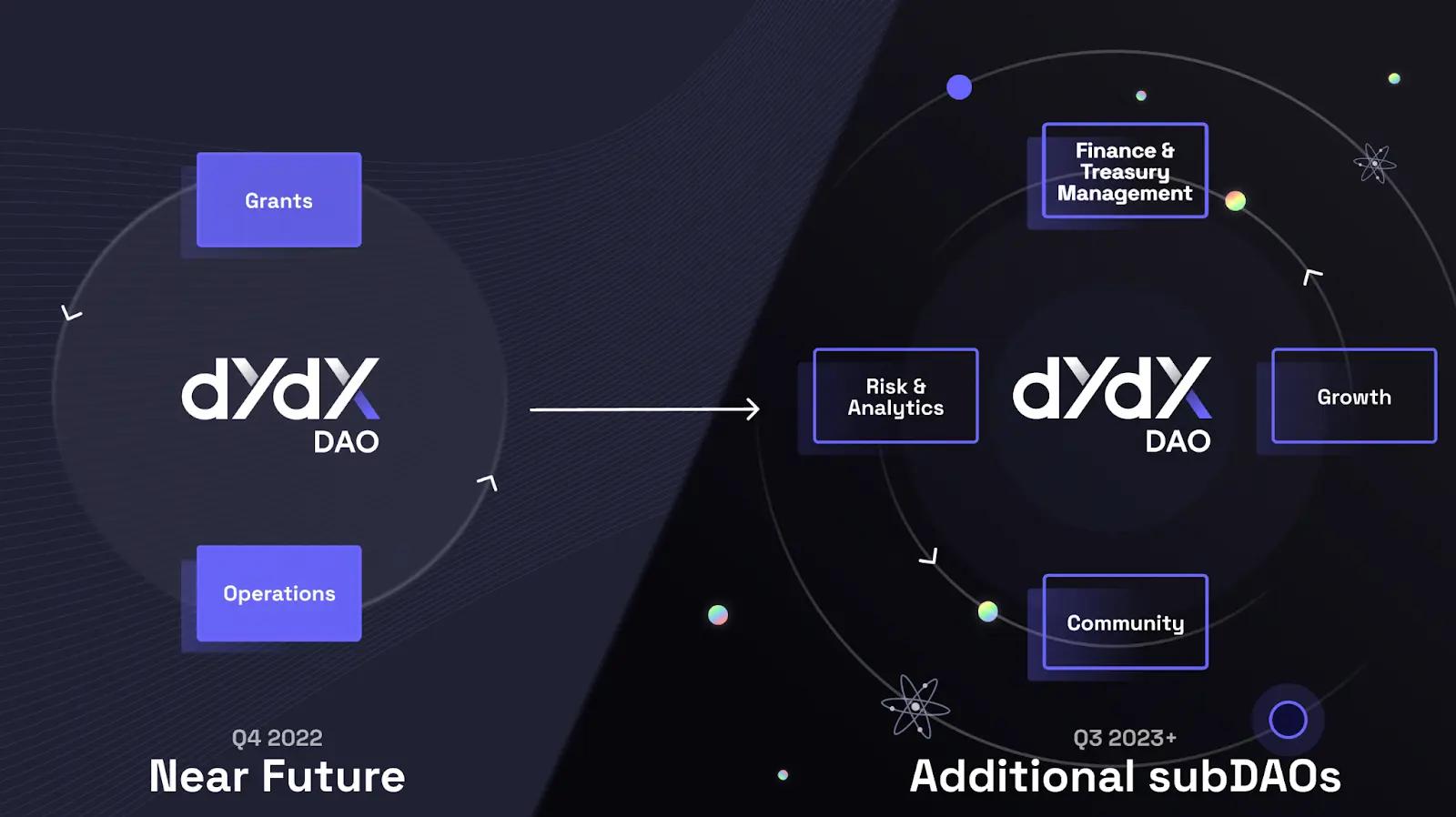
It can be said that the release of dYdX V 4 on the mainnet marks a turning point for the decentralization of the dYdX protocol. From then on, the dYdX DAO will be solely and fully responsible for all aspects of the operation of the dYdX protocol. To this end, the dYdX Foundation released a potential roadmap for the dYdX DAO within the community.
first level title
dYdX governance experience and logic behind it
dYdX's path to decentralization is naturally not achieved overnight.But the dYdX Foundation, which lays its core, was established in Switzerland in June 2021. As a non-profit foundation, its mission is to grow the dYdX ecosystem by supporting the community, developers, and decentralized governance.
On August 3, 2021, the dYdX Foundation officially announced the issuance of the governance token DYDX, which allows the dYdX community to truly govern the dYdX Layer 2 protocol by enabling shared control over the protocol, and coordinate among traders, liquidity providers, and partners incentives and build a strong ecosystem around governance, rewards and staking.
Through the experience and observation of dYdX v3 governance over the years, the official has released some specific figures:
Looking at the prevalence of participation in governance, 30 proposals on dYdX v3 averaged 26 million DYDX (~7.0% of the voting supply) and 412 addresses (~1.1% of all voting wallets )Vote. Despite market volatility, voter governance participation in 2022 increased sequentially.
In terms of consensus efficiency, the average lead time between forum discussion, off-chain voting, and creation of on-chain voting throughout the proposal lifecycle is 17 days and 48 days, respectively.
In order to further improve the popularity and efficiency of dYdX governance, the solution chosen by the dYdX community is to delegate the decision-making power of certain parameters to a dedicated subDAO. In addition, they are also considering further distribution and decentralization of voting rights and proposal rights.
Taken together, among the dozens of proposals in the past few years, discussions on security modules, liquidity modules, funding plans, and incentive plans have aroused widespread enthusiasm in the community because of their direct impact on dYdX’s protocol income and ecological development.Most of the community members who participated in the voting also expressed their opinions from the perspective of the overall interests of the community.
The sense of mission of dYdX DAO originated from its founder Antonio Juliano. He has posted in the community about his views on the values of the dYdX community, and most importantly, he candidly talked about what types of contributors the DAO should consider funding. Rather than compensating a large number of contributors with a small amount of money, Juliano suggests that it is better to pay a large number of talented contributors a large amount of money.
first level title
DAO Governance Challenges and Summary
To date, the governance models of DAOs have mostly been simplified versions of state and corporate governance models. Most governance mechanisms in crypto projects today,It is a form of democratic realization based on tokens.
Mechanism designers have indeed enhanced the old model with novel on-chain features, such as One-Wallet-One-Vote similar to direct democracy, secondary voting mechanism aimed at reducing the voting rights of giant whales, and participation by Vitalik Buterin et al. Proof of Proof (PoP).
These improvements cannot be said to be unimportant, as they mainly focus on improving efficiency and mitigating or delaying the impact of malicious proposals. But they don't answer a key question:Can the underlying governance framework incentivize virtuous behavior while handling complex tasks?
Most DAO governance models have difficulty doing this.
Initially, most on-chain governance systems were designed to coordinate very simple decisions: things like whitelisting staked tokens, modifying a certain parameter, activating or deactivating a less important feature. The DAO's mission is clearly defined, and the contributor's role is to keep it working or make minor improvements.
However, with the increase of user base and income figures, DAO can play a more and more role. When the governance of DAO involves the transfer of a large amount of financial or other resources, the problem will be magnified rapidly. Therefore, almost every DAO faces two core challenges: too centralized and too fragile.
At least at the moment, DAO governance just imitates traditional shareholder governance. In other words, we haven’t seen the real decentralized governance and the charm of Web3—that is,Empower more people to make creative contributions to the system.
But what needs to be confirmed is that the experiment on DAO is progressing very fast, and it is rapidly evolving into something that the traditional model cannot understand or learn. With the help of the scale, granularity, programmability, and composability of the Internet and blockchain, it is expected to evolve into a better model through continuous practice and innovation.
If the DAO experiment is bound to be wrong, we want to see productive, helpful mistakes. There is no need to demand the perfection of DAO at the moment, and more encryption projects like dYdX will move in a direction that is more suitable for the market.


