






ERC-4337: Mnemonics are no longer needed, is Web3 mass adoption coming?


NFTs and Web3 have been making waves, but the process of buying and storing them still needs to be simplified for crypto newcomers.
I remember the first time I traded on Uniswap, I didn't even know what I was doing. Creating a crypto wallet and connecting it to a DeFi protocol is a nightmare.
Currently, the only way for users to interact with blockchain-specific smart contracts is with their EOA (External Owned Account). From sending funds to DeFi liquidity pools, to transferring NFTs to the market to sell to other accounts, each action still requires a separate transaction signature.
While many of us crypto veterans have embraced the process, beginners? Most people will not enjoy creating and using an EOA when they have already experienced the convenience of traditional banking.
These remain a challenge for getting new users into the Web3 space.
This is where ERC-4337 comes in.
This article will take a deep dive into ERC-4337, understand its properties, and explore its impact on the crypto industry and Web3.
What is an Ethereum account?
Ethereum has two different types of "accounts":
You can think of a contract account (CA) as code on the blockchain (smart contract) and an EOA as a person (although a person can have multiple EOAs).
Your MetaMask wallet is an EOA. An EOA consists of a pair of cryptographic keys: a public key and a private key that control account activity.
However, contract accounts do not have private keys. They are smart contracts, controlled by the logic of the code within them, not controlled by the user. Smart contracts have the ability to do anything you can write in code, whereas EOAs can basically only sign transactions.
The key takeaway is: the code defines what the contract account does, and the user controls what the EOA does.
What is an Ethereum transaction?
Every time you want to write information to the blockchain, such as transferring tokens, or minting NFTs, a transaction is required. The transaction requires an EOA signature, and the EOA also needs to pay the Gas fee associated with this transaction.
Transactions are initiated by EOA and can be sent to:
Another EOA, eg, one EOA transfers ETH to another EOA.
A CA, for example, mints NFTs.
Web3 Today: EOA + Bad UX
Performing operations on the blockchain is often slow and tedious. Every time you want to write new information to the blockchain, you need to sign a transaction from your EOA to do so.
Since you're already familiar with the process, it also becomes a standard experience.
However, for new users, it turns out to be a nightmare.
The diagram below shows how a new user can perform their first action on a decentralized application (dApp) with a new EOA:

These steps can be brutal for any new user, blockchain-savvy or not.
But the problems for new users don't stop there.
EOA is extremely risky
You may already know friends who have lost access to EOA due to accidental disclosure or loss of private keys.
There is even a proverb in the encryption industry: "Not your keys, Not your crypto". It means that if someone else (such as a hacker) has your private key, they can control your funds. This has been proven countless times in the past.
This is the harsh reality, private keys are easily lost and cannot be retrieved.
EOA has limited capacity
As we mentioned before, EOA has very limited capabilities.
In EOA, you usually perform two typical actions:
Submit a transaction to transfer tokens to another EOA
Submit a transaction to perform a certain function on the contract account
EOA will never reach mainstream adoption
In the real world, losing your bank card doesn't mean you're Game Over.
There are rules that allow you to transfer funds to new accounts, enforce payment limits, freeze cards, allow transfers of funds only under certain conditions, etc.
In Web3, however, if you make a mistake, your entire account is compromised and cannot be recovered.
So, EOA is even worse than centralized currency storage.
account abstraction
account abstraction
Account abstraction is a proposal to allow users to use CAs.
But why? Is there anything a CA can't do with an EOA?
CAs are much more flexible than EOAs. (because smart contracts can define different rules and configurations in their code)
Here are some example use cases:
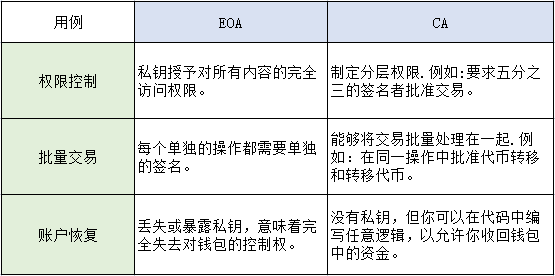
These are just some of the features that CAs can provide over EOAs. The point is this: the contract account is the code. This means you can code anything and implement it in CA.
History of Account Abstraction
Sounds great, but why don't we do it right now? Before answering this question, let's quickly review the history of proposals for account abstraction since 2016. Every technical upgrade proposed to the Ethereum ecosystem initially starts with an EIP (Ethereum Improvement Proposal).
2016: EIP-86 - Proposal to allow users to create "account contracts" that perform any required signature/nonce checks, rather than using the current mechanism hardcoded into transaction processing.
2020: EIP-2938 - Proposal to create a new transaction standard of type AA_TX_TYPE. This type of transaction is called an "AA transaction".
2020: EIP-3074 - A proposal to allow users to delegate control of their EOA to smart contracts. Allow any EOA to act as a wallet without deploying a contract.
None of these proposals have been implemented into Ethereum, and they all currently fall into the “stalled” category. This means they have been on hold for 6 months or more.
Part of the reason these proposals have not been implemented is that they require changes to the consensus layer protocol of the Ethereum network. (You can simply understand the "consensus layer" as the backend of the Ethereum system)
Until 2021, EIP-4337 is proposed: Implement account abstraction on Ethereum without changing the consensus layer!
At WalletCon in Denver on March 1, 2023, developers of the Ethereum Foundation officially announced that the core contract of ERC-4337 has passed the audit of OpenZeppelin and passed various tests. At present, the audited contract has been successfully deployed on the Ethereum main network and several test networks, and can also be operated on various EVM compatible chains, including Polygon, Optimism, Arbitrum, BNB Smart Chain, Avalanche, and Gnosis Chain.
What are EIPs, ERC-4337?
Once the on-chain governance accepts, authorizes, and confirms the EIP, it becomes an ERC (Ethereum Request for Comments, which mainly deals with protocols and development standards).
So there is EIP-4337 before ERC-4337.
ERC-4337 aims to upgrade user EOAs to "smart accounts" (similar to CAs), enabling accounts to run as smart contracts. This means that each crypto wallet can have customizable authorization logic to suit individual user or application needs. Therefore, some use cases of account abstraction can be realized, such as recovering lost private keys, protecting wallets without mnemonic words, performing automatic payments, gas-free transactions, etc.
image description
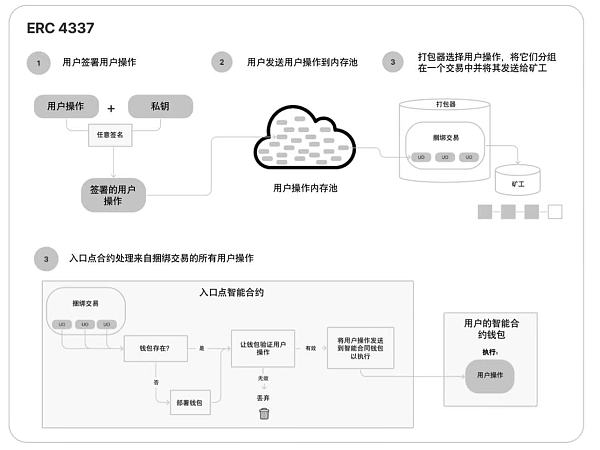
Image: ERC-4337 transaction process, from Nethermind
One of the most obvious benefits of ERC-4337 is that it can make it easier for ordinary users outside the encryption industry to access Ethereum, which can solve some key problems that users currently face from creating wallets to using wallets, making wallets easier to use .
This is how the word "abstract" is understood. you can understand it asidea, Ethereum plans to bring new ideas to users' accounts through ERC-4337. or understood aspull away, allowing users to move away from the traditional handling of user accounts like MetaMask — overreliance on mnemonic phrases, personal transaction signatures, and private keys.
Features of ERC-4337
In simple terms, one of the main features of ERC-4337-based smart accounts is the introduction of a "social recovery mechanism". If you lose your seed phrase, then you can contact the previously designated "guardian" contract or account to help regain access. You can also enable 2 FA (Two-Factor Authentication) and biometrics to secure your wallet without necessarily needing a seed phrase.
In addition, you can also set up automatic payments and time-based spending limits in the wallet to manage your funds more efficiently.
Finally, ERC-4337 allows decentralized applications (dApps) to sponsor gas fees, making transactions cheaper and simpler for users.
Let's look at it in detail:
Smart Accounts: Smart accounts, also known as account abstraction, are becoming an important topic in the crypto industry. Visa has even developed an automated cryptographic bill payment system based on smart accounts. With the implementation of ERC-4337, smart accounts can provide more advanced functions and use cases.
Recovery of lost private keys: ERC-4337 enables a "social recovery mechanism" where if you lose your private key, contacting a previously specified user can help you restore access to your account. This solves one of the most significant risks in the crypto industry - losing a wallet's private key.
Secure Wallet Without Seed Phrase: With this upgrade, users can use 2 FA and biometrics to secure accounts, making them even more secure and user-friendly.
Automated transactions: ERC-4337 allows automated transactions, including monthly spending limits, AI transactions, and adjusting staking positions. These features allow users to conduct transactions more easily.
Gas-free transactions: ERC-4337 supports gas-free transactions, which allows dApps such as DeFi, blockchain games, and DAO to sponsor Gas fees for users, making transactions cheaper for users. This feature also allows users to use dApp tokens to pay Gas fees, which can greatly reduce the cost of using dApps.
Bundled Transactions: Every transaction requires a signature. Through account abstraction, transactions can be bundled and multiple transactions sent as one to save time and even gas costs. Similar to a shopping cart, even if it faces 10 markets, it can be packaged in one transaction.
Pre-approved transactions: Say you are minting multiple NFTs, or playing a game. With Smart Accounts, you can pre-approve transactions based on custom wallet codes and session keys set in advance.
Advantages and disadvantages of ERC-4337
advantage:
advantage:
Enhanced security, added functionality, and improved user experience.
Introduces built-in access controls, permissions, and a more flexible token supply model, making it more secure than existing token standards.
A flexible token supply model enables developers to create tokens with a variable supply, which is useful for dApps and their tokens that require a more dynamic supply.
shortcoming:
shortcoming:
One of the most notable drawbacks is that it has not yet been widely adopted by the Ethereum community. Therefore, developers may be hesitant to use it until it gains more attention and support.
Another disadvantage of ERC-4337 is its limited compatibility with other token standards. This means developers may need to make major changes to their existing dApps to implement it, which can be time-consuming and expensive.
Additionally, the new additions to ERC-4337 may add to the complexity of dApp development, which may create greater challenges for developers unfamiliar with the new standard.
Summarize
Summarize
I see ERC-4337 as a solution to long-standing usability problems in the crypto industry and in Web3. There are already tons of amazing projects implementing incredible use cases. But wallet usage is still an important issue that plagues new users.
The usability and immediacy introduced by ERC-4337 will be a game changer. By merging encrypted wallets with smart contracts, transactions are made more secure and efficient, ultimately making the user's Web3 experience more user-friendly. It is the catalyst that makes Web3 comparable to the "normal" lifestyle of Internet users. L2 Base like Coinbase is already using ERC-4337.
According to the "Notice on Further Preventing and Dealing with the Risk of Hype in Virtual Currency Transactions" issued by the central bank and other departments, the content of this article is only for information sharing, and does not promote or endorse any operation and investment behavior. Participate in any illegal financial practice.
risk warning:
According to the "Notice on Further Preventing and Dealing with the Risk of Hype in Virtual Currency Transactions" issued by the central bank and other departments, the content of this article is only for information sharing, and does not promote or endorse any operation and investment behavior. Participate in any illegal financial practice.


