






A Brief Analysis of the Similarities and Differences of the Regulatory Acts of the Two States: DAO Regulatory Inflection Point?


Xiao Sa lawyer
Original source:Xiao Sa lawyer
In February 2023, Utah released the latest DAO regulatory bill. Compared with the 2021 Wyoming DAO bill, the new law goes further in terms of legal personality and limited liability. The main highlights are as follows:
Overview of Utah DAO Act Highlights
1. The bill gives DAOs a unique, new form of legal recognition. Utah decided not to adopt Wyoming's "new wine in old bottles" regulatory approach and apply the limited liability company (LLC) model to regulate DAO, but to clearly distinguish DAO and LLC, with groundbreaking legislative ideas as the basis The DAO alone creates a new type of legal entity;
2. The bill clarifies that the DAO organization is a limited liability system, and resolves the issue of whether DAO members need to bear unlimited joint and several liabilities with their personal assets in the case of the 2022 U.S. Commodity Futures Trading Commission (CFTC) v. bZx DAO (later renamed Ooki DAO) dispute;
3. Established a DAO tax system;
4. Make it clear that DAO participants have no implied fiduciary duties, unless it is expressly stated that those duties apply to the participants;
5. Protect the anonymity of DAO participants;
6. Incorporate "technical gatekeeping" measures to ensure that a DAO is essentially a DAO.
1. Overview of the Utah DAO Act
About what is DAO, the Sister Sa team has already made a systematic introduction. Interested partners can refer to: "Original | DAO, will it be a new type of "company" in the future?" "We won't go into details today. As a new type of commercial entity that has just emerged in recent years, DAO is obviously different from the existing commercial structure in terms of personnel composition, operation management, income distribution and taxation. Therefore, DAO's legal nature and Regulatory measures are controversial. Although there are many real cases of DAOs in various countries, these DAOs are still in the state of "new wine in old bottles" in terms of regulatory measures and legal nature. The emergence of this status quo is mainly because Wyoming set a precedent in the DAO Act issued in 2021: DAOs are similar to the real world and have matured LLCs for analogy supervision, and even allow DAOs in Wyoming to compete with LLCs. LLC to convert to and from each other. In other words, under this regulatory thinking, DAO is LLC, and LLC is DAO.
To be honest, in the face of new technologies, regulation by analogy to old things is the most common strategy, but in essence it is also a compromise of last resort for legislatures and regulators: although analogy regulation can solve the urgent need, it ignores the uniqueness of emerging things themselves , is not conducive to long-term development.
Therefore, after careful consideration and heated discussions, Utah has taken a big step in the field of virtual asset regulation, expressing its sincerity in embracing virtual assets with practical legislative actions: the Utah Decentralized Autonomous Organization Act ("Utah Decentralized Autonomous Organizations” Act) referred to as “Utah DAO Act”. Many contents of this bill largely refer to the DAO model law template (DAO Model Law) proposed by the encryption community COALA. Some very "innovative" regulations have been made on legal personality and limited liability.
2. Wyoming VS Utah, what are the similarities and differences in DAO supervision?
Wyoming and Utah, for most partners who are not familiar with the United States, have a very low sense of existence. There are neither big cities that are famous for export, nor good universities with world-renowned reputation, and there are not even a few well-known local products. . In addition to popularity, Wyoming and Utah have many similarities: the same beautiful scenery and rich mineral resources, but relatively backward economic development; the same agriculture (animal husbandry) and mineral processing industry as the main pillar industries; the same The land is vast but sparsely populated; the same positive attitude towards the virtual asset industry...
In terms of DAO supervision, Wyoming and Utah have also introduced relevant bills. The answer about Wyoming has been introduced by the team of Sister Sa (for details, see: "Original | DAO, will it be a new type of "company" in the future?"as well as"Sa sister team | DAO, can it operate legally in China?》) Today, on the basis of comparison, we will tell you about innovation in Utah.
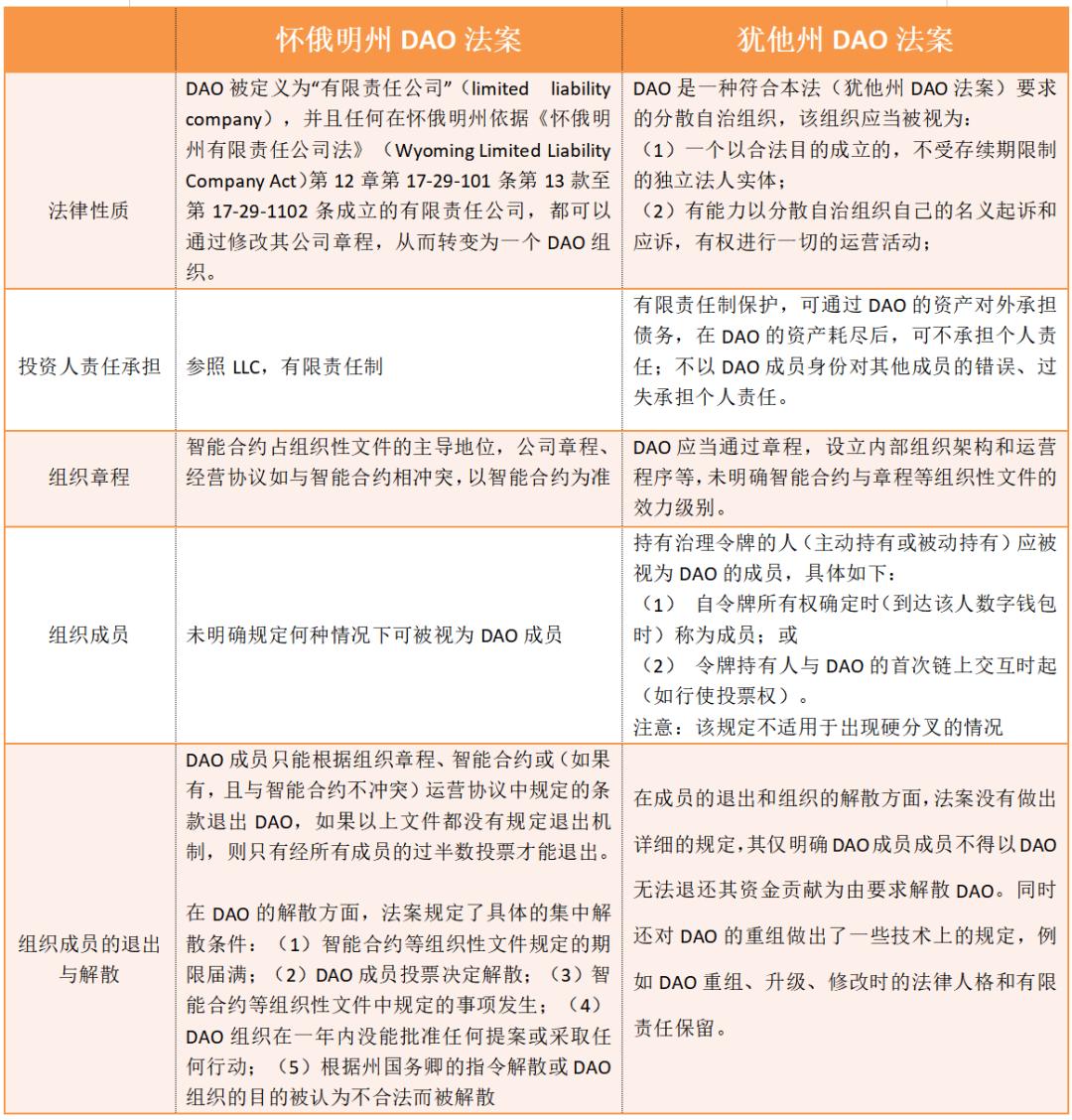
In general, Wyoming's DAO Act has relatively rough regulations, and does not specify many technical characteristics of DAO, but simply uses LLC as a reference for analogous regulation; while Utah's DAO Act is more detailed, not only The long-standing problem of tentatively taxing virtual assets has given its own answer, and even made regulations on technologies such as hard forks. However, although Wyoming is lazy, its DAO bill is relatively down-to-earth and highly compatible with the existing business system. Utah’s DAO bill is full of idealism, but the actual implementation effect is unpredictable for Sister Sa’s team.
3. Utah DAO Act, Compromise or Tolerance?
Sister Sa's team believes that although Utah's DAO Act provides practitioners in the virtual asset industry with a newer and more forward-looking regulatory framework, there are also many practical problems that need to be resolved.
The first is the enforceability of the bill. Under the current corporate law system in the United States, too novel legal personality innovations and limited liability regulations do not necessarily have sufficient normative supply, and law enforcement agencies do not necessarily have the regulatory capabilities required by the bill. In layman's terms, it is difficult for the lofty ideals of the Utah DAO Act to find a fulcrum in the real world. This is because the too cutting-edge institutional innovation does not match the existing business rules in the United States, which may destroy an established and relatively stable system of rules. At present, this kind of contradiction has gradually emerged. On the one hand, the Utah DAO Act’s tax regulations are different from previous practices and have certain discrepancies with the federal tax system. How to resolve tax contradictions and create a plan suitable for virtual assets and DAO organizations Taxation and taxation rules are the key points to be considered in the future; on the other hand, Utah, as a state with traditional animal husbandry and manufacturing as its pillar industries, itself lacks experience in financial and business regulation, and relevant law enforcement agencies lack the requirements of the bill relevant regulatory and law enforcement capabilities.
Fourth, write at the end
Fourth, write at the end
If an idealized bill not only fails to solve real problems, but even has a negative impact on financial security and social stability, then it is better to return to the era of old wine in new bottles. However, we also affirm Utah’s goodwill and tolerance for the virtual asset industry in the DAO Act, as well as the institutional innovation of letting DAO’s belong to DAO and LLC’s to LLC. However, human business systems and dispute resolution mechanisms have undergone thousands of years of evolution, forming a set of established rule systems, and it is very difficult to make changes in the short term. During this period, the virtual asset industry The key is for investors to maintain sufficient patience and confidence.


