






With the rapid development of infrastructure, how to grasp the cross-chain opportunities? | RockTree OG Talk Series


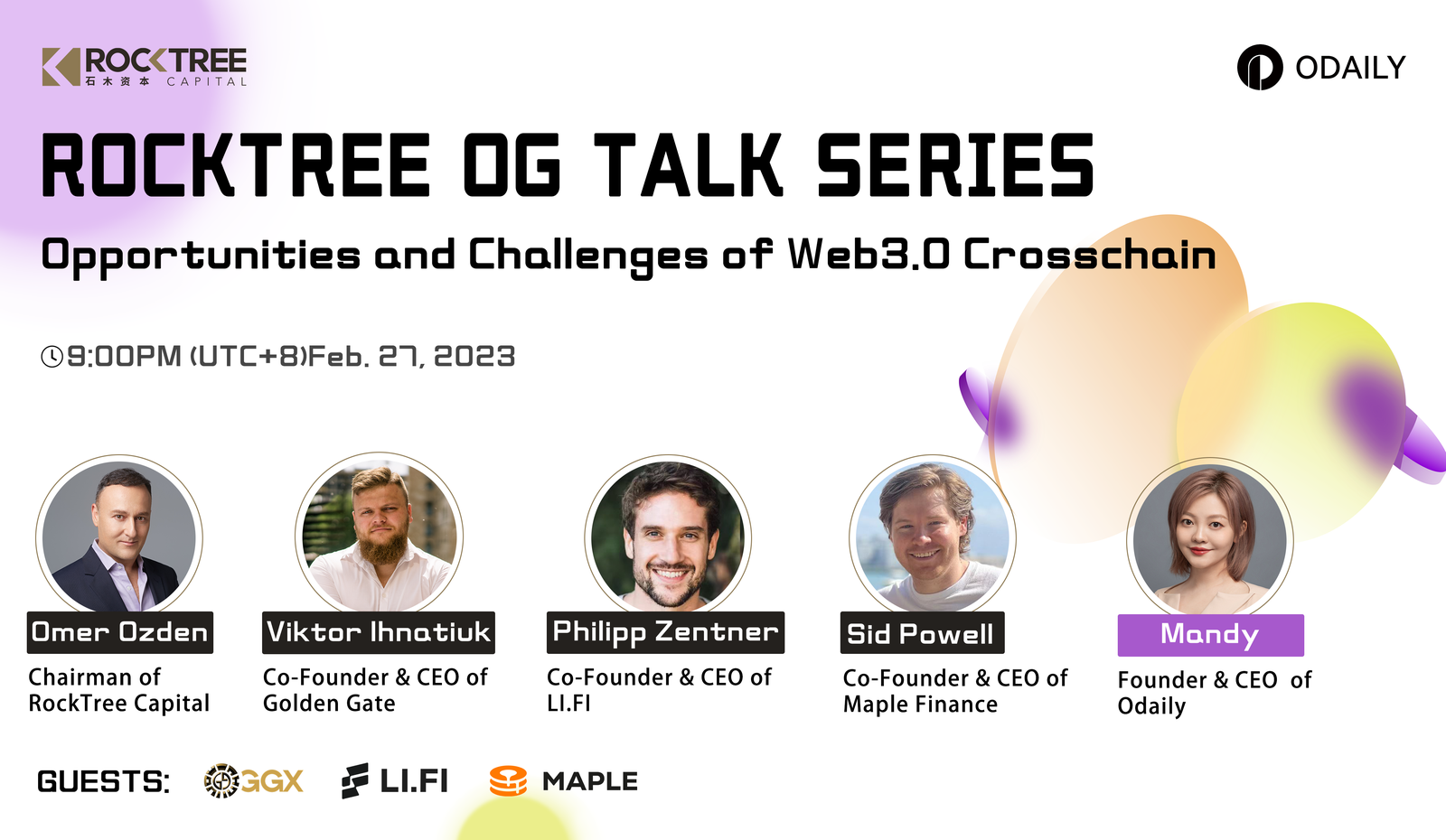
On February 27th, RockTree Capital teamed up with Odaily, Golden Gate, LI.FI, and Maple Finance to host the "RockTree OG Talk Series: Web3.0 Cross-Chain Opportunities and Challenges" online live event. In this event, the guests discussed issues such as the uncertainty and development of infrastructure, how to grasp the opportunities of the cross-chain track, local supervision and policies, cross-chain liquidity, and the market outlook in 2023.(Click to watch the live playback)
Four guests were invited to this event, namely: Omer Ozden, chairman of RockTree Capital, Viktor Ihnatiuk, CEO and co-founder of Golden Gate, Philipp Zentner, co-founder and CEO of LI.FI, CEO and co-founder of Maple Finance Founder Sidney Powell.
Omer Ozden, chairman of RockTree Capital, said, “The development of Web1.0 can be used as a reference for the development path of Web3.0. Web3.0 is still fragmented and fragmented, and the trend will be to integrate various chains and cross-chains. .
Viktor Ihnatiuk, CEO and co-founder of Golden Gate, said, "According to Golden Gate's survey, there were about 200 global blockchain chains in the middle of last year, and now there are about 300. New chains are constantly being added, but there are many of them. The chain cannot survive in the end.
Philipp Zentner, co-founder and CEO of LI.FI, said that with the growth of the entire network traffic, the types of chains will continue to increase, and there will be more chains in specialized segments.
Sidney Powell, CEO and co-founder of Maple Finance, said that investors will pay more attention to the bridge between multiple chains. How to ensure that liquidity flows between different chains is very important, and companies that are not professional enough in some market segments may face being eliminated.
The following is the transcript of the live conversation:
Odaily:Rocktree OG TALK SERIES is a series of interviews. Our theme today is "Inter-Chain Opportunities and Challenges of Web3.0".
First of all, let me introduce the sponsor Stonewood Capital. Rockwood Capital is an international fund and merchant bank, based on the forefront of investment development in North America and Greater China, focusing on early investment and ecological support for leading blockchain and other high-tech companies. Rockwood Capital has formed a strategic investment alliance with the world's leading funds, exchanges, media and other partners to provide high-value strategic investment support and global accelerated growth services for top entrepreneurs and Web3.0 projects.
Dr. Omer Ozden, the founder of Rockwood Capital, is an international partner of ZhenFund. He was part of the team that created the VIE structure that opened China's Internet industry to foreign investment, and participated in the early development of Netease, Baidu, Alibaba, and Facebook in the United States. As a well-known decacorn hunter in the field of encryption investment, Omer Ozden has a keen sense of the market, and has successively invested in a series of star projects with a valuation of more than 1 billion or 10 billion US dollars in the early stage, including ChainLink, The Graph, dYdX , REN, Fantom, Aave, Maple, Pocket Network and a series of hot star projects. Under the leadership of Omer Ozden, Stonewood Capital has become the leading fund in the Web3.0 field, and has become the link that unites the core values of the Eastern and Western cryptocurrency markets.
Omer Ozden:Let me first introduce a few founders who participated in this conversation. Their experience and abilities have surpassed the ordinary people I know, and they are basically in a state like a perpetual motion machine. I will share them with you one by one.
In fact, Stonewood Capital has a basic philosophy. Our investment philosophy is to invest in key people, to invest in these great people. Although we are talking about the decentralization of Web3.0, when we invest in people, people are essentially driven by a central idea.
The first was Sidney Powell, founder of Maple Finance. A few months ago, when the cryptocurrency market was at a low point in December last year, we had a meeting. He prepared two mobile phones by himself. The two mobile phones kept making calls and completing transactions. His energy was superhuman, and he was a real founder. people.
the second isLI.FIFounder Philipp Zentner. His energy is also very human. He was born in Web2.0, and he has the spirit of the Germans who strive for perfection in details, and at the same time, he also has the drive and philosophy of modern people's excellence, which I admire very much.
The last one is Viktor Ihnatiuk from Golden Gate. 5 years ago, he launched the largest blockchain development shop, and we met in Davos earlier this year, when his leg was injured, but he has not stopped exploring projects, walking on crutches Also insist on attending. He is very dedicated and dedicated to development and expansion.
Viktor Ihnatiuk:I entered the cryptocurrency field in 2015, started to focus on the decentralized storage layer in 2016, and served as the head of storage services at a company called Storage, and then founded Boosty Labs, building what may be the largest block in the world One of the chain stores. In 2021, we officially entered the cross-chain application, and encountered many challenges in the whole process, mainly in terms of security protection, but basically the Golden Gate was formally formed at this time, and now we plan to make a unified protection plan And complete the entire ecosystem.
Philipp Zentner:Hello everyone, thank you very much. I've been in the Internet industry for over 20 years, starting my career as a programmer. Over the past 10 years, I have worked in gaming, biotech and market intelligence development companies. I have only entered the encryption market in the past two years, and the liquidity and infrastructure of this market are very fragmented.LI.FIThe goal is to integrate all different layers and integrate all services, such as using DEX. To put it simply, we will provide many simple services on related chains. For example, we can support the movement and trading of different assets on different chains, allowing customers to choose different assets. In addition, we also have some unique intelligent routing systems of our own, which can help users conduct transactions better. We also use financial instruments to move assets. Traders can still use our interface, now we are changing from .com to .xyz, new pages will be available soon. .xyz can help us exchange assets efficiently, and assets on chain a can be seamlessly exchanged on chain b.
Sidney Powell:I have a background in banking and financial services. In the process of working with traditional lending institutions, I discovered a pain point for users. There are many growing companies that cannot obtain sufficient loans from traditional financial institutions. So we thought, we can use the blockchain to provide the funds they need for users in need, especially institutional lenders. Maple is such a platform. We provide loans for large institutions. The process of lending on the chain is transparent and completed in real time. There are smart contract constraints. We require the borrower to have a credit underwriting guarantee, backed by a legal contract guarantee.
Maple Finance was established around May 2021 with 2 billion in loans. In 2022, we discovered a characteristic of the market: some traditional centralized financial institutions defaulted, but because we were using tokens and doing equity pledges, there were no such situations. In 2023, we will enter physical assets, including blockchain.com.
Odaily: More and more institutions are participating in Web 3.0 cross-chain projects, including ZK, new public chains, middleware, etc. However, due to technical barriers and security issues, some infrastructure applications have many uncertainties and vulnerabilities. How can retail investors grasp the potential opportunities in the cross-chain track? After 2-3 years or more, what impact will the development of cross-chains have on DeFi and infrastructure?
Omer Ozden:Going back in time, we can look at how Web1.0 developed. The development process of Web1.0 can be used for reference in the development path of Web3.0. The scale of Web1.0 was small at the beginning, and Web3.0 is still in a state of fragmentation and fragmentation. The integration of various chains and cross-chains will be the trend. He also said that at present, different users have different scenarios with their own preferences, which also makes the current application gradually move away from the virtual to the real. As Viktor, CEO of Golden Gate, said, because of the current vulnerability of the network, we still need to improve security in the future.”
Philipp Zentner:The application of blockchain is increasing, and the traffic of the entire network is increasing. Decentralized systems don't scale very well. With the investment of research and development funds, the technology will be more advanced, the types of chains will increase, and the speed of productization will become faster. There will be more chains in specialized segments, such as high-frequency trading, gaming, inter-bank special use, NFT... Different chains are supported by proprietary technologies. Chains will gradually mature in some segments, and enterprises should do a good job in their own market segments in a multi-chain environment.
Sidney Powell:I have summarized three trends for the future.
"First, more decentralized development. For example, whether the application on one chain can be well bridged to the second chain, investors will also pay more attention to the bridge between multiple chains. How to ensure liquidity in different Inter-chain flow? With the increase of assets, enterprises that are not professional enough in some market segments may face being out.
Second, the development of dedicated chains will accelerate in the future. This also means that the liquidity on its chain will also increase, which will increase the requirements for the speed, security, and professionalism of all transactions.
Third, we are all entrepreneurs and initiators. Taking Maple Finance as an example, it is actively bridging with different chains, such as some Layer 2, or Solana, Avalanche, etc. are doing better docking. "
Viktor Ihnatiuk:In the first direction, I very much agree with what Dr. Ouyang Mo said. I think the prospect of the entire industry is bright. According to a survey by Golden Gate, there were about 200 global blockchain chains in the middle of last year, and now there are about 300. New chains are constantly being added, but many of them do not survive in the end. In the future, the relationship between chains will become closer and closer. No single chain can dominate, and multiple chains will flourish. I am very optimistic about these rising stars. For example, Golden Gate is Layer 0. Our technology can help other chains to perform some bridging and cross-chain transfers, and promote the efficient flow of assets. "
Odaily: Omer, you are known as a "decacorn hunter" in China because you are good at catching projects with a market value exceeding tens of billions of dollars. Web 3.0 is the most ambitious narrative of the Internet, and many traditional Internet giants, such as Amazon, Google, Meta, ByteDance, and Baidu, are actively exploring and entering this field. Current blockchain infrastructure must improve to serve the grand narrative of Web 3.0. How to judge whether an infrastructure application is really valuable, or is it just a concept?
Omer Ozden:We are back to the investment philosophy adhered to by Stonewood Capital. What we invest in is the top team, and what we invest in is the people themselves. We focus on the entire infrastructure of Web3.0, not just the development of a dApp. Entrepreneurial teams need to overcome their own limitations. Web3.0 is built on a complete set of open source technologies and codes, and there is no need to develop them all from scratch. I even encourage the use of existing development resources and programming codes to iterate out Web3.0. The iterative nature is also a key innovation. If everyone wants to start from scratch and go from 0 to 1, the team will spend more time and energy instead of focusing on innovation.
Odaily: Sidney, there are endless voices about decentralized lending increasing liquidity and effectively improving Web3.0 market access. What is the main purpose of Maple in this track? Are more institutions and banking groups considering using DeFi infrastructure? How does Maple fit into it? What do you think will happen to the interest-bearing market next?
Sidney Powell:I will answer your question in two parts.
The first part, the lending market is very critical. Lending is the most direct service that Web3.0 can guarantee the growth of the entire infrastructure and we provide. In order to allow Web3.0 to better contact the real world, when we choose the track, we must also do these businesses linked to the real world. In August of this year, we expect to launch a loan pool related to collateral identified by the government, which is also an on-chain project. The pool also has bonds issued by the government, in the hope that the risk of the lending pool will be lower than that of traditional government bonds.
In the second part, we just talked about the collateral on the chain, and I also want to share it with you. The on-chain collateral we make can be operated with the actual collateral under the chain, and the off-chain collateral will be completed through escrow procedures. For example, we can use the collateral on Ethereum to re-mortgage to our chain, or use other chains, and we can bridge.
Several large banks in Hong Kong, such as HSBC and Goldman Sachs, have issued on-chain bonds. They can directly use tokens to keep accounts. The World Bank also conducted a pilot in Queensland, Australia a few years ago.
Odaily:Philipp,LI.FI is an infrastructure protocol for cross-chain aggregators and decentralized exchanges (DEXs) to facilitate ecosystem liquidity.LI.FI Who is your target audience? Do you think more retail businesses will be involved in the future? Will the cross-chain track in 2023 become more and more mature?
Philipp Zentner:In the trend of the entire industry, we will see the gradual reduction of regulations, while the usage scenarios of users will gradually increase. In the future we may see new applications, including bonds, real-world assets, or real assets that can be tokenized.
In terms of subdivision, of course, different regions in the world have different trends. In France or Germany in Europe, we see that government control is relaxed, and the same is true in South Korea, which will develop relatively rapidly. However, in some countries, some policy regressions have also occurred. The United States is one of the typical cases.
In the long run, we hope that more and more blue-chip companies will continue to emerge. byLI.FIFor example, we mainly focus on the To B business and help customers move with liquidity. In addition to liquidity, there are some wallets, agreements, and even some more complex customer strategies. We hope to help them transfer and move across chains at low cost and efficiently. Of course, in the future, we may also expand some content such as equity mortgage. Through the transformation of .xy, it can also provide services for retail users.
Odaily: Viktor, as a cross-chain infrastructure protocol project, what technological innovations does Golden Gate have? Can you share with us the current development of GGX? What key cross-chain pain points does Golden Gate solve? Can you tell us about it? The development team? What is your original intention to build GGX?
Viktor Ihnatiuk:In fact, our establishment has two basic points. The first point is how to provide better cross-chain performance and experience. Second, better protect users.
Why do we place such an emphasis on security? Last year, due to hacking attacks, the economic loss of the entire blockchain reached 4-5 billion US dollars, of which 50% of the hacking losses were directly completed through the cross-chain bridge, and the total amount was as high as 2.5 billion US dollars, of which 370 million US dollars were caused by the agreement. $700 million is due to decentralized exchanges. This shows that there is a problem with the bridge itself. In June 2021, we started to enter the bridging business, involving event and non-event chaining. After encountering a hacking incident in 2022, we decided to transform. The premise of transformation is to find the weakest link. We believe that the problem lies in the blockchain itself, so we decided to turn our attention back to the infrastructure itself.
We need to start from Layer 0. In order to realize this concept, I need to find a partner. At that time, I found my friend Matthew Doty, who is now in charge of cross-chain research and development. He had worked in Ethereum and NASA before, and later worked on blockchain games. It took me almost a whole year to convince him.
The blockchain technology and protocol we finally chose are practical and applicable. Because the entire platform we developed needs to be used in the market, and we are doing the basic layer, that is, Layer 0, so as to enter the cross-chain business. Our business started in Asia, including Singapore, then Europe, North America, and gradually covered the global market.
We will launch the testnet at the end of next month, and the mainnet will be launched around July.
Odaily: The US Securities and Exchange Commission SEC continues to crack down on exchanges and Staking. Meanwhile, Hong Kong is planning to become the next cryptocurrency hub. Do you think China is doing a U-turn on crypto ban? Will a new bull market start in the East?
Omer Ozden:In the future trend, there will be more and more applications of Web3.0. Relevant regulations and government constraints will gradually be relaxed, and there will be competition between countries.
We have also seen a certain degree of evolution in the attitude of the SEC. In 2017, the SEC's attitude was quite tough, and it did not relax in 2018, so the entire market moved to Asia at that time. When the policy in Asia was tightened, it moved to Europe. If Europe tightens in the future, there must be other places. Because of technology and capital, they will choose where they are willing to go.
I will continue to add some of my views on Asia. Taking Hong Kong as an example, some large banks in Hong Kong have already issued securities based on tokens. These developments and news in Hong Kong happened within the last 60 to 90 days. The Hong Kong Securities Regulatory Commission also issued relevant licenses, and DBS Bank Hong Kong Branch also participated. Hong Kong has sent positive signals. We can see that the development of the entire Web3.0 is self-evident, whether it is the advancement of technology or the boost to the job market.
Odaily: I would like to ask the guests the last question. Are you bullish or bearish in 2023? What is the part or track that excites you the most?
Omer Ozden: For 2023, I don't expect a new round of bull market, but I am always optimistic about the development of Web3.0. I would like to pass this answer to several other guests.
Viktor Ihnatiuk:2021-2022 has finally passed, and in 2023 we see more opportunities, and more growing chains are constantly experimenting and entering the market. We are actually one of them. I predict that the entire market will be in full bloom by 2024.
The encryption market basically has a cycle of four years. The situation this year is similar to that in 2019. For example, there was a round of surge in the summer of 2019, and then the market fine-tuned to decline, and then continued to rise. There may be repeated shocks in 2022, so I am more inclined to be optimistic about the market performance in 2024.
Philipp Zentner:I take an open, wait-and-see attitude. Of course, if you have to choose between the two, I think the market is bullish. Because I am also eager to see the birth of some super platforms and super networks. After all, we are laying the groundwork for Layer 0 technology now.
In terms of government rules and regulations, we can see that there are two directions, both tightened areas and relaxed areas. For the market, our basic forecast is a gradual upward process. So in general, my attitude is open and positive.
Sidney Powell:The first thing to look at is the recovery of the global economy. I expect the economy to gradually recover in the second half of this year, especially in the fourth quarter. So I'm most bullish on real-world based assets. At present, real-world assets are mainly provided by banks. We have prepared DeFi hardware and software and related blockchain technology, and are waiting for these potentials to be utilized by real-world assets. For example, real estate and other assets, as long as they can be capitalized on the chain, I am very eager to see their development.
This is the end of this event, I hope you can gain something from the sharing of RockTree OG Talk Series.
Everyone is welcome to participate in the event lucky draw: Those who follow the Telegram subscription account before March 10 will select 10 people from the followers, and each person will get a $2 0 USD reward.
RockTree Capital News Telegram subscription number:https://t.me/RockTreeCapitalNews


