






In-depth analysis: If USTC is re-pegged, the LUNC community may split again


Today, Terra Classic (LUNC) and TerraUSD (USTC), which have been silent for a long time, once again became the focus of the crypto community.
The results of the community vote show that the proposal #11324 "relinking USTC and LUNC" was passed. Although there are still three days before the voting ends, the proposal has already exceeded the minimum threshold, and more than 78% of the votes were voted in favor. As soon as the news came out, the prices of LUNC and USTC soared, with the highest increases of 24% and 83% in 24 hours, which attracted a lot of attention.
However, there is a lot of resistance for USTC to restore its peg to LUNC, which is difficult to achieve in a short period of time. It is even more difficult for the "USTC to return to $1" that many people fantasize about. Moreover, the proposal may also cause the LUNC community to split again. Smart Stake publicly stated that once the proposal is passed, it will close its validator.
secondary title
1. It is difficult to implement the new proposal and it is easy to die
According to forum information,Proposal #11324Proposed by Duncan Day, it mainly describes an operational framework for the LUNC community to rebind USTC from the code level, consensus level and guidelines. The ultimate goal is to restore the value lost in the "decoupling" event in May 2022, Simultaneously simplify the destruction process of LUNC.
Duncan Day believes that the USTC price is not stable, which makes Terra Classic's ability to generate income effective-currently generating profits mainly relies on complex AMM strategies (mainly arbitrage), but the fluctuation of USTC prices hinders the development of arbitrage strategies, and at the same time does not It is beneficial for some consumer enterprises to adopt USTC as a means of payment. Therefore, a stable USTC is of great significance to the entire Terra Classic ecology.
By re-linking USTC to LUNC, that is, enabling the previous algorithmic stablecoin model, high-frequency transactions can increase the consumption scenario of LUNC-LUNC will now charge 1.2% for each transaction on the chain, and then send these fees to To burn addresses to reduce LUNC supply. The ideal goal is that USTC will eventually return to the value before decoupling ($1).
Sounds good, but there are many problems with this proposal.
One is the cost issue. Funds are needed for early development and later implementation. Where does this money come from? If the community is not interested in the expenditures required by developers or contributors for the plan, or if it is ultimately impossible to raise funds for the plan or resource, the proposal will fail by default.
The second is that the final effect is uncertain. The proposer Duncan Day also said that the implementation will be very difficult. If the test cannot be completed before the absolute deadline (May 27, 2024), it will eventually end in failure; under this expectation, the community Even if the proposal is initially passed, there is still a question mark over whether it will be implemented in the end.
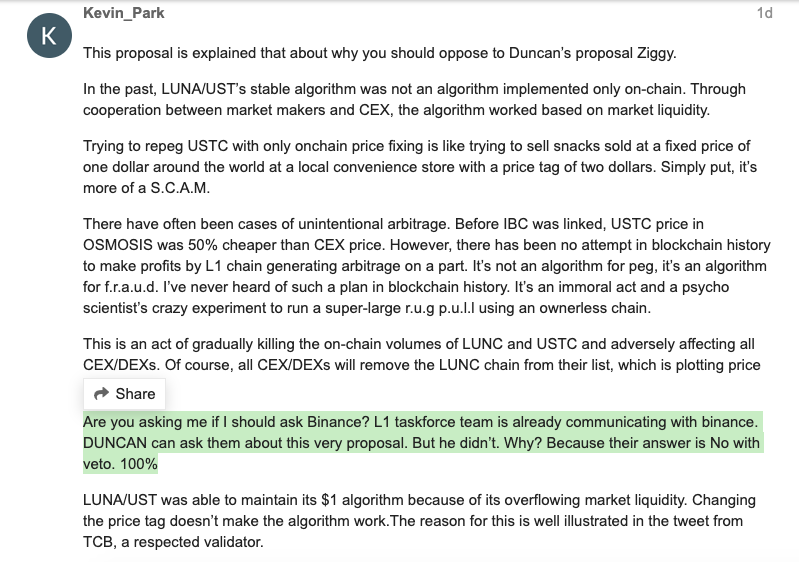
Third, the new proposal may also cause the Terra Classic community to split again. In this vote, 13% of people chose to oppose it. The opposition believes that the USTC’s previous crash has proved that the algorithmic stablecoin model has failed and should not repeat the same mistakes again; re-pegging will cause LUNC to die again, which will be abandoned by major exchanges again.
"The community should focus on building organic demand for LUNC. Build innovative products that add utility to LUNC. Smart Stake will vote against the proposal; if the proposal passes, Smart Stake will close its validators." Terra Classic Ecological Participant Comment.
secondary title
2. Do Kwon and TFL focus on the new Terra chain
The Terra Classic community was full of quarrels, but the "biological father" Do Kwon and Terraform Labs (TFL) did not make any statement, because their focus was not on the old chain, but more on the development of Terra's new chain.
according to
according toDL Newsimage description
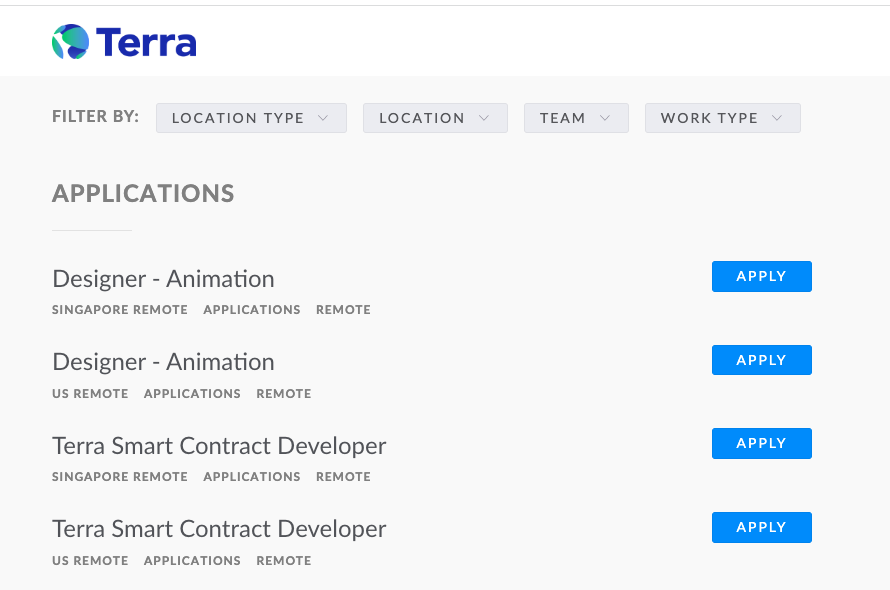
(Terra official website recruitment position)
image description
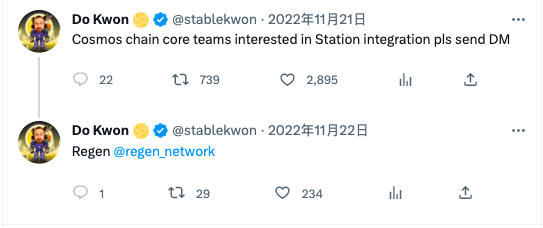
(Do Kwon personally went off to promote the Station wallet and invited the Cosmos core team to join the Station cross-chain integration)
Currently, Station has access to about 24 Cosmos-based blockchain networks. A TFL spokesperson said that it plans to expand Station to the Ethereum EVM chain in the near future.
In addition to Station, Terra 2.0 ecology also has DAO infrastructure Enterprise, which provides original support for DAO. Users can create multi-signature wallets, new tokens or NFT communities. Do Kwon participated in the creation of the project as an advisor, the people said.
Separately, TFL said it was developing an economic module called Alliance. Other protocols register Alliance to become a member of the alliance, and the token holders of the A chain can pledge the tokens to the B chain; the holders can obtain additional benefits, and at the same time ensure the security of the two networks; the alliance members can vote through governance , to choose which tokens to accept. More critically, Alliance does not require stakers to become liquidity providers, thus protecting them from impermanent losses. TFL plans to start rolling out Alliance next month. So far, five projects have indicated that they will implement Alliance at launch.
secondary title
3. Terra 2.0 and Terra Classic are drifting away
“Terra is not a centralized platform that has gone bankrupt due to misuse of funds or fraud, it is one of the largest Layer 1 blockchains with two assets in the CMC top 10.” In his confession last November, Do Kwon Thinking that the failure of UST was just accidental, Terra itself had no problems, so it decided to rebuild the ecology. It is not only self-salvation, but also to prove the bright future of blockchain. “I think the most important use case for crypto is to be a decentralized currency that transcends politics and nation-states. I still believe in that today — and I hope others succeed in our failed mission.”
A Terra Classic that is already full of holes is obviously unable to carry Do Kwon's ambition to rise again. Terra 2.0 is the focus of its development, and many projects have also migrated from the old chain. Of course, objectively speaking, Do Kwon and TFL still maintained the operation of Terra Classic after the crash last year, and did not leave without leaving enough time to hand over the infrastructure to the most technically capable team for operation.
Although Terra Classic proposed some revival plan roadmaps, they did not cause major waves, and the price of the currency also skyrocketed and plummeted due to short-term hype. For Terra Classic, the way forward is not clear. At present, it seems that it can only be used as a meme currency for market games in public opinion.


