






The confrontation and debate between ZKR and OR: EVM equivalent is the lower limit, not the upper limit?


Original author: Nian Qing, ChainCatcher
Original author: Nian Qing, ChainCatcher
Since the second half of last year, the zk-Rollup expansion project has begun to concentrate its efforts and keep catching up with the progress. Related programs and projects have also begun to emerge, and they are also gaining more funds and attention. When everyone praises that zk has a bright future, Optimistic Rollup as a competitor can't sit still, so ZKR (zk-Rollup) and OR (Optimistic Rollup) ushered in (in public opinion) the beginning of 2023 The first head-to-head confrontation.Two days ago, Steven Goldfeder, co-founder of Offchain Labs, the Arbitrum development team, once againTweet
Pour cold water on ZK Rollup and zkEVM.
Steven Goldfeder said that he does not agree with the saying that "ZK Rollup can better replace Optimistic Rollup". At present, zkEVM is far from being implemented in the production environment, and zk-Rollup is more expensive and more compatible than op-Rollup at this stage. Difference.
Furthermore, Goldfeder mentioned that "EVM equivalence is the lower bound, not the upper bound," and in this view, Arbitrum has a long-term advantage as the first Rollup to fully achieve EVM equivalence in production. Based on this step, Arbitrum started to develop higher-level EVM+, which aims to be open to a wider range of developers and users (such as supporting Rust or Move). Nitro's WASM-based design has huge structural advantages in EVM+ innovation, and the zk team is "almost impossible" to achieve EVM+ in the short term.

Finally, Goldfeder made a bold prediction: before any fully functional zkEVM comes out, Arbitrum already supports Solidity and Rust contracts!
Steven Goldfeder's slightly arrogant and indiscriminate shooting at zk-Rollup projects led to a "wonderful discussion (swearing) discussion (war)".Brendan, an engineer at Polygon zkEVM and former zero-knowledge proof development company Mir, took Goldfeder's point of view.Respond item by item
: Goldfeder doesn't quite understand the Polygon zkEVM architecture. First of all, in terms of time, Polygon has released a production-ready zkEVM test network and generated more than 80,000 block proofs, and the main network will be launched in about 3 months. In terms of cost, the proof cost of Polygon zkEVM is not that high. For example, the cost of a Uniswap transaction is $0.0019, and this cost will be reduced to 1/100 of the current cost in the future. Moreover, offloading expensive computations to ZKPs is better than models that force every full node to re-execute.
In addition, Brendan believes that the bigger question should be whether to ensure compatibility with the EVM after introducing new opcodes. And he also made a "targeted" prediction: before the Optimistic Rollup supporting EVM has permissionless fraud proofs, there must be a fully functional zkEVM in production.Scroll co-founder Ye Zhangrefute
, Goldfeder underestimated zkEVM, should take another look at Scroll's blog from 8 months ago, Scroll's zkEVM is built in a very modular way. Moreover, adding functions too aggressively will increase security risks. From the perspective of real needs, it is not considered necessary to add new functions.
In addition, he raises several questions that need to be explored further: How many people actually care about writing Rust contracts with Solidity? How much additional tool support is needed? Does it support composability? What are security assumptions?And zkSync co-founder Alex G.partially positive
Continuing Goldfeder's point of view, he also agrees with EVM+ > EVM, comparing synchronous interoperability with Rust/Move code is much stronger than pure Solidity. But this kind of development can not only be done by Optimistic Rollup, our zkSync is currently compiling Solidity through LLVM, and is also adding Rust and Move. In such a comparison, zk-Rollup wins easily.
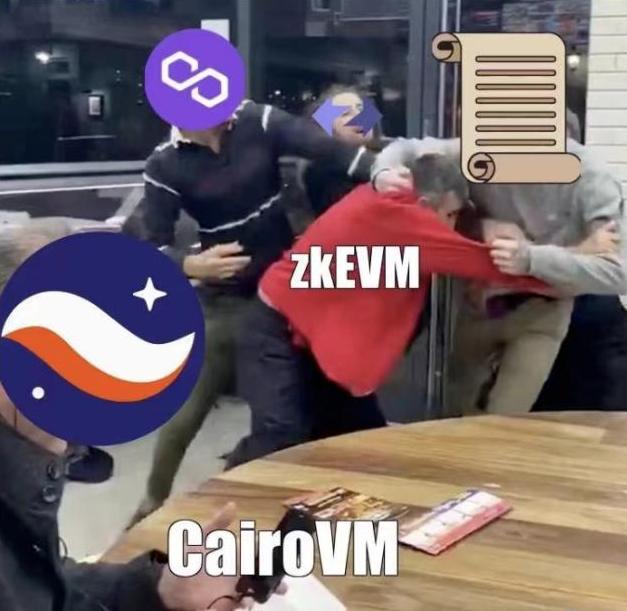
Starkware did not participate in this debate because of the unique temperament of CairoVM.
In fact, with the rise of zk-Rollup, the confrontation and debate between ZKR and OR have continued.
When Polygon happily announced the open source zkEVM code in July last year, Goldfeder poured cold water on "zkEVM is still far away from normal operation". Issues such as open source are indeed true.
And it was even more lively during Devcon in Bogotá last year.
With the launch of zkSync 2.0, zkSync began to advertise itself with much fanfare as "the world's first fully functional open source zkEVM network", and Polygon zkEVM also claimed to be "the first and only decentralized network when it was officially launched during Devcon". zkEVM testnet".
However, when the two argued about "the first zkEVM", they also attracted a lot of doubts. Of course, Steven Goldfeder is indispensable. He believes that zkSync's zkEVM test network has not enabled zk-proofs, nor has it passed a security audit. Polygon was questioned that although the source code of its zkEVM prover (zk prover) is available on Github, it does not have an open source license; although it stated that it is "completely equivalent", its Github code base shows that it has only tested 97% compatibility coverage. In response, the Polygon team responded, "There is no deliberate concealment, and some content is being written for better documentation."
Steven Goldfeder has a more pertinent sentence: "Although many teams are steadily advancing zkEVM, it is far from the 'golden age'. Any team that promotes this narrative is harming the community."The debate between ZKR and OPR can be traced back to the end of 2021. Offchain Labs published a special article titled "Why is Optimistic Rollup more representative of the future of Ethereum expansion than ZK Rollup?
》The article compares the two expansion technologies of ZK Rollups and Optimistic Rollup. Since then, Offchain Labs has been emphasizing the scalability and cost advantages of the Optimistic Rollup system, fully compatible with EVM and existing tools.Then Polygon's zero-knowledge proof engineer Brendan Farmer (the same one mentioned above) published "Polygon refutes Offchain Labs: ZK Rollup is the future of Ethereum scaling
"In response, compared to Optimistic rollup, zk can provide the same security and higher capital efficiency. And OR is limited by L1, since fraud proofs must be executable on Ethereum, ZK does not have this limitation.
You will find that the debate between these two factions has not changed substantially this year. But these discussions are meaningful, if some more extensions can be made on the topic.
Although Optimistic Rollup has a first-mover advantage and still monopolizes more than 80% of the current market share, opinion leaders, including Vitalik, are generally more optimistic about ZKR in the long run. Since the second half of last year, a large number of capital and developers have poured into the zk field, related projects have continued to emerge, and the development progress of zk-Rollup has gradually accelerated. The OR system does have the capital of arrogance at the moment, but in the face of the growing strength of its competitors, Arbitrum, who is firmly seated on the throne, will be a little restless, so it is reasonable to speak diss frequently, and it is also a good urge for zk-Rollup .


