






1confirmation partner: 3 Web3 product trends worthy of attention in 2023


Original author:Richard Chen, Partner at 1confirmation
Compilation of the original text: The Way of DeFi
Compilation of the original text: The Way of DeFi
As a tradition, every year I make three unobtrusive predictions about product trends for the coming year. Let's go back and see what my predictions were last year, and then make three predictions for 2023.
Review last year's forecast
1. Vertical specific NFT market
OpenSea'sTrading volumeTrading volume
A 94% drop from their all-time high, most other vertical NFT marketplaces have seen similar drops; SuperRare and Foundation are down 92% and 90%, respectively.The only exception appears to be music NFTs. Last year I predicted that 2022 would be the breakthrough year for music NFTs. While music NFT volumes are still down significantly from all-time highs, there is still a healthy month-to-month year-over-year growth throughout the bear market。
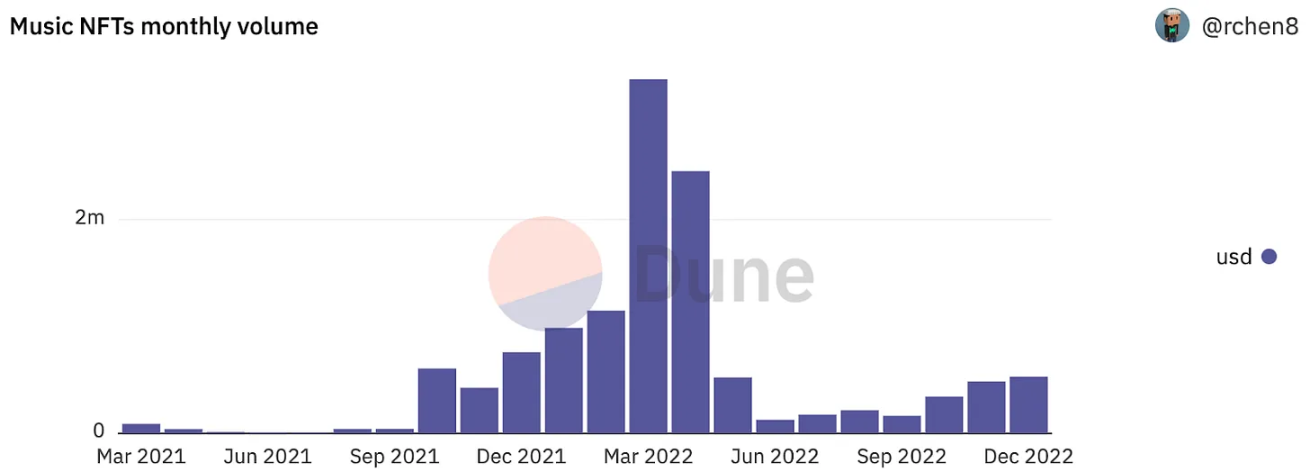
increase
2. Trust-minimized cross-chain bridging
Conclusion: correctLast year I wrote: "Bridges are giant honeypots and I predict cross-chain hacks will be the new CEX and DeFi hacks". Turns out seven of the biggest everhacker attack
Five of them were cross-chain bridges, losing a total of $2.3 billion in funds.
All of these hacked cross-chain bridges took design shortcuts and introduced trust assumptions. For example, having a centralized multisig consisting of several validators, all controlled by the same entity, or having an administrative key that can unilaterally upgrade key parameters in a smart contract. These single points of failure become huge targets for sophisticated hackers. Meanwhile, trust-minimized bridges like Hop have so far been safe from incidents and gained a large market share.
These hacks show why designing a trust-minimized bridge is difficult, and why projects shouldn't glue a solution together, sacrificing security in order to prioritize speed of execution. As the old adage in cybersecurity goes, it doesn't matter that you're right 99% of the time. You only need to be wrong once to be knocked out.
3. Invest in DAOs
Conclusion: wrong
Except for a few OGs investing in DAOs like Flamingo DAO, the new DAOs are basically media hype. They initially got a lot of press coverage and some early adoption, but ultimately had no sustained traction or product-market fit. The number of new DAOs is also a vanity metric, as the law of power in venture capital applies here -- only a small percentage of DAOs will receive nearly all of the return on investment.
Last year, I compared investing in DAOs to dividing collectors rather than artworks. The big use case is group buying expensive Holy Grail NFTs. But it turns out that collectors prefer to buy cheap editions rather than gain access to blue-chip artists.
Forecast for 2023
1. ENS
After reviewing last year's predictions for 2022, here are my thoughts on three or underrated product trends for 2023.ENS is the elephant in the NFT field. In terms of the number of unique holders, it is by far the most spread out of any NFT project and the most called on Ethereum over the past year。
Tenth largest smart contract
However, ENS still isn't really talked about on Twitter because it's not as sexy as JPEG; hyping a name instead of an image doesn't seem convincing. Additionally, there is a misconception that ENS is just about grabbing popular domain names, rather than building a passionate community of holders like other NFT projects. However, it turns out that ENS also have their own version of PFPs, in the form of 3- and 4-digit ENS names. I predict that ENS like 999 Club and 10k Club will be some of the most ideal forms of on-chain identity in the next year.
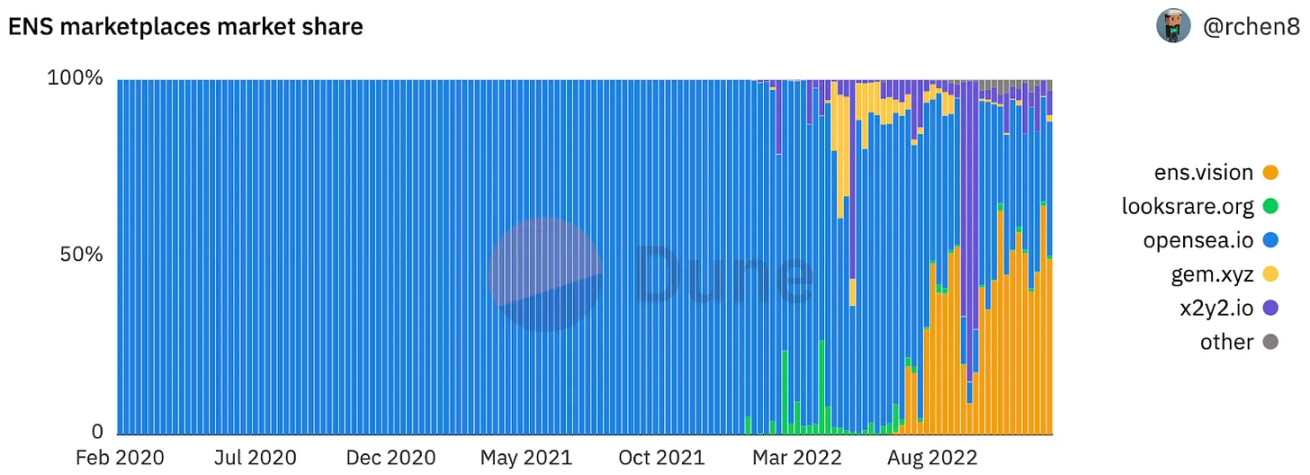
On top of all of this, ENS.Vision has rapidly grown to become the leading vertical marketplace for ENS domains and the preferred place to buy ENS domains, rather than OpenSea. It is always beneficial for a vertical market when it captures more transaction volume than the general secondary market.
2. MEV business model for applications and wallets
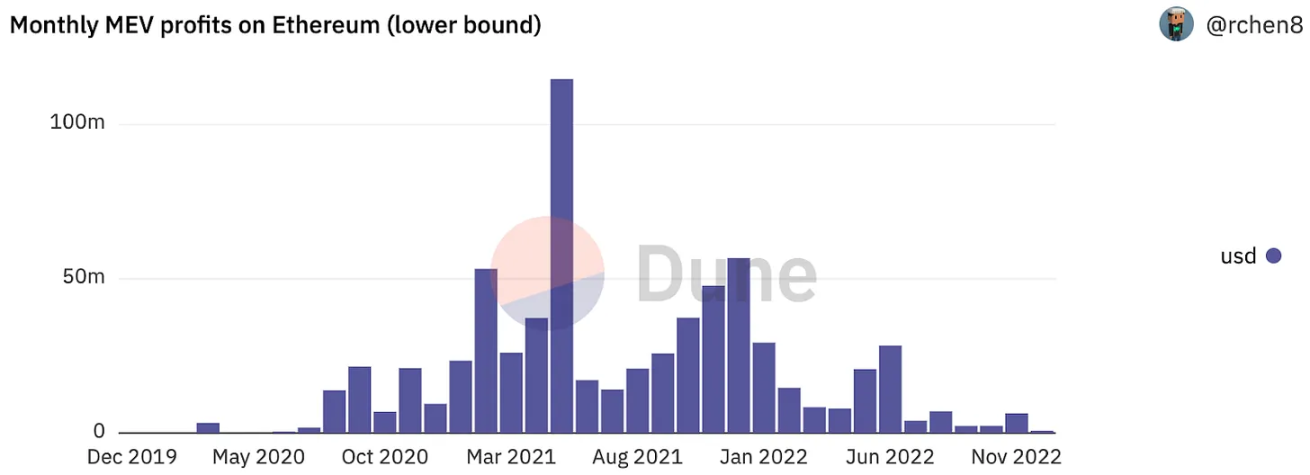
Over the past few years, MEV has grown from a sideline for crypto-native enthusiasts (myself included!) into a specialized industry that requires specialized infrastructure optimized for millisecond execution speeds.
Application chain and rollup. Regarding the application chain theory in 2022, there are already many relatedarticlearticle
up. Unlike the faster/cheaper/better scalability claims, I think MEV will be the biggest reason for dApps to migrate to their own chains or rollups. This is because when dApps are deployed on their own custom chains, they can control the sequencer, which is the order of transactions. Control sequencers are a new business model for dApps, as MEV Seekers pay dApps for the right to order transactions in a certain way, for their forward or backward actions. And this money can either become the income of dApp, or flow back to users to compensate for their impermanent losses.
In addition, MEV can provide a new business model for wallets. Wallets can create their own private mempools (or partner with projects) for users' transactions and let MEV Seekers bid for the right to bundle transactions. The wallet gets the revenue from the bidding and can give some of it back to the user. This is similar to Pay for Order Flow (PFOF), which is how Robinhood makes money, where Citadel pays Robinhood for retail traffic.A common misconception is that all MEVs are bad. But in reality, only a subset of MEV is harmful, such as frontrunning and mezzanine transactions. Arbitrage and liquidation are critical to maintaining the health of the on-chain DeFi ecosystem. Without a strong MEV ecosystem, the protocol will end up with bad debts when the market is disrupted, just like MakerDAO inblack thursday
as happened.
In short, every time a new business model is created, it is a sign of 0 to 1 innovation.
3. Generative art
Generative art is a safe escape for PFPs. Not only does generative art have collectible-like attributes in creating a passionate community of NFT holders, but it is also seen as being created by artists who believe in the long-term value of NFTs rather than random contractors on Fiverr who may not know what an NFT is Higher quality artwork.
When NFT prices drop, critics argue that NFTs have no intrinsic value unless there is a real-world utility associated with owning them. As a result, existing projects are under pressure to create physical goods, build Metaverse games, license their brand IP, etc., to create value for their NFT holders.
But in my opinion, this is usually the wrong approach for projects to take. NFT projects must become more execution-oriented, and most projects have proven that they are mainly good at marketing, rather than building products. When external dependencies are introduced and are expected to be tied to the development of the project, projects have always needed to reward NFT owners for being productive assets, otherwise the NFT becomes worthless.
This is not the same as a store of value. This is counterintuitive, but store of value is a feature rather than a bug. As a store of value, there is more upside and TAM than as a company. NFT projects should strive to be a place for ETH whales and ultra-high net worth individuals to spread and park their funds.


