






Assessment: Market Cost Competitiveness of Main Cross-chain Bridges


The original text is from Multichain, and Odaily is authorized to forward it.
At present, there are hundreds of cross-chain bridge projects on the market. In addition to the official bridges of the public chain, such as Arbitrum Bridge, Avalanche Bridge, Optimism Gateway, etc., there are also many well-known professional cross-chain bridge projects, such as CelercBridge, Stargate , Multichain, etc. The monthly transaction volume of the 18 cross-chain bridges included in Defillama reached 8.04 billion US dollars, and the cross-chain bridge has become the main market for many projects to compete.
secondary title
The fee mechanism of cross-chain bridges has its own characteristics
The following is a brief introduction to the fee mechanism of each cross-chain bridge.
(1) The Across fee includes two parts, the gas fee of the target chain and the protocol usage fee. The agreement usage fee is calculated by a formula, and the specific calculation method refers to its official fee document.
(2) The CelercBridge fee includes two parts, the gas fee of the target chain and the protocol usage fee, and the protocol usage fee ranges from 0% to 0.5%.
(3) Hop uses the AMM mechanism, which requires a swap fee of 0.04%. At the same time, Hop is not suitable for large users, because there will be slippage in the AMM mechanism. In addition, Hop's official fee document mentions that the minimum fee is $1, but this fee is not seen in the actual cross-chain, which should be because the fee document has not been updated.
Eg: The author tested Polygon->Arbitrum, sent 6.8 US dollars, and actually received 6.51 US dollars.
Source chain browser address、Target chain browser address。
(4) Multichain's charging documents include charging standards for altcoins and mainstream currencies, and changes in individual token fees will also be updated on its Twitter. Currently, for the mainstream tokens ETH, USDC and USDT, the target chain Ethereum fee is 0.1%, and the minimum fee is 4.9 US dollars. This fee includes the target chain Gas fee and protocol usage fee. The target chain is BSC, Polygon and Avalanche. The fee is 0.01 % , the minimum fee is $0.19, and the fixed cross-chain fee for other target chains is also $0.19.
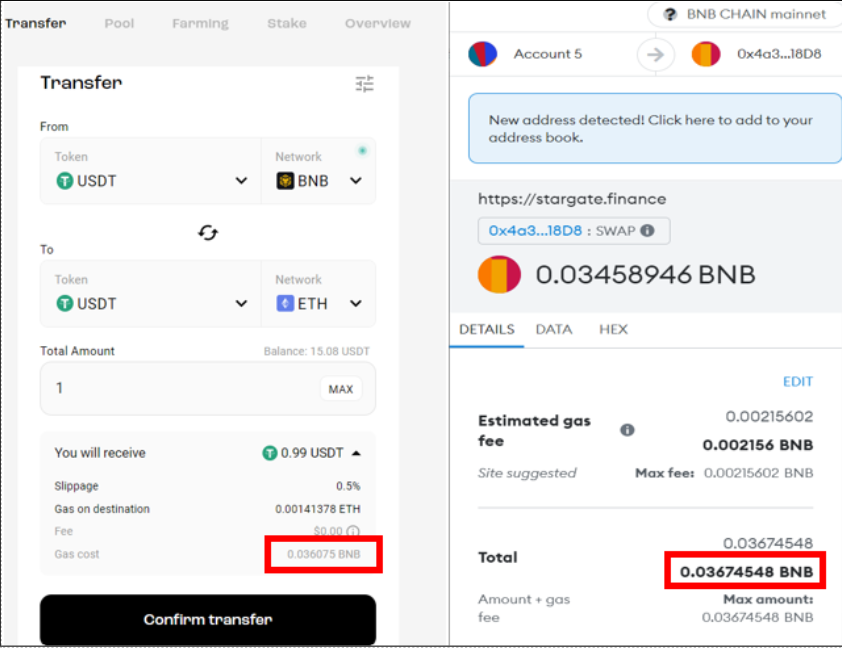
(5) Stargate will charge a fee of 0.06% for non-STG token transfers. The charging mechanism of Stargate is quite special. The estimated amount displayed on the page is the highest. It seems that the fee charged is very small. In addition to the gas cost of the target chain, there are two fees named "Gas cost" and "Fee". Through the actual cross-chain, it is found that Stargate's "Gas on destination" is only the estimated target chain fee, but the actual gas fee charged on the target chain is charged with the tokens of the source chain, and this part of the fee is included in the "Gas cost" Inside, in the actual "Gas cost", the Gas cost of the source chain is also included. Therefore, when users conduct cross-chain transactions, the actual cross-chain fee charged by Stargate is the sum of "Gas cost" and "Fee" after deducting the gas fee of the source chain.
Eg: Take BNBChain>Ethereum transfer 1 USDT as an example, as shown in the figure below, Stargate will directly display the "Gas cost" of 0.036075 BNB on the transaction page, and the user transfers 1 USDT. After deducting the source chain Gas, the cross-chain cost that needs to be paid The handling fee is as high as $10.
Click to view transaction details。
image description
secondary title
Cost comparison of mainstream cross-chain bridges
image description
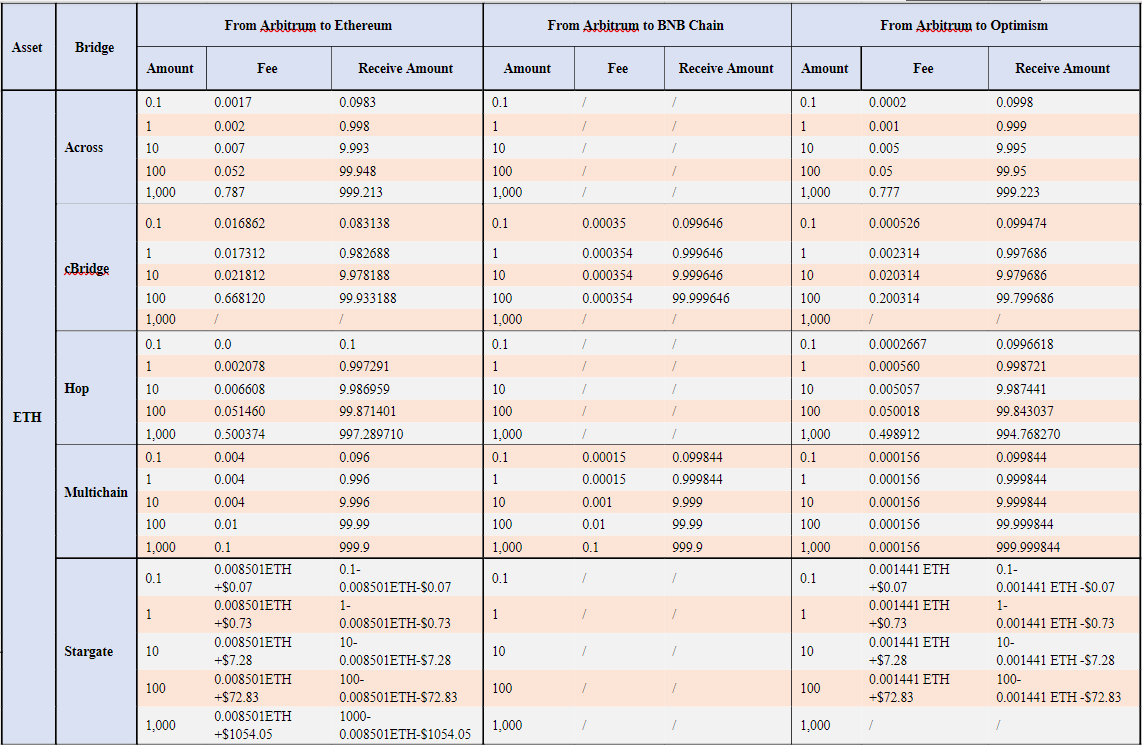
Table 1 The cross-chain fee and cross-chain arrival situation of ETH assets
Note 1: / indicates that the cross-chain of the token is not supported or the current amount of asset transfer is not supported with a cross-chain amount limit;
Note 2: Fee represents the total cost that users need to pay across chains;
Note 3: In order to clearly illustrate the particularity of the Stargate project, the corresponding fees and received quantities of the Stargate project have not unified unit standards;
image description
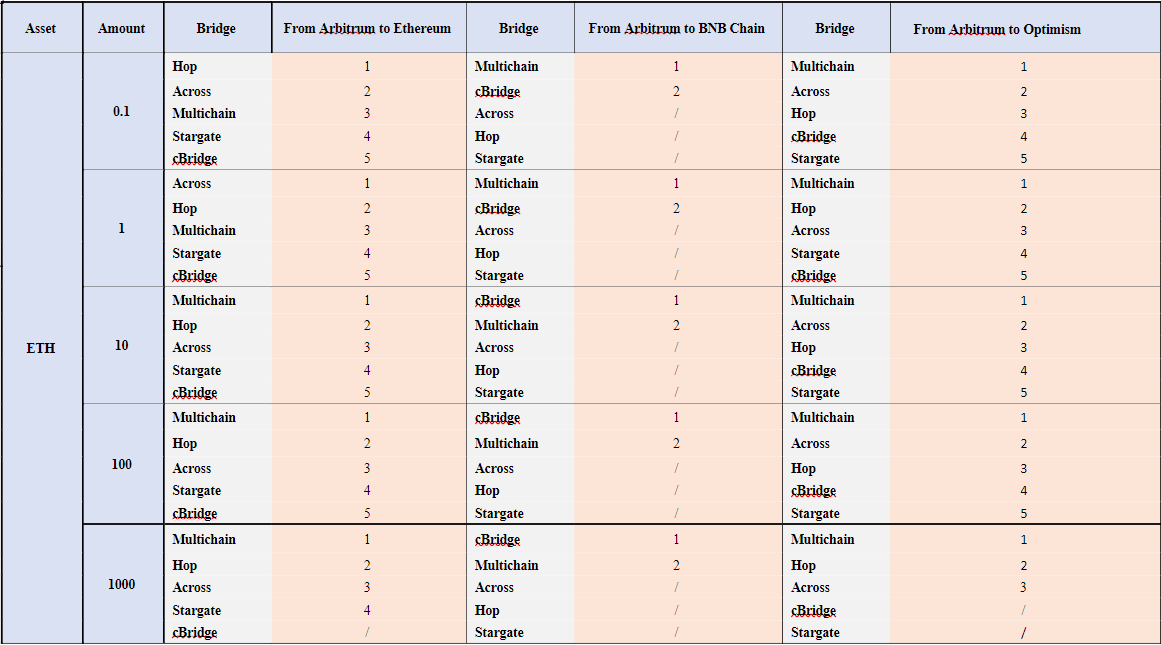
Table 2 Ranking of cross-chain fee competitiveness with assets as ETH
Note: Stargate's ranking is obtained after converting the corresponding data into a unified standard, and ETH is calculated according to the price at that time.
Table 1 shows the cross-chain fees and arrival amount of different amounts of assets ETH from Arbitrum to Ethereum, BNB Chain, and Optimism. According to the collected information, the ranking of each cross-chain bridge is made. See Table 2 for details. .
When ETH is cross-chained from Arbitrum to Ethereum, and the amount is 0.1 and 1, the fees of Across and Hop are the lowest, showing strong competitiveness; the competitiveness of Multichain, Stargate, and cBridge ranks third, fourth, and third respectively. 5. When the amount is 10, 100 and 1000, Multichain has the lowest fee and is the most competitive. Hop, Across, Stargate and cBridge rank second, third, fourth and fifth respectively.
When ETH is cross-chained from Arbitrum to BNB Chain, only Multichain and cBridge support ETH cross-chain. Multichain charges less than cBridge when the amount is 0.1 and 1; cBridge charges less than Multichain when the amount is 10, 100, and 1000.
image description
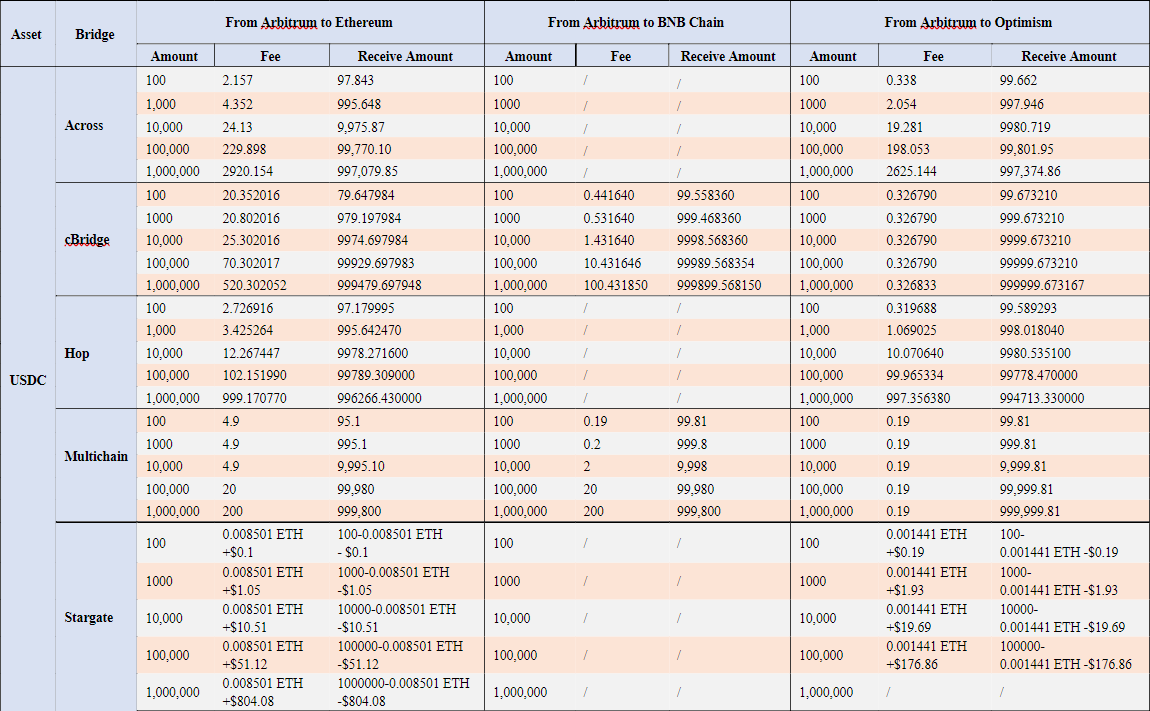
Table 3 Cross-chain fees and cross-chain arrivals with assets in USDC
Note 1: / indicates that the cross-chain of the token is not supported or the current amount of asset transfer is not supported with a cross-chain amount limit;
Note 2: Fee represents the total cost that users need to pay across chains;
Note 3: In order to clearly illustrate the particularity of the Stargate project, the corresponding fees and received quantities have not unified unit standards;
image description
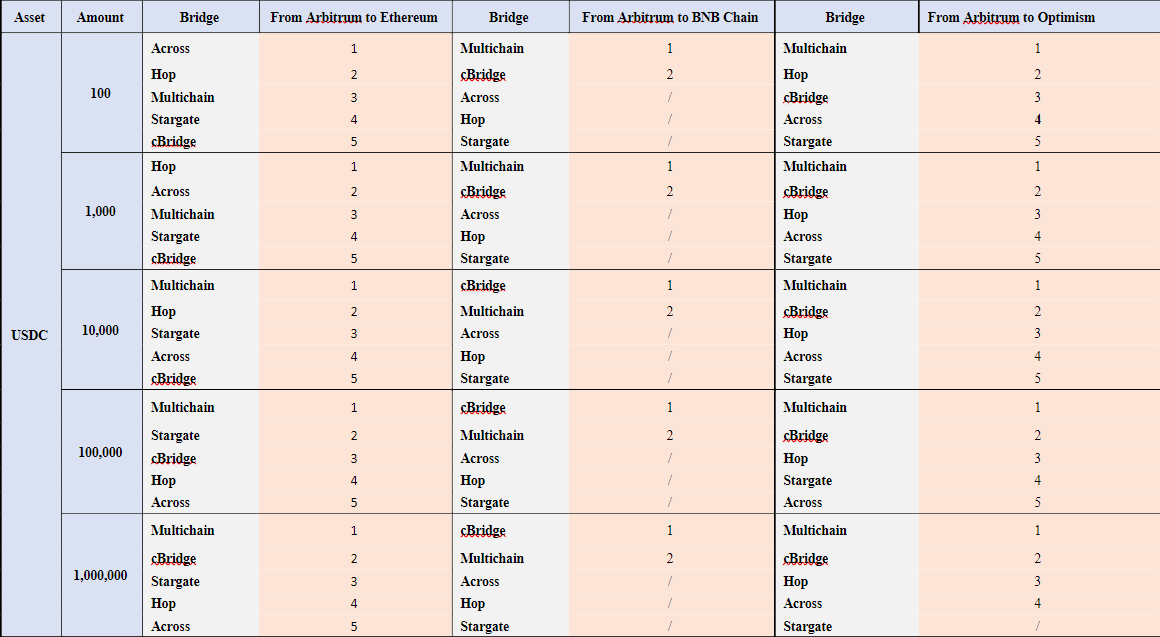
Table 4 The cross-chain fee competitiveness ranking with USDC as the asset
Note: Stargate's ranking is obtained after converting the corresponding data into a unified standard, and ETH is calculated according to the price at that time.
Table 3 shows the cross-chain fees and arrival amount of different amounts of assets USDC from Arbitrum to Ethereum, BNB Chain, and Optimism. Based on the collected information, Table 4 reflects the ranking of each cross-chain bridge.
When USDC cross-chains from Arbitrum to Ethereum, and the number of cross-chains is 100 and 1000, the fees of Across and Hop are relatively small when the number of cross-chains is 100 and 1000, showing strong competitiveness. When the number of cross-chains is 10,000, 100,000 and 100 U, the cost of Multichain is lower and the competitiveness is the strongest; the cost of Across is higher and the competitiveness is weak; the cost of cross-chain of cBridge increases with the number of cross-chains The increase gradually decreases, but the overall competitiveness is weaker than Multichain. In the case of 100,000 U and 1 million U, the cost of Hop is relatively high, and the competitiveness is weak. In the case of 10,000 U, the competitiveness is relatively better, but it is still weaker than Multichain.
When USDC is cross-chained from Arbitrum to BNB Chain, only Multichain and cBridge support USDC cross-chain. Multichain has a lower cost at 100 U and 1000 U and is more competitive. cBridge is at 10,000 U, 100,000 U and 1 million U Under the circumstances, the cost is lower and the competitiveness is stronger.
secondary title
main conclusion
image description
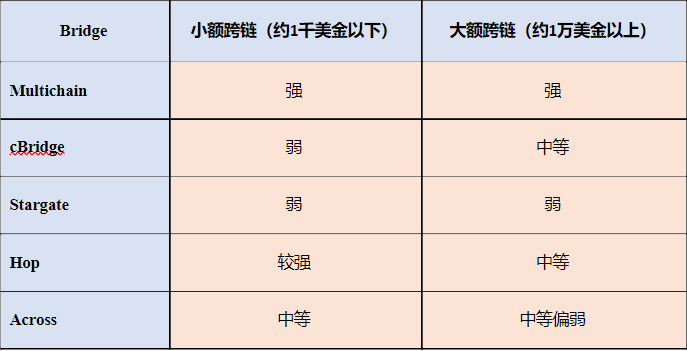
Table 6 Cost Competitive Advantages of Cross-Chain Bridges
Note: Results are only available for the coins and chains the author tried.
From the comprehensive perspective of the cross-chain situation of the two mainstream currencies, ETH and USDC, in the comparison of the fees of the five cross-chain bridges, whether it is a small amount of cross-chain or a large amount of cross-chain, Multichain’s fees have a strong competitive advantage , Hop has certain advantages in small-amount cross-chain, and its performance is relatively medium in large-amount cross-chain. The performance is weak, and the performance is relatively medium when the large amount is cross-chain. Compared with other cross-chain bridges, Stargate has the weakest performance.
image description

secondary title
source
https://cbridge.celer.network/


