IOSG Ventures: After the merger, MEV changes and remains the same


Original Author: Jiawei
Original source: IOSG Ventures
Primer
Source: Flashbots
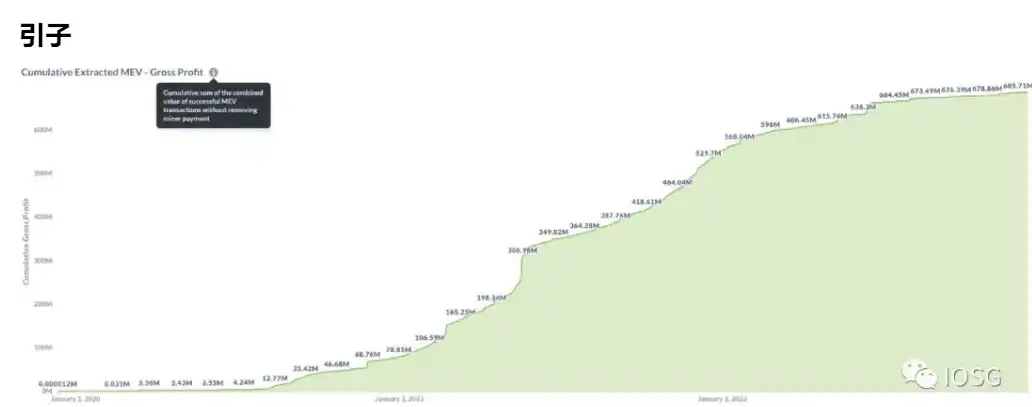
According to the definition given by the Ethereum community: MEV refers to the maximum value extracted from block production beyond standard block rewards and gas fees by including/not including/and ordering transactions in blocks.
Financial activities on the chain are becoming more and more complex, and MEV is also continuously accumulating. According to incomplete statistics, MEV is currently close to 700 million US dollars in volume. This is only in the context of the first layer of Ethereum during the PoW period. If The Merge takes place, and each Layer 2 and Alt-L1 are taken into account, it is conservatively estimated that the total volume of MEV will exceed 1 billion US dollars.
Source: Blocknative, Flashbots, IOSG Ventures
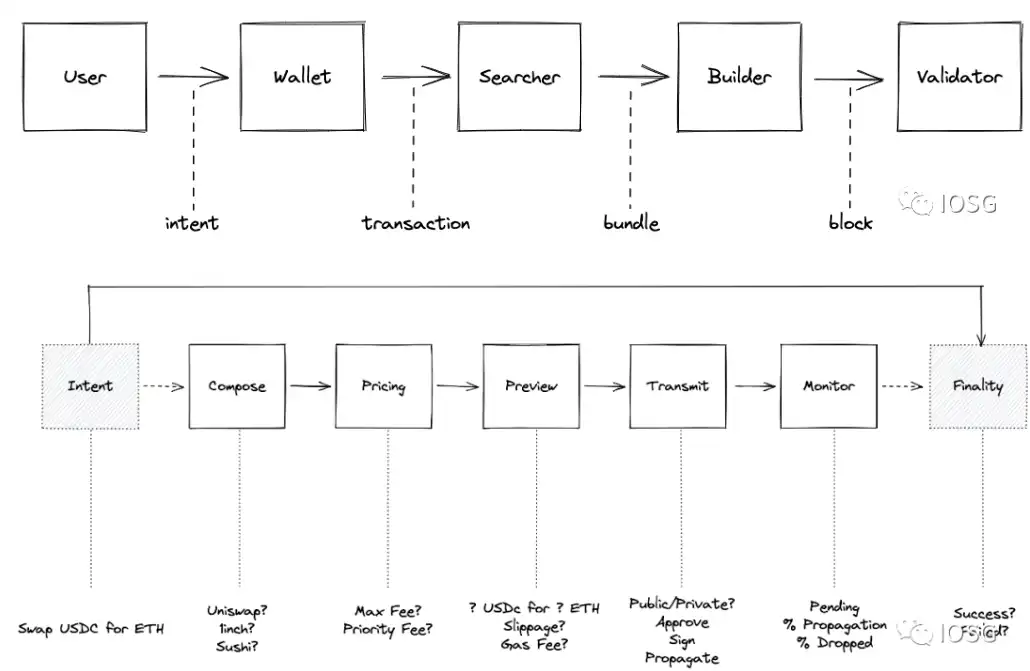
In the life cycle of Ethereum transactions, we can abstract the MEV supply chain. This article mainly discusses the Builder and Validator (Proposer) parts.
Proposer and builder separation (PBS)
In the current protocol layer design of Ethereum, the block builder (Builder) and the block proposer (Proposer) are the same entity - under PoS, they are first a subset of Validator. This entity is pseudo-randomly selected from an extensive Validator Set to build blocks and propose blocks to the PoS network.
Source: Blocknative, IOSG Ventures
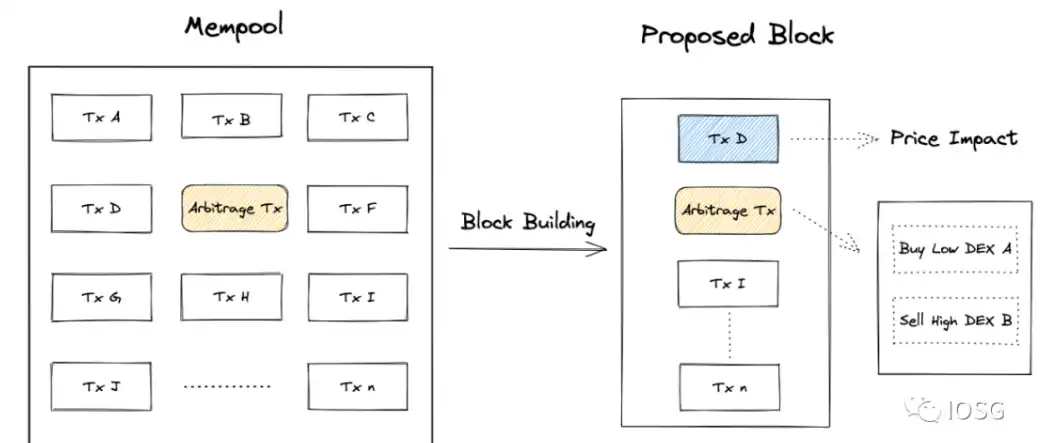
The above figure basically illustrates the process of block construction. There are three main sources for Builder to obtain transactions: public transaction pool (mempool), private transaction Channel (such as Flashbots Protect), and Bundles submitted by MEV searchers. The Builder builds these transactions into a block and submits it to Relay along with the bids to participate in the auction.
Under the growing trend of MEV, the design of Builder and Proposer as the same entity gradually shows its disadvantages: Compared with ordinary Validators, large Validator Pools have more opportunities to realize MEV; in addition, they obviously have more opportunities than ordinary Validators. More powerful MEV capture capability, which leads to serious centralization problems. Therefore, PBS (Proposer-Builder Separation) proposed to separate Builder and Proposer.
After the separation, no matter the ordinary Validator or the large Validator Pool, they outsource the block to a professional Builder for construction to maximize profits, and they only need to do one thing to "propose".
The current PBS is divided into protocol layer and non-protocol layer implementation. The difference between the two is that the former is embedded in Ethereum itself and is technically mandatory; while the latter refers to the fact that PBS is optional and non-mandatory.
Protocol layer PBS (Danksharding)
Protocol layer PBS (In-protocol PBS or Enshrined PBS) will be introduced in the implementation of Ethereum Danksharding, making PBS a protocol layer design. At that time, in addition to building blocks, the Builder also needs to calculate the KZG polynomial commitment of 32 MB of data in about 1 second, and distribute it in the P2P network.
Non-protocol layer PBS (MEV-Boost)
Flashbots proposed an open-source software MEV-Boost as a non-protocol layer implementation of PBS. This is an open market, that is, Builders focus on building blocks and maximize the benefits of each block as much as possible. After participating in the auction, the most profitable blocks are submitted to the Proposer. The latter simply proposes the block, which is equivalent to selling its block space. In return, the proposer of the block can get a fee paid by the block builder. It is estimated that after running MEV-Boost, the validator's pledge income will increase by more than 60%.
Source: Flashbots
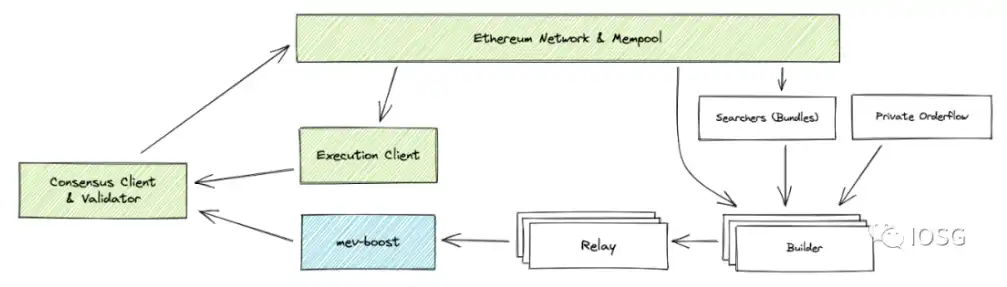
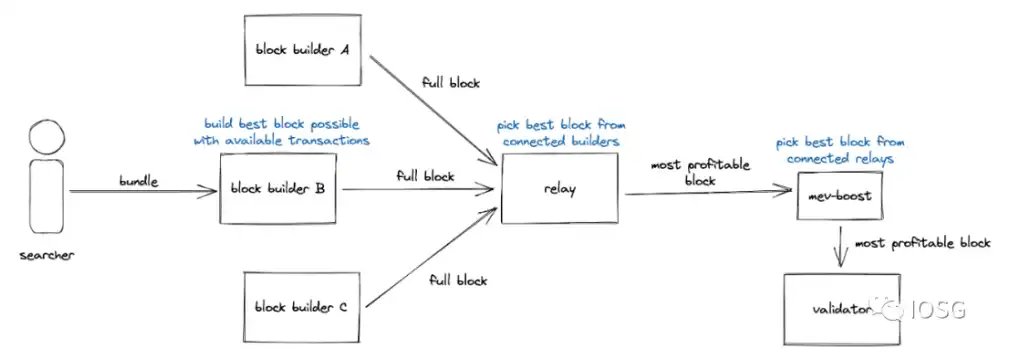
The above is the general workflow of MEV-Boost.
First of all, Validator needs to run MEV-Boost in addition to running the verifier client, consensus client and execution client.
Builder obtains transactions and bundles from the transaction order stream, and builds blocks according to their respective strategies.
Source: Flashbots
As a two-way communication channel between Builder and Proposer, Relay can connect to one or more Builders, verify the validity and bid of the blocks submitted by Builder, and submit the effective highest bid to Proposer.
Proposer can bring together one or more relays, select the most profitable block from them, and make proposals.
Regarding the non-protocol layer PBS and block construction, some interesting topics have been derived, which will be discussed below.
Market supply and demand and changes
In terms of supply and demand, Proposer and Builder have actually achieved a certain degree of separation in the early days.
Complex on-chain activity is making the MEV opportunity increasingly apparent. In PoW, miners with strong computing power have the right to produce blocks, but their ability to search for MEV is average, and most of them simply choose transactions with high Gas fees to generate blocks; on the other hand, searchers capture MEV opportunities The ability is very strong, but the right to generate blocks is not in their hands.
At first, there was no sure way for miners to include transactions submitted by these Seekers; Seekers could only pay as high a gas fee as possible in the hope that their submitted transactions would be included. But this is an open "auction", which is equivalent to Gas War. Even if the bidder fails in the end, he must pay the fee, which will cause network load and push up the gas price, resulting in serious negative externalities.
Therefore, in response to the above supply and demand and pain points, Flashbots proposed Flashbots Auction, which introduced auctions and communication channels between miners and searchers. Seekers send transactions to miners via the Flashbots Auction for an additional fee.
In a nutshell, supply and demand create open markets.
This is the scenario in PoW. After Ethereum transitions to PoS, it only needs to pledge 32 ETH and meet simple hardware requirements to participate in the verification network, which means that the distribution of block production rights has become wider, that is, the number of people who can participate in block production has greatly increased. However, these Validators lack the ability to build blocks compared to miners.
The open market of supply and demand still exists, but some changes have taken place: in the past, miners could choose to build blocks themselves, or outsource block construction - Flashbots Relay sends transactions or blocks to miners, and miners can choose to receive; Now, for Validators, block building will generate additional computational overhead, and most of them do not have enough capacity to capture MEV, so Validators need to request blocks from Flashbots Relay.
Regulation, censorship resistance and decentralization
Regulation and censorship are, to some extent, the same thing. Censorship resistance and decentralization are the narrative pillars of the blockchain, and the relationship between the two is inseparable.
Source: mevwatch.io
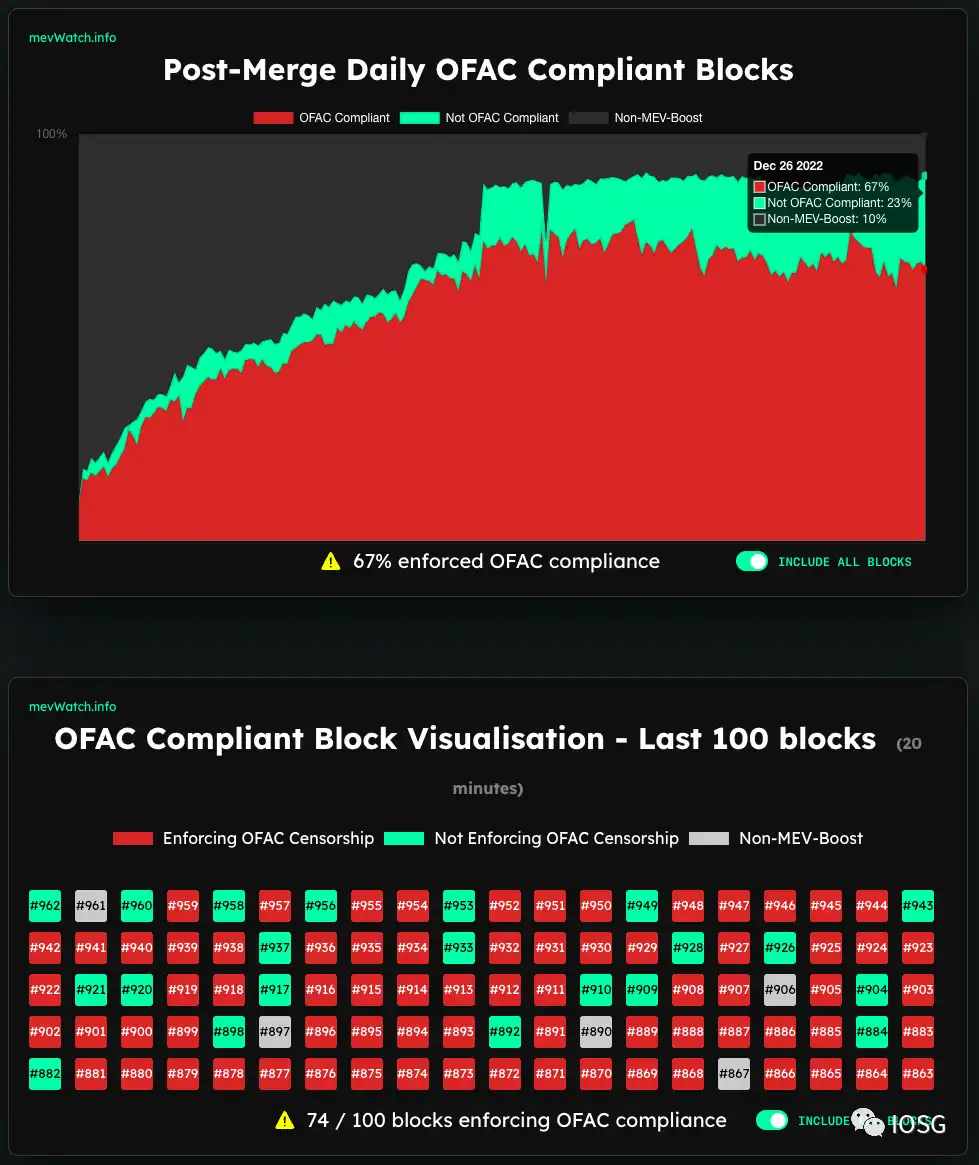
First of all, at the regulatory level, after the merger, centralized trading platforms, pledge service providers and actual operators account for a large proportion of the validators on the entire network. These entities are in specific legal jurisdictions and therefore need to weigh the compliance risks that their operations pose. Ethereum is facing invisible regulatory pressure.
From the perspective of data, the daily blocks meeting OFAC compliance requirements have accounted for as much as 67%; 74 out of every 100 blocks meet OFAC compliance requirements. This data is in an upward trend while maintaining a high level. If the value is close to 100%, it will be difficult for transactions from OFAC-sanctioned addresses to be included in blocks.
Of course, the addresses sanctioned by OFAC so far are all hacker addresses, which seems to be reasonable in terms of morality and ethics; but it is hard to predict whether the scope of this supervision will expand. In the face of regulatory pressure, how should a large validator pool choose between economic interests and the spirit of decentralization? Rather than attempting to answer this question, perhaps we should address the issue of censorship directly from a technical perspective.
In addition to the review at the regulatory level, there are currently builder review issues in MEV-Boost. In the above workflow, we can see that the Proposer can only passively receive the complete block submitted by the Builder, and cannot include the transactions it wants. That is, either receive all or not participate in MEV-Boost at all. In this case, Builders can actually gang up on deliberately not including certain transactions and extort money from their transaction originators.
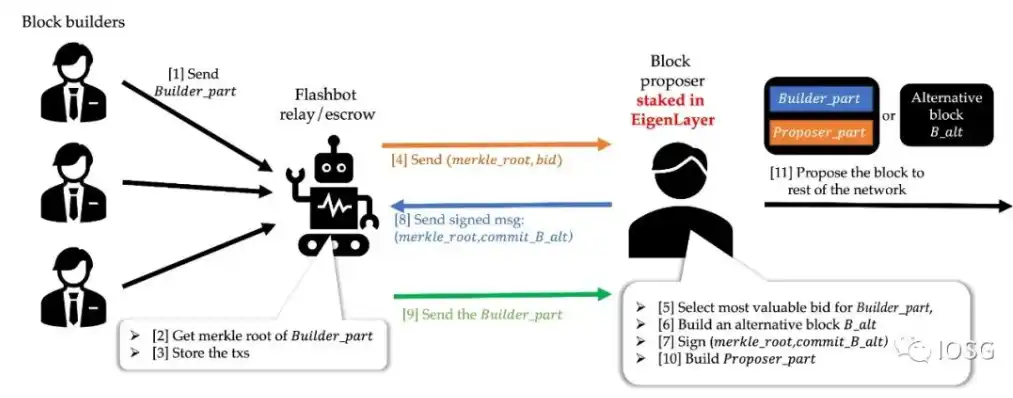
In Danksharding's PBS protocol, crList (anti-censorship list) is introduced to solve the review problem, that is, the Proposer has the right to specify a transaction list, which must be included by the Builder; after winning the auction, the Builder needs to prove that the crList in the crList transactions have been included (or the block is full), otherwise the block will be considered invalid.
Source: EigenLayer
Proposer Part is introduced in MEV-Boost++ proposed by EigenLayer, which is similar to crList, and Proposer has the right to participate in building a part of the block.
further decentralization
Source: relayscan.io
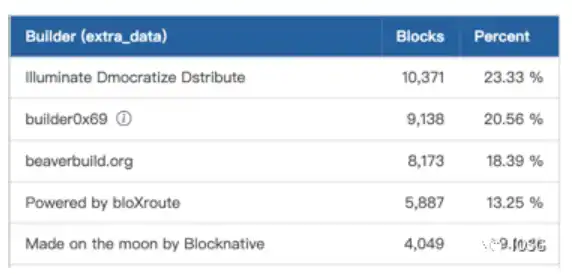
Through the implementation of the non-protocol layer of PBS, the problem of centralization of Validator is alleviated. In the discussion in the previous section, we found that Builder also has the problem of centralization at this stage. Over the past week, the top five Builders built 84.64% of MEV-Boost blocks.
Flashbots has recently open-sourced its Builder API, hoping that multiple Builders will collaborate to build blocks instead of a single entity currently building a complete block.
Roughly speaking, because different Builders can cover MEV searchers and private transaction channels differently, some Builders may have their own advantages in the former or the latter. Now, the block submitted by the Builders is a complete block. If you want the block you built to be selected, you must maximize the overall benefits of the building block.
If multiple Builders cooperate, the former dominant Builder can submit a part of the block, and the latter dominant Builder can submit other parts, which will make the Builder more decentralized as a whole, and theoretically the final income of the Validator will also be greater many. However, at the same time, this has obviously intensified the competition among Builders.
Flashbots proposes that all teams openly develop their Builders, and the community only trusts those Builders that behave in accordance with transparent and free software norms. If each Builder follows this standard, it will make the Builder's role and block construction more decentralized and transparent.
Thinking about Endgame from the perspective of MEV
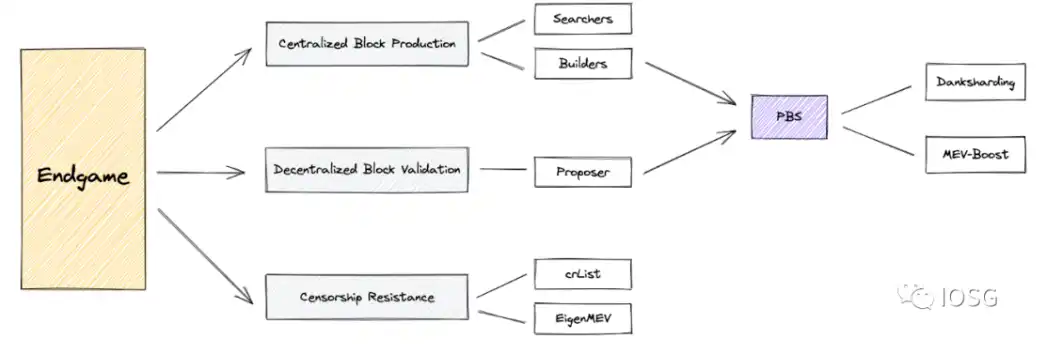
Source: IOSG Ventures
Vitalik described the final picture of Ethereum in his article "Endgame": block production is centralized, but block verification is trustless and highly decentralized, and ensures censorship resistance.
Personal guess, the logic of the first half sentence is based on the following three points:
Considering the degree of decentralization, Ethereum needs to make the hardware requirements or computing resources as low as possible to be a Validator. If the Validator only needs to simply propose a well-built block with the highest bid without building a block by itself, This can reduce some of the computational overhead.
From the perspective of economic incentives, the participants in the system are all Economically Rational. If running MEV-Boost can increase the pledge income by as much as 60%, then removing other objective factors such as supervision, a rational Validator will build blocks The work is outsourced to the Builder, which makes block production centralized.
If Danksharding is implemented in the future, the hardware and bandwidth requirements for Builder will increase significantly, so it will inevitably point to the result of Builder centralization.
Although block production is centralized, Ethereum realizes further decentralization of Validator Set by lowering the threshold for participating in network verification and PBS, and ensures trustless block verification based on extensive Validator Set and pseudo-random voting process , and highly decentralized, this is certain.
Of course, centralization versus decentralization is Spectrum, not a "yes" or "no" question.
Closing Thoughts
The current PBS is a non-protocol layer, and the Validator can still choose to build the block itself instead of outsourcing it to a professional Builder. After the introduction of Danksharding in Ethereum in the future, PBS will become a mandatory implementation of the protocol design, and we will see that the market for block building becomes even larger.
The current PBS is a non-protocol layer, and the Validator can still choose to build the block itself instead of outsourcing it to a professional Builder. After the introduction of Danksharding in Ethereum in the future, PBS will become a mandatory implementation of the protocol design, and we will see that the market for block building becomes even larger.
We pay attention to the investment logic of seeking "change" and seeking "change" in "unchanged":
Considering the large-scale adoption in the future and the increasingly complex financial activities on the chain, we believe that MEV is the "unchanged" trend in the medium and long term.
What "changed" after the merger? First, there is a change in the supply and demand relationship between block proposals and block construction. Second, the need for censorship resistance and decentralization begins to emerge. Finally, the trend of block building becoming a specialized market is also slowly emerging. These changes will lead us to the endgame of Ethereum.
There is a time window of two to three years between the non-protocol layer PBS (MEV-Boost) and the protocol layer PBS (Dankshading). Furthermore, if you jump out of the perspective of Layer 1 of Ethereum, there are also broad cross-domain MEV opportunities in the multi-chain ecology and multi-Rollup ecology.
Original link